Brewing
Gongfu brewing
- Water temperature
- 93 °C
- Tea amount
- 5 g
- Water volume
- 100 ml
- First steep
- 10 s
- Time added per infusion
- 5 s
- Infusions
- 4

Táiwān Wǔyí hóngchá
Choose a brewing method. Start with the recommended quantities and time, then adjust to taste.
Brewing
Brewing
Taste
Tea encyclopedia
Category: Taiwanese red tea (black tea) from historic small-leaf raw material. Niche product of small-batch production with limited quantities.
Category: Taiwanese red tea (black tea) from historic small-leaf raw material. Niche product of small-batch production with limited quantities.
Coordinates: 23.84° N, 120.68° E (Mingjian area, Nantou).
Origin: Táiwān (臺灣, Táiwān), Nántóu County (南投縣, Nántóu Xiàn), Míngjiān Township (名間鄉, Mínjiān Xiāng). The Wǔyí cultivar is a descendant of tea plants brought from the Wǔyí Mountains region (武夷山, Wǔyí Shān), Fujian Province, China, presumably during the reign of Emperor Jiāqìng (嘉庆, Jiāqìng, 1796–1820) of the Qing era. Over more than two centuries, the variety has undergone deep adaptation to the subtropical climate and soils of central Taiwan.
Type: Red tea (black tea) (紅茶, hóngchá), fully oxidized (oxidation degree ~90–100%). In European tradition — "black tea".
Cultural Significance: Taiwan Wuyi Hong Cha is living testimony to the complex cultural history of the island and the multilayered dialogue between three tea traditions. Fujian settlers brought the raw material, Japanese administration formed the technological base, and Taiwanese masters created a unique product that has no direct analogue either on the mainland or in Japan. Today, this tea is perceived as an artifact — simultaneously tea-related and historical, reminiscent of times when Taiwan was a major exporter of red tea (black tea), not just the "island of oolongs".
History: Tea plants from the Wuyi Mountains were brought to Taiwan by settlers from Fujian Province in the late 18th to early 19th century. According to historical records, the first seedlings were delivered to the island between 1796 and 1820. Initially, Wuyi raw material was used predominantly for producing semi-oxidized teas — oolongs and baozhong (包種, bāozhǒng). The decisive turning point came during the Japanese colonial period (1895–1945): beginning in 1905, the Japanese administration took a course toward developing red tea (black tea) production for export to the world market, striving to compete with British India and Ceylon. From 1923, Assam varieties were massively imported to the island, experimental stations were created, and full oxidation technologies were introduced. Local farmers, however, discovered that the already acclimatized Wuyi bushes, when fully oxidized, produced a beverage of unique character: with the density and sweetness of classic red tea (black tea), but with mineral complexity inherited from their Wuyi ancestors. By 1937, red tea (black tea) comprised a significant portion of Taiwan's tea exports. After World War II and the island's return to Chinese administration, the industry focus shifted to oolong production, and red tea (black tea) from the Wuyi cultivar gradually found itself on the periphery, becoming a niche rarity. Currently, the main plantations are preserved in Mingjian Township, where individual families maintain small plantations of old b
Name Breakdown: The name "Wuyi" (武夷, Wǔyí) directly indicates the origin of the cultivar — the Wuyi Mountains in Fujian Province, the famous birthplace of cliff oolongs (岩茶, yánchá) and red tea (black tea) Zhèngshān Xiǎozhǒng (正山小种). Hóng Chá (紅茶, hóngchá) — "red tea". The full name Taiwan Wǔyí Hóng Chá (臺灣武夷紅茶) emphasizes that this is specifically a Taiwanese product, made using red tea (black tea) technology from raw material of Wuyi origin.
Cultivar: Wǔyí (武夷, Wǔyí) — historic small-leaf cultivar Camellia sinensis var. sinensis, genetically related to modern populations of Wuyi cliff teas (including raw material for Zhengshan Xiaozhong). Belongs to the category of Taiwanese "local" (地方品種, dìfāng pǐnzhǒng) varieties, alongside Qīngxīn Oolong (青心烏龍), Qīngxīn Dàmǎo (青心大冇), and Dàyè Oolong (大葉烏龍). Bushes are medium-sized, reaching 1.5–2 m in height with regular pruning. Leaves are medium-sized (6–8 cm in length), oval or elliptical with a pointed tip, dark green, slightly leathery, with pronounced serration along the edge. Young shoots and buds, especially in spring, may have light greyish pubescence on the underside.
Picking: For red tea (black tea) production, predominantly summer harvest raw material is used, typically collected in the second decade of July. During this period, increased solar activity promotes the accumulation of polyphenols and aromatic precursors in the leaves, optimal for deep oxidation. Harvest standard — flush: unopened bud and 2–3 upper young leaves. Harvest is conducted exclusively by hand to ensure raw material integrity.
Raw Material: Leaves must be healthy, succulent, without mechanical damage. Raw material from old bushes (older than 30–50 years) is particularly valued, possessing a deeper mineral profile and complex aromatics.
Altitude: About 350 m above sea level — significantly lower than classic high-mountain oolong plantations (1000–2500 m). This is low-mountain terroir, different from high-mountain Wuyi (600–700 m) and even more so from Taiwanese gaoshan zones.
Climate: Subtropical. Average annual temperature about +22°C, air humidity averaging 80%, abundant precipitation. Warm, humid summers ensure intensive shoot growth and polyphenol accumulation; relatively mild winters do not require special shelters.
Soil: Red soils and yellow soils formed on the basis of weathered sandstone rocks. Slightly acidic reaction (pH 5.0–6.0), rich mineral composition including iron, manganese, and aluminum. The high iron content in the soils, according to connoisseurs, is responsible for the characteristic mineral notes in the taste — shades of "iron ore", "graphite dust", and "wet stone", bringing Taiwanese Wuyi closer to its Wuyi "ancestors".
Míngjiān Township (名間鄉) of Nantou County — Taiwan's largest tea-producing area by volume, providing the greatest share of the island's total production. Wuyi plantations are located on hilly areas with red soil.
The key terroir feature is the combination of ferruginous red soils with subtropical humid climate, creating conditions for forming a pronounced mineral profile that distinguishes Taiwanese Wuyi from other lowland Taiwanese teas.
Hand picking of flushes — bud and 2–3 young leaves.
Collected leaves are spread in a thin layer (up to 10 cm) in the open air under direct or diffused sunlight for 2–3 hours. Moisture loss is 20–30%. Chlorophyll degradation begins and enzymatic processes are activated, forming primary aroma.
After solar withering, leaves are transferred to a cool, ventilated room where they are periodically gently stirred and kneaded — by hand or in special drums. This stage, borrowed from oolong technology, ensures even moisture distribution, further cell wall damage, and juice release, preparing the leaf for intensive oxidation.
Leaves are rolled to give them longitudinal shape and further destroy cellular structure, intensifying oxidation.
Rolled leaves are left for several hours in a warm, humid room for deep oxidation. Oxidation degree reaches 90–100%. The master controls the process by changes in color (from green to copper-red) and leaf aroma. Thanks to raw material with high polyphenol content from summer harvest, oxidation proceeds intensively, forming a rich, "deep" profile.
Oxidation is stopped through thermal treatment. Two-stage roasting is often applied: first — at higher temperature (about 120°C) for rapid enzyme inactivation, second — at lower temperature (80–90°C) for final drying and flavor-aroma profile formation. Some masters use final drying over wood charcoal (炭焙, tàn bèi), which can give the tea a light smoky shade without dominant smokiness.
Finished tea is sorted by leaf size and integrity.
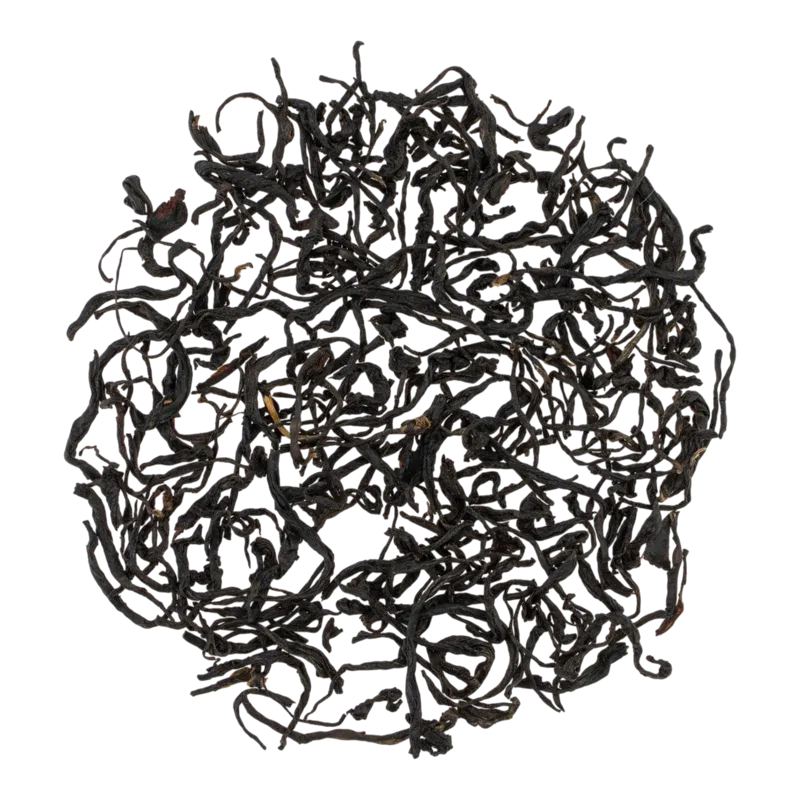
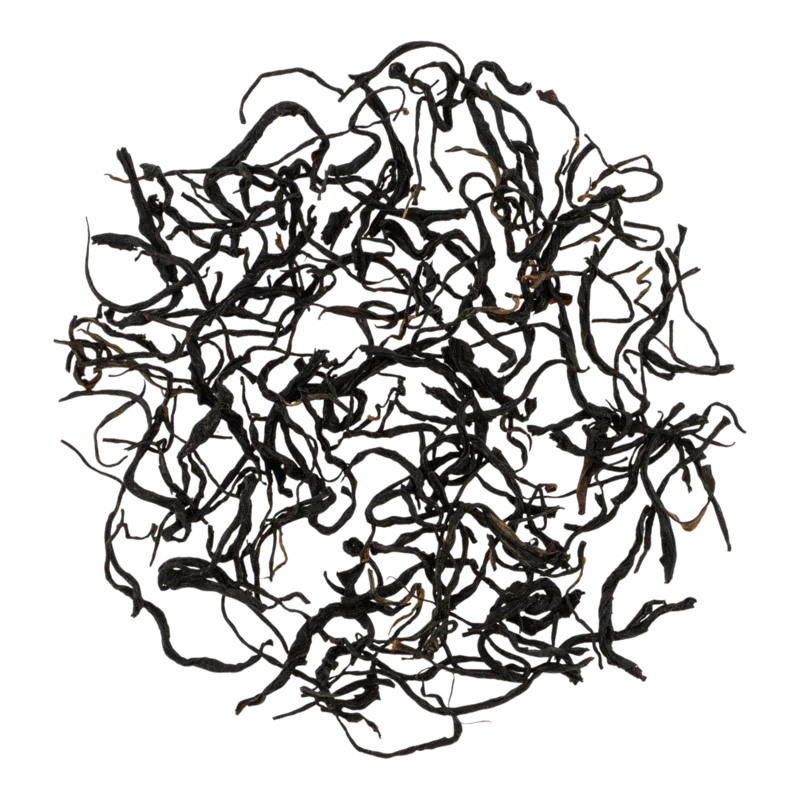
Dry Leaf Appearance: Leaves of longitudinal twist, dark brown, almost black color, sometimes with reddish or golden tint. Golden tips are present. Leaf is elastic, not brittle, of good integrity.
Dry Leaf Aroma: Complex, multilayered, warm. Notes of dark chocolate, dried fruits (prunes, raisins) dominate, supported by light minerality and shades of rye bread, tree bark. With final charcoal drying, a barely perceptible smoky note may be present.
Liquor Aroma: Intense, sweetish, with development of caramel, honey, dried fruit notes and mineral shades ("wet stone", "graphite"). As it cools, floral-rose undertones appear.
Liquor Color: Bright, clear, from copper-red to rich ruby or cognac shade. Deep and "warm" tone, playing in the light.
Spent Leaves: Leaves are even, elastic, copper-brown or reddish-brown color, open well when brewed. Leaf edges — with characteristic serration of the Wuyi cultivar.
Taste: Dense, smooth, enveloping, with pronounced natural sweetness. Astringency is absent or minimally expressed. The taste is dominated by notes of dark berries (blackberry, mulberry), dark chocolate and caramel, complemented by characteristic minerality — shades that connoisseurs describe as "wet stone", "iron", or "graphite dust". Light spiciness and woody tones create volume. Aftertaste is long, sweet, refreshing, with persistent mineral "tail".
Alkaloids: Caffeine (moderate content for red teas), theobromine, theophylline.
Amino Acids: L-theanine, promoting relaxation and concentration improvement, smoothing caffeine action. Content is somewhat lower than in spring raw material due to use of summer harvest.
Essential Oils: Form complex aromatic bouquet with notes of dried fruits, chocolate, and minerality. Key components include linalool, geraniol, β-ionone, methyl salicylate (giving a light "wintergreen" shade).
Minerals: Potassium, manganese, fluorine, iron, zinc. Increased iron content — consequence of ferruginous red soils of the region — presumably contributes to characteristic mineral taste notes.
Polyphenols: During deep oxidation, catechins transform into theaflavins and thearubigins, determining the rich liquor color, mild astringency, and antioxidant properties. High polyphenol content in summer raw material provides a rich base for fermentation transformations.
Vitamins: B-group vitamins, PP; trace amounts of vitamin C.
Theaflavins and thearubigins neutralize free radicals, protecting cells from oxidative damage and slowing aging processes.
Caffeine stimulates the central nervous system, increases performance. L-theanine softens caffeine action, providing mild, "focused" alertness.
Red tea (black tea) polyphenols gently stimulate digestive enzyme secretion and support healthy intestinal microflora.
Regular moderate consumption is associated with improved vascular function and lipid profile normalization.
Antioxidants and biologically active components support the body's defense forces.
Red tea (black tea) is a "warm" beverage in traditional Chinese dietology, especially recommended in cool weather.
Rich mineral composition (potassium, manganese, iron) contributes to maintaining electrolyte balance.
May cause insomnia, anxiety, tachycardia. Not recommended for consumption in the afternoon for people with sleep disorders.
Limit consumption due to caffeine content; medical consultation is advisable.
Strong tea on empty stomach may irritate gastric mucosa in gastritis or peptic ulcer.
Tea polyphenols may reduce non-heme iron absorption from food; with anemia, avoid tea consumption directly during meals.
Tea Amount: 5–7 g per 100–150 ml (flash steeping method, gongfu cha); 3–4 g per 200–250 ml (steeping).
Teaware: Porcelain gàiwǎn (蓋碗, gàiwǎn) — universal choice. Porous Yixing clay teapot — excellent option: over time it will "season" (養壺, yǎng hú) and enhance mineral notes. For European method — porcelain teapot.
Water Temperature: 90–95°C. High temperature well reveals the tea's density, minerality, and sweetness.
Genetic "relative" of Taiwanese Wuyi, produced in the Wuyi Mountains. Classic version — with pronounced smoky aroma (from drying over pine smoke); modern "smokeless" — with fruity-floral profile. Taiwanese Wuyi lacks smokiness (or possesses only minimal shade from charcoal drying), its profile is chocolate-mineral, softer and sweeter.
Flagship of Taiwanese red teas (black teas). Completely different aromatic profile — mint, cinnamon, eucalyptus. Made from hybrid of Assam and Taiwanese wild tea. Wuyi is small-leaf sinensis variety, its character is minerality and chocolate. Common feature — pronounced sweetness, but aromatic directions are diametrically different.
Red tea (black tea) from mass oolong cultivar. Profile is floral-honey, light, "spring-like". Compared to it, Wuyi is significantly denser, deeper, and more "serious", with mineral-chocolate dominance instead of floral.
Anhui red tea (black tea) with elegant floral-fruity aroma. More "light" and "airy" than Taiwanese Wuyi, which possesses greater density, minerality, and chocolate depth.
Price Category: Taiwan Wuyi Hong Cha is a rare product of limited release, produced by small family farms from raw material from old bushes. This determines its high price compared to mass-produced Taiwanese red teas (black teas). Cost depends on raw material quality (harvest season, bush age), processing mastery, producer reputation, and harvest year.
No reviews yet. Tell us what you think of this tea.
Rate this tea and share your impressions. We review each submission before publishing it.