Brewing
Gongfu brewing
- Water temperature
- 75 °C
- Tea amount
- 5 g
- Water volume
- 100 ml
- First steep
- 10 s
- Time added per infusion
- 5 s
- Infusions
- 3

Táiwān jiānchá
Choose a brewing method. Start with the recommended quantities and time, then adjust to taste.
Brewing
Brewing
Taste
Tea encyclopedia
Category: Taiwanese green teas of Japanese type (蒸製綠茶, zhēngzhì lǜchá).
Category: Taiwanese green teas of Japanese type (蒸製綠茶, zhēngzhì lǜchá).
Coordinates: Approximately 23°50′ North latitude, 120°45′ East longitude. Plantation altitude — approximately 400 meters above sea level.
Origin: Taiwan, Nántóu County (南投縣, Nántóu Xiàn), Lóngténg District (龍騰, Lóngténg). Technology borrowed from Japan and adapted to Taiwanese conditions.
Type: Green tea (non-oxidized, oxidation degree 0%). Fixation method — steaming (蒸菁, zhēngqīng), in contrast to the pan-firing method (炒菁, chǎoqīng) predominant in Taiwan.
Cultural Significance: Taiwanese Sencha is a living reminder of the deep Japanese influence on Taiwanese tea cultivation. It demonstrates how borrowed technology, applied to a unique local cultivar and terroir, gives birth to a fundamentally new product. For Taiwanese tea specialists, it is also a symbol of the breadth of the island's "adaptive spectrum" — the ability to produce teas of all types (from white to post-fermented pu-erh) in one territory.
Name Breakdown: "Sencha" (煎茶, Jiānchá / Japanese Sencha) — literally "brewed tea" or "infused tea", a term denoting leaf green tea processed with steam in Japanese tradition. "Taiwanese Sencha" (臺灣煎茶) indicates the place of origin and emphasizes the difference from Japanese sencha: different cultivar, different terroir, different flavour profile.
Cultivar: Camellia sinensis var. sinensis. Main cultivar — Qīngxīn Dàmǎo (青心大冇, Qīngxīn Dàmǎo), also known simply as "Damao" (大冇). English transcription — Chin-Shin-Dapan. This is one of the "four great varieties" of Taiwan (四大名種), selected during the period of Japanese administration. The cultivar traces its origin from small-leaf varieties from the Wǔyí Mountains (武夷山) of Fujian Province, brought to Táiwān at the beginning of the Japanese period and having undergone lǒng local adaptation through seed propagation (蒔茶, shìchá). Belongs to medium-maturing (中生種, zhōngshēngzhǒng) varieties. Medium-sized bush, with slightly spreading habit (稍橫張性) and curved branches. Leaves are larger than Qingxin Oolong, long-elliptical or round-lanceolate, with sharp serrations along the edge and depressed apex; leaf blade thick, rigid, dark green. Young buds are large, densely covered with white down, with characteristic purple-red tint (紫紅色). Venation is distinct, angle between main and lateral veins 55–65°. The cultivar has high yield, strong growth and good disease resistance, but low drought tolerance. Wide "adaptive plasticity" (適製性廣, shìzhìxìng guǎng): highest quality — in Oriental Beauty (東方美人茶), then — in green tea, also good for red tea (black tea).
Picking: Early spring (春茶). Machine picking is applied (mechanical trimmer scissors), which allows processing large volumes of raw material from the large-leaf cultivar. Standard — unopened bud and two upper leaves (一心二葉, yī xīn èr yè).
Raw Material: Fresh, undamaged flushes, immediately delivered to the factory to prevent the onset of oxidation. Processing speed is critical: minimal time should pass from picking to steaming.
Altitude: Approximately 400 meters above sea level.
Climate: Subtropical, with high humidity (75–85%), average annual temperature around +18°C, abundant precipitation and frequent morning fogs. Daily temperature fluctuations (8–12°C) slow down plant metabolism, promoting the accumulation of L-theanine and free sugars.
Soil: Quartz sandy soils with clay inclusions, providing excellent drainage. Moderate acidity (pH ~5.0–5.5). The mineral composition of soils influences the formation of characteristic sweet-mineral notes.
Lóngténg District (龍騰) in Nantou County — an inner mountain area of central Taiwan, between the Yùshān (玉山) and Ālǐshān (阿里山) ranges. Nantou is the only "non-coastal" county of Taiwan, which creates a special continental microclimate within the subtropical island.
Unlike Japanese sencha of the highest category (Gyokuro, Kabusecha), Taiwanese plantations are not shaded. Leaves grow under full sunlight, which stimulates intensive photosynthesis and the formation of pronounced grassy notes. However, mountain fog performs the role of a natural "light diffuser", softening ultraviolet load — an effect partially analogous to artificial shading, but more subtle.
Key stage. Freshly picked leaves are processed with steam at 95–100°C for approximately 20 seconds. Instant inactivation of enzymes prevents oxidation and fixes the green color, chlorophyll and fresh aroma. Steaming is the main difference of Taiwanese Sencha from pan-fired Taiwanese green teas (Sanxia Biluochun, Longjing): it gives the tea a characteristic "marine", "seaweed" aroma register, impossible with pan-firing.
Steamed leaves are dried with a stream of hot air (~80°C) to remove excess moisture and prepare for rolling.
Leaves pass through mechanical rollers, which give them the characteristic needle-like (針形, zhēnxíng) shape — thin, straight, dense "needles". Mechanical rolling destroys cell walls, improving extraction during brewing. Large leaves of Qingxin Damao require precise pressure calibration to achieve uniform shape.
Drying at reduced temperature (~50°C) to fix the shape, preserve bright green color (chlorophyll) and reduce moisture to <5%.
Finished tea is sorted by length and uniformity of needles. Fractions of small fragments and dust are separated.
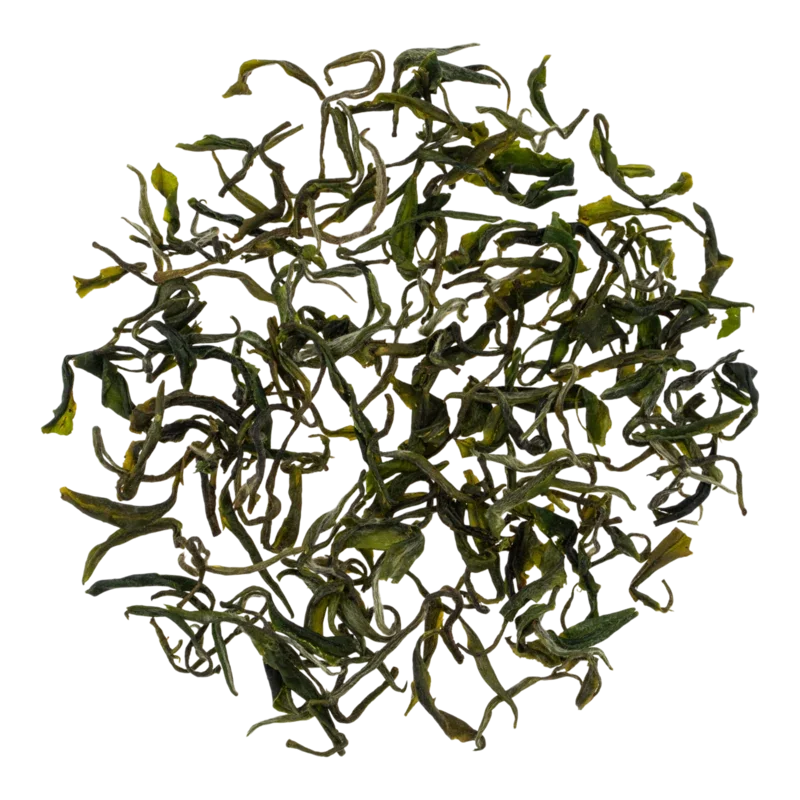
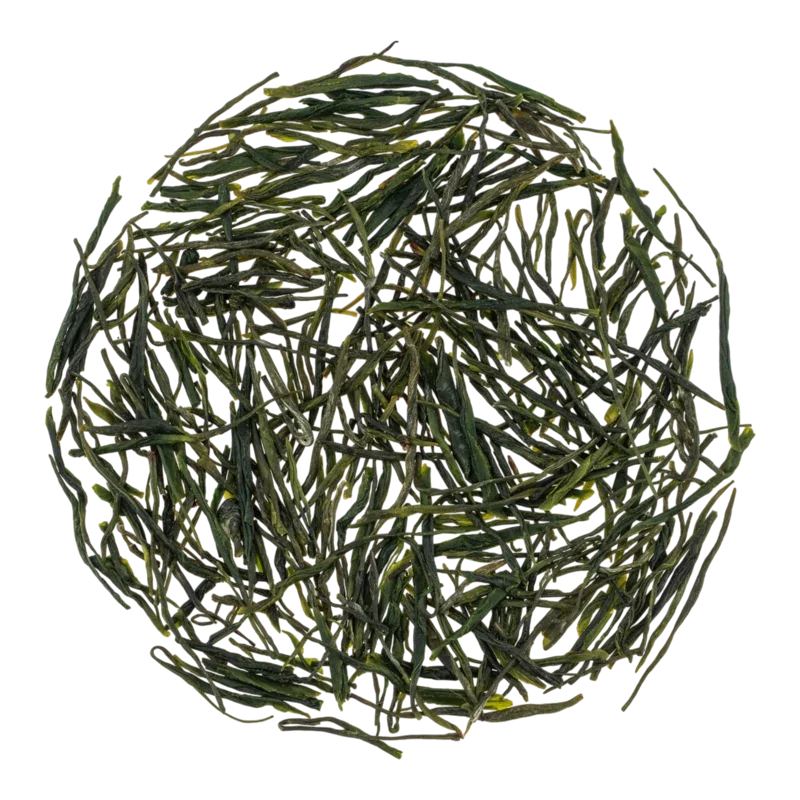
Dry Leaf Appearance: Tightly rolled, thin needles of dark green color with silvery streaks, up to 2 cm long. Uniformity of shape and color is a quality indicator. Presence of fine white down (from Qingxin Damao buds) on highest grades.
Dry Leaf Aroma: Bright, fresh, with dominance of fresh-cut grass (草香, cǎoxiāng), light floral tones (jasmine) and characteristic "marine" note (海苔香, hǎitái xiāng), typical for steamed teas.
Liquor Aroma: Develops a grassy-floral profile, complemented by sweetish notes of young peas and subtle honey tones.
Liquor Color: Transparent, light green, color of "pale jade" (淡翡翠色). Maintains clarity and brightness through several infusions.
Spent Leaves: Evenly opened whole leaves of bright green color. Large purple-green buds with down — distinctive feature of Qingxin Damao cultivar.
Taste: Smooth, silky, with creamy texture (奶滑, nǎihuá). Sweetish, with pronounced umami (旨味) from high L-theanine content. Notes of young green peas, honey, fresh greens. Practically complete absence of bitterness and astringent tannins with proper brewing — result of combination of mountain terroir (slowed growth, amino acid accumulation) and gentle steaming.
Alkaloids: About 3% of dry mass. Caffeine (~20 mg/g dry tea), theobromine, theophylline. Mild, sustained tonic effect.
Amino Acids: About 4% of dry mass, with L-theanine predominance. Increased content is due to mountain terroir (slow growth) and spring picking. L-theanine is responsible for sweetness, umami and relaxing effect.
High content, providing bright green color of liquor and dry leaf.
Minerals: Potassium, manganese, fluorine — due to quartz-clay soils of Nantou.
Polyphenols: About 25% of dry mass. Main component — epigallocatechin gallate (EGCG). Steaming preserves catechins to a greater extent than pan-firing, making Taiwanese Sencha one of the most "antioxidant-saturated" Taiwanese teas.
Vitamins: High content of vitamin C (up to 250 mg/100 g dry leaf) — steaming more effectively preserves ascorbic acid than pan-firing. B-group vitamins (B₂, B₃), vitamin E.
High concentration of EGCG and other catechins (preserved thanks to steaming) provides powerful neutralization of free radicals.
Synergy of L-theanine and caffeine stimulates brain alpha rhythms, increasing concentration and mental clarity without anxiety.
Combination of caffeine and catechins promotes acceleration of metabolism and thermogenesis.
Fluorine and polyphenols suppress bacterial growth (including Streptococcus mutans), reducing caries risk.
High content of vitamin C (better preserved thanks to steam rather than thermal fixation) enhances protective functions.
L-theanine promotes reduction of anxiety, mood improvement and sleep quality with daytime consumption.
Appearance of abundant fine foam (泡, pào) at first contact of hot water with leaf — indicator of correct steaming. Absence of foam may indicate technology violation.
Tea Amount: 4 g per 200 ml water for flash steeping method; 2 g per 200 ml for steeping in cup or teapot.
Teaware: Glass or porcelain (gaiwan, glass kyusu-style teapot). Glass is preferable for observing liquor color. Yixing clay is not recommended — it absorbs the delicate aromas of steamed tea.
Water Temperature: 70°C (±2°C). This is a critically important parameter: steamed green teas are significantly more sensitive to overheating than pan-fired ones. Even 80°C can cause bitterness. Soft, filtered or spring water is recommended.
Classic Japanese analogue, produced from Yabukita (やぶきた), Okumidori (おくみどり) and other cultivars. Aroma — pronounced "marine", seaweed-like, with high umami intensity. Taste — more saturated, with noticeable light bitterness and bright "green" freshness. Taiwanese Sencha — softer, sweeter, with greater creamy texture and less pronounced "marine" character; honey notes more distinct.
Pan-fired (炒菁) Taiwanese green tea from Qingxin Ganzai cultivar. Aroma — bean-grassy (绿豆仁香), "earthy". Taste — dense, rich, resistant to brewing. Taiwanese Sencha — lighter, more delicate, with "marine" register instead of "bean"; less resistant to multiple brewing, but finer in aromatic pattern.
Shaded steamed green tea of highest category. Taste — maximally concentrated umami, almost "brothy", with sweetness and minimal bitterness. Taiwanese Sencha is grown without shading, so L-theanine content is lower, and grassy notes are brighter; Gyokuro is denser and "heavier" in body.
The only Chinese green tea that preserved the steaming method. Produced from local Hubei cultivars. Aroma — fresh, "dewy", with chestnut notes. Taste — sweetish, light. Compared to Taiwanese Sencha — less "marine" and less creamy; closer to classic Chinese green tea in character.
No reviews yet. Tell us what you think of this tea.
Rate this tea and share your impressions. We review each submission before publishing it.