Brewing
Gongfu brewing
- Water temperature
- 75 °C
- Tea amount
- 5 g
- Water volume
- 100 ml
- First steep
- 10 s
- Time added per infusion
- 5 s
- Infusions
- 3

Sānxiá bìluóchūn
Choose a brewing method. Start with the recommended quantities and time, then adjust to taste.
Brewing
Brewing
Taste
Tea encyclopedia
Category: Taiwanese green teas. Included among the "Taiwan Shi Da Jingdian Ming Cha" (臺灣十大經典名茶)—"Ten Classic Famous Teas of Taiwan."
Category: Taiwanese green teas. Included among the "Taiwan Shi Da Jingdian Ming Cha" (臺灣十大經典名茶)—"Ten Classic Famous Teas of Taiwan."
Coordinates: Approximately 24°55′ N, 121°22′ E.
Origin: Taiwan, New Taipei City (新北市, Xīnběi Shì), Sānxiá District (三峽區, Sānxiá Qū). The ancient name of the locality was Sanjiaoyang (三角湧, Sānjiǎoyǒng)—"Three Surging Streams," after three rivers (大漢溪 Dahan, 三峽溪 Sanxia, and 橫溪 Heng) at whose confluence the district is located. Main tea zones: southwestern (弘道里, 五寮, 大埔, 金敏, 插角, 有木) and northeastern (礁溪, 白鷄, 溪南, 成福, 竹崙)—the latter produces higher quality raw material.
Type: Green tea (non-oxidized, oxidation level less than 5%). Fixation method—pan-firing (炒菁, chǎoqīng).
Chinese "namesake" from Jiangsu Province. Produced from small-leaf cultivar Dòngtíngshān Xiǎo Yè (洞庭山小葉). Aroma—fruity-floral, with peach and apricot notes; taste—light, delicate, with slight astringency. Taiwanese Sanxia is denser, with bean-herbaceous aroma, more pronounced sweetness, and significantly greater brewing resistance.
Produced from the same Qingxin Ganzai cultivar but in flat form. Sanxia Longjing is famous for the formula "色綠、香郁、味甘、形美"—"green color, rich aroma, sweet taste, beautiful form." Differs from Biluochun in shape (flat vs spiral) and more accentuated bitterness with subsequent sweetness (先苦後甘).
Chinese classical flat green tea with chestnut-nutty profile. Unlike Taiwanese Biluochun, Longjing is drier and more "mineral," without pronounced bean aroma.
Steamed (蒸製, zhēngzhì) green tea with marine, seaweed profile. Sanxia Biluochun is pan-fired (炒製), with herbaceous-bean character; it is less "marine" and more "earthy" in taste, and also noticeably more resistant to brewing.
Cultural Significance: Sanxia Biluochun is a symbol of revival and sustainability of Taiwanese tea cultivation. This tea vividly demonstrates how a district that survived several waves of radical tea paradigm shifts (oolong → red tea → green tea → decline → revival) found its unique identity through the combination of an endemic cultivar and adapted technology. Sanxia is the only district in Taiwan practicing the principle "jian ya jiu cai" (見芽就採)—"see a bud, pick it"—which emphasizes the special tenderness of local raw material. The tea is actively used in Sanxia gastronomy: desserts with tea filling, tea rolls, and cold infusions have become signature souvenirs of the district.
Cultivar: Camellia sinensis var. sinensis. Main cultivar—Qīngxīn Gānzǎi (青心柑仔, Qīngxīn Gānzǎi), also known simply as "Ganzai" (柑仔). This is a small-leaf early-ripening (早生種, zǎoshēngzhǒng) variety endemic to the Sanxia district—it is not cultivated anywhere else in Taiwan or beyond. The cultivar's origin remains a mystery: neither local old-timers nor researcher-historians can establish when and from where it was brought; written records are absent. The bush is medium or large-sized, weakly branched, with a slightly upright habit. Leaves are large, resembling citrus leaves in shape (柑葉, gānyè)—hence the name. A characteristic feature is noticeably upward-curved leaf blade edges. Young buds are green, with abundant white down (白毫, báiháo). Flowers have an unusually large number of petals. The cultivar is ideally suited for green tea production (especially longjing and biluochun); red tea (蜜香紅茶, mixiang hongcha) with characteristic honey and citrus notes is also produced from it. In recent years, Jīnxuān (金萱, Taiwan Tea No. 12) has also begun to be planted in Sanxia, which causes concern among connoisseurs—the spread of new cultivars may lead to the loss of the unique "green-bean" aromatic profile inherent exclusively to Qingxin Ganzai.
Picking: Main seasons—spring (春茶, chūnchá, March to early April, before the Qingming festival—the most valuable raw material) and winter (冬茶, dōngchá). Summer raw material (months 5–8) often goes to red tea production (蜜香紅茶) when leaves are affected by the leafhopper Jacobiasca formosana. Picking—by hand, following the principle "jian ya jiu cai" (見芽就採)—picking when first buds appear, not waiting for mass opening.
Pluck Standard: For highest grades—one bud and one-two young leaves (一心一葉, yī xīn yī yè; 一心二葉, yī xīn èr yè). Buds must be covered with abundant white down.
Raw Material: Exclusively tender, undamaged young shoots. For elite batches, the "one-day standard" applies: the entire cycle from picking to final drying is completed within 24 hours.
Altitude: 200–400 meters above sea level. Individual plots in the southwestern zone—up to 500 m.
Climate: Subtropical monsoon, with high air humidity (annual average >80%), abundant precipitation (about 2000–2500 mm/year), mild winters (average January temperature +15°C) and hot summers. Morning and evening fogs are characteristic, creating natural light diffusion and reducing ultraviolet stress on leaves.
Soil: Predominantly acidic red soils (pH 4.5–5.5) formed by weathering of sandstones, with elevated iron content and mineral inclusions. Good drainage is provided by the river system.
Sanxia district is located in northwestern Taiwan, in hilly terrain at the confluence of three rivers, surrounded by mountain ranges. Plantations are scattered across gentle slopes and river valleys.
Intercropping of tea with fruit trees (peaches, persimmons) is practiced, which serve as natural windbreaks and, according to local farmers, may enrich the tea's aroma with subtle fruity nuances. A number of farms have switched to organic farming (no pesticides, minimal fertilizers), which is supported by the local farmers' association. By 2018, the industry was actively developing ecological tea cultivation.
Hand picking of young shoots in early morning hours, after dew has dried.
Brief withering of freshly picked leaves indoors. This stage is a distinguishing feature of Taiwanese technology: leaves contact air, gentle moisture evaporation begins, and primary aromatic transformations occur. This withering is precisely what makes Sanxia Biluochun softer and sweeter than typical Chinese green tea.
Pan-firing at high temperature (~180°C) in a rotating drum pan. Enzymes are inactivated, oxidation stops, characteristic roasted notes form. Because the equipment is analogous to bāozhǒng (包種茶) production equipment, Sanxia factories possess a well-developed technical base.
Leaves are shaped into tight spirals using special rollers with controlled pressure. The process mimics hand rolling but ensures uniformity of shape. White down on buds is preserved in the process.
Final drying at moderate temperature to reduce moisture to stable level (<5%), fixing shape and aromatic profile.
Hand and mechanical sorting by spiral size, leaf integrity, and bud content.
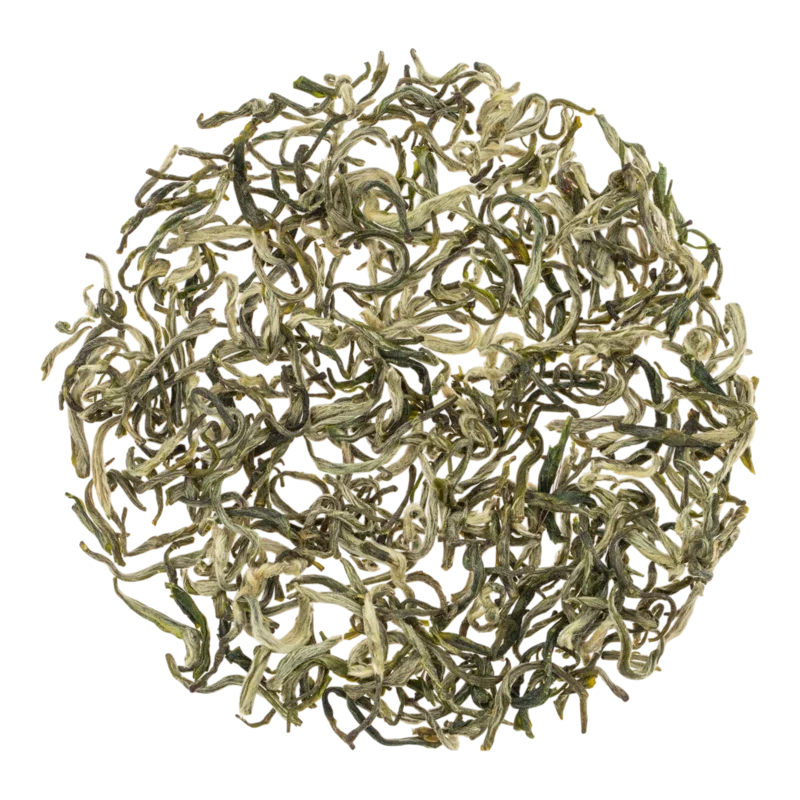
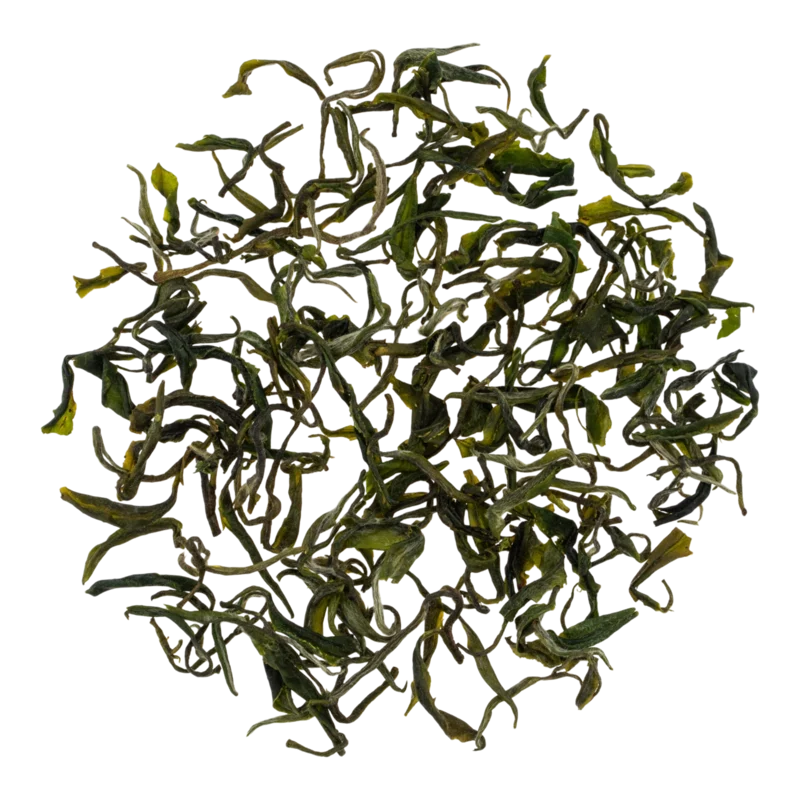
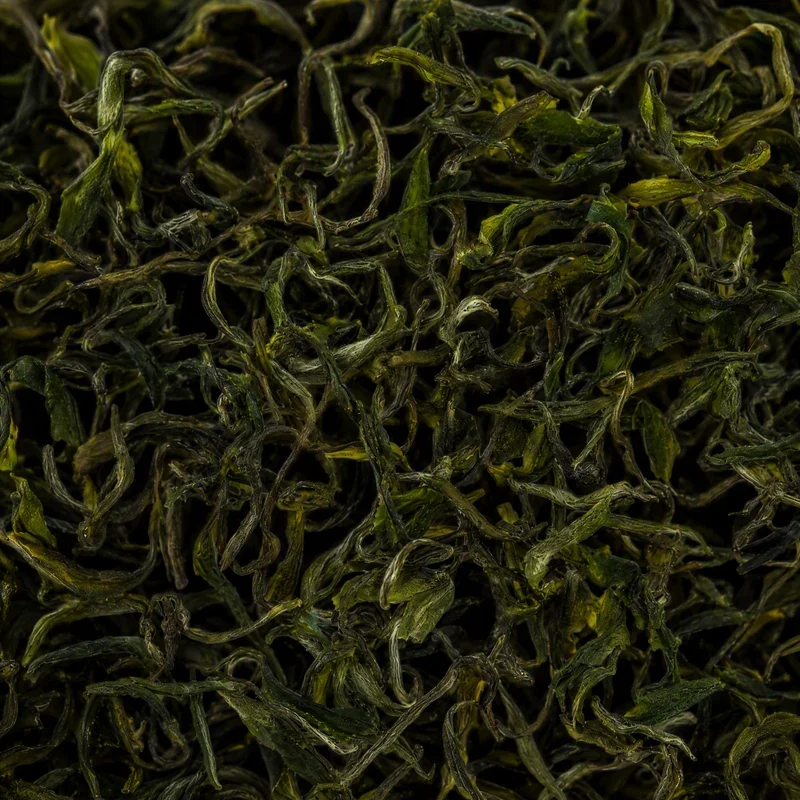
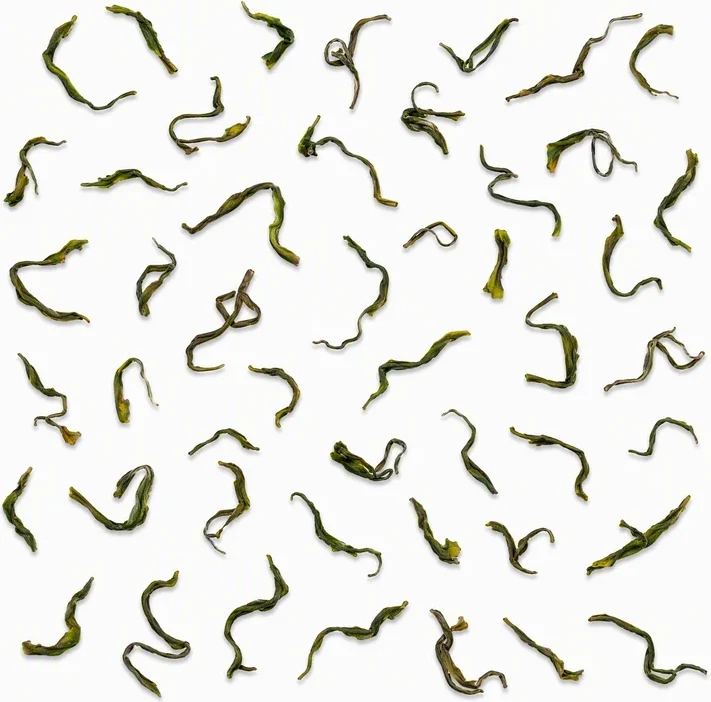
Dry Leaf Appearance: Small, tightly twisted spirals of emerald-green color (碧綠, bìlǜ), covered with noticeable white down (白毫). Leaves are visually slightly larger and denser than Chinese Dongting Biluochun.
Dry Leaf Aroma: Bright, high, with characteristic mung bean aroma (綠豆仁香, lǜdòurén xiāng)—the main aromatic "calling card" of Sanxia Biluochun. Additional notes: nori/seaweed (海苔, hǎitái), chestnuts (栗子, lìzi), sugar cane (甘蔗, gānzhè), pasture grasses (牧草, mùcǎo), licorice (甘草, gāncǎo). The aroma is described as belonging to the "herbaceous register" (草本調, cǎoběn diào).
Liquor Aroma: Retains the "green-bean" profile, complemented by light floral and sweet notes. The aroma is high, clean, persistent.
Liquor Color: Clear, light green or greenish-yellow (淡綠, dànlǜ), clean, bright. Maintains clarity throughout several infusions.
Spent Leaves: Tender, whole young leaves and buds of green color, fully opening after several steeps. Uniformity of spent leaves is an indicator of raw material quality.
Taste: Lively, fresh (鮮爽, xiānshuǎng), with pronounced natural sweetness (甘醇, gānchún) and dense, rounded body (質厚, zhìhòu). Characteristic light astringent freshness transitions to long sweet aftertaste with citrus undertone—the unique "varietal character" of Qingxin Ganzai. Compared to Chinese and Japanese green teas, Sanxia Biluochun is noticeably denser, richer, and more resistant to brewing.
Alkaloids: Moderate content of caffeine, theobromine, theophylline.
Amino Acids: Elevated L-theanine content due to spring picking and foggy microclimate. L-theanine is responsible for taste sweetness (umami) and relaxing effect.
High content, providing emerald-green color of dry leaf and liquor.
Elevated content of free sugars (result of spring picking and varietal specificity of Qingxin Ganzai), enhancing natural sweetness.
Minerals: Iron, potassium, manganese, fluorine—conditioned by acidic red soils of the region.
Polyphenols: High content, including EGCG—the main antioxidant of green tea.
Vitamins: Vitamin C (up to 200–250 mg/100 g), B vitamins, vitamin E.
High catechin concentration provides powerful protection against oxidative stress.
L-theanine and caffeine synergy promotes gentle enhancement of concentration and mental clarity without nervous overstimulation.
The combination of caffeine and catechins contributes to metabolism acceleration.
L-theanine promotes anxiety reduction and mood improvement.
Vitamin C and mineral complex support the body's protective functions.
Due to high amino acid and sugar content, Sānxiá Bìluóchūn excellently reveals itself in cold steeping technique (冷泡, lěng pào), allowing enjoyment of beneficial properties without losses from thermal destruction of vitamins.
3 g tea per 400 ml cold water, steep in refrigerator 4–8 hours. This method reveals special freshness and sweetness characteristic of Sanxia Biluochun and is the signature serving method in the district.
Tea Amount: 5 g per 200 ml water for flash steeping method (功夫泡法); 1 g per 100 ml for cup steeping; 1 g per 130 ml for cold brewing.
Teaware: Porcelain gàiwǎn (蓋碗)—best choice; porcelain teapot and glass vessel also suitable. Order of preference: porcelain > ceramics > glass.
Water Temperature: 85–90°C. Sanxia Biluochun is more resistant to high temperature than many green teas, but boiling water is not recommended.
Chinese "namesake" from Jiangsu Province. Produced from the small-leaf cultivar Dòngtíngshān Xiǎo Yè (洞庭山小葉). Aroma — fruity-floral, with notes of peach and apricot; taste — light, delicate, with mild astringency. Taiwanese Sanxia is denser, with a bean-grassy aroma, more pronounced sweetness and significantly greater brewing endurance.
Produced from the same Qing Xin Gan Zai cultivar, but in flat form. Sanxia Longjing is renowned for the formula "色綠、香郁、味甘、形美" — "green color, rich aroma, sweet taste, beautiful form." It differs from Biluochun in shape (flat vs spiral) and more accentuated bitterness followed by sweetness (先苦後甘).
Chinese classic flat green tea with a chestnut-nutty profile. Unlike Taiwanese Biluochun, Longjing is drier and more "mineral," without the pronounced bean aroma.
Steamed (蒸製, zhēngzhì) green tea with a marine, seaweed profile. Sanxia Biluochun is pan-fired (炒製), with a grassy-bean character; it is less "marine" and more "earthy" in taste, and also notably more resistant to brewing.
No reviews yet. Tell us what you think of this tea.
Rate this tea and share your impressions. We review each submission before publishing it.