Brewing
Gongfu brewing
- Water temperature
- 93 °C
- Tea amount
- 5 g
- Water volume
- 100 ml
- First steep
- 10 s
- Time added per infusion
- 5 s
- Infusions
- 4


Táishān hóngchá
Choose a brewing method. Start with the recommended quantities and time, then adjust to taste.
Brewing
Brewing
Taste
Tea encyclopedia
Category: Regional Guangdong red tea. Belongs to the gōngfū black tea (工夫红茶, gōngfū hóngchá) category. It is a characteristic product of Tàishān City (台山市特产).
Category: Regional Guangdong red tea. Belongs to the gōngfū black tea (工夫红茶, gōngfū hóngchá) category. It is a characteristic product of Tàishān City (台山市特产).
Coordinates: approximately 22°05′ N, 112°50′ E (Gudoushan mountain massif area, southeastern Taishan).
Origin: China, Guǎngdōng Province (广东省, Guǎngdōng shěng), Taishan County-level City (台山市, Táishān shì), within Jiangmen Prefecture-level City (江门市, Jiāngmén shì). The main production area is the Gudoushan mountain system (古兜山, Gǔdōu shān), located in the southeastern part of Taishan. The Gudoushan mountain massif covers an area of approximately 1,000 square kilometers with more than thirty peaks exceeding 700 meters. Tea gardens are also found on the hilly slopes of the county's interior regions.
Type: Chinese red tea (black tea) (红茶, hóngchá), fully oxidized (fermented).
Cultural Significance: Taishan occupies a unique place in Chinese history as the main "exporter" of people and culture: from this small county, over the course of a century and a half, hundreds of thousands of people emigrated overseas, establishing communities throughout Southeast Asia, North and South America, Australia, and Africa. The Taishanese dialect of Cantonese became the lingua franca of early Chinatowns worldwide. Red tea from Taishan thus carries not only the taste of South Chinese terroir but also the spirit of one of the most cosmopolitan corners of China. The development of the tea brand is viewed by local authorities as part of the "rural revitalization" strategy (乡村振兴) and tourism development of the region, combining diasporic heritage, diaolou landscapes (碉楼, fortified tower-mansions, a UNESCO site in neighboring Kaiping), and mountain tea gardens.
History: Tea cultivation in the Taishan area has ancient roots. The Gudoushan mountain system and adjacent hills have long been known for producing "Baiyun Cha" (白云茶, Báiyún chá) — "White Cloud Tea," a local green tea named after the characteristic mists that envelop the mountain peaks. The tea cultivation tradition in the region can be traced back at least to the early 20th century.
Name Breakdown: "Taishan" (台山) — the name of the county-level city. Until 1914, the county was called Xinning (新宁); the renaming occurred as part of a reform eliminating duplicate toponyms in China. "Hong cha" (红茶) — "red tea." The full name is "Red tea from Taishan."
Cultivar: Primarily uses the large-leaf variety Camellia sinensis var. assamica — Yúnnán type (云南大叶种, Yúnnán dàyè zhǒng), widely introduced in Guangdong Province starting in the 1950s for red tea production (analogous to the Yingde Hong Cha creation program). Besides Yunnan large-leaf, some farms use local population varieties adapted to the conditions of the Gudoushan mountain system, including varieties used for traditional "Baiyun Cha."
Picking: Thanks to the warm subtropical climate, the growing season is long: first spring harvest — from early March; main harvest — March-May. Summer and autumn harvests are also possible, but spring leaves are valued higher for their amino acid and aromatic compound content.
Pluck Standard: One bud and one-two leaves (一芽一二叶). For higher grades — predominantly tippy buds with one leaf.
Raw Material: Whole, fresh leaves without damage. The large-leaf variety provides greater cellular juice volume, which intensifies fermentation and produces a more concentrated, full-bodied infusion.
Altitude: from 300 to 900 m, with the highest quality plantations at elevations above 600 m — in the zone of persistent cloud cover.
Soil: Acidic lateritic (red earth) and yellow-red soils (pH 4.5-6.0), typical of South Chinese mountain landscapes. Well-drained, rich in iron and aluminum.
Taishan is located in the southwest of the Pearl River Delta, with access to the South China Sea (coastline — over 300 km, 557 islands). The Gudoushan mountain massif forms a natural watershed between the coastal zone and interior plains. Tea gardens are located on mountain slopes, where frequent mists and cloud cover provide diffused lighting — ideal conditions for accumulating aromatic compounds.
approximately 22°C — typically subtropical, significantly warmer than most tea regions of central and eastern China. Winters are mild and frost-free; summers are hot and humid.
1,700-2,200 mm per year, with pronounced monsoon character. The main precipitation occurs from April to September.
Proximity to the sea creates a unique microclimate for tea regions: sea breezes moderate daytime heat, while salty air humidity adds a subtle mineral note to the tea's organoleptic profile.
Freshly picked large-leaf material is spread in thin layers on bamboo trays or in special withering containers. In the humid subtropical climate conditions of Taishan, the duration and method of withering are carefully controlled to achieve optimal moisture loss (55-65%). The leaves become elastic, lose their grassy smell, and acquire a light floral note.
Withered leaves undergo intensive rolling. The large-leaf variety contains more cellular juice than small-leaf varieties, which during rolling ensures abundant enzyme release and more "juicy" fermentation. Tea particles are formed into thin, tight twisted strips (细紧条索), characteristic of Guangdong gongfu black teas.
In Taishan's warm and humid climate, fermentation proceeds actively. Catechins oxidize to theaflavins and thearubigins, forming the bright red color of the infusion, floral-fruity aroma, and rich taste. The master controls the degree of oxidation, striving for balance between aroma brightness (high theaflavins) and body depth (thearubigins). In the best batches, fermentation is stopped at the moment of maximum floral-fruity aroma development.
Two-stage: initial drying at high temperature to inactivate enzymes, then final drying at reduced temperature to fix aroma and remove residual moisture to 4-6%.
Finished tea is sorted by fractions, separating tippy, leaf, and mixed grades.
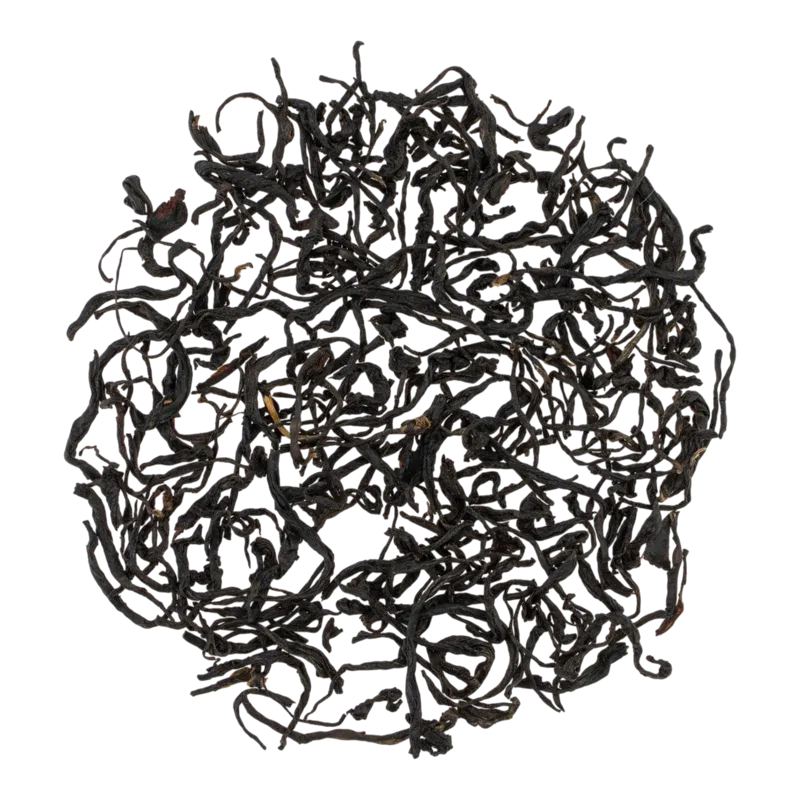
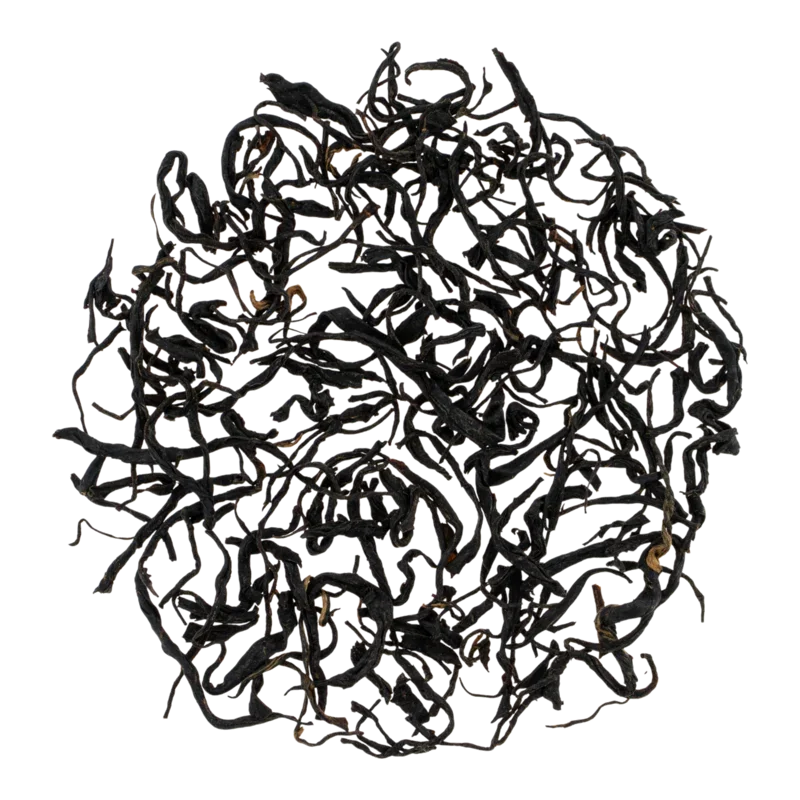
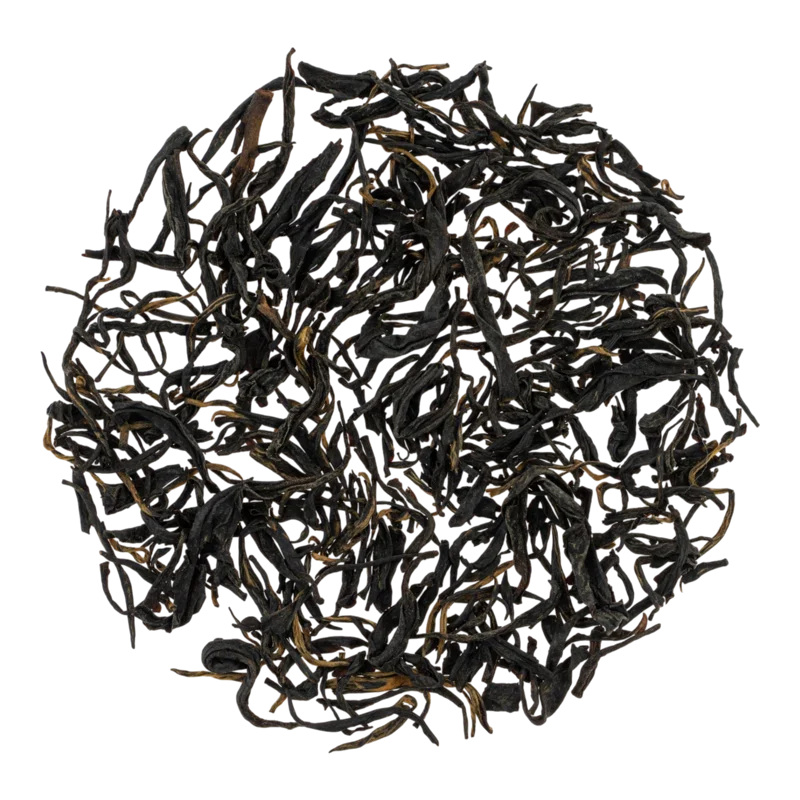
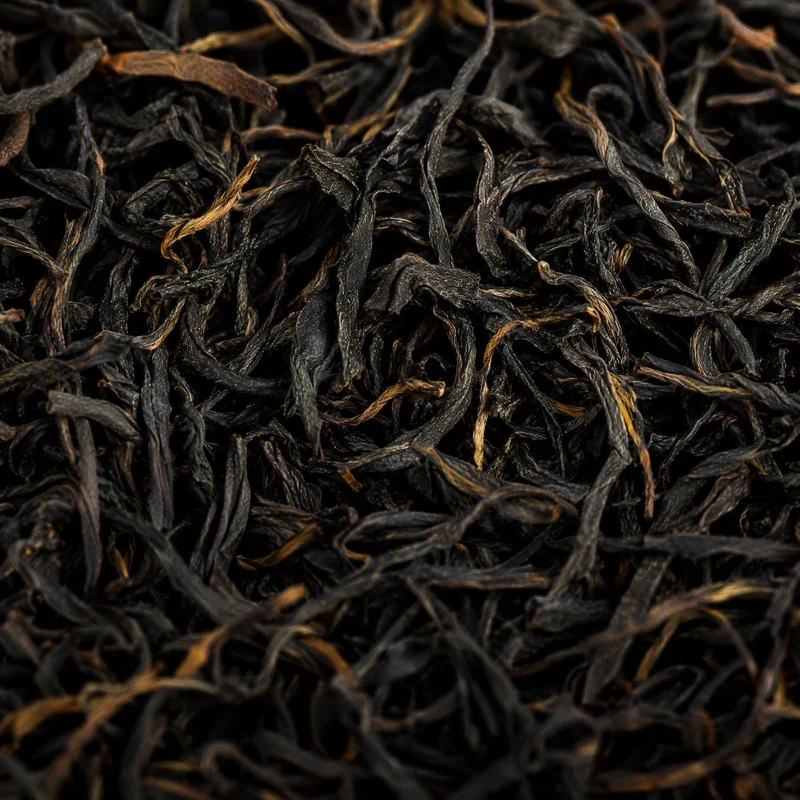
Dry Leaf Appearance: Thin, tightly twisted strips (细紧条索), dark, with pronounced "oily" luster (乌润), abundantly covered with golden tips. Leaves are even, dense, "heavy" to the touch — a sign of high extractive substance content.
Dry Leaf Aroma: Bright floral-fruity profile (花果香高扬), rising high and clean. Notes of lychee, mangosteen, osmanthus, with honey undertones. The aroma is "open," active — unlike the more "closed," "smoky" northern black teas.
Intense, "perfumed," with pronounced floral "top notes" and fruity "heart." First steeps — bright floral wave (osmanthus, magnolia); middle steeps — ripe tropical fruits (lychee, longan); final steeps — honey sweetness and warm caramel.
Bright red, clear, brilliant (红艳明亮), with pronounced golden rim around the cup edge — a sign of high theaflavin content.
Spent Leaves: Red-copper, bright, evenly colored. Leaves are large (heritage of large-leaf variety), whole, soft and elastic.
Taste: Rich and full-bodied, with pronounced, "lively" sweetness (甘爽) and soft-juicy texture (鲜活). The large-leaf variety provides density and "oiliness" of body. Astringency is moderate, quickly dissolving into sweet aftertaste (回甘). Aftertaste — long, fruity-honey, with a sensation of warmth.
Alkaloids: Caffeine — 3-4.5% of dry mass, which is higher than in small-leaf varieties. This provides a more pronounced tonic effect. Theobromine and theophylline — in standard amounts for red tea.
Amino Acids: Content — 2-3.5% of dry mass. L-theanine provides natural sweetness and "freshness" of taste. In large-leaf red teas, the amino acid proportion is usually lower than in small-leaf varieties, but is compensated by a more concentrated polyphenol profile.
Linalool and its oxides, geraniol, nerol, benzaldehyde, methyl salicylate. The warm subtropical climate and large-leaf raw material promote accumulation of terpenoid compounds that form the characteristic "perfumed" floral-fruity profile.
Minerals: Potassium, magnesium, calcium, zinc, manganese, iron. Lateritic soils rich in iron may influence the tea's mineral composition.
Polyphenols: The large-leaf variety var. assamica is characterized by increased polyphenol content in the raw material (up to 30-35%), which with full fermentation gives high content of oxidation products — theaflavins (茶黄素) and thearubigins (茶红素). This provides rich color, "velvet" taste, and bright golden rim.
Vitamins: C (partially preserved), B₁, B₂, P, PP.
Increased caffeine content in large-leaf red tea provides noticeable alertness and improved concentration. The effect is softened by L-theanine.
Theaflavins and thearubigins are powerful antioxidants that neutralize free radicals. Studies show that red tea from large-leaf raw material may have higher antioxidant potential due to increased content of polyphenol oxidation products.
Warm red tea stimulates gastric juice secretion, facilitates digestion of fatty foods — especially relevant in the context of rich Guangdong cuisine.
Regular moderate consumption of red tea is associated with improved blood lipid profile and vascular tone.
Despite Taishan's tropical climate, red tea is traditionally considered a "warm" beverage (性温) and is recommended for strengthening "yang" energy.
Polyphenols suppress the growth of pathogenic bacteria, supporting immunity and oral health.
The combination of L-theanine and warm floral-fruity aroma has a relaxing effect, reducing stress levels.
The antioxidant properties of red tea polyphenols help protect skin from photoaging and oxidative damage. In traditional Guangdong practice, red tea is recommended for maintaining skin youth with regular moderate consumption.
Tea Amount: 5-6 g per 100-120 ml (gongfu method); 3-4 g per 200-250 ml (steeping).
Teaware: Porcelain gàiwǎn (盖碗) — universal choice allowing extraction control. Clay teapot (紫砂壶) is also appropriate, especially for dense, rich batches — clay "wraps" the taste and adds softness. Glass cup is suitable for observing the bright infusion color.
Water Temperature: 90-95°C. Large-leaf red tea tolerates high temperatures well, which reveal its full potential.
Closest "neighbor" and main competitor within Guangdong. Yingde Hong Cha is a significantly more famous brand with geographical indication, produced from the same Yunnan large-leaf cultivars (including the famous Yinghong No. 9). Yingde is located in northwestern Guangdong, away from the sea, with more "continental" terroir. Compared to Yingde Hong Cha, Taishan Hong Cha is less "powerful" and less "creamy," but has brighter floral-fruity aroma and "tropical" freshness related to maritime terroir.
Yunnan red tea — the "progenitor" of large-leaf red tea cultivation in Guangdong. Dianhong is the most powerful and full-bodied among Chinese red teas, with notes of cocoa, dried fruits, and honey. Taishan Hong Cha is lighter, more "fruity" and "floral," with higher, "perfumed" aroma and less pronounced "chocolate" character.
Fujian red tea — from small-leaf variety, with smoky (traditional version) or fruity-floral (modern version) profile. Stylistically, Taishan Hong Cha is closer to modern, smokeless Xiaozhong, but differs in larger, "heavier" body and "tropical" fruity accent due to large-leaf material and warm climate.
Zhejiang red tea from small-leaf material — elegant, delicate, with plum blossom aroma. Taishan Hong Cha is its stylistic opposite: full-bodied, "juicy," with tropical character and more intense taste.
No reviews yet. Tell us what you think of this tea.
Rate this tea and share your impressions. We review each submission before publishing it.