Brewing
Gongfu brewing
- Water temperature
- 93 °C
- Tea amount
- 5 g
- Water volume
- 100 ml
- First steep
- 10 s
- Time added per infusion
- 5 s
- Infusions
- 4

Táichá 23 hào qíyùn
Choose a brewing method. Start with the recommended quantities and time, then adjust to taste.
Brewing
Brewing
Taste
Tea encyclopedia
Category: Premium Taiwanese selective red tea (black tea), small-leaf variety. Belongs to the "Taicha" (臺茶, Táichá) cultivar series developed by the Taiwan Tea Research and Extension Station (茶及飲料作物改良場, Chá jí yǐnliào zuòwù gǎiliáng chǎng, TRES). Orthodox loose-leaf tea.
Category: Premium Taiwanese selective red tea (black tea), small-leaf variety. Belongs to the "Taicha" (臺茶, Táichá) cultivar series developed by the Taiwan Tea Research and Extension Station (茶及飲料作物改良場, Chá jí yǐnliào zuòwù gǎiliáng chǎng, TRES). Orthodox loose-leaf tea.
Coordinates: approximately 23°50' N, 120°41' E (Mingjian area).
Origin: Táiwān (臺灣, Táiwān), Nántóu County (南投縣, Nántóu Xiàn), Míngjiān Township (名間鄉, Míngjiān Xiāng). The cultivar was developed by TRES subdivision—Yúchí Branch (魚池分場, Yúchí fēnchǎng).
Type: Red tea (black tea) (紅茶, hóngchá). Fully oxidized tea. According to Western classification—black tea.
Specialized tea farms in Mingjian Township, Nantou County. Many farms offer direct sales through online platforms or tea tourism programs.
Established importers with direct relationships with Taiwanese producers, offering traceability and quality guarantees.
Taiwan tea events where farmers and cooperatives present their products directly to consumers.
Several Mingjian farms have obtained organic certification, offering Qi Yun No. 23 grown without synthetic chemicals.
Cultural Significance: The appearance of Qi Yun No. 23 became an important milestone in Taiwan's tea industry diversification strategy. If Taicha No. 18 Hóng Yǔ (紅玉) represents the large-leaf direction inherited from Assam, then Qi Yun embodies the small-leaf tradition tracing back to Keemun—one of the three greatest red teas in the world. The tea was warmly received in the international specialty tea market, confirming Taiwan's reputation as a center of tea innovation capable of not only perfecting oolongs but also creating world-class red teas. The cultivar also demonstrates high plasticity: besides red tea, white tea and GABA oolong are successfully produced from its raw material.
History: The genetic lineage of Qi Yun traces back to 1938 (27th year of Showa reign), when Professor Ryō Yamamoto (山本亮, Yamamoto Ryō), working at Taihoku Imperial University (臺北帝國大學), brought tea bush seeds from the famous Keemun (祁門) tea region in Ānhuī Province (安徽省). The seeds were transferred to the Yúchí Black Tea Experimental Branch (魚池紅茶試驗支所) under the Central Research Institute of the Taiwan Governor-General—an institution that later became the Yuchi Branch of modern TRES. For decades, the planting material underwent adaptation and field selection under local conditions. In 2001–2002 (民國90–91年), a promising specimen was selected from descendants of Keemun seeds, receiving the designation "Qiban 1" (祁辦1). In 2015–2017 (民國104–106年), comparative trials were conducted with the control variety Qīng Xīn Oolong (青心烏龍, Qīngxīn Wūlóng)—the main Taiwanese cultivar for oolongs, demonstrating significant advantages of the new specimen in productivity and red tea quality. The cultivar was officially registered in 2017–2018 (民國106–107年) under number TTES No. 23. The path from seed to official registration took 80 years: seeds were brought from Keemun in 1938, and the cultivar received its number only in 2017–2018. This is one of the longest histories "from field to cup" in modern tea cultivation. In May 2019, during the celebration of TRES's 116th anniversary, a vote was held for the commercial name: from four candidates—"Hong Yue" (紅悅), "Qi Yu" (祁玉), "Qi Yun" (祁韻), and "Hong Qi" (紅祁)—the
Name Breakdown: "Qi Yun" (祁韻) consists of two characters: "Qi" (祁)—a direct reference to Keemun (祁門), the homeland of ancestral seeds, one of China's most prestigious tea toponyms; "Yun" (韻)—"charm," "melody," "aftertaste"—a concept close to "tea rhyme" (茶韻, cháyùn), describing the depth and resonance of flavor-aromatic sensations. Thus, "Qi Yun" can be translated as "Keemun Charm" or "Keemun Melody." The number "23" (23號, 23 Hào) indicates the sequential registration number in the TRES cultivar catalog.
Cultivar: TTES No. 23 (Qi Yun, 祁韻). Originates from seeds of one of the Keemun tea bushes brought to Taiwan in 1938. Small-leaf variety (Camellia sinensis var. sinensis). Medium-sized bush habit (樹姿中間型, shùzī zhōngjiān xíng), early maturation type (早生種, zǎoshēng zhǒng). Strong vitality, high bud density on shoots, ensuring high yield per unit area. Mature leaf is elongated-elliptical, 8–10 cm long, 3–4 cm wide, with slightly wavy leaf surface. Young buds and shoots in spring are colored yellow-green with reddish tint, and under certain conditions may acquire a light purple tone, which is associated with possible genetic influence of Taiwanese wild tea forms (Camellia formosensis). Buds are covered with noticeable down (茸毛, róngmáo). The cultivar possesses strong disease resistance and high drought tolerance.
Picking: Spring bud awakening precedes Qing Xin Oolong by approximately two weeks—in Nantou conditions, the first harvest is possible as early as early April. For producing highest quality red tea, predominantly summer harvest raw material is used: bud and two-three upper leaves (一芽二三葉, yī yá èr sān yè). The cultivar is suitable for producing highly aromatic red tea year-round (一年四季均可產製高香型紅茶).
Raw Material: Hand-picking is preferred to preserve flush integrity. Only healthy, undamaged shoots are used, harvested in the optimal vegetation phase when the balance of aromatic substances and catechins is most favorable.
Altitude: 300–350 meters above sea level. This is significantly lower than for high-mountain oolongs of Alishan or Lishan, which reduces production costs and makes Qi Yun a more accessible product.
Climate: Subtropical monsoon, with sufficient precipitation (about 1800–2000 mm annually) and warmth. Average annual temperature around +20–22°C. Moderate altitude ensures a long growing season and high bush productivity.
Soil: Red-brown lateritic soils (紅壤, hóng rǎng) with good natural drainage. Slightly acidic reaction (pH 4.5–5.5) is favorable for tea plants.
Míngjiān Township (名間鄉, Míngjiān Xiāng), Nantou County—Taiwan's largest tea-growing area by acreage, historically specializing in oolongs and green teas. Successful adaptation of the small-leaf red cultivar in this region opens new market opportunities for local farmers and allows production diversification beyond traditional oolongs. Besides Mingjian, the cultivar is also grown in the vicinity of Yúchí (魚池鄉) and adjacent Nantou areas.
Many Mingjian farmers apply ecologically oriented farming methods: hand weeding, use of biological preparations, rejection of synthetic pesticides, although formal organic certification is not universal. The compactness of Qi Yun's small-leaf bushes allows higher planting density compared to traditional oolong cultivars, increasing output per hectare.
Fresh-picked leaves are spread to remove excess moisture. A combination of solar and shade withering is possible. The leaf loses turgor, becomes soft and pliable. At this stage, formation of the floral-fruity aromatic complex begins.
Mechanical or manual rolling of withered leaf. Cell wall destruction ensures cell juice release and contact of polyphenols with oxidative enzymes. Qi Yun's small leaf rolls into compact semi-spherical or curved forms.
Complete polyphenol oxidation under controlled temperature and humidity conditions. It is at this stage that characteristic citrus and floral notes form, due to high content of limonene and linalool oxide—volatile compounds genetically predetermined by Keemun origin of the cultivar.
Final thermal treatment to stop oxidation and stabilize moisture content. Some producers use infrared dryers, providing more uniform heating and better preservation of volatile aromatic components—primarily limonene and linalool oxide, forming the signature bergamot bouquet. Traditional hot air drying is also acceptable but may lead to partial loss of the most delicate top notes. Final moisture content of finished product—less than 5%.
After drying, manual or mechanical sorting is conducted to remove stems, substandard leaves, and even out fractional composition. Select batches with high tips content are valued significantly higher.
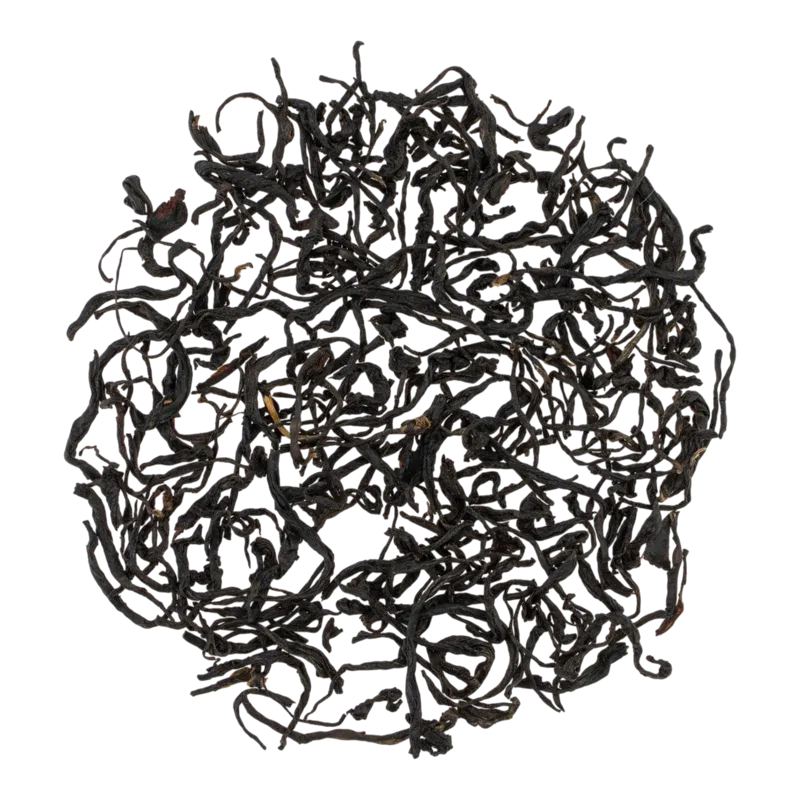
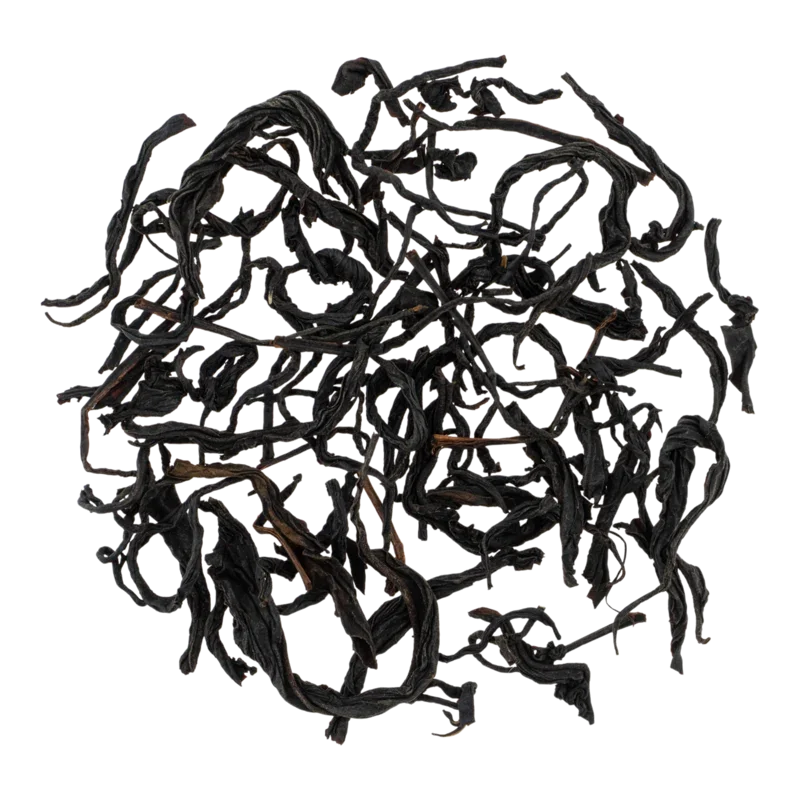
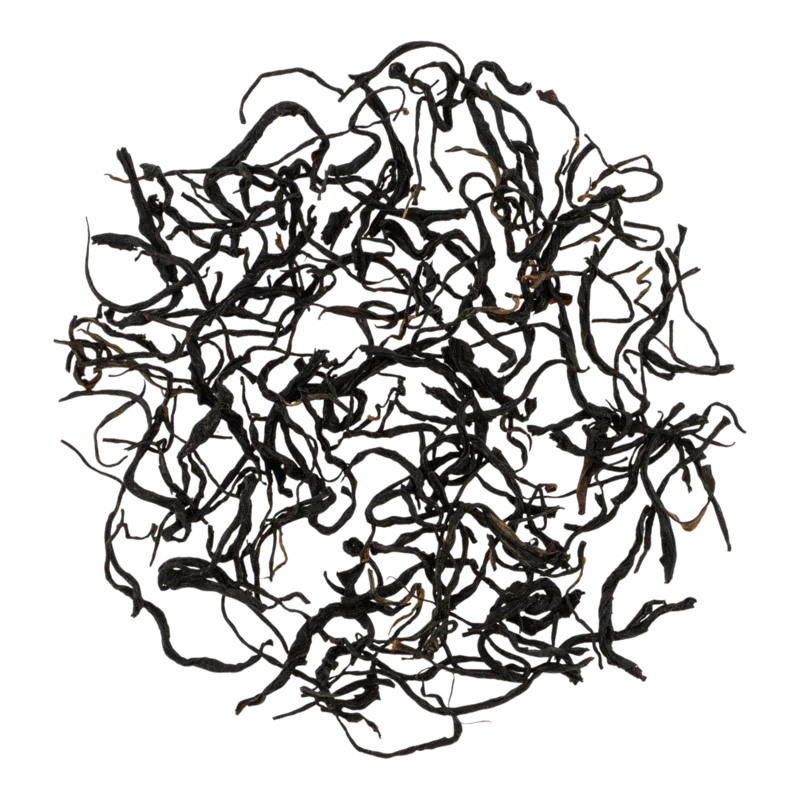
Dry Leaf Appearance: Small, tightly rolled leaflets of dark brown, almost black color, in the form of compact hemispheres or curved strips. Notable presence of silvery-golden buds (tips) gives the loose tea characteristic variegated texture.
Dry Leaf Aroma: Intense, complex, multi-layered. Dominant notes of caramelized orange and dark chocolate interweave with malty background and light woody shades. When heated, pronounced citrus tone emerges.
Liquor Aroma: Bright, sweetish, with dominant citrus chord strikingly reminiscent of bergamot (bergamot zest, bergamot oil). This natural "bergamot" aroma is Qi Yun's calling card, achieved without any flavoring. Additionally present are honey and floral nuances, with spicy tones in the background.
Liquor Color: Bright, clear, saturated amber-orange or copper-red color with pronounced brilliance. Official TRES description characterizes the liquor as "orange-red, magnificent and bright-clear" (水色橙紅艷麗明亮, shuǐsè chénghóng yànlì míngliàng).
Spent Leaves: Small, elastic leaves of dark brown color, uniform in size, maintaining integrity after multiple brewings.
Taste: Rich, full-bodied, yet soft and enveloping. Honey sweetness harmoniously combines with light maltiness and refreshing citrus acidity. Aftertaste is warm, spicy, with shades of nutmeg or cinnamon, prolonged and memorable. With proper brewing, the tea is practically devoid of astringency.
Alkaloids: Caffeine (theine), content typical for small-leaf red teas—around 25–40 mg/g dry matter. Theobromine and theophylline in trace amounts.
Amino Acids: L-theanine—key tea amino acid, providing mild relaxing effect and "sweet" taste component. The balance of L-theanine and caffeine forms the characteristic "alert calmness" state typical of quality red tea.
Key feature of Qi Yun. High content of limonene (citrus tone) and linalool oxide (floral, bergamot tone) determines natural "bergamot" aroma. Presence of specific terpene complex is assumed, forming this characteristic bouquet exclusively through cultivar genetics and terroir, without adding flavorings.
Minerals: Potassium, magnesium, manganese, zinc, fluorine.
Polyphenols: Catechins during complete oxidation transform into theaflavins (0.3–1.5%) and thearubigins (5–11%), determining liquor brightness, its taste structure and antioxidant potential.
Vitamins: B-group vitamins (B₁, B₂), vitamin C (partially preserved), vitamin E.
Caffeine combined with L-theanine provides gentle increase in alertness and attention without nervousness and anxiety.
Theaflavins and thearubigins are powerful antioxidants, reducing oxidative stress and protecting cells from free radical damage.
Moderate red tea consumption stimulates digestive secretion and promotes comfortable food digestion.
Red tea polyphenols contribute to vascular elasticity and may have positive influence on blood lipid profile.
Red tea belongs to "warm" (溫性, wēnxìng) beverages in traditional East Asian dietetics.
Qi Yun's unique citrus-floral aroma may have relaxing and mood-lifting effects—an aromatherapeutic effect complementing the tea's physiological impact.
Caffeine and L-theanine synergy positively affects working memory and concentration ability.
Red tea polyphenols possess moderate antimicrobial properties, supporting oral hygiene and gum health.
Antioxidant properties of red tea polyphenols may contribute to protecting skin from premature aging associated with oxidative stress.
With European method, steep for 3–5 minutes. One-two re-brewings are acceptable.
Teaware: Porcelain or glass gàiwǎn (蓋碗, gàiwǎn) is ideal for revealing citrus-floral aroma and evaluating bright liquor color. Clay teapot is also acceptable but may somewhat mute aromatic brightness.
Water Temperature: 90–95°C. Small-leaf raw material is sensitive to overheating—boiling water may increase astringency and suppress delicate aromatic notes.
Container: Airtight, opaque container (tin can, ceramic tea caddy, vacuum bag).
Humidity: No more than 60%.
Light: Protection from direct sunlight.
Shelf Life: Under proper conditions—up to 2–3 years. Optimal consumption—within the first year after production, while volatile aromatic components remain at maximum level.
Store isolated from strongly scented products—tea easily absorbs foreign aromas, which may distort its natural citrus bouquet.
Temperature: Room temperature, stable (15–25°C), without sharp fluctuations.
Large-leaf hybrid of Assam and Taiwanese wild camellia. If Qí Yùn is elegance and citrus refinement, then Hóng Yù is power and menthol freshness. Hóng Yù has a denser body, pronounced mint-cinnamon notes and a more astringent character. Qí Yùn is softer, more aromatic and more affordable.
Hybrid of Keemun and Indian varieties. Distinguished by pronounced floral-fruity aroma with notes of citrus blossoms (mandarin peel aroma). More "tropical" in character than Qí Yùn, and with a more pronounced citrus note. Qí Yùn is closer to the classic Keemun profile — more restrained, spicy and deep.
Direct genetic ancestor. Classic Qímén possesses the famous "Qímén aroma" (祁門香, Qímén xiāng) — a complex bouquet with notes of orchid, honey and dried fruits, which earned it a place in the trinity of the world's greatest black teas alongside Indian Darjeeling and Ceylon Uva. Qí Yùn inherited part of this profile, but Taiwanese terroir shifted the emphasis toward more pronounced citrus-bergamot notes, creating a distinctive "Taiwanese" variant of the Qímén tradition. In flavor profile, Qí Yùn resembles Sri Lankan black tea in the top notes, but with characteristic spicy depth inherited from its Qímén ancestor.
Price Category: Qi Yun No. 23 belongs to premium Taiwanese red tea category, though its non-high-altitude origin and good cultivar yield make it somewhat more accessible than Hong Yu No. 18. In the international specialty tea market, prices range from 10–20 USD per 50 g. Cost depends on harvest season (summer is valued higher), processing method, and specific farmer's reputation.
No reviews yet. Tell us what you think of this tea.
Rate this tea and share your impressions. We review each submission before publishing it.