Brewing
Gongfu brewing
- Water temperature
- 75 °C
- Tea amount
- 5 g
- Water volume
- 100 ml
- First steep
- 10 s
- Time added per infusion
- 5 s
- Infusions
- 3

sānqīngshān báichá
Choose a brewing method. Start with the recommended quantities and time, then adjust to taste.
Brewing
Brewing
Taste
Tea encyclopedia
Category: Agricultural Geographical Indication Product (农产品地理标志, since 2011, Announcement No. 1635); "Famous Tea of Jiangxi" (江西名茶, 2013). Rare mutant tea type — "high amino acid, low polyphenol" (高氨基酸低茶多酚).
Category: Agricultural Geographical Indication Product (农产品地理标志, since 2011, Announcement No. 1635); "Famous Tea of Jiangxi" (江西名茶, 2013). Rare mutant tea type — "high amino acid, low polyphenol" (高氨基酸低茶多酚).
Coordinates: 117°52′–118°25′ E, 28°30′–28°59′ N (Yushan County territory).
Origin: China; Jiāngxī Province (江西, jiāngxī); Yùshān County (玉山县, yùshān xiàn), part of Shangrao Prefecture-level City (上饶市, shàngráo shì). Protection zone — entire county territory. Quality core — Sānqīng Township (三清乡, sānqīng xiāng), Zǐhú Town (紫湖镇, zǐhú zhèn), and Huáiyù Township (怀玉乡, huáiyù xiāng) — high-altitude tea gardens (>700 m) at the headwaters of Xìnjiāng River (信江, xìnjiāng), in the perpetual cloud zone at the foot of Mount Sanqingshan.
Type: Green tea (绿茶, lǜchá) (non-oxidized), produced from a white-leaf mutant variety. Despite the name "bai cha," this is not white tea in the classical sense (which belongs to the category 白茶 with minimal processing), but green tea with a characteristic white/pale yellow color of the leaf blade. Fixation method — drum roasting at 130–140°C.
Sanqingshan Bai Cha is one of the world record holders for amino acid content. For comparison: Anji Bai Cha — 5–7%, standard Lóngjǐng (龙井) — 2–3%, Japanese gyokuro (shaded) — 4–6%. The Sanqingshan mutant surpasses even gyokuro without any shading.
Mount Sanqingshan was included in the World Heritage list in 2008 under criterion VII (exceptional natural beauty). Tea gardens are located in the site's buffer zone — this imposes strictest ecological restrictions but also guarantees unique environmental purity.
Yushan County is one of the few "oxygen bars" among China's tea regions. Negative ion concentration in air is 50 times higher than urban — an indicator characteristic of virgin forests.
County gazetteer from Tongzhi era (1862–1874) recorded Sanqingshan tea's superiority in the 19th century — a century and a half before scientific explanation (white-leaf mutation + amino acid profile).
One of the highest values among teas — beneficial side effect of reduced chlorophyll and increased carotenoid accumulation in white leaves.
Sanqingshan underwent unusual brand evolution. In the 1970s classical green tea "Yunwu" (cloud mist) was made here, in the 1990s the industry collapsed, and in the 2000s — revived through a completely different product: white-leaf mutant. This is one of few examples in Chinese tea cultivation where a region completely changed "tea identity" within one generation.
Cultural Significance: Sanqingshan Bai Cha is inextricably linked to one of China's most spectacular mountain landscapes. Mount Sanqingshan is famous for its granite pillar-"fingers" immersed in seas of clouds and its richest biosphere (over 2,300 plant species). Tea gardens are located in the UNESCO buffer zone, which imposes strict ecological restrictions and guarantees environmental purity. Yushan County is certified as a "Natural Oxygen Bar of China" (中国天然氧吧) — the concentration of negative ions in the air is 50 times higher than in cities.
Name Breakdown: 三清山 (sānqīngshān) — "Mountain of Three Purities" — a sacred Daoist mountain, one of the four sacred mountains of Daoism (四大道教名山), a UNESCO World Heritage site since 2008 (criterion VII — "exceptional natural beauty"). "Three Purities" — three supreme deities of the Daoist pantheon (元始天尊, 灵宝天尊, 道德天尊); 白茶 (báichá) — "white tea," referring to the unusual white/pale yellow color of the mutant cultivar's leaf blade. Full meaning: "White-leaf tea from the Mountain of Three Purities."
Primary — Bái Chá Yǔ (白茶玉, báichá yù, "White Tea Jade") — a local breeding mutant variety of Camellia sinensis var. sinensis. This is a temperature-sensitive white-leaf mutant: at temperatures below ~23°C, young leaves lose chlorophyll and acquire a pale yellow or milky white color (叶肉玉白, "leaf flesh jade-white"), while veins remain emerald green (叶脉翠绿) — creating a characteristic two-tone effect. When temperature rises, leaves gradually turn green. Distinguished by early awakening, frost and heat resistance, extended tenderness period (7–10 days longer than standard varieties). Additionally uses Fúdǐng Dà Bái Chá (福鼎大白茶). Trees older than 30 years. The "Five Prohibitions" standard applies (五不采, wǔ bù cǎi): do not pick rain leaves, purple buds, diseased, insect-damaged, or deformed leaves.
Picking: Spring — from late March to mid-April. Optimal period — while temperature has not exceeded ~23°C and leaves retain white/pale yellow color. If harvest is delayed, leaves turn green and lose the unique "white-leaf" characteristic.
Pluck Standard: Premium grade — single buds or bud with one half-opened leaflet. First grade — bud with one to two leaflets.
Raw Material: Tender shoots with characteristic white/pale yellow coloration of leaf blade and green veins. Without mechanical damage or pest traces.
Altitude: 758–1182 m — one of the highest tea zones in Jiangxi.
Climate: Subtropical monsoon, mountainous. Average annual temperature 17–18°C; precipitation 1400–1724 mm/year; foggy days >180 per year; daily temperature variation >8°C. Cool spring nights (below 23°C) are critically important for white-leaf mutation manifestation — precisely the mountain microclimate ensures a prolonged "white" period, unattainable on plains.
Soil: Red earth and yellow earth (红壤、黄壤), pH 5.0–6.5. Enriched with zinc (76.2 mg/kg) and selenium (0.82 mg/kg) — geochemical markers of the Sanqingshan granite massif.
Forest coverage — 81%. "Natural Oxygen Bar of China" certification (中国天然氧吧) — negative ion concentration 50 times higher than urban. Tea gardens are located in the UNESCO Sanqingshan buffer zone, irrigation — by spring waters from Xinjiang River headwaters. Industrial pollution completely excluded. The ecosystem is unique: tea terraces interspersed with relict coniferous forests, while granite pillar-"fingers" of Sanqingshan create natural windbreaks and microzones with increased fog condensation.
4–6 hours in a ventilated room.
Natural sun drying — a stage atypical for classical green tea. Gentle solar heat initiates primary aromatic transformations and partial dehydration, giving the tea additional sweetness and florality not characteristic of purely "fired" green teas.
Drum roasting at 130–140°C — moderate temperature to preserve the delicate amino acid profile. Too high temperature would destroy L-theanine and other amino acids.
Minimal rolling to form shape and release juices, while preserving bud integrity and their white down (成条保毫, "thread preserves down").
At 70°C — fixing straight form.
At 50°C the master rolls tea with palms, "raising" white fuzz to the surface — a stage determining characteristic silvery luster.
At 60°C on charcoal to moisture ≤6.5%. Charcoal heating forms a subtle sweet background without overwhelming delicate aromatics.
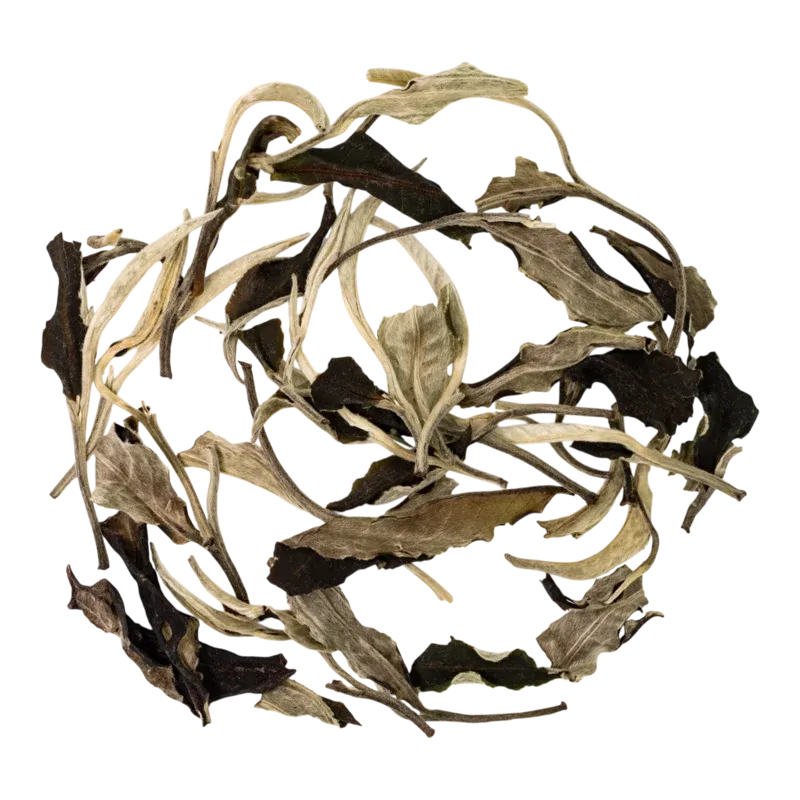
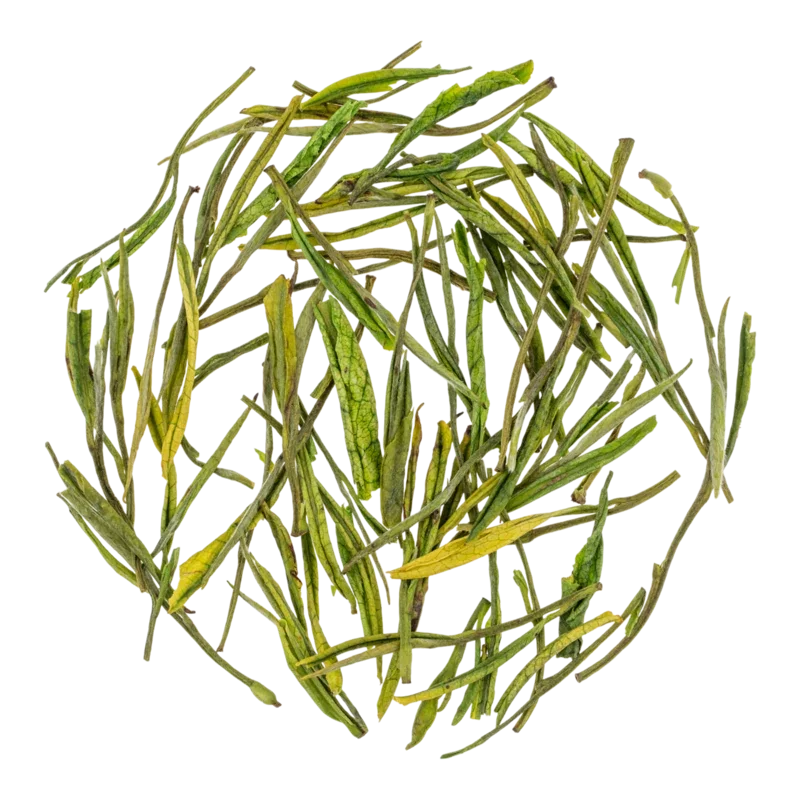
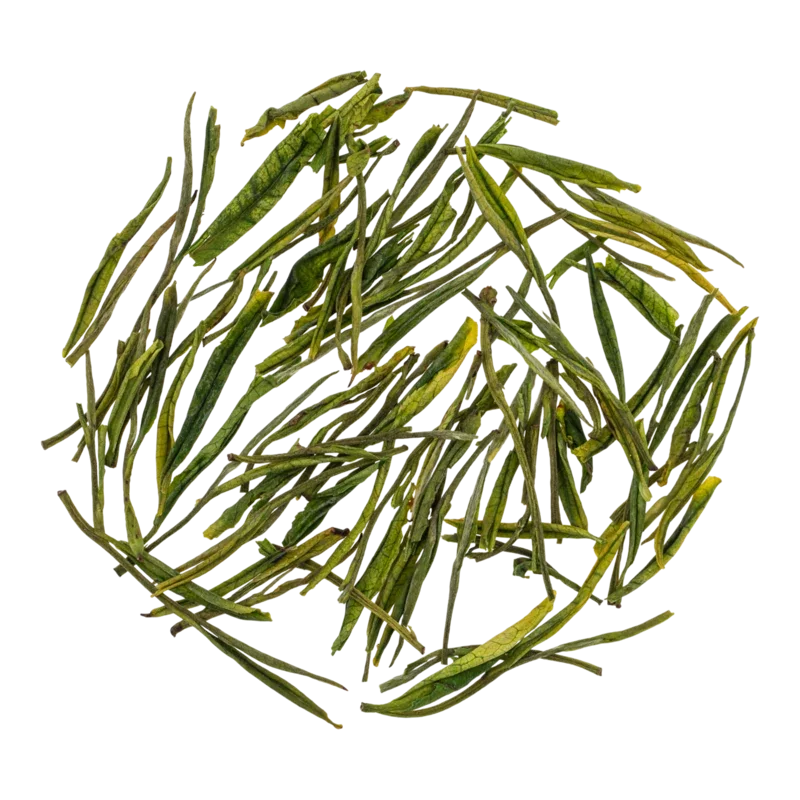
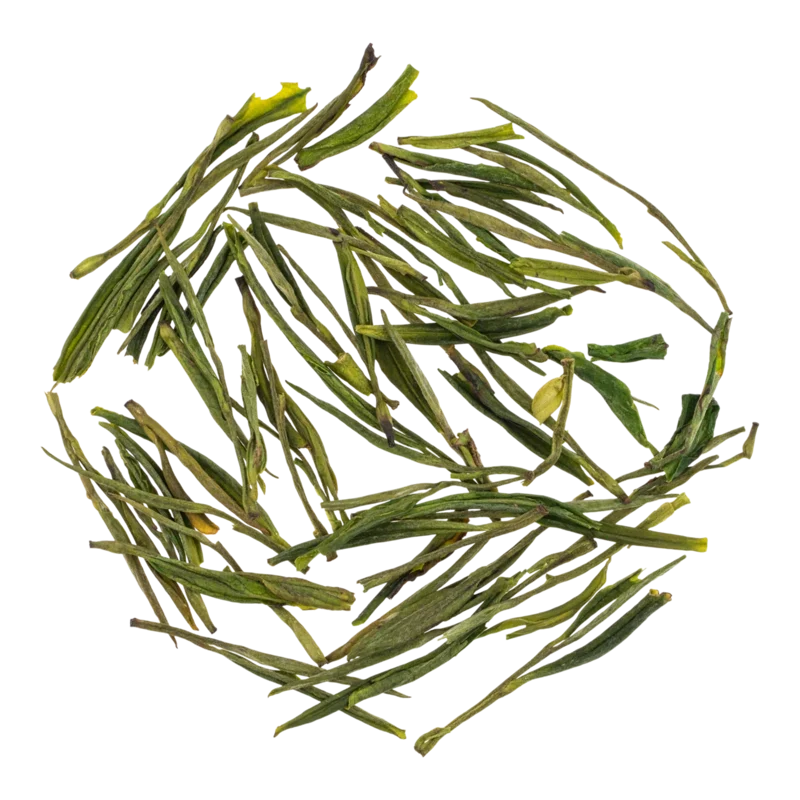
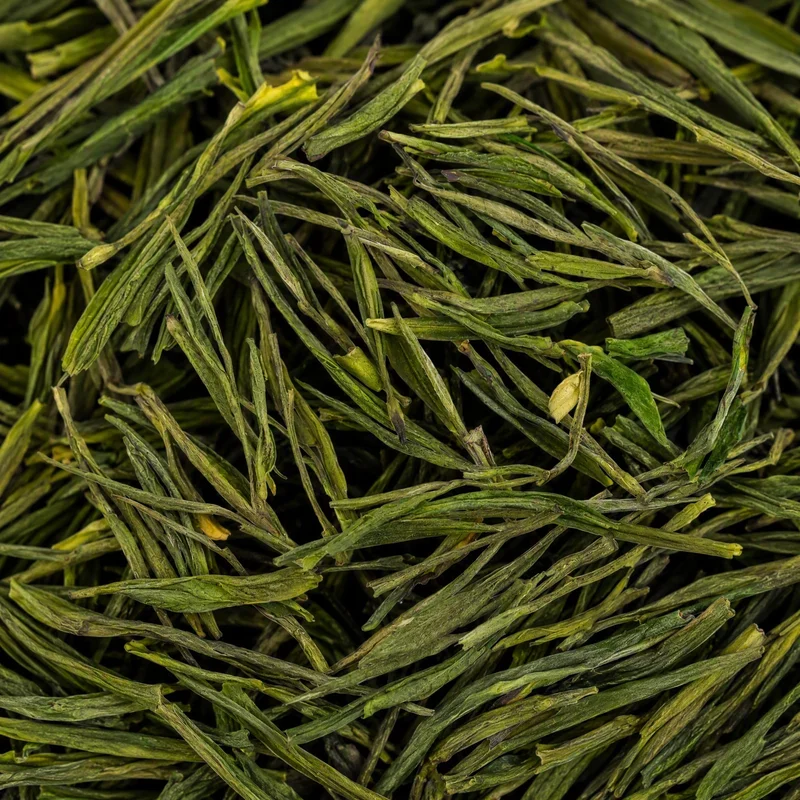
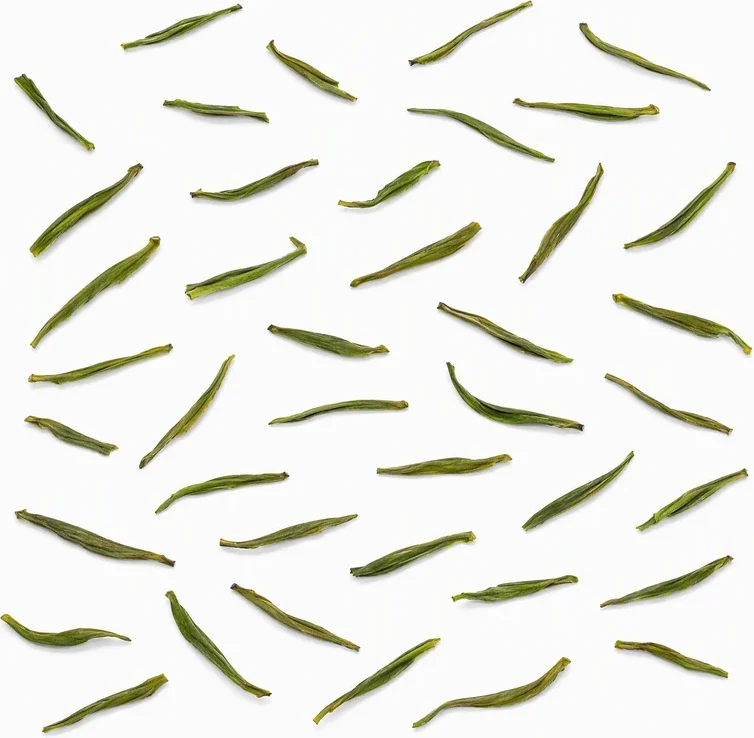
Dry Leaf Appearance: Straight, tight, neat threads (挺直紧结); pale yellow with greenish tint (嫩黄绿润), with noticeable white down (显毫). Two-tone "white flesh — green veins" preserved even in dry leaf.
Dry Leaf Aroma: Pure green (清香) with pronounced floral background (花香). Delicate, "milky" tone — result of high amino acid content.
Liquor Aroma: Rich and persistent (馥郁, fùyù). Floral-green, with "creamy" background. Not typical "roasted" profile — closer to white tea in softness, but fresher.
Liquor Color: Clear, light yellow (for "silver needle" type) or orange-yellow (for "shou mei" type). High clarity.
Spent Leaves: Jade-white with emerald-green veins (玉白翠绿) — characteristic two-tone "marble" effect. Lively, opens in "buds" (鲜活成朵).
Taste: Exceptionally fresh and brisk (鲜爽), with bright natural sweetness (甘醇) and silky smoothness (滑, huá). Bitterness and astringency practically absent — consequence of extraordinarily low polyphenol level (13–16%). Long sweet aftertaste. "Jade milk" — poetic description dating to 19th-century county gazetteer.
Alkaloids: Caffeine in standard range; theobromine, theophylline.
Amino Acids: 6–10% — extraordinary level, 2–3 times exceeding average for green teas (2–3%). L-theanine dominates, providing sweetness, "creaminess" and powerful relaxing-tonic effect. This is one of the highest amino acid concentrations among all teas worldwide.
Reduced content during white-leaf phase — cause of characteristic yellow-white color. As warming progresses leaves turn green, but early harvest fixes "white" phase.
Minerals: Zinc — 76.2 mg/kg; selenium — 0.82 mg/kg (geochemical markers of Sanqingshan granite soils). Potassium, manganese, fluorine.
Polyphenols: 13.2–15.6% — approximately half that of standard green tea (25–30%). Low polyphenol level explains practically complete absence of bitterness and astringency.
Vitamins: Vitamin A — elevated content (provitamin A up to 12.6 mg/100 g); vitamin C, B-group vitamins, vitamin E.
Despite reduced polyphenol level, catechins combined with vitamin E and selenium provide effective protection against oxidative stress.
Extraordinary L-theanine content (6–10% amino acids) stimulates alpha-wave brain activity — one of the most powerful "relaxing-focusing" teas.
Elevated provitamin A content (12.6 mg/100 g) beneficial for retinal health and may reduce eye fatigue from screen work.
Natural selenium (0.82 mg/kg) — important trace element for thyroid and immunity.
Low polyphenol content makes this tea significantly gentler on gastric mucosa than standard green teas.
Catechins promote lipid regulation and blood sugar levels.
Listed properties are based on general data and are not medical recommendations. Not recommended on empty stomach (despite gentleness) and before sleep (4 hours prior). For endocrine disorders — consult physician.
Maximum sweetness and "milkiness" manifests in first infusion — result of L-theanine, which extracts faster than polyphenols. Second and third steeps become more "green" in taste but retain characteristic softness and absence of bitterness.
Tea Amount: 3 g per 150 ml (1:50 ratio).
Teaware: Glass tumbler — for observing two-tone "marble" effect of leaves; white porcelain gaiwan (盖碗) — for concentrating floral aroma. Purple clay (紫砂壶) acceptable.
Water Temperature: 80–85°C. Do not use boiling water — temperature above 85°C destroys L-theanine and increases bitterness.
Container: Hermetic vacuum or foil packaging.
Light: Complete light isolation — chlorophyll already reduced, additional oxidation will make tea dull.
Up to 12 months at 0–5°C. Recommended consumption within first 6 months for maximum freshness and sweetness — over time amino acids degrade faster than polyphenols, and tea loses its unique "milky" characteristic.
Temperature: 0–5°C (refrigerator) — mandatory; white-leaf green teas especially sensitive to oxidation.
Zhejiang. Same principle — white-leaf mutant (Bai Ye 1, 白叶一号), processed as green tea. Shape — flat, "lanceolate" (凤形/龙形). Amino acids 5–7% vs 6–10% in Sanqingshan. Anji — more "chlorophyll" and "green" in taste, with noticeable chestnut note; Sanqingshan — sweeter, more "milky," with more pronounced floral background and mineral tone from granite soils. Anji significantly more famous and accessible; Sanqingshan — niche luxury product with extreme amino acid profile.
Jiangsu, Tianmu Lake area. Also white-leaf mutant (cultivar Bai Ye 1). Lighter and more "watery" profile, less "body." Sanqingshan — with deeper aroma due to charcoal drying and high-altitude terroir (758–1182 m vs 200–400 m).
Jiangxi, Zixi County (neighboring region). Similar mutant type, but at lower altitudes (400–800 m). Less pronounced amino acid profile. Sanqingshan — with more "extreme" composition and stricter ecological standards thanks to UNESCO buffer zone.
No reviews yet. Tell us what you think of this tea.
Rate this tea and share your impressions. We review each submission before publishing it.