Brewing
Gongfu brewing
- Water temperature
- 75 °C
- Tea amount
- 5 g
- Water volume
- 100 ml
- First steep
- 10 s
- Time added per infusion
- 5 s
- Infusions
- 3

Rǔshān lǜchá
Choose a brewing method. Start with the recommended quantities and time, then adjust to taste.
Brewing
Brewing
Taste
Tea encyclopedia
Category: PRC Geographical Indication Product (国家地理标志产品, 2010). Included in the "National Registry of Famous, Special, Superior and New Agricultural Products" (全国名特优新农产品, 2021). European organic certification in progress. Total tea garden area by 2024 — 18,000 mu (~1,200 hectares), annual production value — 300 million yuan.
Category: PRC Geographical Indication Product (国家地理标志产品, 2010). Included in the "National Registry of Famous, Special, Superior and New Agricultural Products" (全国名特优新农产品, 2021). European organic certification in progress. Total tea garden area by 2024 — 18,000 mu (~1,200 hectares), annual production value — 300 million yuan.
Coordinates: 121°11′–121°51′ E, 36°41′–37°08′ N. The center of the zone — approximately 36°50′ N — is one of the highest latitudes for commercial tea cultivation in the world. Seoul, San Francisco and Sicily are located on the same parallel.
Origin: China, Shāndōng Province (山东省, Shāndōng Shěng), Rǔshān City (乳山市, Rǔshān Shì), Jiāodōng Peninsula (胶东半岛, Jiāodōng Bàndǎo). Tea gardens are distributed across several townships, with the core in Baishatan District (白沙滩镇), where the first seedlings were planted in 1966.
Type: Green tea (绿茶, lǜchá), unoxidized. Produced in three forms: spiral (卷曲形, juǎnqū xíng) — main commercial product; flat (扁形, biǎn xíng) — highest grade, technologically similar to Longjing; needle-shaped (针形, zhēn xíng) — mingqiancha (明前茶), tea picked before Qingming. Technology — pan-firing with rotary kill-green and final charcoal drying.
Cultural Significance: Rushan Lü Cha is a symbol of "impossible tea": green tea growing at the latitude of Seoul and San Francisco, in a climate where snow falls in winter. Its history — from a political experiment in 1966 through near-complete disappearance (120 mu in 1995) to 18,000 mu in 2024 — is a metaphor for Chinese agronomic persistence. At the same time, the "impossible" conditions created not just "northern" tea, but tea with objectively superior water-extractable substances and brewing endurance compared to "southern" analogs.
History: Rushan Lü Cha is one of the youngest and most "impossible" teas in China. Its history is not one of antiquity, but of persistence and agronomic engineering.
Cultivar: Camellia sinensis var. sinensis varieties are used, selected for frost resistance:
Picking: Spring — main and most valuable. Due to northern latitude (37° N), vegetation begins later than in the south: late April — May (for comparison: in Zhejiang — mid-March). This delay is compensated by maximum amino acid accumulation in shoots (≥3.0% in spring tea) — consequence of prolonged "cold dormancy." Summer picking (June–July) — less valuable, polyphenols predominate over amino acids, taste more astringent.
Climate: Temperate oceanic monsoon (暖温带海洋性季风气候, nuǎn wēndài hǎiyángxìng jìfēng qìhòu). Average annual temperature — 12°C — 4–6°C lower than in main tea regions of southern China. Daily temperature fluctuation — more than 15°C — one of the highest among all tea regions worldwide. This fluctuation is the key factor: at night plant respiration slows and consumption of accumulated sugars and amino acids decreases, resulting in leaves "gaining" more flavor substances. Annual precipitation — 775 mm (half that of Fujian or Zhejiang). Diffused light from frequent sea fogs promotes L-theanine accumulation.
Soil: Brown soils on volcanic rocks (火山岩风化棕壤土, huǒshānyán fēnghuà zōng rǎng tǔ), pH 5.5–7.0. Volcanic origin provides increased mineral content: selenium (Se) and zinc (Zn). Organic matter — ≥1.0%.
About 300 m — low by "tea" standards. However, northern latitude (37° N) compensates for elevation: actual microclimate is equivalent to 800–1000 m in the south in terms of average annual temperature and growing season length.
Forest cover — 81%. Negative ion content in air — 50 times higher than urban, which allowed Rushan to receive "Chinese Natural Oxygen Bar" certification (中国天然氧吧). Tea gardens are irrigated with mineral water (崂山矿泉水). Ecological purity is one of the main advantages: distance from industrial centers, absence of heavy metals in soils.
Key agronomic problem of "northern" tea cultivation. Modern technologies include: mulching the root zone with rice straw or special material, installing greenhouse arches with covering fabric, planting windbreak strips. Without winter protection, bushes die at temperatures below −15°C.
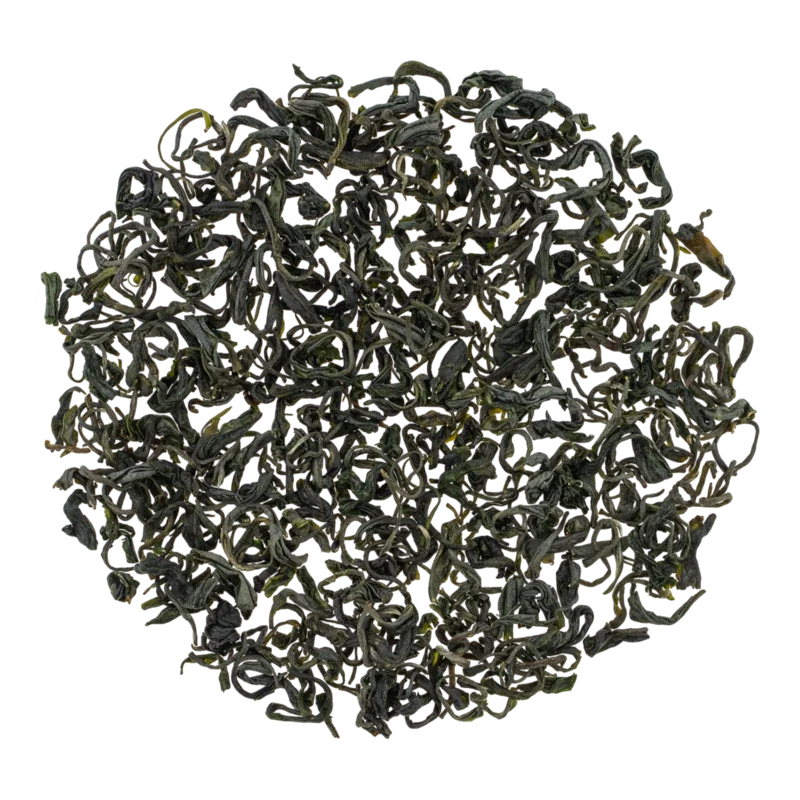
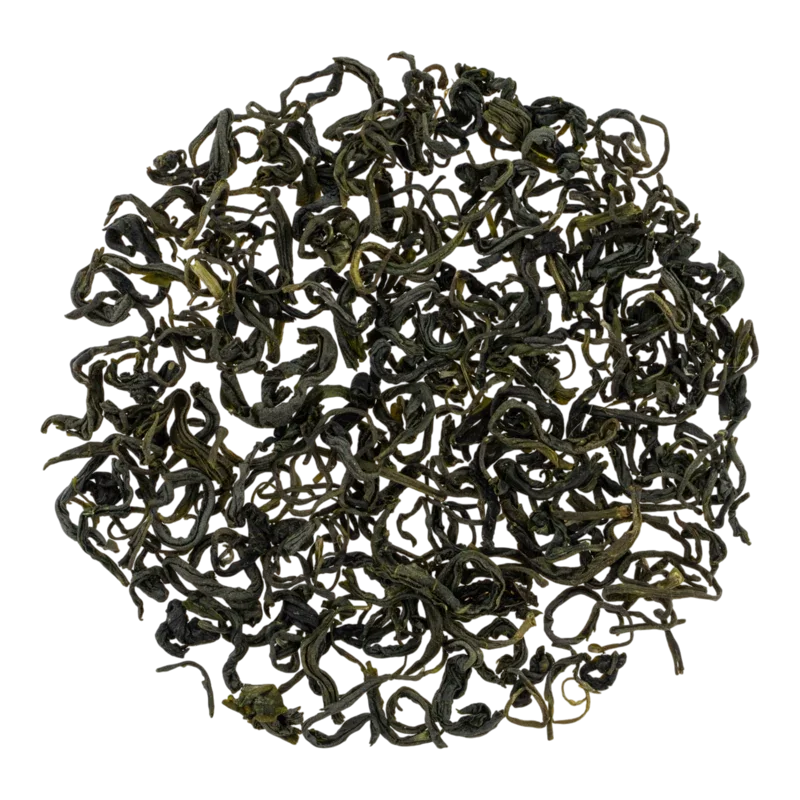
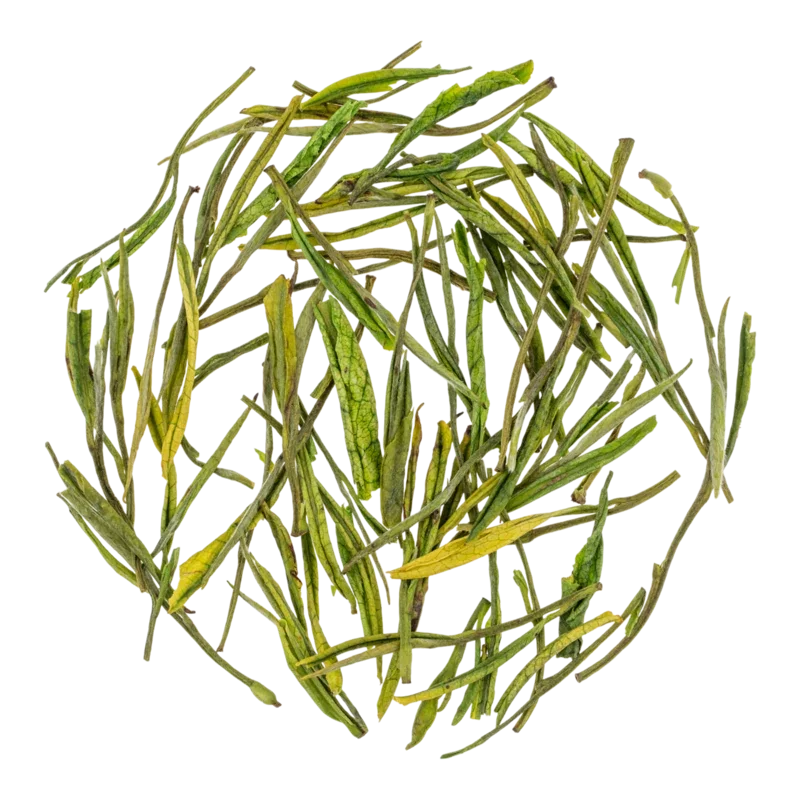
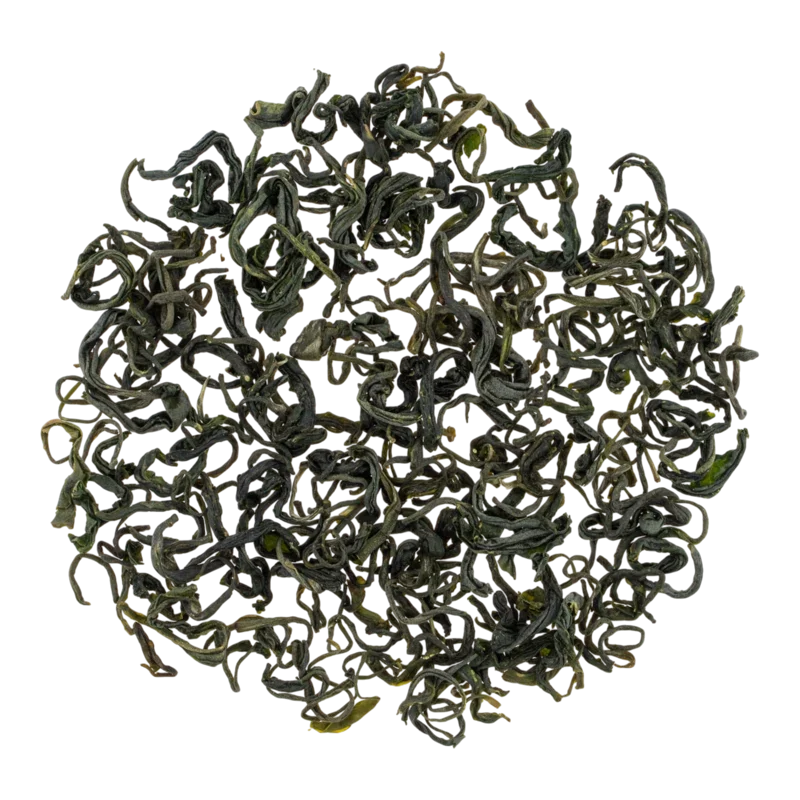
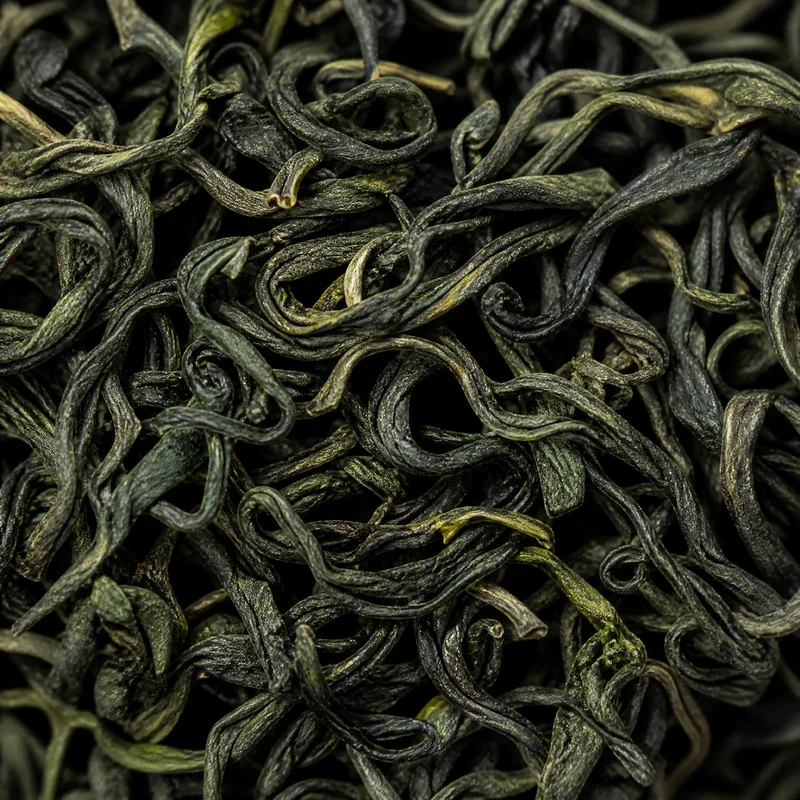
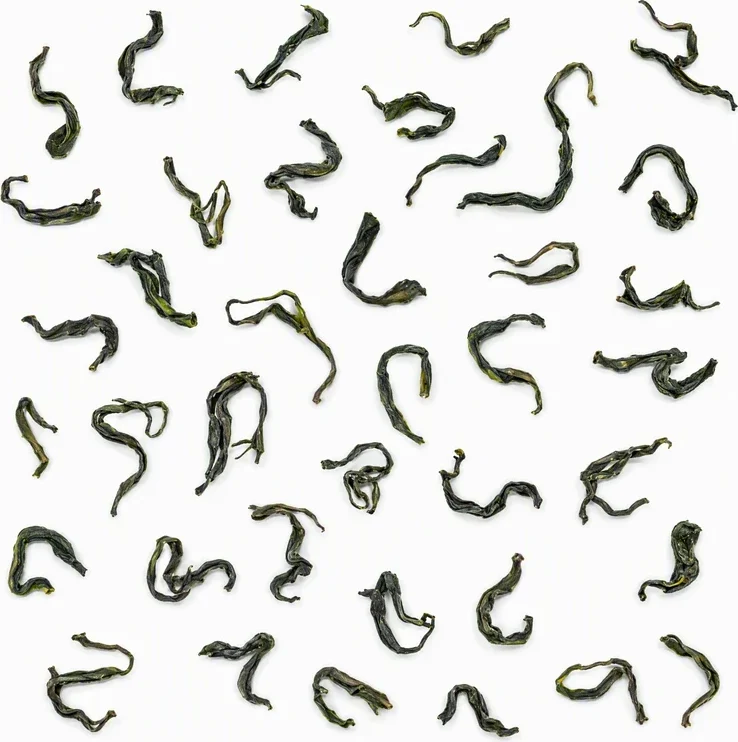
Dry Leaf Appearance: Three forms — each with its own aesthetics. Spiral: tight, dense spirals of dark green color with "frost" (墨绿起霜) and down — resembles Biluochun but larger and heavier. Flat: straight, emerald, with smooth surface — visually similar to Longjing. Needle-shaped: straight, thin "needles" with white down — most delicate grade. Common feature of all three forms — noticeable "heaviness" and density of tea particles, due to "northern" leaf thickness.
Dry Leaf Aroma: Chestnut (板栗香, bǎnlì xiāng) — calling card of Rushan Lü Cha. Intense, "roasted," with clean sweetness. Spring tea has additional fresh "green" note (清香, qīngxiāng). Persistent — retained even after long storage.
Liquor Aroma: Chestnut warmth with "marine" mineral note — influence of oceanic terroir. When cooling, light honey sweetness emerges.
Liquor Color: Yellow-green, clear and transparent. More saturated than typical "southern" green teas — consequence of high extractability.
Spent Leaves: Thick, fleshy, tender green (叶底肥厚嫩绿, yèdǐ féi hòu nèn lǜ). "Northern" density is visually noticeable: leaf is denser, thicker, heavier than southern analogs.
Taste: Mellow and rich (醇厚, chúnhòu) — "body" noticeably higher than average green tea from southern China. Fresh and brisk (鲜爽, xiān shuǎng) — high amino acid content (≥3.0%) provides pronounced "umami" undertone. Returning sweetness (回甘, huígān) — stable and long, with chestnut aftertaste. Brewing endurance — 5+ infusions — indicator atypical for green teas, due to "northern" leaf tissue density and high water-extractable substance content.
Amino Acids: ≥3.0% in spring tea. L-theanine comprises the main portion. Prolonged "cold dormancy" (winter) and slow spring vegetation ensure maximum free amino acid accumulation — responsible for freshness and "umami" taste.
≥42.5% (≥45% for premium grade) — 14% higher than typical "southern" green teas (average 37–38%). This is the key indicator of "northern" tea: slowed shoot growth under 15°C daily fluctuation conditions ensures maximum liquor saturation with flavor and aromatic substances.
Increased content — according to producer claims, tooth enamel protection 40% more effective than ordinary green tea. Fluorine accumulates from volcanic soils of Jiaodong Peninsula.
Selenium (Se) and zinc (Zn) — from volcanic rocks on which soils formed. Silicon — from basaltic rock components.
Moderate content — about 2.5–3.5% of dry mass. Combined with high L-theanine level gives mild, "focusing" tonic effect.
Polyphenols: ≥22.6% — above average for green teas from temperate latitudes. Main components — catechins: EGCG, EGC, ECG, EC. Increased polyphenol content — result of plant adaptation to high UV levels at northern latitudes with less cloudiness.
Vitamins: C, B1, B2, E. Vitamin C is preserved thanks to gentle final drying regime.
Polyphenols ≥22.6% — powerful antioxidant protection. Catechins, primarily EGCG, neutralize free radicals and reduce oxidative stress.
Catechins combined with high extractability (water-extractable ≥42.5%) promote reduction of LDL cholesterol and triglyceride levels.
Increased fluorine content from volcanic soils strengthens enamel and inhibits cariogenic bacteria development.
Combination of caffeine and L-theanine provides "calm alertness" — improved concentration without anxiety. L-theanine stimulates alpha-wave brain activity.
Selenium and zinc from volcanic soils — natural replenishment of trace elements important for immunity, thyroid function and reproductive system.
Green tea polyphenols stimulate digestive enzyme production and have mild antibacterial action on pathogenic GI flora.
Regular consumption of green tea with high L-theanine content (≥3.0% amino acids) is associated with improved working memory and reaction speed.
Mountain spring — ideal: soft water minerals enhance chestnut aroma. Filtered — acceptable. Avoid hard or alkaline water.
Tea Amount: 3 g per 150 ml water (1:50 ratio).
Teaware: Glass tumbler (for observing spirals unfurling in water) or white porcelain gaiwan (盖碗). For "flat" grade, glass gaiwan is also suitable — it allows appreciation of flat tea particle shape.
Water Temperature: 80–85°C. For needle-shaped (premium grade, 针形) — "top pouring" method (上投法, shàng tóu fǎ): water first, then tea. For spiral and flat — "middle pouring" (中投法, zhōng tóu fǎ): pour 1/3 water → add tea → gently swirl for wetting → fill to full volume.
Container: Airtight, light-proof packaging — foil bag or tin canister. Remove air maximally before closing.
Enemies: Moisture, light, foreign odors, heat. "Northern" leaf, despite its density, is as sensitive to oxidation as "southern."
Freshly made tea — "rest" 7 days to dissipate "fire energy" (火气) from charcoal drying.
No more than 1 month in refrigerator. Without refrigerator — 2 weeks.
Temperature: Refrigerator, 0–5°C. Like all green teas, Rushan Lü Cha is sensitive to heat and light.
Another famous "northern" green tea from Shandong, from Qingdao city. Terroir — Láoshān Mountains (崂山), marine climate. Profile — "pea" aroma (豌豆香), lighter and more "floral" than Rushan. Rushan is denser in body, with pronounced chestnut tone; Laoshan — lighter, with emphasis on freshness. Laoshan is significantly more famous and expensive.
Third "northern" Shandong tea, from Rizhao city. Also a product of the "南茶北引" program. Profile — chestnut, but less pronounced than Rushan. Rizhao is produced in significantly larger volumes and occupies a more mass-market segment. Rushan is more "boutique," with denser body and better endurance.
Green tea from Zhejiang with anomalously high amino acid content (up to 6–7%). Profile — "fresh," "jade-like," with minimal astringency. Rushan Lü Cha is denser, more "masculine," with chestnut base instead of "jade" freshness. Anji is finer and more delicate; Rushan is more powerful and enduring.
Famous green tea from Henan, also "northern" in character (32° N). Profile — floral-chestnut, with down. Rushan is located 5° further north and has more extreme terroir, giving denser body and greater endurance.
Price Category: Upper middle segment of Shandong green teas.
No reviews yet. Tell us what you think of this tea.
Rate this tea and share your impressions. We review each submission before publishing it.