Brewing
Gongfu brewing
- Water temperature
- 75 °C
- Tea amount
- 5 g
- Water volume
- 100 ml
- First steep
- 10 s
- Time added per infusion
- 5 s
- Infusions
- 3


Qīngliángshān chá
Choose a brewing method. Start with the recommended quantities and time, then adjust to taste.
Brewing
Brewing
Taste
Tea encyclopedia
Category: Historical famous teas of the Meizhou region; Chinese regional green teas with geographical indication. Part of the tradition of "Hakka pan-fired green teas" (客家炒绿, Kèjiā chǎolǜ).
Category: Historical famous teas of the Meizhou region; Chinese regional green teas with geographical indication. Part of the tradition of "Hakka pan-fired green teas" (客家炒绿, Kèjiā chǎolǜ).
Coordinates: 24°06′40″–24°21′29″ N, 116°04′12″–116°20′11″ E.
Origin: China, Guǎngdōng Province (广东省, Guǎngdōng Shěng), Méizhōu City (梅州市, Méizhōu Shì), Méijiāng District (梅江区, Méijiāng Qū). Main production territories — Xīyáng Township (西阳镇, Xīyáng Zhèn) and Chángshā Township (长沙镇, Chángshā Zhèn), covering 33 administrative villages.
Type: Green tea (绿茶, lǜchá), non-oxidized. By fixation method, belongs to hongqing lucha (烘青绿茶, hōngqīng lǜchá) — green tea dried with hot air, with elements of pan-firing in the kill-green (杀青) process.
Cultural Significance: Qīngliángshān Chá is inseparably linked with Hakka culture (客家, Kèjiā) — a sub-ethnic group of Chinese people who constitute the main population of Meizhou. Meizhou bears the honorary title "Thousand-year Tea Homeland" (千年茶乡) and is considered one of the largest centers of green tea production in Guangdong — by 2017, the city's tea plantation area exceeded 200,000 mu (more than 13,300 hectares), comprising a quarter of all tea gardens in the province. Tea is the calling card of Qingliangcun village (清凉村), where more than 90% of families are engaged in tea production. The Qingliangshan area has consecutively received the titles "One of Guangdong's Ten Tea Villages" (广东十大茶乡) and "One of Meizhou's Ten Tea Mountains" (梅州十大茶山). Tea traditionally plays an important role in Hakka hospitality culture and community unity rituals. In 2017, the tea garden area in the geographical indication zone comprised about 1,200 hectares with annual production of about 1,106 tons, and by 2018, plantations in Qingliangcun village alone reached 6,000 mu (400 hectares) with output of about 100,000 jin (50 tons) of finished tea.
History: Tea cultivation in the Qīngliángshān mountains traces its history to the Míng dynasty (明朝, Míng Cháo), spanning more than 400–500 years. Classical evidence is contained in the "Jiayingzhou County Records" (《嘉应州志》, Jiāyìng Zhōu Zhì) from the Guāngxù (光绪, Guāngxù) period of the Qing dynasty, which states: "The mountains of the prefecture are high and rocks exposed, therefore excellent tea is born here; the best comes from Qingliang, Yinna and Santai mountains — its taste is pure and fresh, similar to Longjing." A tea poem from the Qing era has also been preserved: "In Jiaying the third month is the time of spring tea; pity that the harvest season finds one far from home; but mentally now in palace chambers — a bowl of fresh water absorbs the cloud color." In 1860, after the opening of Shàntóu port (汕头开埠, Shàntóu kāibù), Qingliangshan tea began to be exported to Southeast Asia. In 1925, the tea shop "Suxinji" (苏信记) was the first to begin branded commercial trade of this tea. In 1973, the state-owned Qīngliángshān Tea Farm (国营清凉山茶场) was established, providing impetus for large-scale production. In 2014, the traditional technology for making Qīngliángshān tea was included in the registry of intangible cultural heritage of Méizhōu City (梅州市非物质文化遗产). In 2018, the tea received geographical indication product status (certificate number AGI02339). In 2020, it entered the first national catalog of famous, special, excellent and new agricultural products (全国名特优新农产品名录).
Name Breakdown: Qīngliángshān (清凉山) — literally "Cool Mountain" (清 qīng — pure, cool; 凉 liáng — cool; 山 shān — mountain). The name reflects the characteristic mountain microclimate with year-round mists and cool mountain air. Chá (茶, chá) — tea. Thus, the full name means "tea from Qingliang Mountain."
Cultivar: The main cultivar is the local small-leaf population variety (本地小叶群体种, běndì xiǎoyè qúntǐ zhǒng), colloquially known as "bird's tongue" (鸟舌茶, niǎoshé chá). Represents a bush type (Camellia sinensis var. sinensis), small-leaf class, with high frost resistance. Additionally, improved varieties Huángdān (黄旦, Huángdān), Shuǐxiān (水仙, Shuǐxiān), Jīnxuān (金萱, Jīnxuān), Qílán (奇兰, Qílán) and Méizhàn (梅占, Méizhàn) are cultivated, used primarily for producing green tea with floral aroma.
Picking: Main harvest falls in spring. By harvest time, four seasons are distinguished:
Raw Material: Young uniform material without coarse leaves, with clean aroma, without foreign odors.
Altitude: 800–898 m above sea level. The main peak Yangshanji (扬扇岌) reaches 898.2 m, and the famous tea zone Zǐshùào (梓树坳, Zǐshùào) is located at 860 m altitude.
Soil: Formed as a result of weathering of granites and quartzites from the Yanshan period. Yellow-red soils (黄红壤, huánghóng rǎng) predominate, pH 4.5–6.5, with high organic matter content. An important feature — elevated selenium content (0.018–0.066 mg/kg), which is three times higher than indicators of ordinary green teas. Industrial pollution is absent.
The area is located deep in the Lianhuashan mountain system (莲花山系), characterized by complex topography — three sides surrounded by mountains, one facing the river. Average annual temperature is 21.2°C, annual precipitation — 1,479.9 mm. Daily temperature variation exceeds 10°C, and foggy days per year — more than 180. Diffused light comprises about 70% of total light flow, which suppresses catechin accumulation and promotes amino acid synthesis, forming the characteristic sweetness and mildness of the tea.
Tea gardens are located in the cloud belt (云雾带, yúnwù dài) at altitudes above 800 m. Mountain diffused light promotes accumulation of amino acids and aromatic substances. The area is recognized as an ecologically clean zone without industrial pollution.
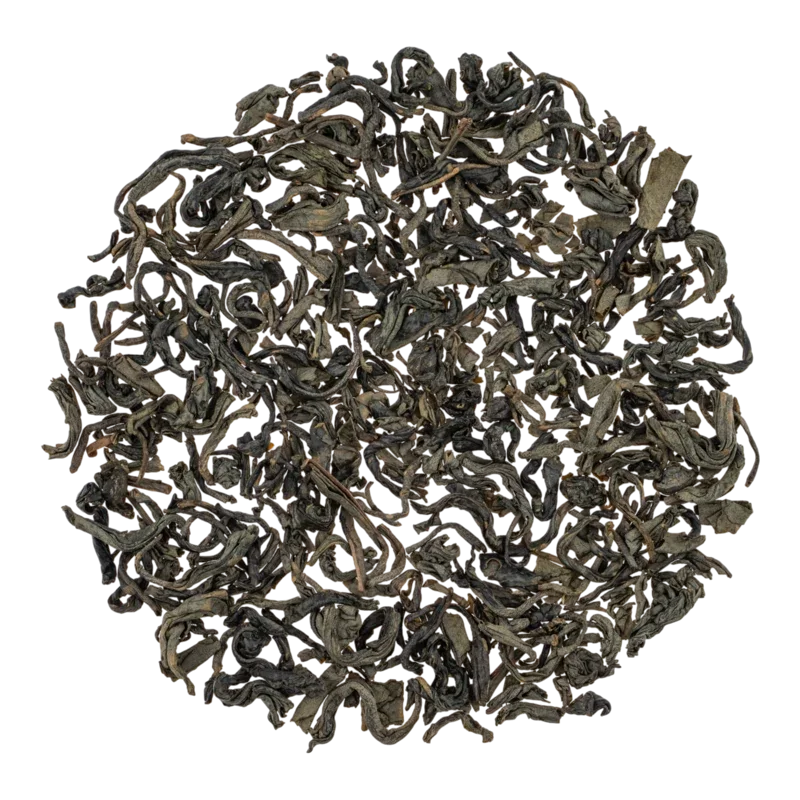
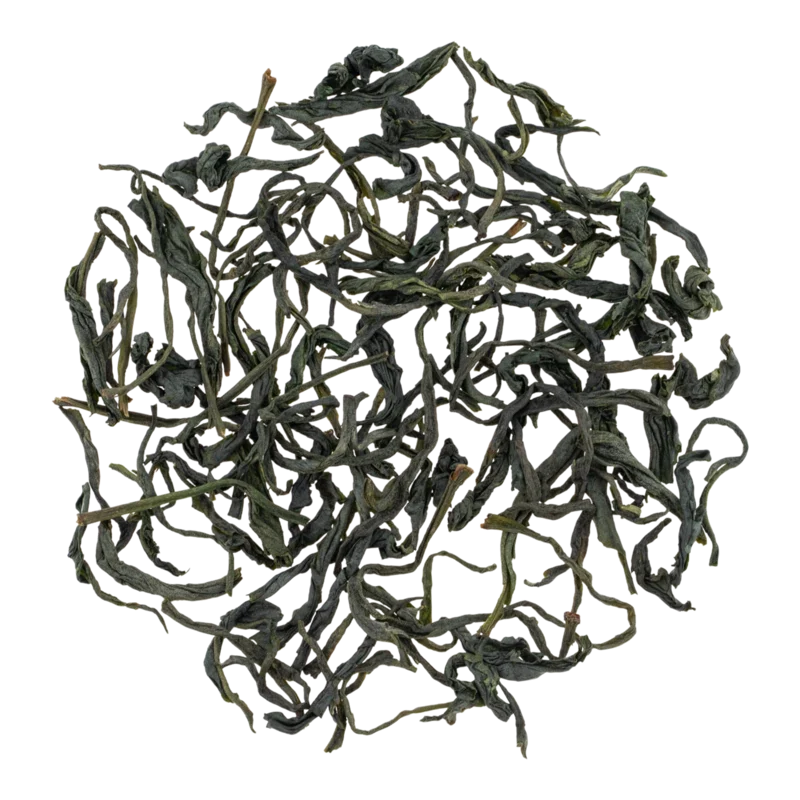
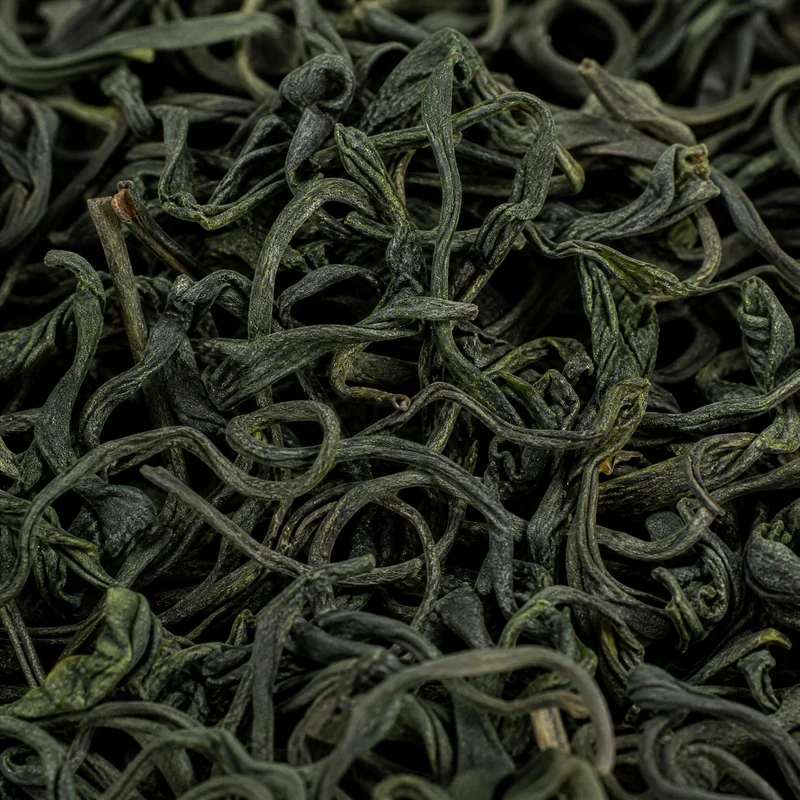
Dry Leaf Appearance: Tightly twisted curved strips (条索紧结弯曲, tiáosuǒ jǐnjié wānqū), gray-green color with characteristic whitish bloom (灰绿起霜, huīlǜ qǐshuāng), uniform in size.
Dry Leaf Aroma: Bright and persistent roasted rice aroma (炒米香, chǎomǐ xiāng) — the calling card of this tea, formed during high-temperature fixation. Base — clean grassy freshness.
Liquor Aroma: Rich rice aroma with clean green notes, unfolding in several waves: first intense and sharp, then soft and sweetish.
Liquor Color: Yellow-green, clear and bright (黄绿清澈, huánglǜ qīngchè).
Spent Leaves: Yellow-green soft leaves with whole buds, covered with silvery down.
Taste: Sweet and mellow (甘醇, gānchún), simultaneously fresh and smooth (爽滑, shuǎnghuá). Amino acid sweetness harmoniously complements moderate polyphenol content, creating balanced taste without pronounced astringency. Pronounced and prolonged "returning sweetness" (回甘, huígān) with characteristic high-mountain coolness (高山韵清凉感).
Alkaloids: Caffeine (咖啡碱, kāfēi jiǎn) — 3.3–3.5%, theobromine, theophylline. Caffeine content is somewhat higher than average green tea.
Amino Acids: ≥ 3.3% (up to 3.9% in the best spring samples), including L-theanine — the key amino acid responsible for taste sweetness and calming effect. High content is due to mountain diffused lighting.
38–42%, which indicates a rich flavor profile.
0.018–0.066 mg/kg — a unique feature related to soil geochemistry. Organic selenium increases the antioxidant activity of tea.
Essential Oils: Form the characteristic rice-nutty aromatic profile; their composition is determined by terroir and fixation regime.
Minerals: Potassium, manganese, zinc and other trace elements.
Polyphenols: Content in spring material ≥ 18.3%. The base consists of catechins — epigallocatechin gallate (EGCG), epicatechin gallate (ECG) and others, providing the antioxidant potential of the tea.
Vitamins: C (in fresh material), B group, K.
The combination of catechins with organic selenium provides increased efficiency in neutralizing free radicals — according to available data, 40% higher than standard green teas.
Elevated caffeine content (3.5%) combined with L-theanine provides mild but pronounced central nervous system stimulation, improves concentration and mental clarity.
Tea polyphenols help reduce blood lipid levels by suppressing fat synthesis enzyme activity.
Moderate tannin content stimulates gastrointestinal tract function when consumed after meals.
The complex of vitamins, minerals and polyphenols supports the body's protective functions. Vitamin C, preserved in green tea through gentle processing, promotes collagen synthesis and strengthens blood vessel walls.
Caffeine combined with catechins helps activate metabolic processes, may contribute to body weight control with regular consumption.
The antioxidant complex, enhanced by organic selenium, helps slow cellular oxidation processes and maintains healthy skin tone.
Tea Amount: 3 g per 150 ml water (1:50 ratio).
Teaware: Glass tumbler (玻璃杯, bōli bēi) allows observing the "dance of tea leaves" and leaf opening; white porcelain gaiwan (白瓷盖碗, báicí gàiwǎn) — for aroma concentration.
Water Temperature: 80–85°C (for particularly delicate highest grade material — 75°C). It is recommended to boil water and let it cool for about 3 minutes.
Another famous tea from the Meizhou region (Meixian District), also protected by geographical indication (since 2014). Made according to similar Hakka pan-firing tradition, however produced from local large-leaf and medium-leaf varieties. Aroma is less pronounced in rice notes compared to Qingliangshan Cha. Taste is denser and richer.
Famous Zhejiang green tea of flat shape. As Qing chronicles noted, Qingliangshan Cha is "similar to Longjing in taste," however differs in leaf shape (twisted strips vs. flat), technology (hongqing/chaoqing vs. pure chaoqing) and characteristic rice aroma, uncharacteristic for Longjing.
Green tea from neighboring Jiaoling County (also Meizhou), produced from Shuixian variety. Lighter, with pronounced floral notes, but without rice aroma and less rich aftertaste.
Henan famous green tea with abundant white down. Distinguished by fine needle shape, more delicate chestnut aroma and pronounced umami. Qingliangshan Cha is denser in body and has brighter roasted aroma.
Price Category: Prices vary significantly depending on grade and harvest season. Highest grade tea (特级, tèjí) — entirely buds or bud with one leaf, early spring — costs over 600 yuan per jin (500 g). First grade tea (一级, yī jí) — 200–400 yuan per jin. Mass tea (大宗茶, dàzōng chá) — significantly cheaper, used for bagged tea and restaurant segment.
Price Factors: Growing altitude, harvest season (early spring significantly more expensive), manual labor, material grade, presence of geographical indication certificate.
No reviews yet. Tell us what you think of this tea.
Rate this tea and share your impressions. We review each submission before publishing it.