Brewing
Gongfu brewing
- Water temperature
- 93 °C
- Tea amount
- 5 g
- Water volume
- 100 ml
- First steep
- 10 s
- Time added per infusion
- 5 s
- Infusions
- 4

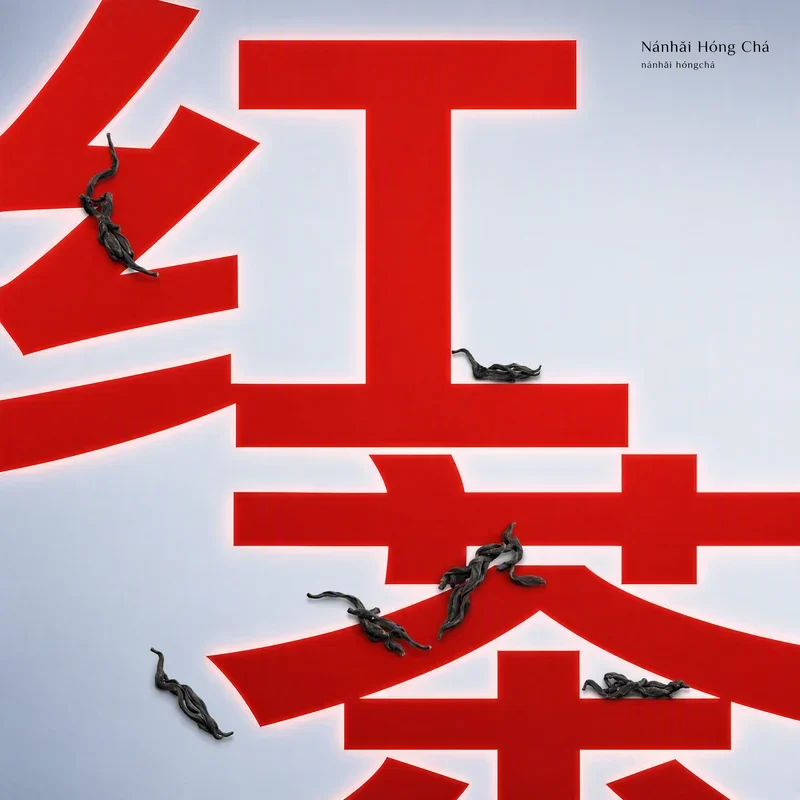
Nánhǎi hóngchá
Choose a brewing method. Start with the recommended quantities and time, then adjust to taste.
Brewing
Brewing
Taste
Tea encyclopedia
Category: Hainan red teas (black teas); historic export brand. In the modern period — a reviving regional product with elements of geographical indication protection (地理标志, dìlǐ biāozhì).
Category: Hainan red teas (black teas); historic export brand. In the modern period — a reviving regional product with elements of geographical indication protection (地理标志, dìlǐ biāozhì).
Coordinates: ≈ 19.7° N, 110.3° E (reference point based on the location of Nanhai State Farm in Ding'an County).
Origin: China, Hǎinán Province (海南省, Hǎinán Shěng), Ding'an County (定安县, Dìng'ān Xiàn). The Nánhǎi State Farm (南海农场) is located in the northeastern part of Hainan Island, in the foothills zone transitioning from coastal plains to the central highlands.
Type: Red tea (black tea) (红茶, hóngchá) — fully oxidized. Historically, Nanhai Hong Cha was produced predominantly in the format of broken red tea (black tea) (红碎茶, hóng suì chá) using CTC technology, and also — in limited volumes — in the format of gongfu hong cha (工夫红茶, gōngfū hóngchá).
Closest "compatriot" from the same Hainan, but from a different county (Baisha) and with different terroir (meteorite crater). Baisha Hong Cha is more "exotic" in mineral profile. Nanhai Hong Cha is more "classical" tropical red tea (black tea), historically oriented toward export.
High-altitude Hainan red tea (black tea) (up to 1,000+ m) from the same Hainan Daye Zhong. Considered the "pearl" of Hainan red teas (black teas) due to high-altitude terroir. Nanhai Hong Cha is more foothills, with different climatic profile.
Yunnan red tea (black tea) from var. assamica — closest analog by raw material type. Dian Hong is more "dry" and "peppery"; Nanhai Hong Cha is more "moist," tropical, with pronounced notes of longan and caramel.
Closest international analog to the CTC version of Nanhai Hong Cha. Both are produced from var. assamica, both oriented toward export and consumption with milk. Assam CTC is more powerful in "strength" and "maltiness"; Hainan is softer, with tropical sweetness.
Cultural Significance: Nanhai Hong Cha is a symbol of the industrial past of Hainan tea cultivation, an era when red tea (black tea) from the island "was fragrant throughout the world" (香飘全世界, xiāng piāo quán shìjiè). For generations of Hainan tea workers, the Nanhai Factory was a place of work and pride. The modern revival of the brand is embedded in Hainan's large-scale strategy for developing the tea industry within the framework of the free trade port (自由贸易港, zìyóu màoyì gǎng): red tea (black tea) from large-leaf Hainan raw material is positioned as a world-class product capable of competing with the best Indian and Ceylon samples.
History: The history of Nanhai Hong Cha is, essentially, a brief history of Hainan's industrial tea cultivation.
Name Breakdown: "Nan" (南) — "south," "Hai" (海) — "sea": "South Sea" — the historic name for both the South China Sea and the specific state farm in Hainan. "Hong Cha" (红茶) — "red tea (black tea)." Nanhai Hong Cha literally means "red tea (black tea) of the South Sea."
Cultivar: Historically, two main cultivars were used on the plantations of Nanhai State Farm:
Picking: Hainan's tropical climate provides practically year-round vegetation. Main seasons: spring (February–April), summer (May–July), autumn (August–October), and also winter picking (November–January). Historically, all seasonal pickings were used for CTC production; for modern gongfu hong cha, spring picking is most valued.
Pluck Standard: For CTC — relatively mature leaf (one bud and two–three leaves). For modern gongfu hong cha — one bud and one leaf (一芽一叶, yī yá yī yè) or one bud and two leaves (一芽二叶, yī yá èr yè). For tippy batches — one bud (单芽, dān yá).
Raw Material: For CTC — voluminous, fresh leaf without coarse stems, suitable for mechanical processing. For gongfu hong cha — tender shoots with pronounced buds, without mechanical damage; fresh, elastic raw material with high juiciness.
Altitude: 50–300 m above sea level. The territory of Nanhai State Farm is located in the foothills zone at the transition from coastal plains to the central highlands of Hainan.
Climate: Tropical monsoon. Average annual temperature 23.8°C — one of the highest among China's tea regions. Average annual precipitation 1,900–2,000 mm, however distributed extremely unevenly: more than half falls during the period from August to October, winter and early spring are relatively dry. Average annual humidity about 85%. Frequent fogs and cloudiness in the foothills zone. The tropical climate provides year-round vegetation of tea bushes — besides spring, summer, and autumn pickings, winter picking is also possible.
Soil: Predominantly brick-red lateritic soils (砖红壤, zhuān hóng rǎng), developed on basaltic (玄武岩, xuánwǔyán) rocks. Soils are deep, viscous, of medium fertility. Basaltic origin provides good mineralization, including iron, manganese, potassium, and trace elements content, which positively affects the formation of "body" and minerality of red tea (black tea).
Historically, Nanhai State Farm practiced intensive plantation tea cultivation with mechanized harvesting for CTC production. Modern producers oriented toward gongfu hong cha are transitioning to more gentle practices: hand picking, limiting agrochemicals, organic fertilization. Overall, Hainan tea cultivation is moving toward ecologization and certification.
Shortened, often using hot air — 4–8 hours to reduce moisture to 65–68%.
Leaf is passed through a pair of rollers with different rotation speeds, which perform three operations: Crush, Tear, and Curl. The cellular structure of the leaf is almost completely destroyed, ensuring rapid and intensive oxidation.
Due to maximum cell destruction — accelerated and intensive, 1–2 hours at 25–30°C. High concentrations of theaflavins and thearubigins are formed.
Rapid high-temperature drying.
By fractions — from large granules (BOP analog) to fine dust (Dust).
Hand selection of tender shoots.
Natural, in well-ventilated room, 12–18 hours.
Classical mechanical rolling to form leaf shape and release juices.
At 25–30°C, 3–5 hours. Large-leaf Hainan raw material with high polyphenol content gives a rich, "full-bodied" profile.
Two-stage: initial at 105–115°C, finishing at 80–90°C to develop honey-caramel notes.
By leaf quality and tips content.
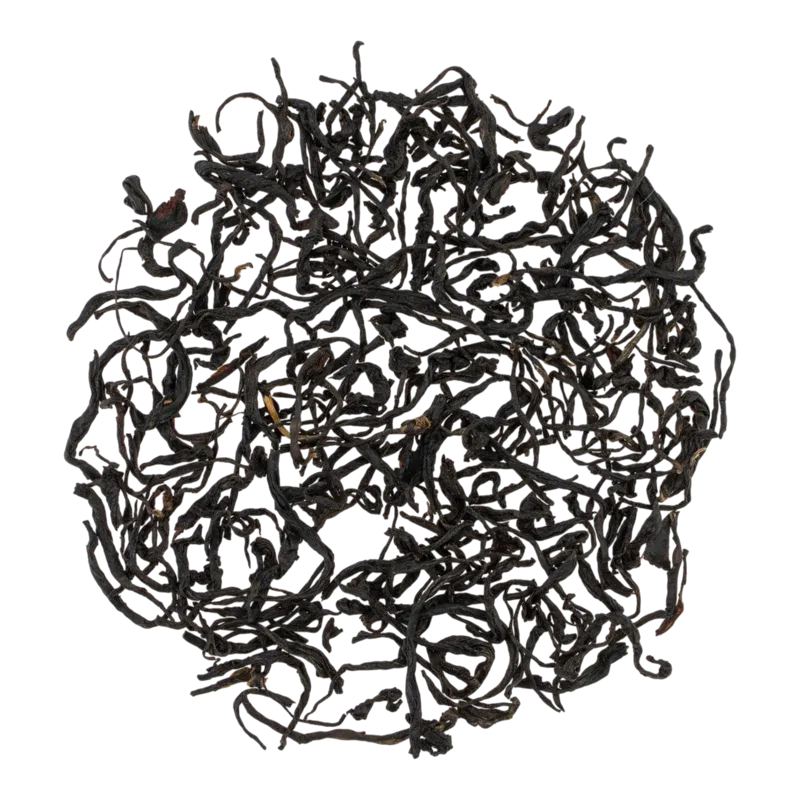
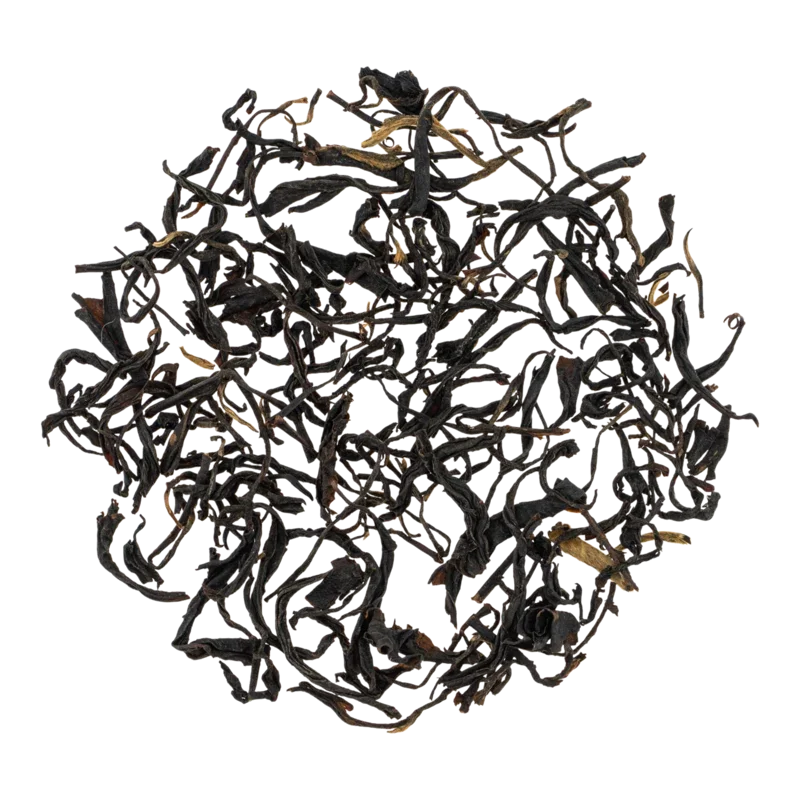
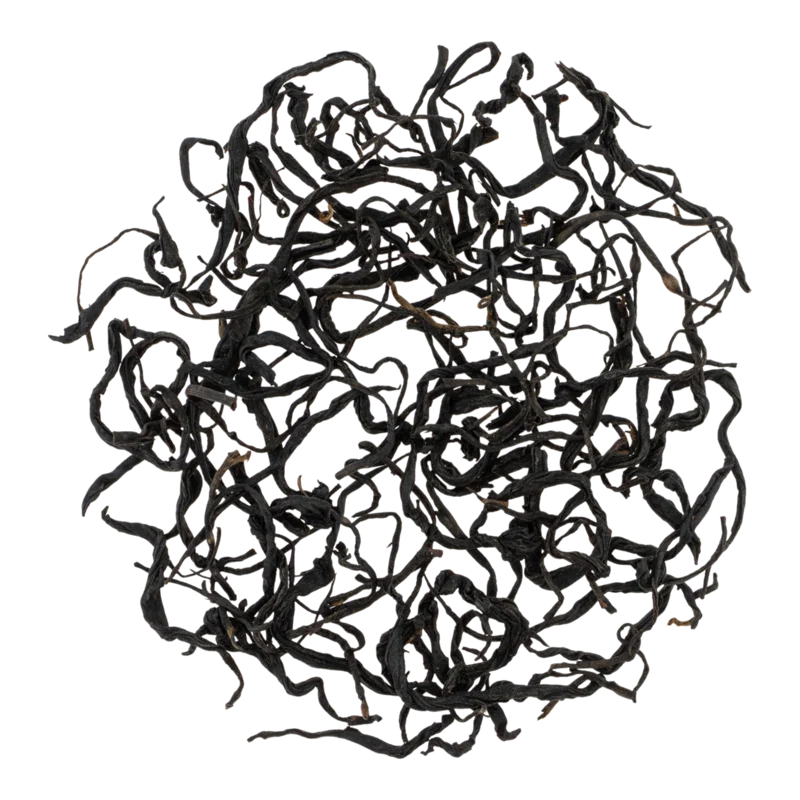
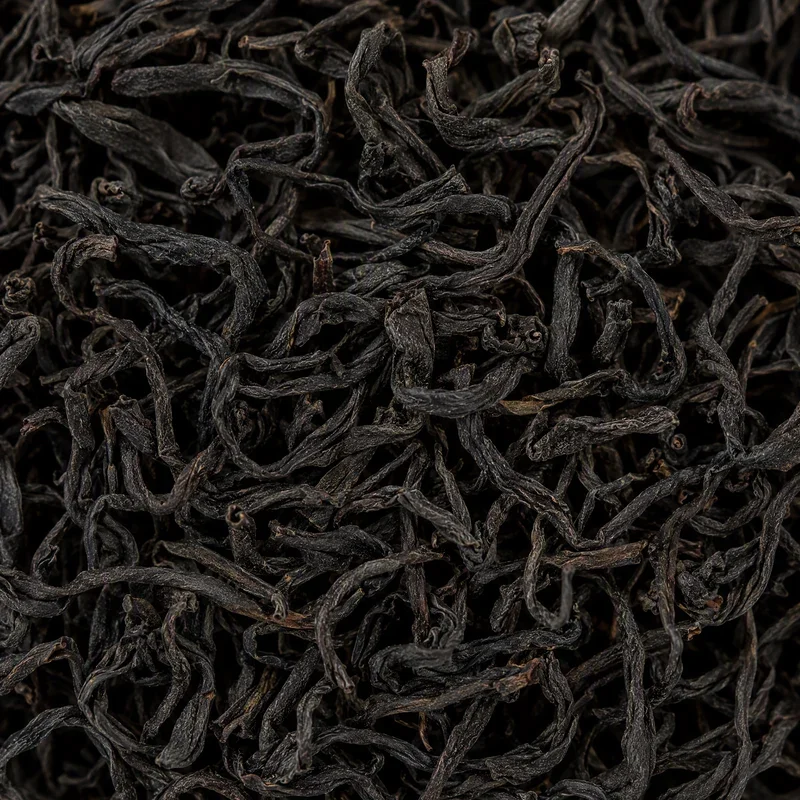
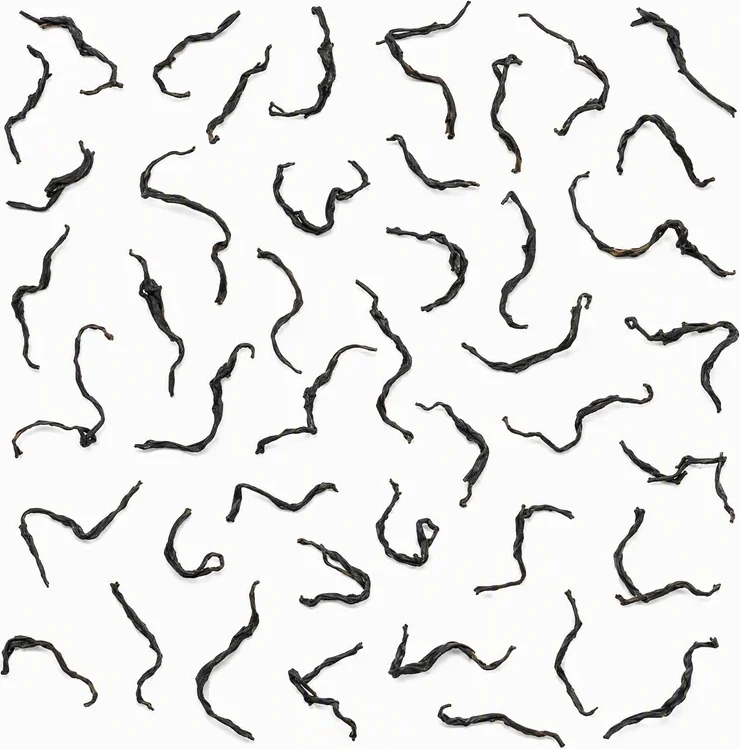
Dry Leaf Appearance: Tight, dense twist; large, fleshy leaf with golden tips (金毫). Color — dark chestnut to black.
Dry Leaf Aroma: Honey-like, with notes of tropical dried fruits, longan, and light caramel. For tippy batches — pronounced "fresh briskness" (鲜爽, xiān shuǎng).
Liquor Aroma: Warm, enveloping, with multi-layered transition from honey and ripe tropical fruits to bread-caramel tones and subtle spice in the base.
Liquor Color: Red-amber, bright, clear, with pronounced golden rim.
Uniform, dense dark granules with oily luster.
High, sharp, persistent, with notes of malt and caramel.
Spent Leaves: Large, elastic leaves, uniformly colored copper-red to chestnut; buds — golden-orange.
Taste: Dense, rounded, with characteristic "oiliness" of Hainan large-leaf raw material. Sweetness is clean, astringency moderate and soft. Aftertaste (回甘) is long-lasting, warming, with honey trail.
Alkaloids: Caffeine — up to 6% in fresh leaf (one of the highest indicators among Chinese teas), due to the large-leaf Assam type. Theobromine and theophylline — in trace amounts.
Amino Acids: L-theanine, glutamic acid; total content — about 2–3% of dry weight. Provide softness and sweet character.
Essential Oils: Linalool, geraniol; Maillard reaction products — maltol, furanone, forming honey-caramel profile.
Minerals: Potassium, magnesium, manganese, iron, zinc. Basaltic soils enrich tea with trace elements.
Polyphenols: Hainan large-leaf variety is one of the record holders for polyphenol content (up to 35% in fresh leaf). With CTC processing, polyphenols oxidize maximally, forming high concentrations of theaflavins (TF, 1.5–2.5%) and thearubigins (TR, 12–18%), ensuring intensive color and "strength" of the liquor. In gongfu format, oxidation is more restrained, and the TF/TR balance is softer.
Vitamins: Group B (B₁, B₂), P (rutin). Vitamin C — in fresh leaf up to 200+ mg/100 g, after full oxidation significantly decreases.
Tea Amount: 5–6 g per 100–120 ml.
Teaware: Gàiwǎn (盖碗), porcelain teapot, Yixing teapot.
Water Temperature: 90–95°C.
The closest "fellow countryman" from the same Hainan, but from a different county (Baisha) and with a different terroir (meteorite crater). Baisha Hong Cha is more "exotic" in its mineral profile. Nanhai Hong Cha is a more "classic" tropical red tea, historically oriented toward export.
High-altitude Hainan red tea (up to 1,000+ m) from the same Hainan Da Ye Zhong. Considered the "pearl" of Hainan red teas thanks to its high-altitude terroir. Nanhai Hong Cha is more foothill-based, with a different climatic profile.
Yunnan red tea from var. assamica — the closest analog by raw material type. Dian Hong is more "dry" and "peppery"; Nanhai Hong Cha is more "humid," tropical, with pronounced notes of longan and caramel.
The closest international analog to the CTC version of Nanhai Hong Cha. Both are produced from var. assamica, both are oriented toward export and consumption with milk. Assam CTC is more powerful in "strength" and "maltiness"; the Hainan version is softer, with tropical sweetness.
Price Category: Historic CTC Nanhai Hong Cha was an export mass product — "below average" price category. Modern whole-leaf batches of Nanhai Hong Cha (gongfu format) — from 200 to 800 yuan per 500 g depending on grade and picking standard. Tippy and ancient tree batches — from 1,000 yuan.
No reviews yet. Tell us what you think of this tea.
Rate this tea and share your impressions. We review each submission before publishing it.