Brewing
Gongfu brewing
- Water temperature
- 93 °C
- Tea amount
- 5 g
- Water volume
- 100 ml
- First steep
- 10 s
- Time added per infusion
- 5 s
- Infusions
- 4

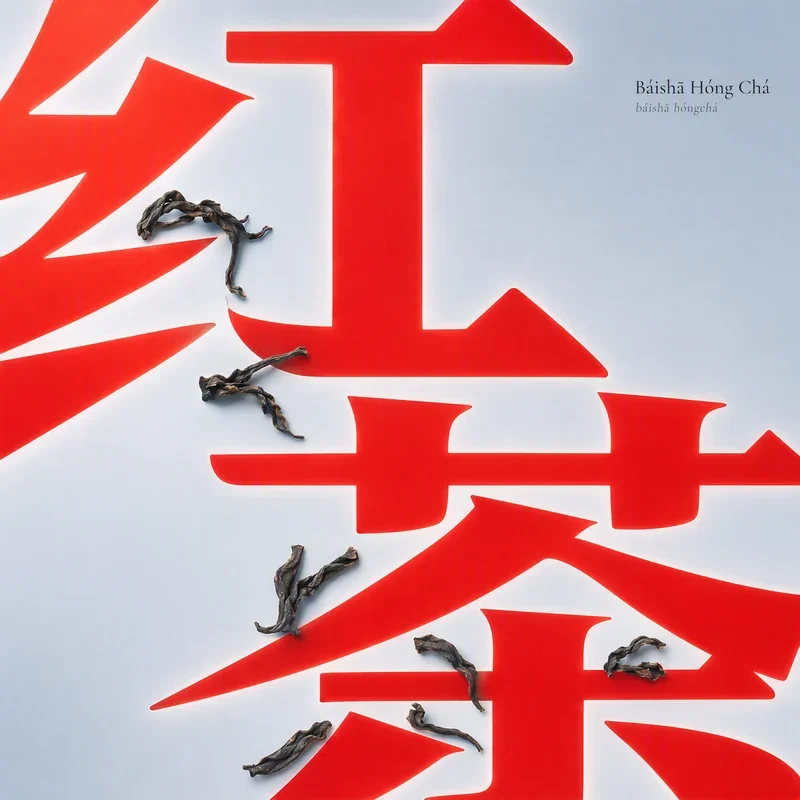
báishā hóngchá
Choose a brewing method. Start with the recommended quantities and time, then adjust to taste.
Brewing
Brewing
Taste
Tea encyclopedia
Category: Hainan red teas; regional tea included in the group standard system (团体标准, tuántǐ biāozhǔn) of Baisha County. Produced both in gōngfū hóng chá format (工夫红茶, gōngfū hóngchá) and in gushu hong cha format (古树红茶, gǔshù hóngchá) from ancient tree material.
Category: Hainan red teas; regional tea included in the group standard system (团体标准, tuántǐ biāozhǔn) of Baisha County. Produced both in gōngfū hóng chá format (工夫红茶, gōngfū hóngchá) and in gushu hong cha format (古树红茶, gǔshù hóngchá) from ancient tree material.
Coordinates: ≈ 19.2° N, 109.3° E (center of Baisha County).
Origin: China, Hǎinán Province (海南省, Hǎinán Shěng), Báishā Lì Autonomous County (白沙黎族自治县, Báishā Lízú Zìzhìxiàn). Main production zones: Yáchā Town (牙叉镇, Yáchā Zhèn), Qīfāng Town (七坊镇, Qīfāng Zhèn), Bāngxī Town (邦溪镇, Bāngxī Zhèn), and the territory of Báishā State Farm (白沙农场, Báishā Nóngchǎng) in the meteorite crater zone.
Type: Red tea (black tea) (红茶, hóngchá) — fully oxidized.
Cultural Significance: Baisha Hong Cha is an integral part of the reviving Hainan tea culture. Baisha County, included in the Hǎinán Tropical Rainforest National Park (海南热带雨林国家公园, Hǎinán Rèdài Yǔlín Guójiā Gōngyuán), positions its products at the intersection of ecology and Li people traditions: tea is perceived as the material embodiment of the concept "Green mountains and clear waters are golden and silver mountains" (绿水青山就是金山银山). In 2021, Baisha entered the number of national basic territories of "two mountains" (两山实践创新基地). In 2024, at the First Global Tasting Conference of Hainan Rainforest Tea (2024首届自贸港海南雨林大叶茶全球品鉴招商大会), Baisha red tea was presented as one of the key positions.
History: Baisha is one of the oldest tea regions of Hainan, whose history is closely intertwined with the culture of the Lì people (黎族, Lízú). The black-fruited wild tea variety was discovered in the county territory as early as the 19th century: in 1882, American botanist Henry Benjamin Hance (香便文, Xiāng Biànwén) documented wild tea trees near the locality "Shimanting" (什满汀), which subsequently became one of the proofs of tea's origin from China. The Li people for centuries collected wild-growing large-leaf tea for medicinal and household needs.
Name Breakdown: "Bai" (白) — "white," "Sha" (沙) — "sand": the county name refers to the white sandy shores of local rivers. "Hong Cha" (红茶) — "red tea." Thus, the full name translates as "red tea from [county] Baisha."
Cultivar: The raw material base consists of two large-leaf cultivars:
Picking: Thanks to the tropical climate, tea in Baisha is harvested practically year-round, including the winter period: the first early spring harvest begins as early as December — this is the earliest "chuncha" (春茶) in all of China. Peak seasons — early spring (December-February), spring (March-April) and autumn (September-October).
Pluck Standard: Single bud (单芽, dān yá) for highest grades; one bud and one leaf (一芽一叶, yī yá yī yè) or one bud and two leaves (一芽二叶, yī yá èr yè) for standard batches. Hand-picked.
Raw Material: Fresh, undamaged leaf with pronounced golden tips (金毫, jīn háo); without mechanical damage and traces of pests.
Altitude: 200-600 m above sea level. Individual massifs of wild trees are found at altitudes up to 1,400 m on the slopes of Límǔ Mountain range (黎母山, Límǔ Shān).
Climate: Tropical monsoon. Average annual temperature about 22-23°C, average annual precipitation 1,800-2,000 mm. Forest coverage of the county — over 83%, which provides frequent morning and evening fogs in the meteorite crater zone. Characteristic feature — noticeable difference between day and night temperatures in mountain areas, promoting accumulation of aromatic substances in the leaf.
Soil: The main uniqueness — the meteorite crater zone (陨石坑, yǔnshí kēng) aged about 700,000 years, occupying an area with a radius of about 10 km. The impact breccia of the crater contains more than 48 minerals, which gives the soils exceptional diversity of trace element composition. The main soil type — brick-red lateritic soils (砖红壤, zhuān hóng rǎng), developed on basaltic rocks: weakly acidic (pH 4.5-5.5), deep, with good organic content. It is precisely the unique mineralization of the crater soil that forms the unique flavor profile of Baisha tea — it has been noted that the same varieties planted 3 km from the crater produce noticeably less expressive tea.
In recent years the county has actively developed organic tea cultivation: the area of certified organic tea gardens exceeds 3,500 mu (≈ 230 ha). Total area of Baisha tea plantations — more than 10,000 mu (≈ 680 ha), which comprises about one-third of all tea plantings in Hainan. Ecological practices are applied: abandonment of synthetic pesticides, use of organic fertilizers, mulching, integration with tropical forestry.
Hand picking of tender shoots in morning hours.
Natural withering on bamboo trays in well-ventilated rooms or outdoors in shade. Duration 12-18 hours depending on humidity. Goal — reducing moisture content to 60-64% and activating enzymatic processes. Hainan's tropical climate allows natural withering year-round.
Mechanical rolling to break cell walls and release juices. Hainan's large-leaf raw material requires more intensive and prolonged rolling than small-leaf varieties.
At temperature 25-30°C and humidity 90-95% for 3-5 hours. Hainan large-leaf raw material, rich in polyphenols, gives intensive oxidation with formation of large amounts of theaflavins and thearubigins, which ensures characteristic density and brightness of the liquor.
Profile fixation at 100-120°C. A number of farms apply two-stage drying: initial drying at higher temperature followed by "finishing" at 80-90°C, which enhances honey-caramel notes.
Separation by fractions, selection of tippy and leaf grades.
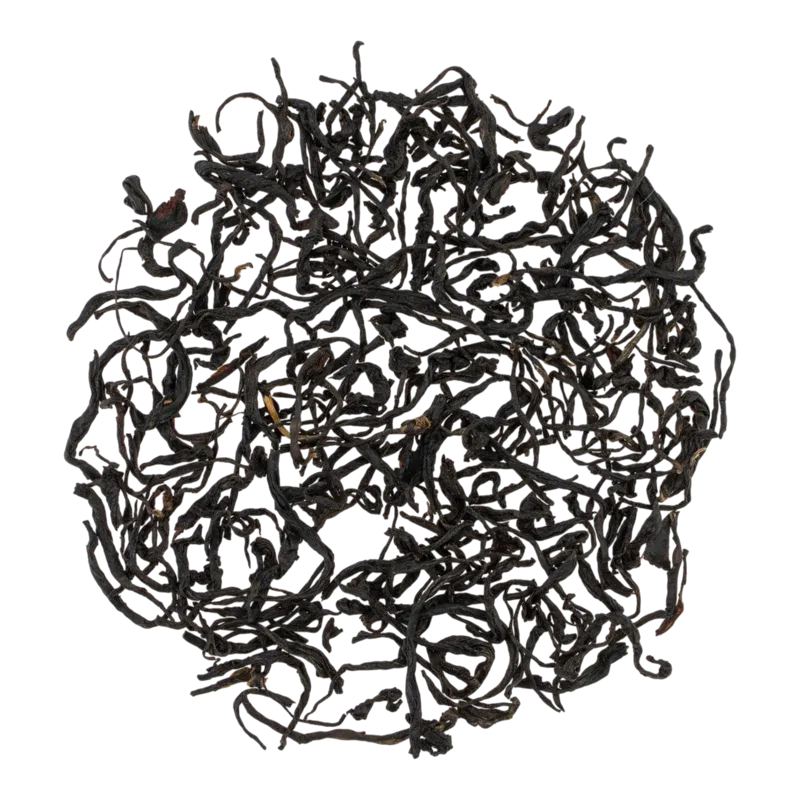
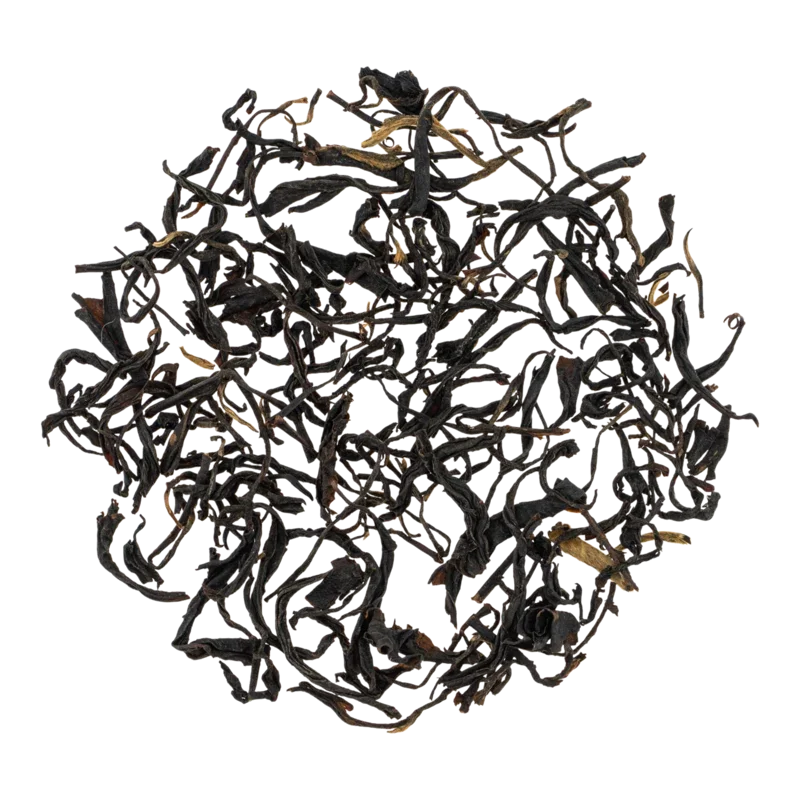
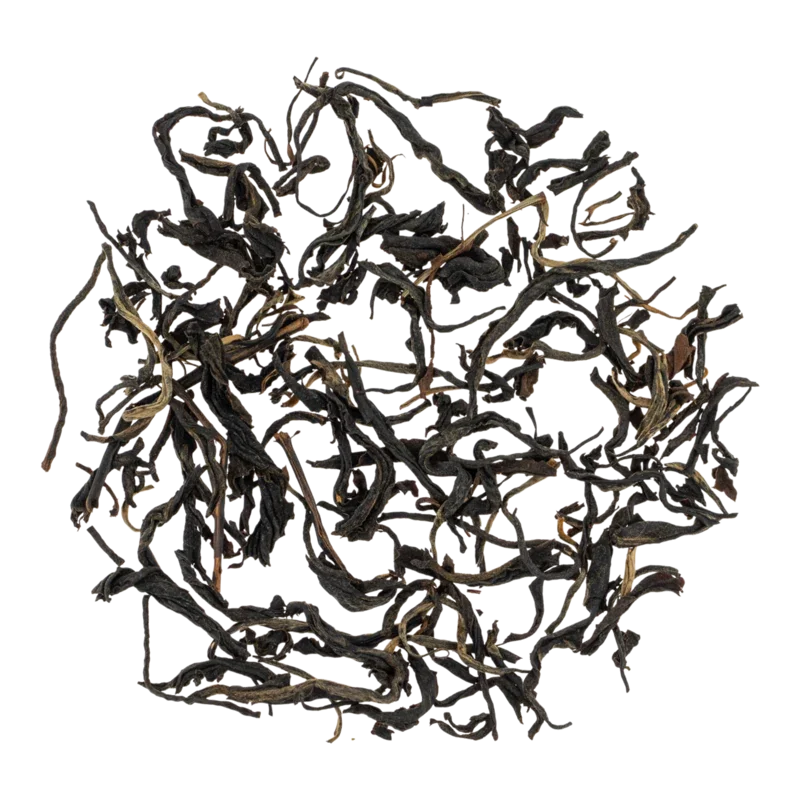
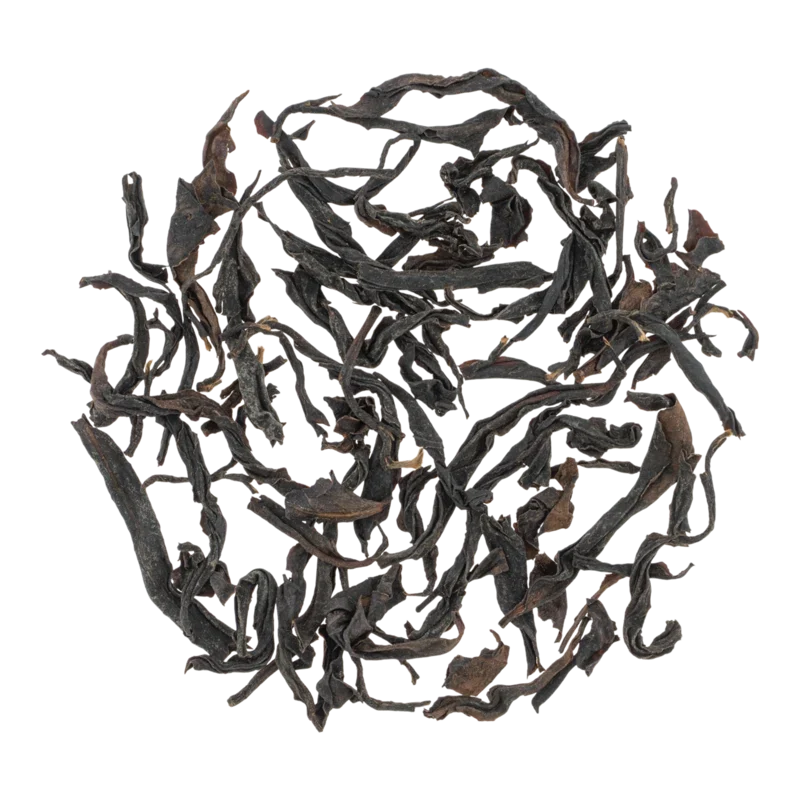
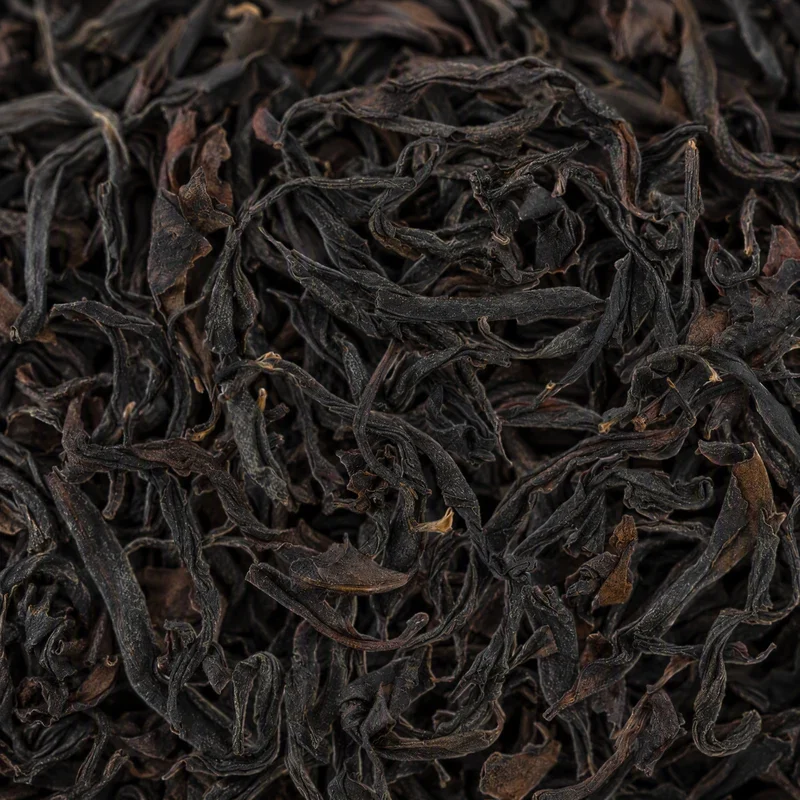
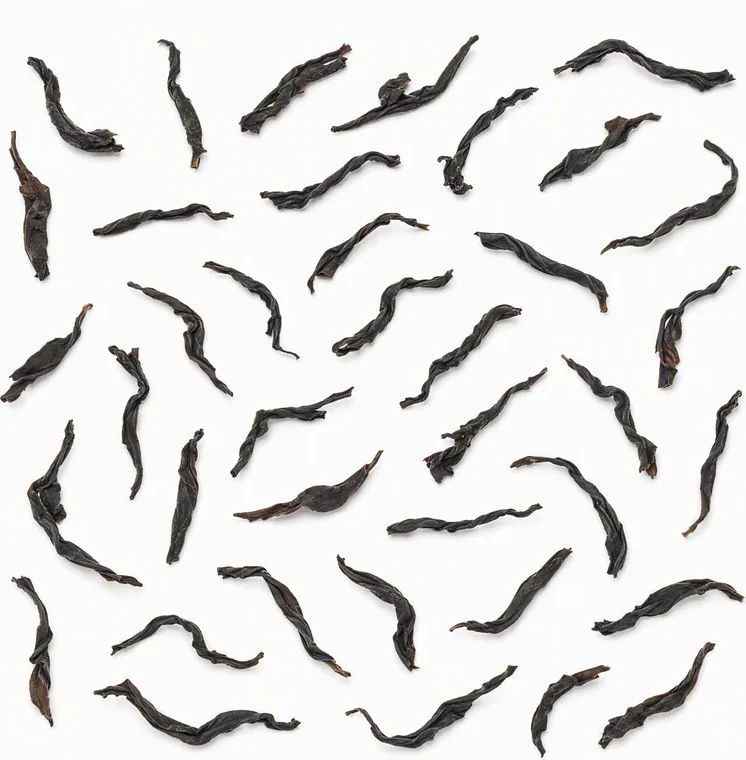
Dry Leaf Appearance: Tight, dense, wiry twist. Leaf large, with abundant golden tips (金毫, jīn háo). Color — from dark chestnut to black with golden inclusions.
Dry Leaf Aroma: Pronounced honey tone with notes of tropical dried fruits (longan, lychee), light shade of cocoa beans. In batches from ancient tree material — additional "forest" depth reminiscent of warm tree bark.
Liquor Aroma: Warm, enveloping. In top notes — honey and ripe tropical fruits; in middle notes — caramel, baked sweet potato; in base — subtle smokiness and spice. Aroma is persistent, remains in empty cup (杯底香, bēi dǐ xiāng).
Liquor Color: Red-amber, bright and clear, with pronounced golden rim (金圈, jīn quān) around the cup edge. As brewing progresses — from dark amber to copper-red.
Spent Leaves: Large leaves open completely and evenly; color from copper-red to chestnut; leaf elastic, fleshy, maintains integrity.
Taste: Dense, oily, with pronounced "body" (厚实, hòushí). First steeps reveal rich sweetness with shades of honey and caramel. In middle steeps a mineral note appears — "memory" of meteorite soil. Astringency is soft, well-balanced. Aftertaste (回甘, huígān) is long, warming, with distinct honey sweetness and light peppery spice.
Alkaloids: Caffeine — about 4-6% of dry weight (above average due to large-leaf Assam-type variety); theobromine and theophylline in trace amounts.
Amino Acids: L-theanine, glutamic acid, aspartic acid. Total amino acid content — about 2-3% of dry weight. L-theanine is responsible for softness and sweet character of aftertaste.
Complex of terpene alcohols (linalool, geraniol, nerol), as well as Maillard reaction products formed during drying — furanone, maltol, forming honey-caramel aroma.
Minerals: Potassium, calcium, magnesium, manganese, zinc, selenium. Unique mineralization of meteorite soils potentially enriches tea with rare earth trace elements.
Polyphenols: Large-leaf Hainan variety is distinguished by high content of tea polyphenols — up to 35% in fresh leaf (for comparison, typical small-leaf varieties — 20-25%). During oxidation, catechins transform into theaflavins (TF, 1-2%) and thearubigins (TR, 10-15%), which provide liquor brightness and taste "body."
Vitamins: B-group vitamins (B₁, B₂, B₆), vitamin C (in fresh leaf — up to 200 mg/100 g, significantly reduced after oxidation), vitamin P (rutin).
Western method — 3-4 g per 200 ml, steeping 3-4 minutes at 90°C. Also Baisha Hong Cha is well-suited for cold brewing (冷泡, lěng pào): 5 g per 500 ml cold water, 8-12 hours in refrigerator.
Tea Amount: 5-6 g per 100-120 ml.
Teaware: Gàiwǎn (盖碗, gàiwǎn) — optimal choice for revealing aromatic profile; porcelain or glass teapot; Yixing teapot from red clay for more rounded, "bodied" liquor character.
Water Temperature: 90-95°C. For batches from bud material (单芽) — 85-90°C; for standard leaf batches — 90-95°C.
Closest "neighbor" — red tea from neighboring Wuzhishan County. Uses same raw material (Hainan Daye Zhong), but terroir differs: Wuzhishan is more high-altitude (up to 1,000+ m), giving slightly lighter, more floral character. Baisha wins due to mineral "crater" aftertaste.
Yunnan red tea from same Assam type (var. assamica). Dian Hong is typically brighter in honey and peppery notes, has more pronounced "muscatel" character. Baisha Hong Cha — more tropical in character: longan and lychee notes, softer body, less aggressive astringency.
Red tea from Guangdong Province, also from large-leaf raw material (Yinghong No. 9 and others). Yingde Hong Cha — more "classical" Guangdong style: moderate sweetness, chocolate and dried rose notes. Baisha Hong Cha differs with more pronounced tropical fruitiness and mineral base.
Small-leaf Fujian red tea from Wuyi reserve. Stylistically — fundamentally different style: smoky-pine (in smoked versions) or longan-floral (in unsmoked) notes, delicate, silky "body." Baisha Hong Cha — different scale of taste: denser, more "oily," with tropical fruitiness and mineral base characteristic of large-leaf tropical raw material.
Historical "elder brother" of Baisha Hong Cha — broken red tea produced at South Sea Tea Factory (南海茶厂) in Ding'an County from similar large-leaf raw material, but using CTC technology. Unlike whole-leaf Baisha Hong Cha, CTC version was oriented to export market and consumption with milk and sugar. Factory ceased operation, but its legacy is part of Hainan red tea history.
Price Category: Standard batches of Baisha Hong Cha — from 300 to 800 yuan per 500 g (depending on grade). Batches from ancient tree material (古树红茶) and tippy "Jin Hao" (金毫) — from 1,000 to 3,000+ yuan per 500 g. Organic certified batches of "Bo Sha" (薄沙) brand occupy upper price segment.
No reviews yet. Tell us what you think of this tea.
Rate this tea and share your impressions. We review each submission before publishing it.