Brewing
Gongfu brewing
- Water temperature
- 100 °C
- Tea amount
- 6 g
- Water volume
- 100 ml
- First steep
- 10 s
- Time added per infusion
- 5 s
- Infusions
- 10


Mòtuō zhuānchá
Choose a brewing method. Start with the recommended quantities and time, then adjust to taste.
Brewing
Brewing
Taste
Tea encyclopedia
Category: Tibetan brick tea (藏茶, Cáng Chá). Compressed tea (紧压茶, jǐnyā chá). Belongs to border-sale teas (边销茶, biānxiāo chá), historically produced for the needs of border peoples.
Category: Tibetan brick tea (藏茶, Cáng Chá). Compressed tea (紧压茶, jǐnyā chá). Belongs to border-sale teas (边销茶, biānxiāo chá), historically produced for the needs of border peoples.
Coordinates: 94°–96° East longitude, 29°–30° North latitude.
Origin: China, Tibet Autonomous Region (西藏自治区, Xīzàng Zìzhìqū), Nyingchi City (林芝市, Línzhī Shì), Moto County (墨脱县, Mòtuō Xiàn). Moto was the last county in China to receive a motor road (2013), which for centuries preserved its ecosystem in pristine purity.
Type: Post-fermented tea, belongs to the dark tea (黑茶, Hēichá) category. Undergoes wet piling (渥堆, wòduī) and prolonged natural aging.
Moto Zhuan Cha received its folk name thanks to Tibetan tradition of tying compact bricks to the belt during long mountain journeys. Tea served simultaneously as provisions and "currency" for exchange in remote villages.
Moto County remained China's last county without automobile connection until 2013. This means that for centuries tea was exported from here exclusively by pack transport — on yaks and donkeys — along dangerous mountain trails.
Some Moto plantations are located in zones irrigated by Himalayan glacier meltwater — one of the few cases where tea bushes receive glacial irrigation.
Moto is one of China's most biodiverse territories: from subtropical jungles at the gorge bottom to eternal snows on peaks. Five climatic zones can be found on one mountain slope. Tea gardens here neighbor rhododendrons, bamboo groves, and relict coniferous forests.
At the 2025 Beijing International Tea Exhibition, Moto Zhuan Cha was chosen as the only officially represented Tibetan tea — a landmark event for a region that was practically isolated from the outside world just 12 years ago.
Cultural Significance: Moto Zhuan Cha is inseparably linked with the daily life of Tibetan ethnic groups inhabiting the lower reaches of the Yarlung Tsangpo — the Monpa (门巴族) and Lhoba (珞巴族). For them, tea was not merely a beverage but a vital food product, a source of vitamins and calories in high-altitude conditions. Traditionally, compact bricks were tied to the belt during mountain pass crossings — hence the folk name "belt tea." Moto Zhuān Chá was and is used for preparing butter tea (酥油茶, sūyóu chá) — the main beverage of Tibetan cuisine.
Moto Zhuān Chá was created during the reign of Emperor Qiánlóng (乾隆, Qiánlóng), more than 200 years ago. Initially, it was a traditional local beverage of Moto County and circulated along the Ancient Tea Horse Road (茶马古道, Chámǎ Gǔdào), which connected Tibetan lands with China's interior provinces.
In 2013, after the opening of the highway to Moto, county authorities declared the tea industry a priority sector and began restoring brick tea production. In 2015, the company "Nyingchi Moto Tea Co., Ltd." (林芝墨脱茶业有限公司) was founded, becoming the only enterprise in Tibet included in the state registry of border tea producers. By 2025, the brand "Sacred Tea of the Himalayas — Dark Tea" gained international recognition, marking Moto Zhuan Cha's transition into the premium product segment.
Cultivar: Main cultivars:
Picking: Spring harvest (March–April, before and after Qingming — 清明 and Guyu — 谷雨) for premium categories; summer-autumn for mass production.
Pluck Standard: Varies by grade:
Raw Material: Leaves must be healthy, without mechanical damage, harvested in morning hours after dew has dried. All tea gardens in Moto have OFDC (China Organic Food Development Center) certification, guaranteeing complete absence of pesticides and chemical fertilizers.
Altitude: 800–2200 m a.s.l. Core plantations (Moto-zhen, Beibeng, Dexing) are located at optimal altitudes of 1100–1200 m.
Climate: Subtropical humid, unusual for Tibet. Average annual temperature around 16°C, annual precipitation exceeds 2300 mm, foggy days — more than 200 per year. Significant diurnal temperature variation promotes accumulation of aromatic compounds in the leaf.
Soil: Weakly acidic yellow-brown mountain soils (pH 5.0–6.0) with a thick humus horizon up to 1.2 meters deep and organic matter content exceeding 2%. Tea gardens are irrigated by glacial meltwater.
Forest coverage of the county territory is 78.5%. Tea plantations are surrounded by virgin forests of subtropical and temperate zones, ensuring rich biodiversity and natural protection from pests.
Topography: Tea gardens are located on gentle gorge slopes at 800–2200 meters above sea level. Mountain ranges — the Himalayas from the south and Nyenchen Tanglha from the north — create a natural "corridor" through which warm and humid air currents from the Indian Ocean penetrate deep into the Tibetan Plateau.
Hand-picking according to the corresponding grade standard.
Uses the original method of "three dryings and three coolings" (三晒三凉, sān shài sān liáng): leaves are laid out in the sun three times and moved to shade three times for slow and even moisture removal. This stage lays the foundation for the future aroma with a subtle pine smoke note.
Hand or machine rolling to break down leaf cell structure and release juices.
Key post-fermentation stage. Tea leaves are piled and maintained at constant temperature of 28°C for 48 hours. Under the influence of microorganisms, deep biochemical transformations occur, forming the characteristic dark color and mild taste.
Traditional hand-pressing into brick molds. Tea is compacted into a dense, compact block.
Pressed bricks are dried over slowly smoldering pine wood. This imparts the signature aroma of "songyan" (松烟香, sōngyān xiāng) — subtle pine smokiness, relating it, though distantly, to Zheng Shan Xiao Zhong.
After drying, bricks are laid down for natural aging for at least 3 years. Slow post-fermentation in high-altitude climate conditions enhances depth and roundness of flavor.
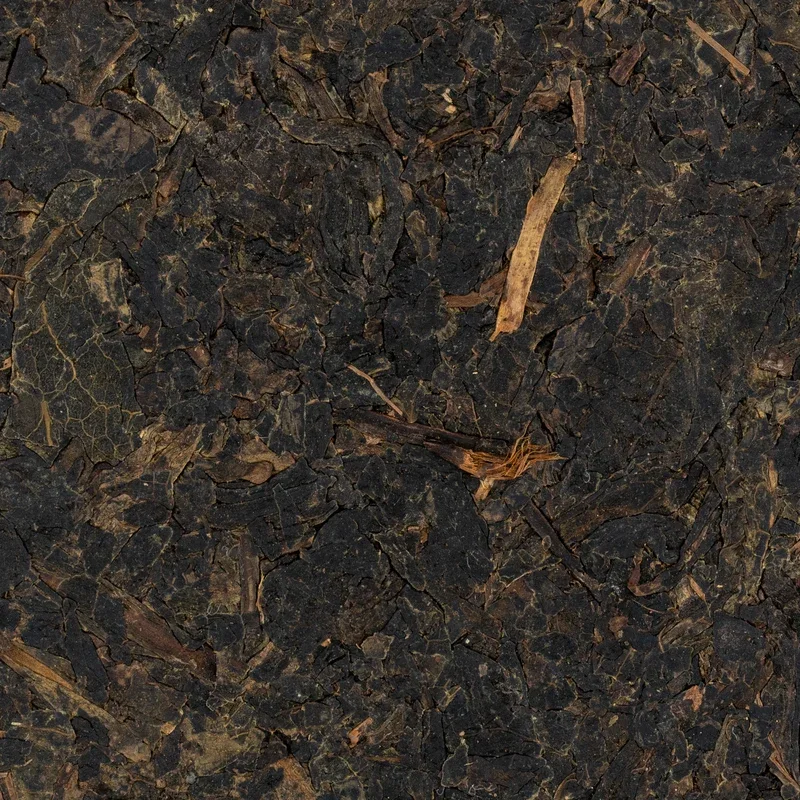
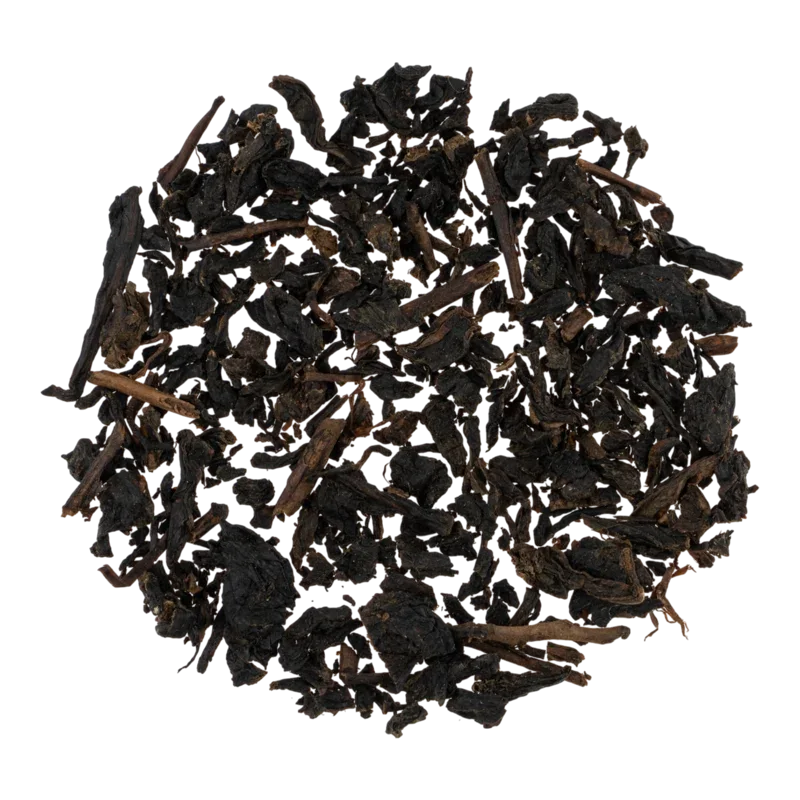
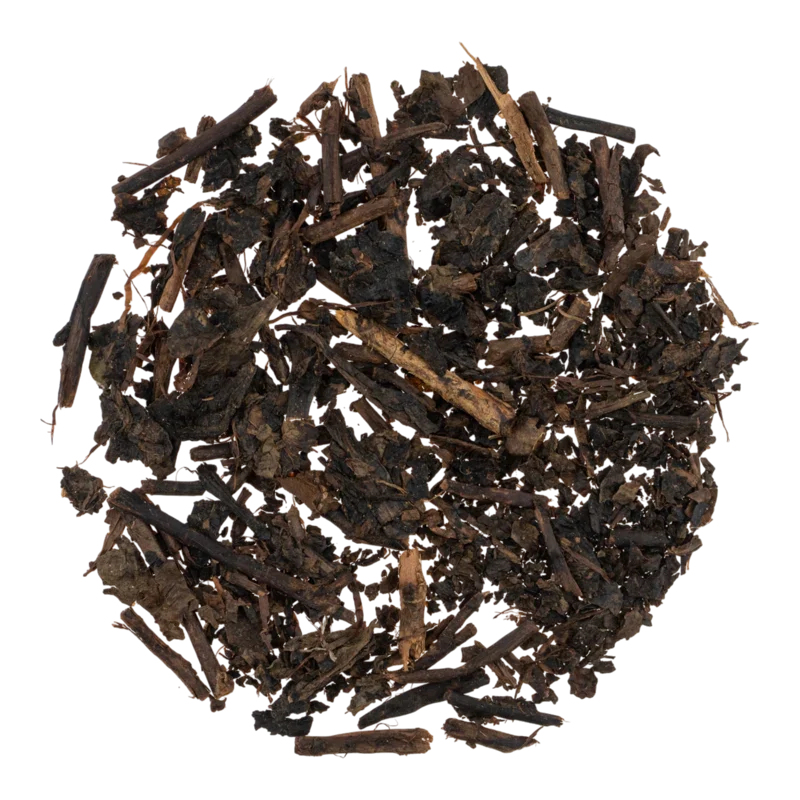
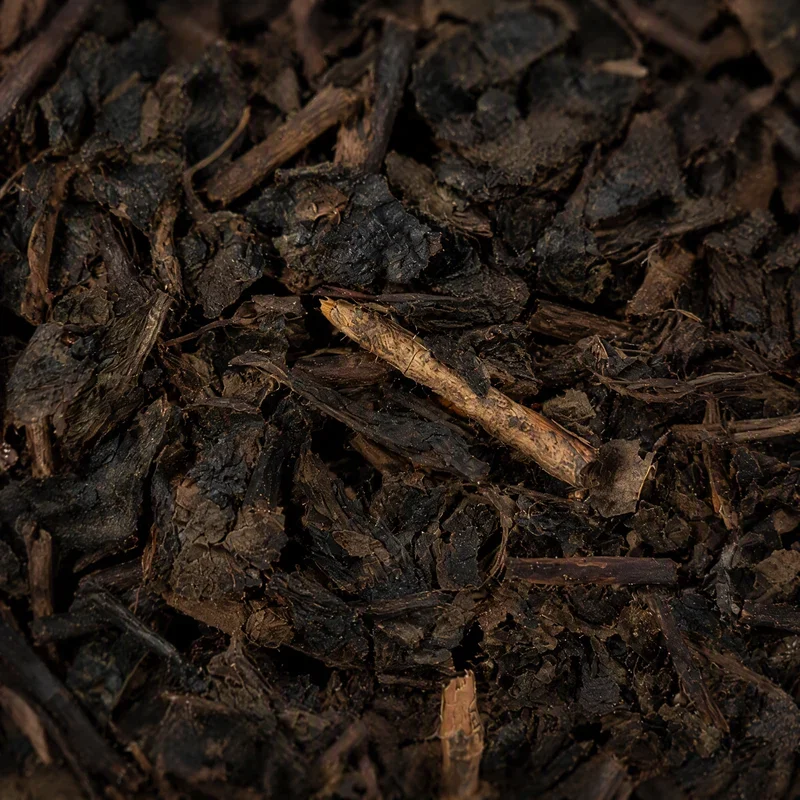
Dry Leaf Appearance: Compact brick of correct rectangular shape with dense, smooth surface. Color — deep dark green with noticeable luster. Special grade is distinguished by abundant golden down (金毫, jīn háo) on the surface.
Dry Leaf Aroma: Pronounced aged aroma (陈香, chénxiāng) with tones of old wood, dried fruits, and withered leaves. In the background — characteristic note of pine smokiness (松烟香, sōngyān xiāng), giving the tea a recognizable "forest" character.
Liquor Aroma: Deep, warm, multi-layered. Dominated by aged aroma — mature, velvety scent of aged dark tea with undertones of pine resin, dry wood, and barely perceptible sweetness of dark honey.
Liquor Color: Red-brown (红褐, hóng hè), clear and transparent, with deep ruby reflection under side lighting.
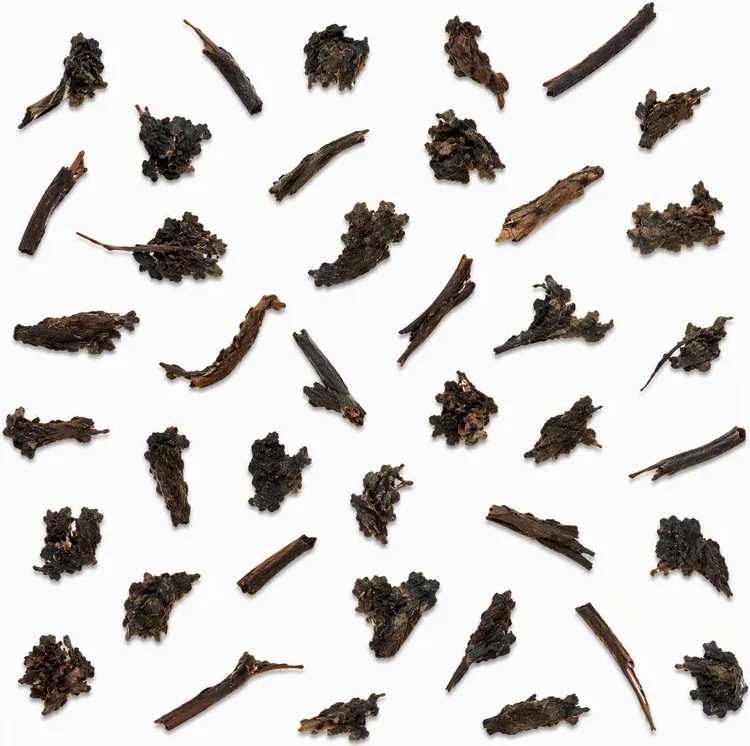
Spent Leaves: Uniform red-brown color, leaves soft, resilient, elastic — "spring back" when pressed, indicating quality raw material and proper fermentation.
Taste: Mellow and rich (醇厚, chúnhòu): full-bodied, oily-smooth, without rough astringency. Sweetness (甘, gān) is pronounced — felt from the first sip and spreads in a long, warming aftertaste. Balance between density and softness is this tea's calling card. Second grade, intended for brewing butter tea, is distinguished by increased body density and resistance to repeated boiling.
Alkaloids: Caffeine ≥ 3.8% — elevated content provides pronounced warming and tonic effect, exceptionally important in high-altitude conditions. Theobromine and theophylline are also present.
Amino Acids: ≥ 2.5% (for first grade), including L-theanine, giving the tea mild sweetness and relaxing effect.
≥ 45% (for special grade) — indicator of high content of water-soluble beneficial compounds.
Thearubigins (茶红素, chá hóngsù) — ≥ 12% (for special grade), providing rich red-brown liquor color.
Antioxidant activity of Moto Zhuan Cha polyphenols, according to the producer, exceeds that of vitamin E by 18 times, attributed to synergistic action of high-altitude catechins and theabrownins.
Minerals: Calcium, potassium, magnesium, zinc, selenium, manganese, fluorine. Fluorine content requires attention with prolonged and abundant consumption.
Polyphenols: 28–32% — notably higher than most dark teas from lowland provinces. Thearubigins and theabrownins (茶褐素, chá hè sù — up to 35%) predominate, ensuring taste smoothness and high efficiency in fat breakdown.
Vitamins: C, B1, B2, PP. High-altitude origin promotes vitamin C accumulation.
High theabrownin content (35%) ensures effective breakdown of heavy, fatty foods — yak meat, mutton, butter. This property made it indispensable for Tibet's nomadic peoples.
Elevated caffeine content (≥ 3.8%) stimulates circulation and helps warm the body in high-altitude cold conditions.
Polyphenols neutralize free radicals, protecting cells from oxidative stress — especially relevant under intense ultraviolet radiation at high altitude.
Gentle but sustained alertness thanks to combination of caffeine and L-theanine.
Thearubigins and theabrownins help reduce "bad" cholesterol levels.
Vitamins C and B group, plus trace elements (zinc, selenium) support the immune system.
Post-fermentation products (microorganism metabolites) have prebiotic effects.
Tea Amount: 5–7 g per 500 ml water.
Teaware: Ceramic or cast iron teapot for boiling; for steeping — gaiwan or Yíxīng purple clay teapot (紫砂壶, zǐshā hú).
Water Temperature: 100°C (rolling boil).
Container: Store in original packaging or wrap in kraft paper. Storage in unglazed ceramics is acceptable. Airtight packaging is strongly discouraged — tea needs minimal gas exchange to continue post-fermentation.
Enemies: Foreign odors (tea actively absorbs aromas), direct sunlight, dampness, sharp temperature changes.
Humidity: Moderate (50–70%). Excessive humidity leads to mold, insufficient humidity stops the aging process.
Dry, dark, well-ventilated room, away from direct sunlight.
Practically unlimited. New tea is recommended to "breathe" (醒茶, xǐng chá) for 1 year before consumption — this allows weakening of "fire energy" (火气, huǒ qì) from pine drying. Tea aged 5–10 years is considered optimal for drinking; older specimens acquire collectible value.
Temperature: Room temperature (15–25°C), without sharp fluctuations.
"Elder brother" among Tibetan brick teas. Kang Zhuan is produced from Sichuan raw material on a mass scale, has coarser, simpler texture and less pronounced aroma. Moto Zhuan Cha is distinguished by greater delicacy, taste purity, and distinct pine smokiness.
If Qing Zhuan is the "Silk Road tea" oriented toward Mongolia and Russia, then Moto Zhuan Cha is the "Himalayan tea" directed at inner-Tibetan consumption. Qing Zhuan is distinguished by longer fermentation (60+ days) and characteristic mushroom aroma (菌花香), while Moto possesses pronounced pine smokiness (松烟香).
Hunan brick tea with "Golden Flowers" (Jin Hua). Fu Zhuan possesses characteristic mushroom aroma and mild, "honey" sweetness. Moto Zhuan Cha is more straightforward, "masculine," with bright warming effect and smoky note.
Giant "logs" from Hunan. Qian Liang is distinguished by woody-spicy profile and longer natural fermentation. Moto Zhuan Cha is more compact, easier to store and brew, its "high-altitude" character is more pronounced.
Price Category: Moto Zhuan Cha belongs to medium and high price segment teas:
Contact official dealers of "Sacred Tea of the Himalayas" brand or specialized Tibetan tea shops with good reputation.
Genuine brick is dense, heavy, with smooth dark green surface with luster. Special grade should be abundantly covered with golden down. Loose structure and uneven coloring are warning signs.
Dry brick should emit pure aged aroma with pine smokiness note. Musty, sour, or "moldy" smell indicates improper storage or counterfeit.
Color should be clear, red-brown, transparent. Cloudy, dull liquor with foreign taste is cause for doubt.
Tea at suspiciously low price (significantly below 600 yuan per jin for first grade) is almost certainly not genuine Moto product.
Price Factors: Organic status, region inaccessibility (logistics costs), limited production volume, aging period.
No reviews yet. Tell us what you think of this tea.
Rate this tea and share your impressions. We review each submission before publishing it.