Brewing
Gongfu brewing
- Water temperature
- 100 °C
- Tea amount
- 6 g
- Water volume
- 100 ml
- First steep
- 10 s
- Time added per infusion
- 5 s
- Infusions
- 8

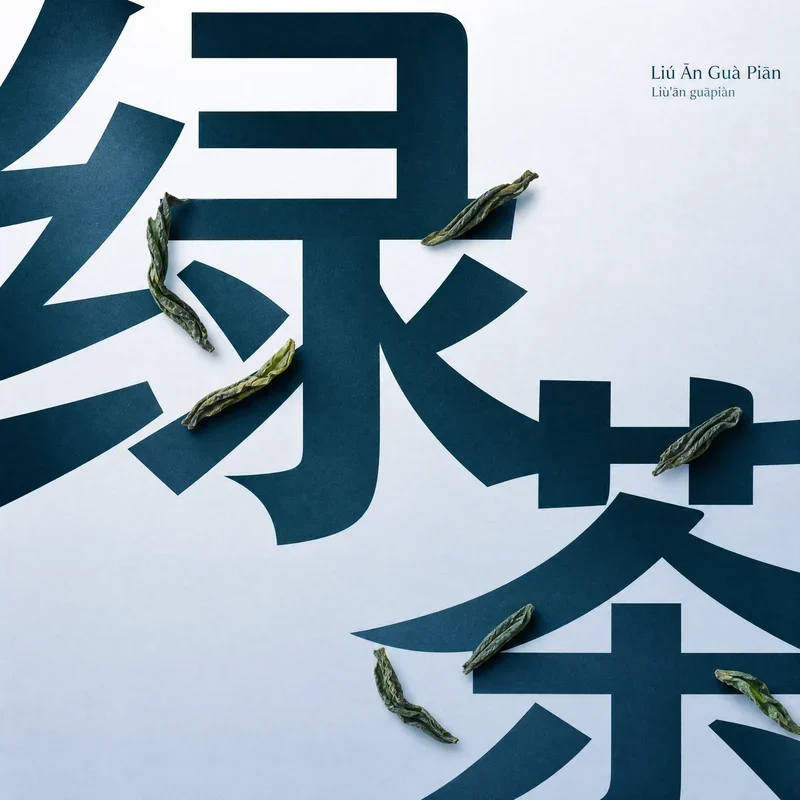
Liù'ān guāpiàn
Choose a brewing method. Start with the recommended quantities and time, then adjust to taste.
Brewing
Brewing
Taste
Tea encyclopedia
Alt Names: Guā Piàn (瓜片) — abbreviation; Piàn Chá (片茶, "leaf tea"); Lu'an Piàn (六安片).
Alt Names: Guā Piàn (瓜片) — abbreviation; Piàn Chá (片茶, "leaf tea"); Lu'an Piàn (六安片).
Category: Famous Teas of China (中国十大名茶). Intangible cultural heritage of the PRC (国家级非物质文化遗产, 2008). Geographical indication product.
Coordinates: ~31°30′ N, 115°50′ E.
Origin: China, Ānhuī Province (安徽省), Lu'an Prefecture (六安市, Liù'ān Shì), Dàbié Mountains (大别山, Dàbié Shān). Main zones: Jīnzhài County (金寨县, Jīnzhài Xiàn) — inner mountain region (内山); Yu'an District (裕安区, Yù'ān Qū) — outer region (外山). Reference terroir — Qí Mountain (齐山 / 齐头山, Qí Shān) and the famous Bat Cave (蝙蝠洞, Biānfú Dòng) in Qishan Village, Xianghongdian Township (响洪甸镇).
Type: Green tea (绿茶, lǜchá), unfermented. Belongs to the special category "piancha" (片茶, "leaf/blade tea").
Liu An Gua Pian is the only one of China's "Ten Great Teas" (and one of few in the world) produced exclusively from leaf blades — without buds and without stems. This "negative selection" is a paradoxical move: tea orthodoxy values buds; Gua Pian proves that leaf without bud can be no less great.
According to widespread legend, Premier Zhōu Enlai (周恩来) presented Liu An Gua Pian to Henry Kissinger during his secret visit to Beijing in July 1971 — for preparing Nixon's historic visit. Gua Pian became one of the "teas that opened diplomacy".
In Cao Xueqin's great novel, tea from Lu'an is mentioned more than 80 times — evidence of its popularity among the Qing elite.
Two people lift a huge bamboo basket with tea over blazing coals, turn and lower it — ~150 times in succession. This is not a conveyor — this is a ritual requiring perfect coordination, and one of the most impressive visual scenes in the tea world.
Most famous micro-location of Gua Pian. Tea bushes grow on steep slopes around a karst cave where bats winter. Their guano enriches the soil with phosphorus and microelements, which, according to local farmers, creates the unique taste of the best batches.
Cultural Significance: Liu An Gua Pian is the "quietest" of the ten greats: less known abroad than Longjing or Biluochun, but "among the ten famous teas it holds the highest quality rating" (在十大名茶中质誉最高) — according to the State Administration of Technical Supervision of the PRC. Its uniqueness is absolute: nowhere in the world exists another green tea made exclusively from individual leaf blades.
History: Lu'an's tea history extends deep into centuries. Already in the "Classic of Tea" (《茶经》) by Lú Yù (陆羽, 8th century), "Luzhou Lu'an tea" (庐州六安茶) is mentioned. Míng scholar Xú Guāngqǐ (徐光启) in the "Complete Treatise on Agriculture" (《农政全书》) called "Lu'an Prefecture's leaf teas the highest grade" (六安州之片茶,为茶之极品). In the Qing era, Guā Piàn became imperial tribute tea (贡茶); according to legend, Empress Dowager Cixi received monthly 14 liang of "Qi Shan Yun Wu" (齐山云雾) — the predecessor of Gua Pian. The modern form of Liu An Gua Pian took shape around 1905: according to one version, a tea evaluator from Lu'an began selecting only tender leaf blades from finished tea, discarding buds and stems; according to another — farmers from Jīnzhài (齐头山后冲) began separately collecting and roasting leaves of different maturity. The resulting tea, resembling sunflower seeds, was called "guazi pian" (瓜子片, "seed blades"), later shortened to "gua pian".
Name Breakdown: "Liu An" (六安) — name of the prefecture (since the Han era); "Gua Pian" (瓜片) — "melon/gourd seed-blades" — description of the leaf shape.
Harvested shoots are manually sorted: first the third leaf is removed, then the second, then the first, then the upper tender stem and lower coarse stem/fourth leaf are separated. Each fraction is roasted separately.
Cultivar: Local populations of Camellia sinensis var. sinensis, growing in the Dabie Mountains. For the inner mountain region (内山), indigenous varieties with increased amino acid content are used.
Picking: Late by green tea standards — around Gǔyǔ (谷雨, ~April 20), ±10 days. Principle: "seek strong, not tender" (求壮不求嫩) — unlike most green teas that value the youngest buds. By Lìxià (立夏, ~May 6) the season ends: "After Lixia — no more Gua Pian" (立夏之后,再无瓜片).
Pluck Standard: Second and third leaf on the branch — mature, fleshy, "壮" (strong). Without buds, without stems — unique requirement. After harvest, "banpian" (扳片) is performed — manual separation of each leaf blade from the stem and from neighboring leaves, with sorting by maturity.
Climate: Average annual temperature ~15.3°C. Precipitation — 1,200–1,400 mm. Humidity — 80%+. Mountain gorges create a microclimate with abundant mists, short daylight hours and significant diurnal temperature variations.
Soil: Yellow-brown mountain soils (黄棕壤), slightly acidic (pH ~6.5), loose, deep, rich in organic matter and minerals.
Powerful mountain range on the Anhui–Hubei–Henan border. Tea gardens are located on the northern slope, in deep gorges with abundant mists. Forest coverage — over 50%.
Jinzhai — Qishan (齐山), Xianghongdian (响洪甸), Xianhualing (鲜花岭). Elevation — 300–800 m a.s.l. Best tea — from Qǐ Mountain (齐头山, 804 m), especially from the vicinity of Bat Cave (蝙蝠洞). Local tea is called "Qi Shan Ming Pian" (齐山名片, "Famous Blades of Qishan") — highest grade.
Yu'an — Shibanchong (石板冲), Shiposhe (石婆店), Shizigang (狮子岗). Elevation — 100–300 m a.s.l. More accessible tea, often machine-produced.
*
After harvest, shoots are manually sorted — each leaf blade is separated from the stem. Leaves are sorted by maturity: tender (1st leaf), medium (2nd), mature (3rd). Buds and stems are removed. Why? Without buds — no "grassy" taste (青草味); without stems — no bitterness (stems have already lignified by harvest time). Result: "flavor rich but not bitter; aroma bright but not astringent" (味浓而不苦,香而不涩).
*
Primary roasting in a heated wok (~100°C+). Enzyme inactivation, beginning of shaping.
Secondary roasting at gentler temperature. Final shaping — leaf is pressed against wok walls, edges curl backward (叶缘背卷), forming the characteristic "seed" shape.
*
First drying on bamboo baskets over coals (~100°C), turned every 2–3 minutes. Until ~80% dryness. Leaf acquires "seed" shape, color becomes emerald.
Second drying (~120°C). Until ~90% dryness. Aroma formation. Then — "rest" 3–5 days (吐绿/回疲, "green release") for even distribution of residual moisture.
Final and most spectacular operation. Temperature — 160–180°C. Huge bamboo basket (Ø ~1.5 m) with 3–4 kg of tea — two people lift it over blazing coals, hold for 2–3 seconds, remove, turn the tea, lift again — and so ~150 times in succession. "Lift basket quickly, turn tea evenly, place basket precisely, stand firmly, lower basket gently" (抬笼要快,翻茶要匀,拍笼要准,脚步要稳,放笼要轻). Characteristic "frost" (白霜, bái shuāng) appears on the leaf surface — crystallization of sugars and amino acids. Precisely "La Laohuo" forms the famous "宝绿" (bao lü, "precious green") color and unique aroma of Gua Pian.
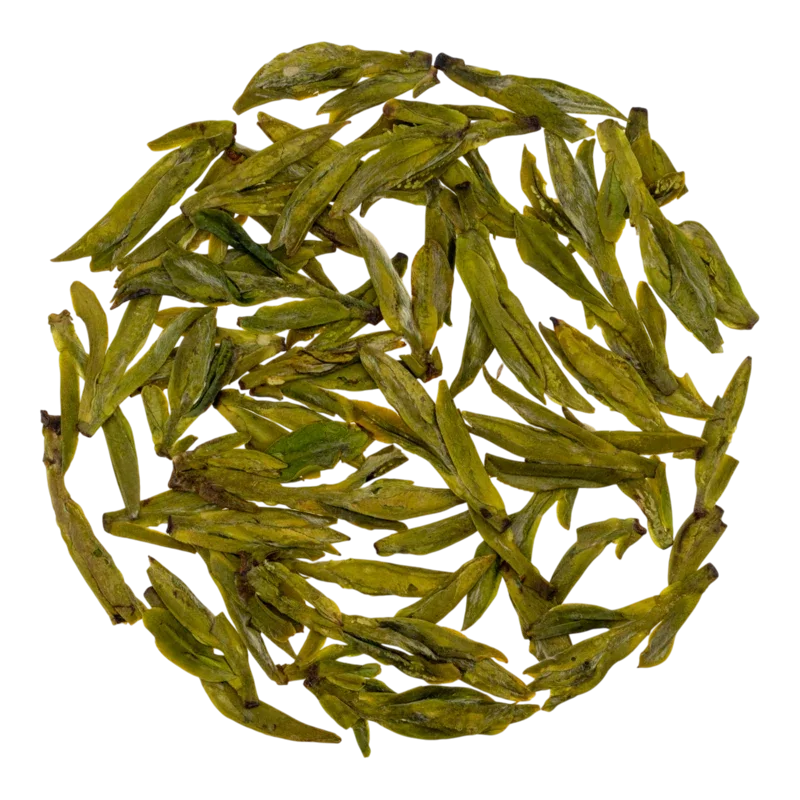
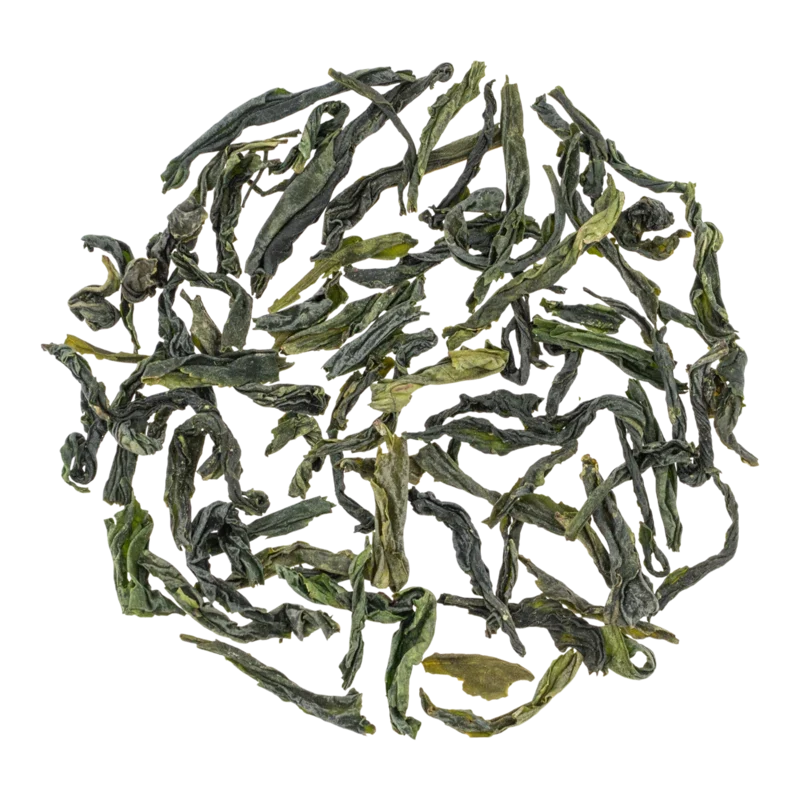
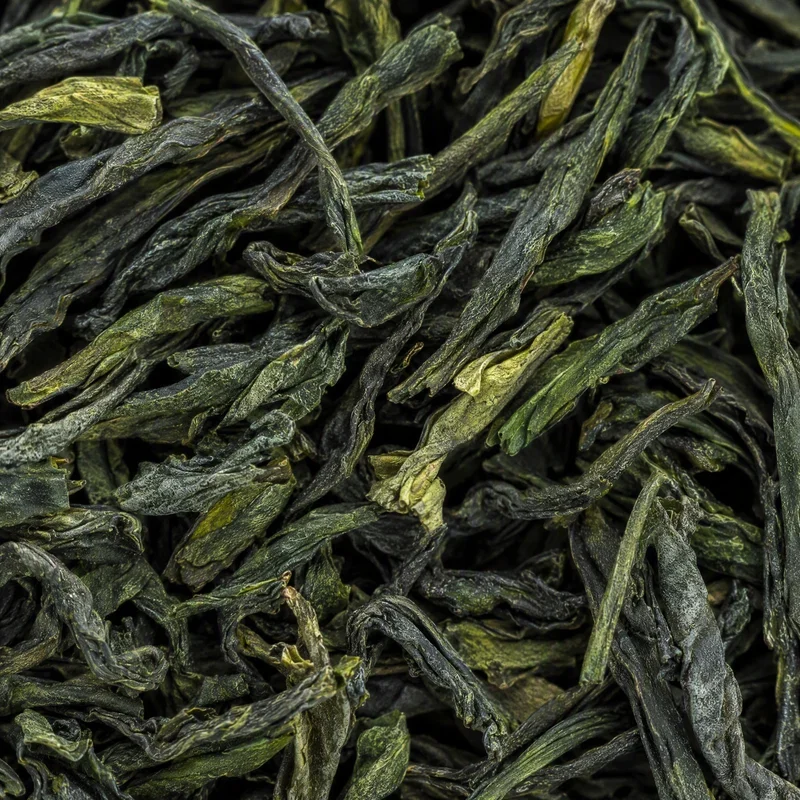
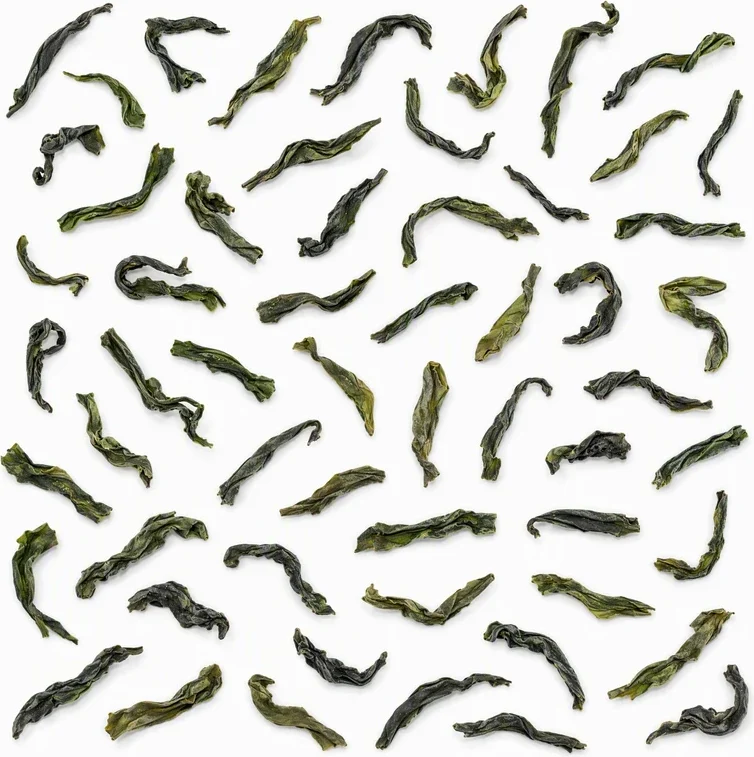
Dry Leaf Appearance: Flat blades resembling melon seeds (瓜子形) — hence the name "Guapian". Edges curled backward (叶缘背卷). Color — "precious green" (宝绿, bǎo lǜ) with characteristic white "frost" (白霜, bái shuāng) on the surface — trace of final fire drying "La Laohuo". Leaves even, uniform in size (grade determined by fraction).
Dry Leaf Aroma: High, persistent, with characteristic notes of roasted chestnuts (板栗香, bǎnlì xiāng) — signature aroma of Gua Pian, formed by "triple fire". Additional overtones — light floral (orchid), "green" (fresh-cut grass), sometimes — light smokiness.
Liquor Aroma: "Fresh and high" (清香高爽, qīngxiāng gāoshuǎng). Chestnut background, floral and grassy notes. Aroma persistent — maintained throughout 3–5 infusions.
Liquor Color: Clear, bright green with yellowish tint (清澈明亮). "Living" color — like a mountain stream.
Spent Leaves: Whole, flat, resilient leaf blades — without buds, without stems, without fragments. Uniform yellow-green color. Precisely the spent leaves of Gua Pian are the best way to evaluate quality: all leaves should be the same size, whole, "alive".
Taste: "Rich but not coarse; sweet but not cloying" (味浓而不苦,香而不涩). Dense, "full-bodied" (醇厚, chúnhòu). Natural sweetness, with chestnut-nutty depth. Astringency — minimal (absence of buds and stems). Light minerality from mountain soils of Qi Shan. Aftertaste — long, sweet, with "returning sweetness" (回甘, huígān). Huigan pronounced, building.
Amino Acids: L-theanine — medium-high content. Mountain terroir (800+ m a.s.l., mists, temperature variations) promotes amino acid accumulation.
Moderate content — lower than bud teas (buds contain maximum caffeine; Gua Pian is produced from leaves).
Complex of pyrazines and furans, formed during "triple fire" — responsible for chestnut aroma. Linalool, geraniol — floral overtones.
Minerals: Enriched profile — granite and slate soils of Qi Shan. Potassium, manganese, zinc, magnesium, phosphorus.
Polyphenols: High catechin content, especially EGCG. Mature leaves (not buds!) contain more polyphenols than tender bud shoots — making Gua Pian one of the most "antioxidant" green teas.
Vitamins: C (high — green tea), B₁, B₂, E, K.
Mature leaves (not buds) contain more polyphenols — Gua Pian is one of the "leaders" in EGCG among green teas.
Caffeine + L-theanine. Caffeine content lower than bud teas — gentler stimulation, suitable for afternoon tea drinking.
Catechins accelerate thermogenesis and fat oxidation.
Polyphenols improve vascular elasticity, normalize cholesterol.
Absence of buds and stems reduces irritating effect on stomach.
Enriched mineral profile thanks to mountain soils.
4–5 g in gaiwan 100–120 ml, 70–80°C, first brewing — 60 seconds, then — 45–60 seconds, 4–6 infusions.
Tea Amount: 3–5 g per 150–200 ml.
Teaware: Glass tumbler (玻璃杯) — classic method: allows observing how flat "seeds" slowly sink to the bottom, opening. Porcelain gaiwan — for more controlled extraction. Small-volume teapot.
Water Temperature: 80–85°C. Flat mature leaves are less sensitive to high temperature than bud teas, but boiling water is not recommended — may "cook" the flavor.
Container: Airtight, opaque — tin can, foil-lined bag with zip closure.
Enemies: Light, moisture, oxygen, heat, foreign odors.
Shelf Life: 6–12 months in refrigerator. Fresh Gua Pian (first 3 months) — best chestnut aroma and freshness. "White frost" (白霜) on leaves — sign of freshness; if it disappears — tea is aging.
Refrigerator (0–5°C) — strongly recommended for green tea. Airtight packaging mandatory (green tea quickly absorbs odors). At room temperature — consume within 2–3 months.
Also flat, also from Anhui, also with chestnut aroma — but Da Fang includes buds and leaves; Gua Pian — only leaves. Da Fang is the "ancestor of Longjing"; Gua Pian is an "independent branch of evolution". Da Fang is softer and sweeter; Gua Pian is denser and richer.
Also flat, but from Zhejiang. Longjing uses buds + leaves; Gua Pian — only leaves. Longjing — bean-grassy aroma; Gua Pian — chestnut. Longjing is "light" and "fresh"; Gua Pian is "dense" and "deep".
"Neighbor" in Anhui. Twisted (not flat), with abundant white down. Orchid aroma. More "floral" and "airy" than the "chestnut-dense" Gua Pian.
Another Anhui "great" green tea. Giant flat leaves with "netting". Orchid-vanilla profile. More "extravagant" in form, less "concentrated" in taste than Gua Pian.
From Jiangsu — twisted "spirals" with abundant down. Floral-fruity profile. Completely different style — "light" vs "dense".
Flat blades without buds and stems, with edges curled backward. If there are buds — this is NOT Gua Pian.
Characteristic coating on fresh Gua Pian — trace of "La Laohuo". Absence of frost — sign of old tea or simplified technology.
Signature marker. If aroma is "flat" or "grassy" without chestnut-nutty depth — simplified production.
Authentic Gua Pian — from Yu'an District (裕安区) and Jīn County (金寨县), Lu'an City, Anhui Province. Key zones: Qí Shān (齐山), Bianfudong (蝙蝠洞), Shitouba (石头坝).
Often cheaper flat green teas are sold as Gua Pian from Anhui.
No reviews yet. Tell us what you think of this tea.
Rate this tea and share your impressions. We review each submission before publishing it.