Brewing
Gongfu brewing
- Water temperature
- 93 °C
- Tea amount
- 5 g
- Water volume
- 100 ml
- First steep
- 10 s
- Time added per infusion
- 5 s
- Infusions
- 4

Lìchuān gōngfu hóngchá
Choose a brewing method. Start with the recommended quantities and time, then adjust to taste.
Brewing
Brewing
Taste
Tea encyclopedia
Category: Premium Chinese red tea (black tea) with protected geographical indication (国家地理标志保护产品). Part of the "Yihong Gongfu" (宜红工夫, Yíhóng Gōngfu) group — one of China's four great gongfu red tea traditions alongside Qíhóng (祁红), Diānhóng (滇红), and Mǐnhóng (闽红). A key sub-brand of the umbrella brand "Enshi Xicha" (恩施硒茶, "Selenium Tea from Enshi"). The production technology is listed in the registry of intangible cultural heritage of Hubei Province.
Category: Premium Chinese red tea (black tea) with protected geographical indication (国家地理标志保护产品). Part of the "Yihong Gongfu" (宜红工夫, Yíhóng Gōngfu) group — one of China's four great gongfu red tea traditions alongside Qíhóng (祁红), Diānhóng (滇红), and Mǐnhóng (闽红). A key sub-brand of the umbrella brand "Enshi Xicha" (恩施硒茶, "Selenium Tea from Enshi"). The production technology is listed in the registry of intangible cultural heritage of Hubei Province.
Coordinates: Approximately 30°05′ N, 108°56′ E. Plantation altitude — 800–1500 m a.s.l. (main plantations at approximately 900 m elevation).
Origin: China, Húběi Province (湖北省, Húběi Shěng), Ēnshī Tujia and Miáo Autonomous Prefecture (恩施土家族苗族自治州, Ēnshī Tǔjiāzú Miáozú Zìzhìzhōu), Lìchuān City (利川市, Lìchuān Shì). The core production area is Máobà Town (毛坝镇, Máobà Zhèn), located at the foot of Xingdoushan National Nature Reserve (星斗山国家级自然保护区). Other significant production zones include Zhonglu (忠路镇), Baiyangba (柏杨坝镇), Shaxi (沙溪乡), and Wendou (文斗乡).
Type: Red tea (black tea) (红茶, hóngchá) — fully oxidized. Belongs to the highest category of gōngfu hóng chá (工夫红茶, gōngfu hóngchá) — red teas requiring special mastery in production and multi-stage precision processing. In Western tradition corresponds to black tea.
On April 28, 2018, Lìchuān Hóng together with Ēnshī Yùlù (恩施玉露) was served at "Donghu Chaxi" — the tea ceremony on the shore of East Lake in Wuhan, where the leaders of China and India discussed international relations. This event instantly transformed Lichuan Hong into one of the most recognizable Chinese red tea brands.
Clouding when cold is a consequence of interaction between theaflavins and caffeine, forming complex compounds that precipitate from solution when temperature drops. This phenomenon is observed only in teas with exceptionally high theaflavin content — i.e., it is a physico-chemical "certificate" of quality.
Twelve successive leaders of Maoba Town over more than three decades steadily developed the tea industry — an example of patience that became a symbol of tea "gongfu" in the organizational sense.
Lichuan company "Jinli Chaye" (金利茶业) became the first Chinese tea enterprise to open its own production abroad — in Morocco, registering the brand and creating a packaging factory.
Cultural Significance: Lìchuān is located in the historical territory of the Tujia people (土家族, Tǔjiāzú). Tea occupies a central place in Tujia rituals: in marriage ceremonies it symbolizes life force and fidelity; in funeral rites it is used for symbolic purification; during Chunjie (春节, Spring Festival) celebrations it is served as an obligatory drink. In 2020, Lichuan received the title "China's Tea Culture City" (中国茶文化之乡), awarded by the China Tea Culture International Research Association. Twelve successive party secretaries of Maoba Town over more than 30 years consistently developed the tea industry — this fact became a symbol of patience and continuity in Chinese tea cultivation.
History: Tea cultivation in Lichuan has ancient roots. According to the "Lichuan County Gazetteer" (《利川县志》, Lìchuān Xiànzhì), tea growing here dates back to the Western Zhōu period (西周, Xīzhōu, 1046–771 BCE). During the Míng dynasty (明, 1368–1644), the local tea "Wudong Cha" (雾洞茶, "Tea from the Misty Cave") was already supplied to the court as tribute. However, industrial red tea production began much later — in the mid-19th century, when Guǎngdōng merchant Jùn Dàfú (钧大福) established red tea procurement in Lichuan for export through Wuhan. The decisive event was the opening of Yíchāng port (宜昌) for international trade in 1876 (under the Chefoo Agreement): the door to the world market opened, and Lichuan became one of the main production bases for export red tea, which foreign traders named "Yihong" (宜红). By 1880, Lichuan red tea was being supplied to Russia and Great Britain. By the early 20th century, Lichuan accounted for, according to some sources, up to 80% of all Yihong export volume.
Name Breakdown: "Lichuan" (利川) — literally "Beneficial Plain" — the city name, referring to the fertile valleys of the Qingjiang River surrounded by mountains. "Gongfu" (工夫) — "mastery," "skill" — indicates the category of red tea requiring virtuoso processing. "Hong Cha" (红茶) — "red tea."
Local endemic variety discovered in 1980. Elite Lichuan Hong with the characteristic "clouding when cold" phenomenon is produced from this variety. Grows slowly, develops horizontally for the first four years, yields low harvests, difficult to propagate by cuttings. Leaves are rich in theaflavins and thearubigins.
Breeding variety from China Tea Research Institute, frost-resistant, with good productivity.
Local Hubei selection adapted to mountain conditions.
Another Hubei cultivar.
Universal variety with pronounced astringency.
Local early-ripening variety that matures 20 days earlier than others. Distinguished by unique "triple aroma" (三香合一): delicate freshness, chestnut note, and florality.
Cultivar: Several cultivars are used for production, each with its own characteristics:
Picking: Season lasts from late February to August. Spring picking (春茶): bud and two upper leaves, tips proportion not less than 60%. Summer picking (夏茶): bud and three leaves, tips proportion not more than 30%. Spring picking is considered significantly more valuable.
Altitude: 800–1500 m a.s.l., main plantations at approximately 900 m elevation. The average elevation of Lichuan is 1100 m; the city bears the unofficial name "Western Cool City" (西部凉城).
Climate: Subtropical monsoon mountain climate with pronounced vertical zonation. Average annual temperature +14–16.7°C (summer — around +22.2°C, without extreme heat: historical maximum — 35°C). Annual precipitation — approximately 1400 mm. Abundant fogs, cloudiness, minimal insolation. Significant daily temperature fluctuations slow tea leaf growth, promoting accumulation of aromatic substances and phenolic compounds. Forest coverage of the area — more than 64%, in the Xingdoushan Reserve zone — more than 85%.
Soil: Slightly acidic yellow-brown soils (黄棕壤, huáng zōng rǎng) with pH 4.8–5.2, deep profile (more than 80 cm), high organic content (> 2%), and, critically important, natural selenium enrichment (硒, xī). Selenium content in Lichuan tea consistently remains in the range of 0.25–4 mg/kg — one of the highest indicators among Chinese teas.
Southwestern part of Hubei Province, at the junction of Hubei, Hunan, and Chongqing. Plantations are located in the Qīngjiāng River (清江, Qīngjiāng) valley — the "Mother River of the Tujia" — and in the foothills of the Qiyaoshan (齐岳山), Xingdoushan (星斗山), and Fobaoshan (佛宝山) ranges. The territory is located on the 30th parallel north — the "golden belt of tea cultivation."
Karst topography with a developed system of caves and underground rivers. The territory of Xingdoushan National Nature Reserve ensures exceptional ecological purity.
Picked leaves are spread for moisture loss for 12–24 hours until moisture content drops to 62%. At this stage, natural oxidation begins, enzymes are activated, and the leaf becomes soft and pliable. Some producers use electric withering chambers (电萎凋槽, diàn wěidiāo cáo), invented by Qiu Jianhong to improve quality stability.
Conducted in two stages. First rolling — about 45 minutes in mechanical rollers, second — about 30 minutes to give leaves the characteristic form of tight twists and further destroy cell walls. Masters use a complex of 14 hand techniques: "搭、抹、抖、捺、压、抓、荡、推、搓、滚、捞、拍、挺、磨" (da, mo, dou, na, ya, zhua, dang, tui, cuo, gun, lao, pai, ting, mo).
Key stage. Rolled leaves are laid in layers and covered with damp linen cloths. Temperature is controlled at 23–25°C, not exceeding 30°C. During oxidation, deep oxidation of polyphenols occurs with formation of theaflavins and thearubigins, which form color, aroma, and taste. Readiness is determined by the master through leaf color change (to copper-red) and appearance of characteristic fruity-floral aroma.
Primary drying at approximately 115°C to stop oxidation and fix achieved characteristics. Moisture is reduced to less than 6%.
Red tea crude (红毛茶, hóng máochá) undergoes complex processing: sieving (毛筛, 抖筛, 分筛), cutting (切断), winnowing (风选), hand sorting (拣剔), finish drying (补火), cooling (清风), blending (拼和), and packing (装箱). The labor-intensive nature of this stage gave the name to the "gongfu" category — "mastery."
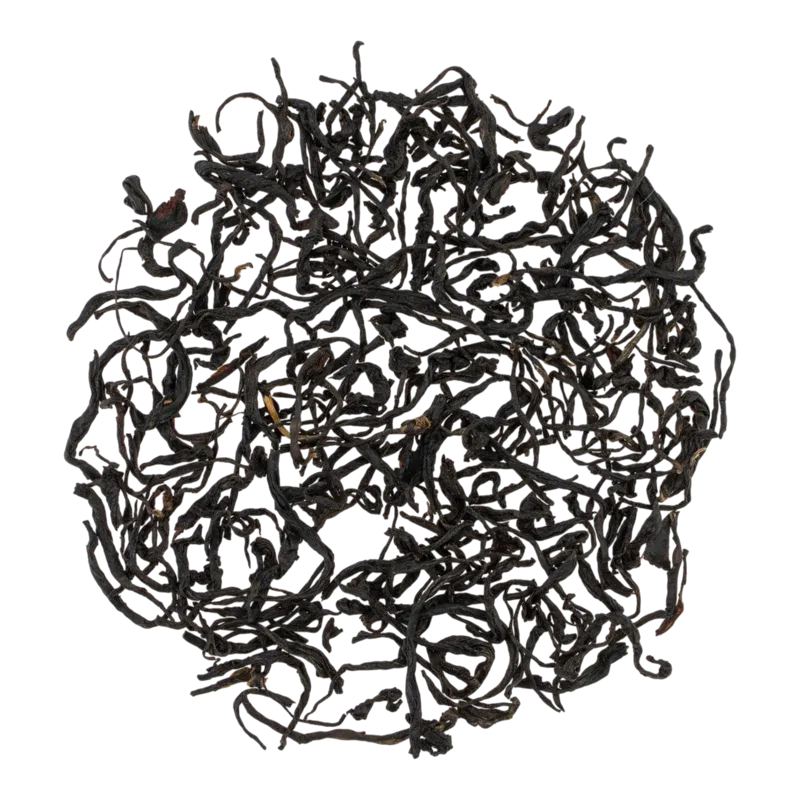
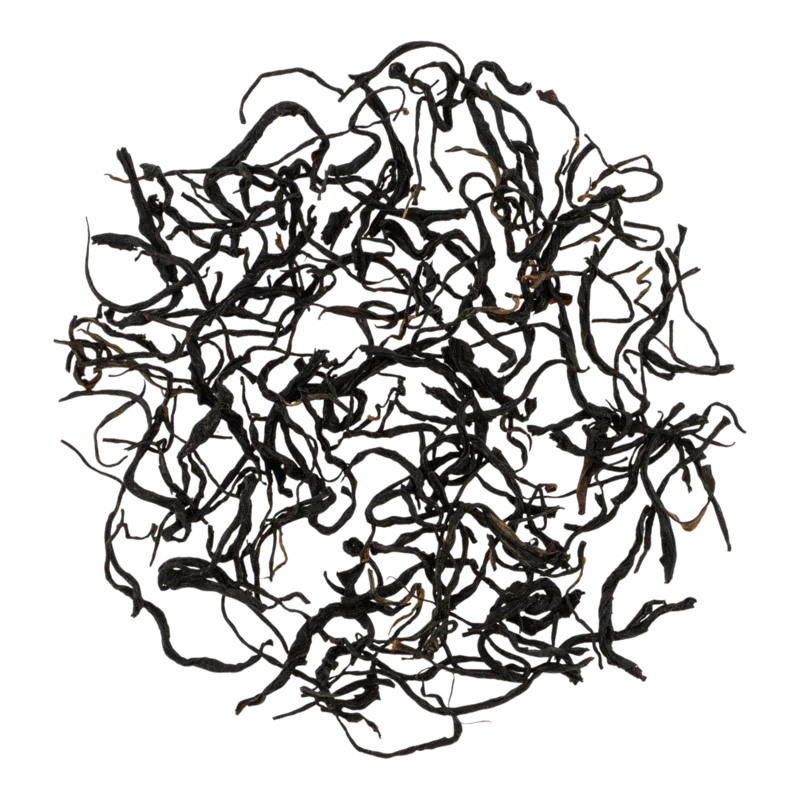
Dry Leaf Appearance: Neat, tight, finely twisted strips about 2 cm long, dark chocolate, almost black color with oily luster (乌润, wūrùn). Golden tips (金毫, jīnháo) are visible on the surface.
Dry Leaf Aroma: Intense, warm, enveloping. Dominated by roasted chestnut notes (板栗香, bǎnlì xiāng), dried fruits (especially dried persimmon and dates), with light spiciness and hints of baked bread.
Liquor Aroma: Complex, sweetish, with honey (花蜜香, huāmì xiāng), fruity, and woody tones. Floral notes emerge upon cooling.
Liquor Color: Bright, clear, rich amber-red color with golden highlights — "Manou Hong" (玛瑙红, "Agate color"). Characteristic golden rim (金圈) at cup edges. Upon cooling below 8–10°C, the best samples exhibit the "lenghohun" (冷后浑) phenomenon — the liquor becomes cloudy, acquiring oily opacity, and clears again when heated.
Long, warming, sweetish, with refreshing fruity notes reminiscent of Antonovka apple. The aftertaste — "huigan" (回甘, returning sweetness) — persists for several minutes.
Spent Leaves: Tender, whole, elastic leaves of copper-red color, with visible buds. Uniform coloration indicates proper oxidation.
Taste: Dense, rich, but soft, without excessive bitterness. Honey sweetness dominates, complemented by velvety astringency and hints of oak bark and baked fruits. Texture — thick, oily, enveloping.
Amino Acids: L-theanine and other free amino acids forming sweetness and umami.
About 1.2%. Responsible for liquor brightness, golden rim, and invigorating properties. High theaflavin content is one of the causes of the "lenghohun" phenomenon.
About 2.2%. Give the liquor color depth, richness, and smoothness.
About 7% (after oxidation). Provide antioxidant properties.
About 2.5%. Tonic effect.
Participate in forming liquor body and thick texture.
Linalool, geraniol, methyl salicylate, β-ionone, and others — form the characteristic "chestnut-honey" aroma.
0.25–4 mg/kg — natural enrichment from soils. Selenium is a powerful antioxidant and immunomodulator.
A specific ratio of theaflavins (TF) to their digallic esters (TFdiG) of more than 4:1 is noted, which, according to researchers, explains the combination of pronounced astringency with complete absence of bitterness. High antioxidant activity of the tea is confirmed by an ORAC value of about 35,000 μTE/100 g.
Caffeine combined with L-theanine provides gentle, sustained alertness, increases performance and concentration without anxiety.
Complex of theaflavins, catechins, and selenium provides powerful protection of cells from free radicals (ORAC ~ 35,000 μTE/100 g).
Theaflavins and thearubigins help strengthen vessel walls, improve microcirculation, and reduce atherosclerosis risk.
There is data on inhibition of alpha- and beta-amylase, which may contribute to reducing postprandial glucose levels.
Promotes normalization of gastrointestinal tract function, especially after heavy and fatty meals.
Antioxidants and selenium have positive effects on skin elasticity and tone.
Red tea of "warm nature" is ideal for cold mountain climate and winter period.
Tea Amount: 5–7 grams per 100–150 ml water for flash steeping method; 3–4 grams per 200 ml for European steeping.
Teaware: Porcelain gàiwǎn (盖碗) — most universal option allowing control of extraction time. Yixing teapot or porcelain teapot also suitable.
Water Temperature: 90–95°C. Soft, clean water.
Classic gongfu hong with legendary "Qimen aroma" (祁门香) — notes of orchid, plum, and honey. Lighter and more aromatic than Lichuan Hong, with less body. Lichuan Hong surpasses it in liquor density and richness.
From large-leaf var. assamica raw material. Bright malty-honey profile, thick body, abundance of golden tips. Lichuan Hong is produced from small-leaf var. sinensis raw material and has a more chestnut-fruity, less malty character.
"Elder brother" of Lichuan Hong in the Yihong family. Produced in neighboring Hubei areas (Yichang, Hefeng). Similar profile, but Lichuan Hong is distinguished by more pronounced "lenghohun" effect and higher selenium content.
Progenitor of all red teas (black teas). Traditional versions have smoky aroma (smoking over pine charcoal), modern ones — floral-fruity. Lichuan Hong does not undergo smoking and has pure chestnut-honey character without smoky notes.
Price Category: Lichuan Hong belongs to the medium and upper price segment of Chinese red teas (black teas). Regular grades — 300–350 yuan per 500 g; quality tea with "lenghohun" effect — 800–1500 yuan; special grade (特级) and elite batches from "Lenghohun" raw material — from 3000 yuan and higher per 500 g.
No reviews yet. Tell us what you think of this tea.
Rate this tea and share your impressions. We review each submission before publishing it.