Brewing
Gongfu brewing
- Water temperature
- 93 °C
- Tea amount
- 5 g
- Water volume
- 100 ml
- First steep
- 10 s
- Time added per infusion
- 5 s
- Infusions
- 4


Láoshān hóngchá
Choose a brewing method. Start with the recommended quantities and time, then adjust to taste.
Brewing
Brewing
Taste
Tea encyclopedia
Category: Regional Chinese red tea (black tea). Product of the "Nan cha bei yin" (南茶北引, nán chá běi yǐn) program—"Moving Southern Tea North," one of the most ambitious agronomic projects of the PRC in the mid-20th century.
Category: Regional Chinese red tea (black tea). Product of the "Nan cha bei yin" (南茶北引, nán chá běi yǐn) program—"Moving Southern Tea North," one of the most ambitious agronomic projects of the PRC in the mid-20th century.
Coordinates: 36.10°–36.20° N, 120.24°–120.43° E.
Origin: China, Shāndōng Province (山东省, Shāndōng Shěng), Qīngdǎo City (青岛市, Qīngdǎo Shì), Láoshān District (崂山区, Láoshān Qū). Tea plantations are located in the administrative sub-districts of Wangkezhuang (王哥庄), Shāzǐkǒu (沙子口), Zhōnghán (中韩), and Běizhái (北宅). Laoshan is one of the northernmost commercial tea cultivation zones in China (along with Rizhao in the same Shandong Province).
Type: Red tea (black tea) (红茶, hóngchá), fully oxidized (oxidation level ~90–100%). In European tradition—"black tea."
Cultural Significance: Despite the youth of the tea tradition, the Laoshan region possesses the deepest cultural roots. Mount Laoshan is considered one of the most important abodes of Daoism, associated with the name of Lǎozǐ (老子, Lǎozǐ). The Tàiqīng Palace (太清宫, Tàiqīng Gōng), founded according to legend during the Western Han era, remains an active Daoist monastery today. Modern producers use this cultural aura, positioning the tea as a beverage that promotes contemplation and inner harmony. However, no historical connection exists between ancient Daoism and local tea cultivation—tea here is little more than half a century old. Nevertheless, Laoshan Hong Cha has become a calling card of the region and a symbol of the success of the "Nan cha bei yin" program, proving that high-quality tea can be produced far beyond the traditional "tea belt."
History: Shandong Province was historically not a tea-producing region, although tea consumption there was always high. In the early 1950s, seeking to reduce costs of inter-regional tea supplies from the south, the PRC government initiated the "Nan cha bei yin" (南茶北引) program—a large-scale experiment to introduce tea plants to northern provinces. The first experimental plantings in the Laoshan area were established in 1957 using seeds and seedlings from Zhejiang, Anhui, and Fujian provinces. After a series of failures related to harsh winters, success was achieved by 1959: individual populations adapted to local conditions, marking the beginning of tea cultivation in Shandong. Initially, only green tea was produced—Laoshan Lü Chá (崂山绿茶, Láoshān Lǜchá), which received "Product with Geographical Indication" status (地理标志产品, dìlǐ biāozhì chǎnpǐn) in 2006 (national standard GB/T 26530-2011). Red tea (black tea) production began much later—in the 2000–2010s, when local farmers, seeking to rationally use summer raw material (less suitable for green tea due to higher polyphenol content) and responding to growing market demand, mastered the technology of full oxidation. Thus, Laoshan Hong Cha is a young tea with a history of less than two decades.
Name Breakdown: Láoshān (崂山, Láoshān)—literally "High Mountain Lao": 崂 (láo)—toponym, 山 (shān)—"mountain." Hóng Chá (红茶, hóngchá)—"red tea." Mount Laoshan is one of China's most important Daoist sacred landscapes, the highest peak in Shandong Province (1,132.7 m), an abode of legendary immortals and a pilgrimage site for millennia.
Cultivar: For Laoshan Hong Cha production, predominantly small-leaf varieties of Camellia sinensis var. sinensis are used, brought from southern provinces and adapted to northern conditions. Among the main cultivars: Longjing No. 43 (龙井43号, Lóngjǐng 43 Hào)—an early, cold-resistant variety known for producing the eponymous green tea; Fúdǐng Dà Bái Chá (福鼎大白茶, Fúdǐng Dà Bái Chá); Huángshān Qún Tì Zhǒng (黄山群体种, Huángshān Qúntǐ Zhǒng)—a population from Anhui; Jiūkēng Zhǒng (鸠坑种, Jiūkēng Zhǒng) from Zhejiang. Bushes adapted to cool climate are compact, with relatively small, lanceolate, dark green leaves. A characteristic feature is the thickened leaf blade with high cellular juice content, providing enhanced flavor intensity and resistance to multiple infusions.
Picking: Main harvest is spring, occurring in late April to early May (later than in southern provinces due to cooler climate). Summer harvest (June–July)—red tea (black tea) is most often produced from this raw material, since summer leaves contain higher polyphenol content, making them less suitable for green tea but ideal for oxidation. Autumn harvest occurs in September–October. Harvest standard for high-quality grades—tender flush: bud and two upper young leaves.
Raw Material: Leaves must be fresh, undamaged, harvested in morning hours after dew has dried. For highest grades, exclusively hand-picking is used.
Altitude: 50–500 m above sea level. Significantly lower than most famous Chinese teas, however the harsh climate and slow shoot growth compensate for the low elevation.
Climate: Temperate marine monsoon, with pronounced seasonality. Average annual temperature +12.6°C (significantly lower than in southern tea-growing regions). Average annual precipitation ~800 mm. Sea fogs and high humidity create natural diffused lighting. Winters are cold (down to –10°C and below), requiring special protective measures: use of greenhouse covers, film tunnels, and mulching in the winter-spring period. Long, cool growing seasons slow shoot growth but allow leaves to accumulate increased concentrations of amino acids (especially L-theanine) and aromatic substances.
Soil: Brown earths and brown forest soils based on granite parent rocks. Acidic reaction (pH 4.5–6.5), deep fertile horizon (at least 60 cm), high organic matter content (over 1%). Granite substrate provides rich mineral composition, including potassium, manganese, fluorine, and trace elements that are transmitted to the tea through the root system.
Tea plantations are located on coastal plains and lower slopes of Mount Laoshan, predominantly at elevations from sea level to 300–500 m. Mount Laoshan—the highest point of the Chinese coast (1,132.7 m)—creates a unique microclimate: on one side the open Yellow Sea, on the other granite massifs. This is the only area in China where tea plantations are located in direct proximity to the sea coast at such northern latitude (36° N).
Water: For irrigation, the purest water from local mountain springs is used, filtered through granite rocks and saturated with minerals. It is believed that the mineral composition of water makes a significant contribution to the characteristic softness and sweetness of Laoshan teas.
Hand or machine picking of young shoots. For highest grades—exclusively hand-picking: bud and two young leaves.
Picked leaves are spread in a thin layer in a ventilated room or outdoors. Duration—4–8 hours depending on humidity and temperature. Goal—loss of 50–60% moisture, leaf softening, beginning of enzymatic processes and formation of primary aromas. Due to thick, juicy leaves of Laoshan raw material, withering requires more prolonged time than for thin-leaf southern cultivars.
Withered leaves are rolled in roller machines to break cell walls, release cellular juice, and initiate the oxidation process. Rolled leaves acquire characteristic spiral or needle-like shape.
Key stage. Rolled leaves are left at controlled temperature (25–30°C) and high humidity for 2–5 hours. Polyphenols oxidize under the action of polyphenol oxidase, transforming into theaflavins and thearubigins. A feature of Laoshan Hong Cha—often longer oxidation using solar heat, which contributes to the development of a unique sweet, chocolate-caramel profile. The master controls the process by changes in leaf color (from green to copper-red) and aroma character.
Final drying at high temperature (90–120°C) to quickly stop oxidation and reduce moisture to 3–5%. Drying fixes the achieved aromatic profile and ensures tea preservation.
Finished tea is sorted by leaf size, wholeness, and quality. Grades from supreme (特级, tèjí) to third (三级, sānjí) are distinguished.
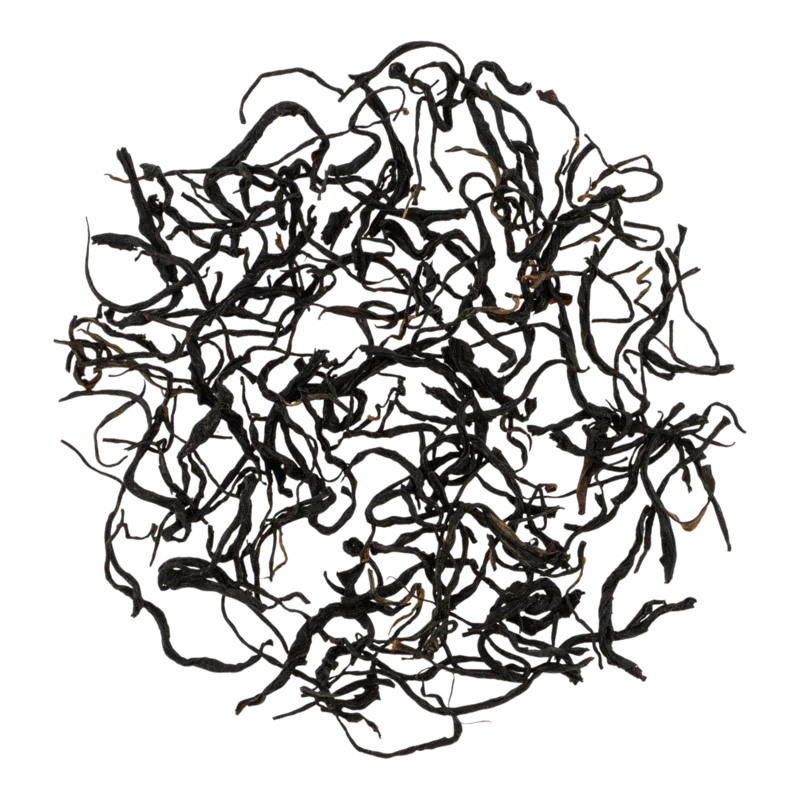
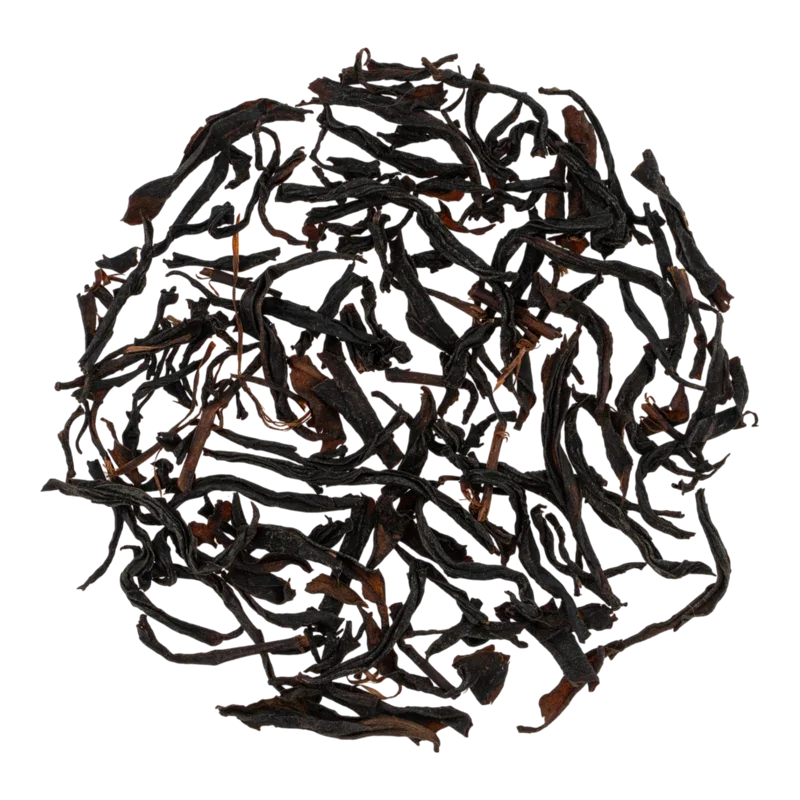
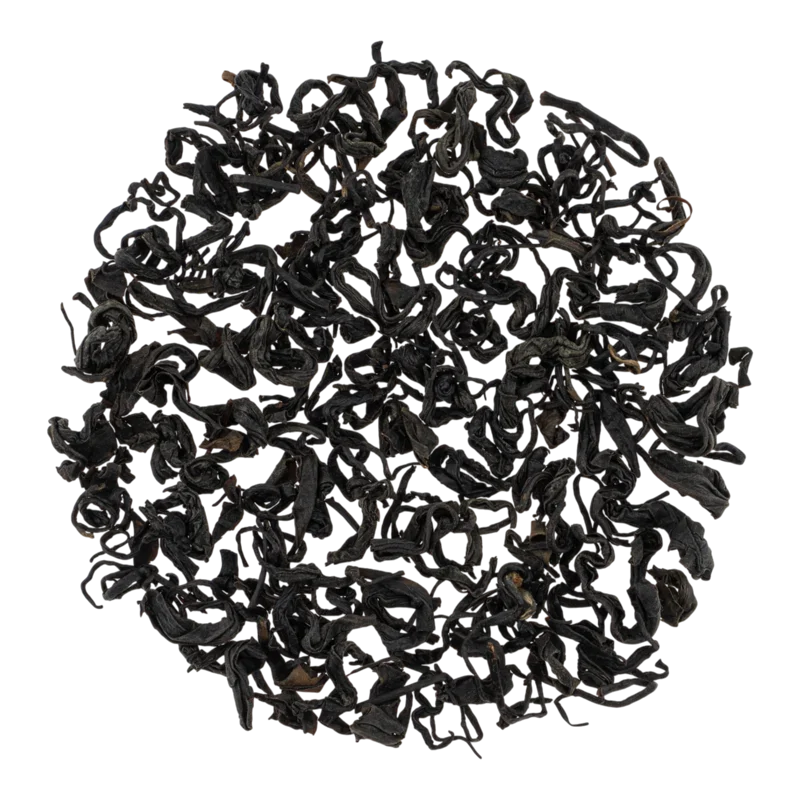
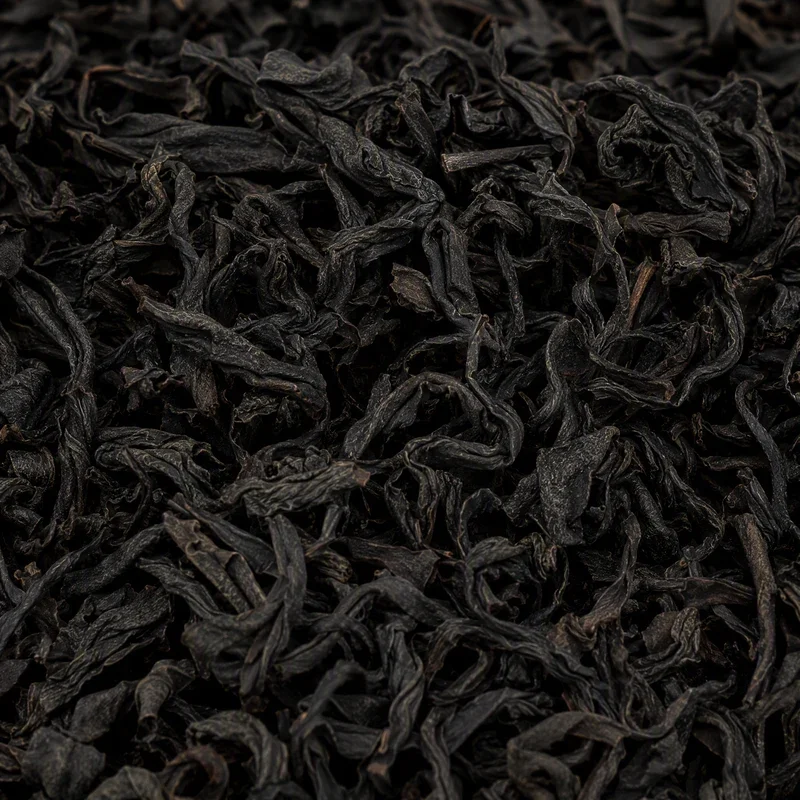
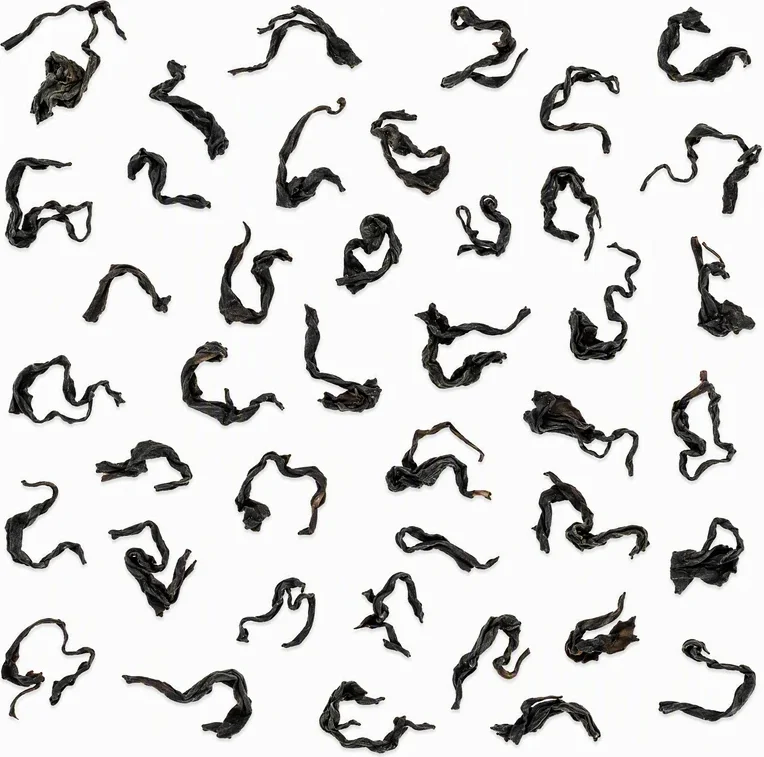
Dry Leaf Appearance: Small, tightly twisted tea particles of needle-like or spiral shape, dark brown, almost black color, often with glossy sheen. In highest grades, golden tips (buds) are present. Leaf is uniform, without stem impurities.
Dry Leaf Aroma: Intense, warm, sweet, with dominating notes of dark chocolate, cocoa beans, roasted nuts (hazelnuts, almonds), and caramel. Complementary shades—honey, rosehip, sweet pastry, sometimes light floral tones (rose).
Liquor Aroma: Deep, enveloping, with pronounced notes of caramel, malt sugar, dark chocolate, and dried fruits. As it cools, honey and rye bread notes emerge.
Liquor Color: Bright, clear, from golden-orange to rich copper-red. Noticeably lighter than many other red teas (black teas), due to small-leaf raw material and oxidation characteristics.
Spent Leaves: Small, uniform leaves of copper-brown color, elastic, with well-expressed traces of rolling.
Taste: The calling card of Laoshan Hong Cha—exceptional natural sweetness and softness. Bitterness and astringency are virtually completely absent. The taste is dominated by notes of dark chocolate, caramel, molasses, roasted malt, sometimes with nuances of baked fruits or rose jam. Liquor texture is dense, oily, "velvety." Aftertaste is long, warming, sweetish, with persistent chocolate-caramel notes.
Alkaloids: Caffeine (provides tonic effect), theobromine, theophylline. The synergy of caffeine and L-theanine creates mild, "focused" alertness without excessive stimulation.
Amino Acids: A distinctive feature of Laoshan teas—increased L-theanine content, due to slow growth in cool climate. Precisely the high concentration of theanine is responsible for the characteristic natural sweetness ("umami"), taste softness, and relaxing effect. Free amino acid content in Laoshan teas is estimated above average for red teas (black teas).
Essential Oils: Form the warm chocolate-caramel aromatic profile. Among key components—linalool, geraniol, β-ionone, benzaldehyde, and furfural.
Minerals: Potassium, manganese, fluorine, iron, zinc. Rich mineral composition is due to granite soils and mineralized water of the region.
Polyphenols: Theaflavins and thearubigins—products of deep catechin oxidation during oxidation. Determine liquor color, antioxidant activity, and mild astringent note (minimally expressed in this tea). Residual catechin content is low.
Vitamins: B group vitamins, E; trace amounts of vitamin C (significantly destroyed during oxidation), PP.
Balanced ratio of caffeine and L-theanine provides alertness without anxiety, improves concentration and working memory.
Theaflavins and thearubigins protect cells from oxidative stress, slowing aging processes.
Regular moderate consumption of red tea (black tea) is associated with improved endothelial function, blood pressure normalization, and reduction of "bad" cholesterol (LDL) levels.
Red tea (black tea) polyphenols have a mild stimulating effect on the digestive system, supporting intestinal microflora.
Red tea (black tea) belongs to "warm" beverages in traditional Chinese dietology, especially indicated in cold seasons.
High L-theanine content promotes relief of nervous tension and mood improvement.
Polyphenolic compounds of red tea (black tea) possess pronounced anti-inflammatory activity.
May cause insomnia, tachycardia, anxiety. Not recommended in large quantities late in the evening.
Strong tea on empty stomach may irritate gastric mucosa in gastritis or peptic ulcer.
Consumption should be limited due to caffeine content. Doctor consultation is recommended.
Tea polyphenols may slightly reduce absorption of non-heme iron from food; in anemia, tea should not be drunk directly during meals.
Tea Amount: 3–5 g per 150–200 ml water (flash steeping method); 2–3 g per 200–250 ml (steeping).
Teaware: Porcelain gàiwǎn (蓋碗, gàiwǎn) or teapot—optimal choice, allowing full appreciation of aroma and liquor color. Also suitable is a thin-walled Yixing clay teapot or tall glass cup (for visual observation of leaf opening).
Water Temperature: 90–95°C. Not recommended to use boiling water to avoid destroying delicate sweet notes.
Classic Anhui red tea (black tea) with delicate, elegant aroma reminiscent of orchid and rose. Profile is more floral, delicate, and "high," while Laoshan Hong Cha is denser, sweeter, and more "dessert-like," with chocolate-caramel dominance.
Fujian red tea (black tea) from Wuyi Mountains. Classic version has smoky aroma (from drying over pine smoke), "smokeless"—fruity-floral. Laoshan Hong Cha lacks smokiness, its profile is defined by chocolate and caramel, and texture is softer and sweeter.
Produced from large-leaf Assam raw material. Has powerful, rich honey-peppery taste and thick, "meaty" texture. Laoshan Hong Cha, made from small-leaf raw material, is significantly more delicate, lighter, and sweeter.
Taiwan Tea No. 18 (紅玉)—mint-cinnamon profile, completely different from chocolate-caramel Laoshan. Common feature—softness and low astringency, but aromatic directions are diametrically different.
Price Category: Laoshan Hong Cha belongs to medium and high price categories among Chinese red teas (black teas). Cost is due to unique terroir, complexity of cultivation in northern conditions, relatively small production volumes, and high costs of winter plantation protection. Price of highest grades (especially spring harvest) can reach significant levels, while summer and autumn grades are more accessible.
No reviews yet. Tell us what you think of this tea.
Rate this tea and share your impressions. We review each submission before publishing it.