Brewing
Gongfu brewing
- Water temperature
- 75 °C
- Tea amount
- 5 g
- Water volume
- 100 ml
- First steep
- 10 s
- Time added per infusion
- 5 s
- Infusions
- 3


Jīnjǐng máo jiān
Choose a brewing method. Start with the recommended quantities and time, then adjust to taste.
Brewing
Brewing
Taste
Tea encyclopedia
Category: Hunan regional green teas; included in the list of "Ten Famous Teas of Hunan" (湖南十大名茶, 2005).
Category: Hunan regional green teas; included in the list of "Ten Famous Teas of Hunan" (湖南十大名茶, 2005).
Coordinates: approximately 28°40′ N, 113°–114° E.
Origin: China, Húnán Province (湖南省, Húnán shěng), Chángshā County (长沙县, Chángshā xiàn), Jīnjǐng town (金井镇, Jīnjǐng zhèn). The core production area is located on hilly tea plantations at the confluence of the Jīnjǐng River (金井河) and Tuojia River (脱甲河).
Type: Green tea (绿茶, lǜchá), unoxidized.
Cultural Significance: The tea history of Jinjing town is closely intertwined with the economic history of the region: in the 19th century, red tea from Jinjing was exported through Hankou to Europe and Russia, and tea trade formed a local merchant class. The transition to green tea in the 20th century was a response to changes in the domestic market, and Jinjing Mao Jian quickly occupied the niche of "regional flagship." Today it is the calling card of the tea culture of Changsha County. Jinjing town positions itself as an ecologically clean area, having received certification as a "Chinese Natural Oxygen Bar" (中国天然氧吧). In 2023, the "Jinjing" brand occupied one of the leading positions by value among tea brands in Hunan. Tea in decorative porcelain packaging "Zhongguo Hong" (中国红, "Chinese Red") was once sold at auction for 63,800 yuan per package of two liang (100 g), which earned it the informal nickname "green gold" (绿色金茶).
History: The tea traditions of Changsha County date back to the Tang dynasty (618–907): Tang sources already recorded tea production in the Changsha area. During the Song era, there were more than twenty varieties of famous teas here, including Xiānzhī (仙芝) and Yujin (玉津). Lǐ Shízhēn (李时珍, Lǐ Shízhēn) in the "Compendium of Materia Medica" (本草纲目, Běncǎo Gāngmù) mentions "chu zhi cha" — tea from Hu(nan) Province, including "bai lu" (白露) from Jinjing, which is one of the early testimonies to the fame of local tea. During the Xianfeng and Tongzhi reigns of the Qing dynasty (1851–1874), red tea from Jinjing and Gaoqiao gained particular fame, forming the so-called "red tea zone" of Changsha–Liuyang–Pingjiang. Subsequently, green tea displaced red tea, and Jinjing Mao Jian became the flagship of the green tea line. The modern form of the tea was officially created in 1984 and in the same year was awarded by the Ministry of Agriculture, Animal Husbandry and Fisheries for quality. In 2005, the tea entered the top ten teas of Hunan. In 2008, the "Jinjing" trademark (金井牌) became the first in the provincial tea industry to receive the status of "China Well-Known Trademark" (中国驰名商标, Zhōngguó chímíng shāngbiāo). In 2016, the production technology was included in the registry of intangible cultural heritage of Hunan Province.
Name Breakdown: 金井 (Jīnjǐng) — "Golden Well," a toponym of the town, associated with a local natural spring. 毛尖 (Máo Jiān) — "downy tips" — a classic designation for the category of green teas made from young buds and upper leaves covered with white down (bai hao, 白毫).
Cultivar: Several varieties of Camellia sinensis var. sinensis are cultivated on Jinjing plantations: the main ones are Báiháo Zǎo (白毫早, Báiháo Zǎo, early-ripening with abundant down), Fúdǐng Dà Bái (福鼎大白, Fúdǐng Dà Bái, high shoot-forming ability), Zhū Yè Qí (槠叶齐, Zhū Yè Qí) and Xiangbo Lü (湘波绿, Xiāngbō Lǜ). The age of most bushes exceeds 30 years. The weight of one hundred shoots of the "one bud — one leaf" standard is about 45 g, and the period of maintaining tenderness of the raw material is extended by 7–10 days compared to flatland plantations.
Picking: Main picking — early spring; tea of the "mingqian" category (明前, míngqián, before the Qingming festival) is valued most highly. The principle of "five prohibitions" (五不采, wǔ bù cǎi) is strictly observed: leaves are not picked after rain, damaged by pests, purple leaves, as well as overly long and deformed shoots.
Pluck Standard: Special grade (特级, tèjí) — predominantly whole buds no longer than 2.0 cm; first grade — one bud and one leaf in initial opening stage (≥80%); second grade — one bud and two leaves.
Raw Material: Exclusively organic farming — only organic fertilizers are used; plantations are certified by the Swiss organization IMO (Institute for Marketecology) according to organic tea standards.
Altitude: 200–300 m a.s.l. (hilly terrain).
Soil: Purple soils (紫色土, zǐsè tǔ) predominate with pH 5.5–6.5, rich in potassium, silicon and trace elements. Forest coverage of the watershed is 72–87.6%, and the concentration of negative oxygen ions reaches fifty times the urban indicators.
The area belongs to a subtropical monsoon humid climate. Average annual temperature — 17.2°C, annual precipitation — 1,300–1,400 mm, frost-free period — 274 days. The number of foggy days exceeds 180 per year, providing predominance of diffused light — one of the key factors for accumulation of aromatic substances and amino acids in tea leaves.
Tea plantations are irrigated with local spring waters. The combination of fog, acidic fertile soils and mild temperature fluctuations forms the characteristic "chestnut" aromatic profile that distinguishes Jinjing Mao Jian from other Hunan mao jians. High forest coverage of surrounding territories creates a natural ecological barrier, preventing the spread of pollution and pests. Plantations are located in the zone of hilly interfluve, where morning fogs linger in valleys until late morning, providing leaves with additional hours of diffused lighting. This slows photosynthesis and promotes accumulation of amino acids (primarily L-theanine) at the expense of catechins, which forms the characteristic mildness of taste and increased sweetness.
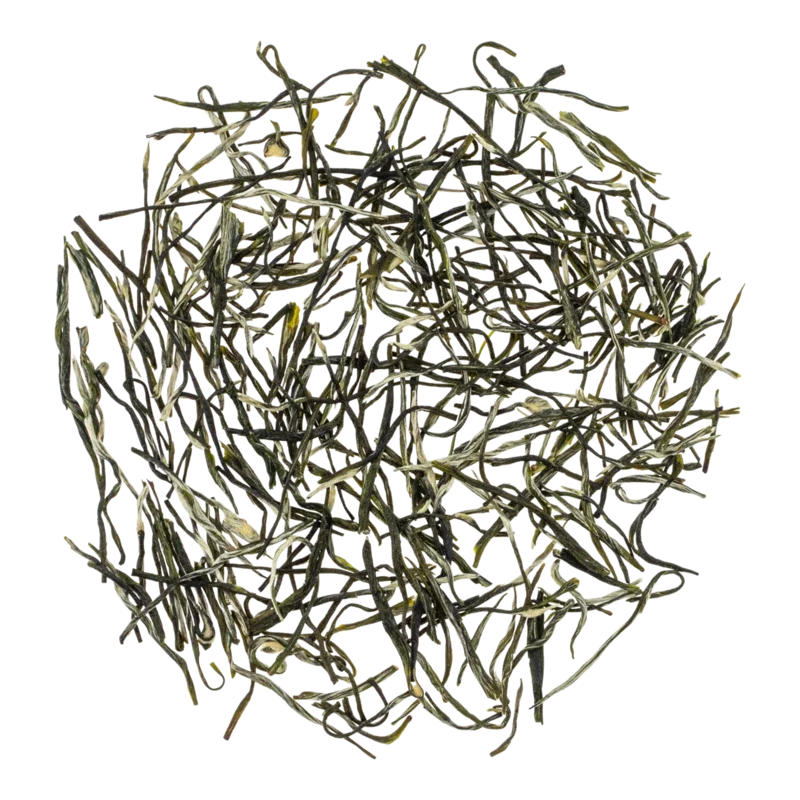
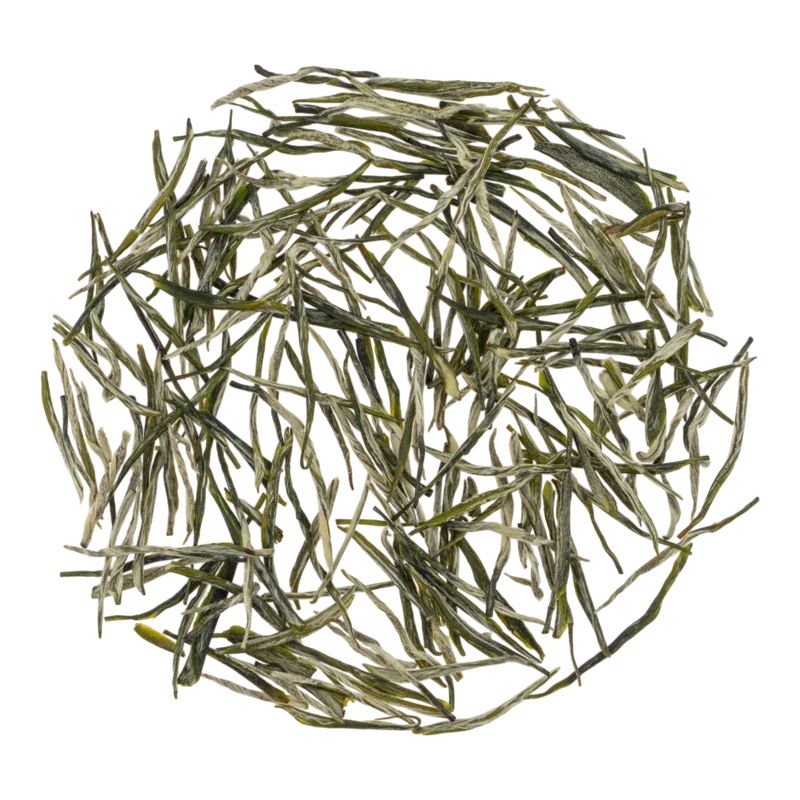
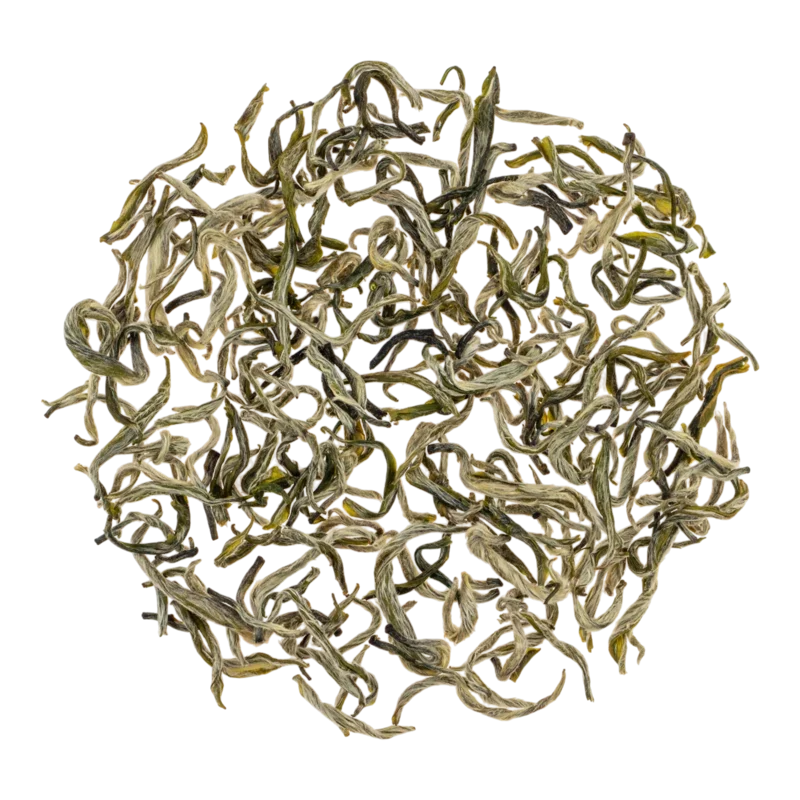
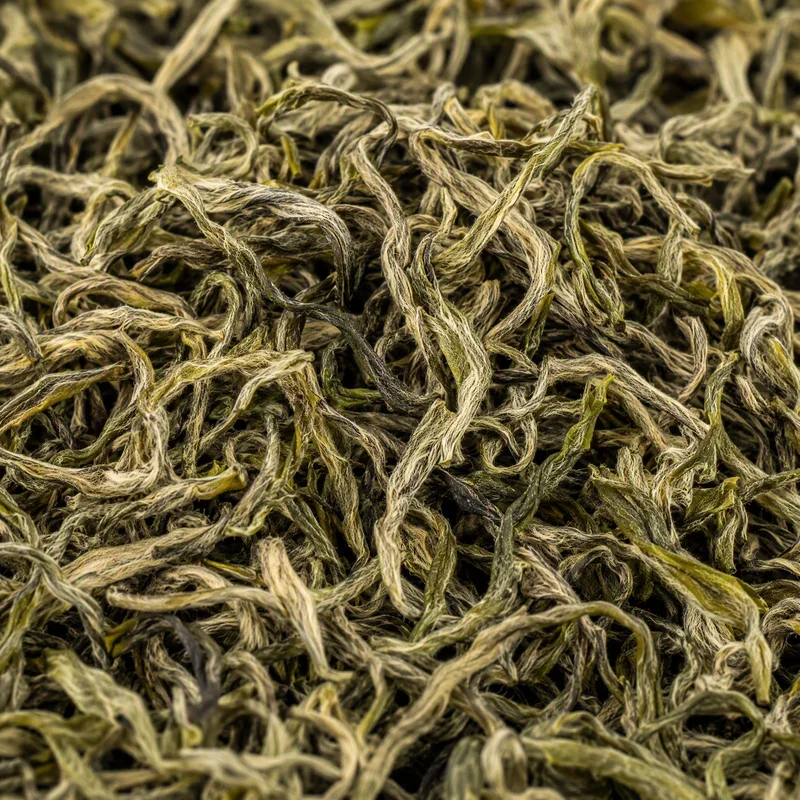
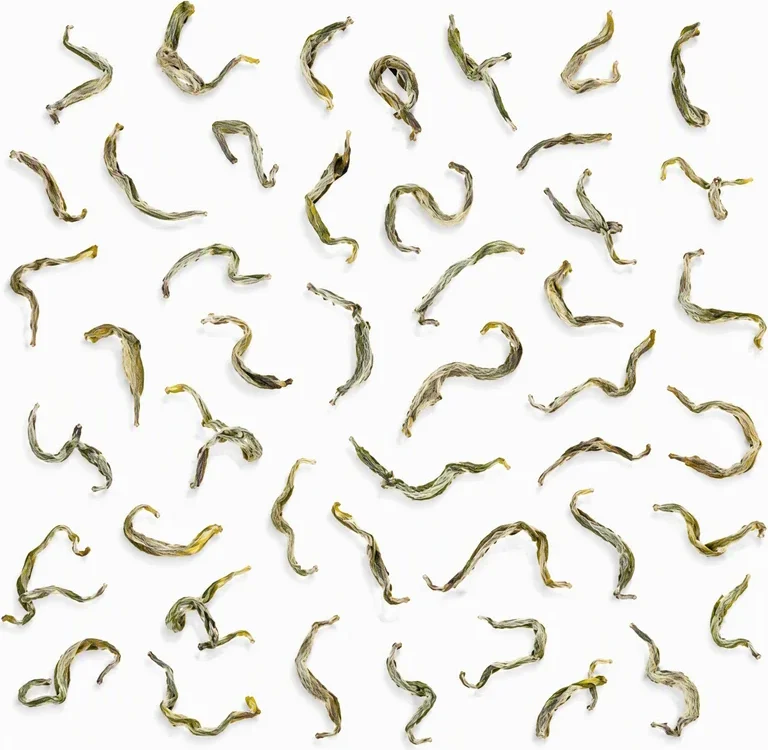
Dry Leaf Appearance: Tea particles are thin, uniform, spirally twisted (卷曲似螺), with abundant white down (白毫显露), silvery-green color with emerald undertone. Surface is smooth, glossy.
Dry Leaf Aroma: Clean, high aroma with pronounced chestnut note (栗香, lì xiāng), especially noticeable in special grade. When warmed in the hand, fresh floral-herbal base unfolds.
Liquor Aroma: Persistent, clean, with chestnut accent in top notes and refreshing greenness at the base. Aroma persists through several infusions.
Liquor Color: Tender green, transparent, with bright clean luster (嫩绿清澈, nèn lǜ qīngchè).
Spent Leaves: Tender, uniform, bright green, with preserved integrity of buds and leaves.
Taste: Fresh (清鲜, qīng xiān), with pronounced sweetness in aftertaste — returning sweetness (huí gān) (回甘, huígān). Body is light but not watery; amino acid component gives gentle umami-like component. Bitterness and astringency are practically absent with proper brewing.
Alkaloids: Caffeine, theobromine, theophylline — standard set for quality green tea, providing mild stimulation.
Amino Acids: High level due to foggy microclimate and shading, forms sweetness and "body" of taste.
≥45% (special grade), indicating rich content of soluble substances and high extractability.
The tea is distinguished by increased content of zinc (Zn) and selenium (Se) — result of specific mineral composition of purple soils in the region.
Fluorine content promotes strengthening of tooth enamel and suppression of cariogenic bacteria.
Essential Oils: Chestnut and herbaceous aromatic compounds formed during drum fixation and down lifting stage.
Polyphenols: Tea polyphenol content ≥30% (for first grade), providing pronounced antioxidant activity. According to the producer, the effectiveness of free radical neutralization by Jinjing Mao Jian polyphenols is 18 times higher than the similar indicator of vitamin E.
Vitamins: B group, vitamin C (significant content in fresh spring raw material), vitamin K.
Spring or filtered soft water; tap water with high mineralization is undesirable as it may distort taste.
Tea Amount: 3 g per 150 ml (1:50 ratio) for glass method; 5–6 g per 120 ml for gaiwan in gongfu style.
Teaware: Glass tumbler — ideal option for observing the "dance" of leaves (top-down method is recommended — shang tou fa, 上投法, when tea is lowered into already poured water). White porcelain gaiwan is suitable for focused aroma tasting. Yixing teapot is not recommended — porous clay may absorb delicate aroma.
Water Temperature: 85°C (for special grade — 80°C). Using boiling water above 85°C is categorically not recommended: this destroys L-theanine and provokes excessive bitterness.
Container: Airtight packaging (vacuum bags or tin cans with tight lid), mandatory protection from foreign odors, light and moisture.
Consume within one month; store in refrigerator in tightly closed container.
Freshly picked tea is recommended to be aged for 7 days in darkness for "fire calming" (醒茶, xǐng chá), so that slight heat from roasting dissipates.
Temperature: Optimally 0–5°C (refrigerator) for long-term storage; shelf life under proper conditions — up to 12 months. Before opening, packaging must be brought to room temperature in closed form to avoid moisture condensation on leaves.
Henan Province. One of the "Ten Famous Teas of China." Straight needle-like shape (unlike spiral shape of Jinjing), pronounced chestnut aroma with note of "ripe chestnut peel." Produced at higher fixation temperature (160–200°C in hand wok), liquor is denser and more saturated.
Hunan Province (Xiangxi). Straight shape with abundant down, fresh aroma with floral accents. Grown at high altitudes (up to 800 m) in area with high selenium content in soils. Technology includes eight stages with hand shaping.
Guizhou Province. "Ten Famous Teas of China." Produced from small-leaf mountain varieties at altitudes over 1,000 m. Shape — tightly twisted "hooks" with silvery down; taste is lighter with pronounced sweetness, aroma is thinner and more delicate. Polyphenol content — about 20%, which is noticeably lower than Jinjing Mao Jian (≥30%).
Hunan Province (Ningxiang). Important difference: belongs to yellow tea category (黄茶), not green. Includes "sealed yellowing" stage (闷黄, mèn huáng), giving liquor orange-yellow color and smoky aroma of pine resin — completely different flavor profile.
Hunan Province (Xuefeng range). Named after Baima mountain range, at whose foot plantations are located at confluence with Huangjinjing valley (黄金井). Tea particles are denser, slightly curved; aroma is high and floral; liquor is lighter, with clean green tone. Assigned status of "famous tea of Hunan Province" in 1991.
Special grade (单芽, whole buds, hand processing) — from 800 yuan/jin (500 g) and higher; first grade — 200–500 yuan/jin; second grade — 100–300 yuan/jin. Gift sets in decorative porcelain packaging may cost significantly more.
Price Factors: Picking season (mingqian more expensive than yuqian), picking standard (whole bud more expensive than bud with leaf), manual or machine labor, specific year's harvest.
No reviews yet. Tell us what you think of this tea.
Rate this tea and share your impressions. We review each submission before publishing it.