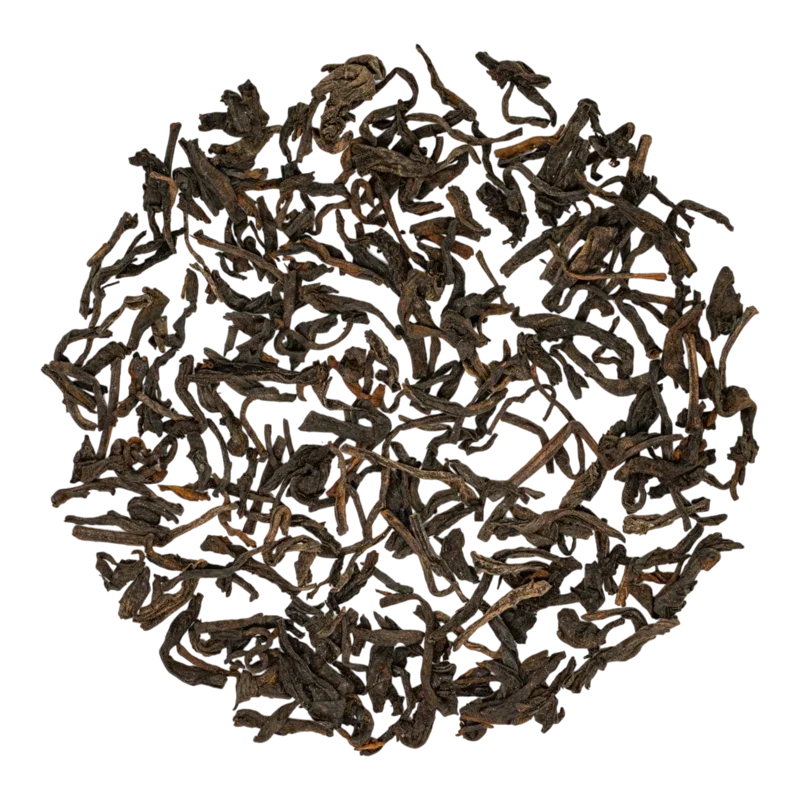
Brewing
Gongfu brewing
- Water temperature
- 100 °C
- Tea amount
- 6 g
- Water volume
- 100 ml
- First steep
- 10 s
- Time added per infusion
- 5 s
- Infusions
- 10

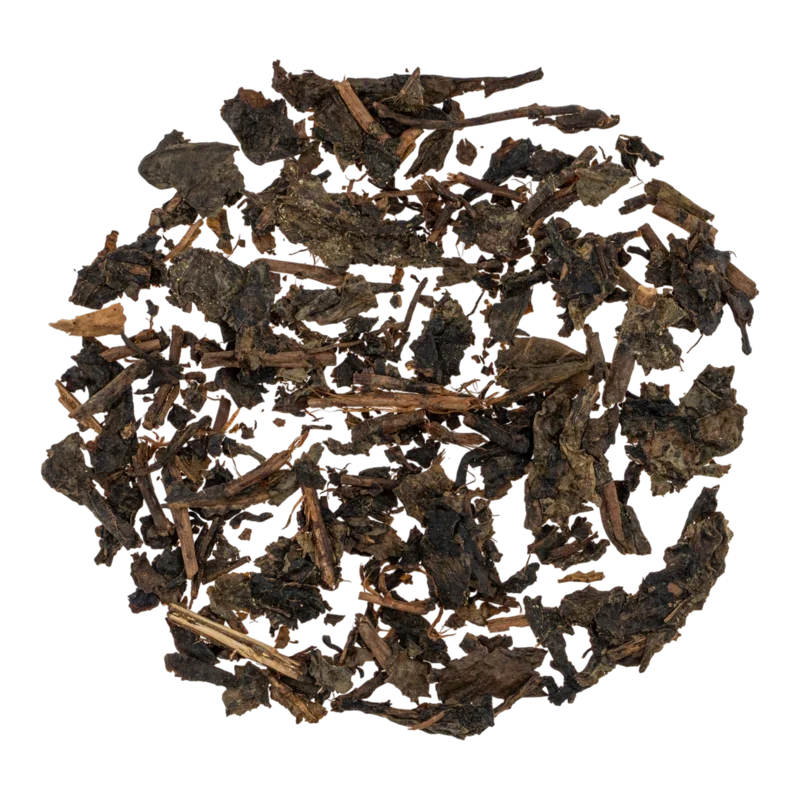

Jīngyáng fú zhuān
Choose a brewing method. Start with the recommended quantities and time, then adjust to taste.
Brewing
Brewing
Taste
Tea encyclopedia
Category: Famous Teas of China. One of the most renowned representatives of Shaanxi Hēi Chá and the only dark tea to receive National Product with Geographical Indication status (国家地理标志产品) in Shaanxi Province (since 2013). Product of intangible cultural heritage at provincial and national levels (the Fu Zhuan production technique was included in 2022 in UNESCO's Representative List of the Intangible Cultural Heritage of Humanity as part of the collective application "Traditional tea processin...
Category: Famous Teas of China. One of the most renowned representatives of Shaanxi Hēi Chá and the only dark tea to receive National Product with Geographical Indication status (国家地理标志产品) in Shaanxi Province (since 2013). Product of intangible cultural heritage at provincial and national levels (the Fu Zhuan production technique was included in 2022 in UNESCO's Representative List of the Intangible Cultural Heritage of Humanity as part of the collective application "Traditional tea processing techniques and associated social practices in China").
Coordinates: Approximately 34°26′–34°44′ North latitude, 108°29′–108°58′ East longitude.
Origin: China, Shaanxi Province (陕西, Shǎnxī), Xiányáng Prefecture (咸阳, Xiányáng), Jīngyáng County (泾阳县, Jīngyáng Xiàn). Jingyang is the historical birthplace and unchanging center of Fu Zhuan production, despite the fact that raw tea leaves are not grown there. The tea is created from imported dark raw tea (黑毛茶, hēi máo chá), delivered from southern regions of Shaanxi, Hunan, and Sichuan.
Type: Post-fermented tea, belonging to the category of Hēi Chá (黑茶, Hēichá — "dark tea"). Undergoes double fermentation: primary (渥堆, wò duī — wet piling) and secondary — "development of golden flowers" (发花, fāhuā), during which the fungus Eurotium cristatum is cultivated in the tea mass.
Tmall, JD.com (sections with geographical indication products), specialized tea shops with reputation and customer reviews.
In major Chinese cities and international Chinatowns, look for shops specializing in Shaanxi teas or dark teas in general.
Cultural Significance: Jingyang Fu Zhuan occupies a special place in the history of Chinese tea culture as the only dark tea whose production developed not in a tea-growing region, but at a trade crossroads. Folk wisdom states: "自古岭北不植茶,唯有泾阳出砖茶" — "Since ancient times, tea is not planted north of the ridges, but only in Jingyang is brick tea made." For the nomadic peoples of Northwest China — Uyghurs, Tibetans, Mongols, Kazakhs — Fu Zhuan was "life-essential tea" (生命之茶, shēngmìng zhī chá): it compensated for the deficiency of vitamins and fiber in a diet consisting predominantly of meat, dairy products, and fats. Hence the saying: "Better three days without food than one day without tea" (宁可一日无粮,不可一日无茶). The famous rule of "three inseparabilities" (三不离, sān bù lí) — "cannot be made without Jingyang water, cannot be made without Jingyang climate, cannot be made without the craftsmanship of Jingyang people" — reflects this tea's unique dependence on place and people.
History: The history of Jingyang Fu Zhuan spans more than six centuries and is inextricably linked to the tea-horse trade (茶马贸易, chámǎ màoyì) — a crucial economic mechanism connecting central China with the nomadic peoples of the Northwest.
Name Breakdown: The tea's name consists of several semantic components:
Cultivar: Jingyang Fu Zhuan is made not from local raw materials, but from imported dark raw tea (黑毛茶, hēi máo chá) from several origins:
Picking: Main harvest of raw material for dark raw tea occurs in summer and autumn (May to October). Mature leaves with stems are used — it is in mature leaves that the maximum concentration of substances providing substrate for Eurotium cristatum development is contained.
Pluck Standard: Depends on target product class: for special grade (特级) — no less than 90% single buds; for first grade (一级) — no less than 80% "one bud + one leaf"; for second grade (二级) — "one bud + two leaves" and mature leaves.
Raw Material: Dark raw tea must undergo a complete cycle of primary processing (杀青 — shaqing, 揉捻 — rouniyan, 渥堆 — wodui, drying) before arriving in Jingyang, where secondary processing begins.
Climate: Warm temperate continental monsoon. Average annual temperature about 13°C. Annual precipitation — 548.7 mm. It is precisely the combination of moderate warmth and increased humidity for this region that creates ideal conditions for Eurotium cristatum reproduction.
Soil: Brown forest soils (棕壤, zōngrǎng) with organic matter content over 1.0%, creating a favorable microbiological environment in production facilities.
Jīngyáng County is located in the heart of the Guanzhong Plain (关中平原), in the lower reaches of the Jing River. From the north it is protected by the Cue and Beizhong mountain ranges (嵯峨山, 北仲山), from the south — by the Zhongnanshan range (终南山). Such surroundings form a peculiar lowland "bowl" in which a unique microclimate with increased humidity — about 75% — arises, which is generally atypical for the arid Northwest China.
Water: Jingyang's groundwater, fed by the Jing River, has a weakly alkaline reaction (pH ≈ 8.2) and is rich in potassium, calcium, and fluoride ions. This water is used at all stages of processing — from moistening during piling to brewing tea juice (熬茶汁, áo chá zhī). It is believed that precisely the mineral composition of local water is one of the key factors of the "three inseparabilities."
Imported raw tea is sorted by fractions and quality. Foreign inclusions are removed, leaves are divided into classes.
Raw tea is moistened with local water, laid in low piles and fermented at 40–60°C for approximately 12 hours. This stage differs from the primary piling conducted at the place of raw material origin.
Part of the tea is boiled with water until a thick extract — "tea glue" — is obtained, which is then used for binding the mass during pressing and serves as a nutrient medium for "golden flowers."
The tea mass is heated in a wok or special vats to equalize moisture and activate enzymatic processes. Fruit wood fuel is used.
Precise weighing of tea for each brick.
Brief steam treatment softens the leaf and makes it pliable for molding.
Tea mass is placed in a wooden mold (traditionally — from mulberry or fruit wood).
Key stage, recognized as intangible cultural heritage. The master (筑茶匠, zhù chá jiàng) compacts the tea in the mold using a wooden mallet (木槌, mù chuí), delivering rhythmic blows. The packing density must be strictly defined: too dense a brick will not allow air for "golden flowers" growth, too loose — will fall apart. Control is carried out exclusively by touch and sound, passed from master to master.
The most crucial stage, lasting about 12 days. Formed bricks are placed in special rooms (发花房, fāhuā fáng), where temperature of 24–28°C and humidity of about 75–85% are maintained. Under these conditions, the fungus Eurotium cristatum begins to develop vigorously on tea leaves, forming characteristic golden-yellow specks — "golden flowers" (金花, Jīn Huā). The process is divided into three stages with gradual change of temperature-humidity regime — this is the unique "three-stage controlled temperature and humidity flower development technology" (发花三阶段控温控湿技术), developed by Jingyang masters.
Conducted stepwise (梯度升温): temperature gradually rises to 50°C, then slowly decreases. This ensures preservation of "golden flowers" viability and prevents brick cracking.
Liquor Aroma: Rich, enveloping, with dominant mushroom tone, notes of dried fruits, nuts, and warm wood. Old tea reveals medicinal, "pharmaceutical" notes (药香, yào xiāng).
Liquor Color: Orange-red, transparent and bright (橙红透亮), resembling young amber. With increased aging acquires a deeper red-brown tone.
Dense rectangular brick with even edges and flat surfaces. Surface color — black-brown with oily luster. When the brick is broken, the internal mass is densely studded with golden-yellow specks of "golden flowers," resembling a starry sky or scattered millet grains. The more abundant and larger the "flowers," the higher the tea quality.
Characteristic mushroom aroma of "golden flowers" (菌花香, jūn huā xiāng) — something between the aroma of fresh chanterelles and light honey sweetness. Aged specimens develop a pronounced old woody note (陈香, chén xiāng), and with significant aging — a warm camphor shade (樟香, zhāng xiāng).
Spent Leaves: Yellow-brown, uniform, retaining resilience and elasticity. Residual traces of "golden flowers" may be visible on leaves.
Taste: Liquor body — full, dense, oily. Taste is characterized by three key qualities: 醇厚 (chún hòu) — "rich depth," without harshness and sharp edges; 回甘 (huí gān) — prolonged sweet aftertaste; 绵滑 (mián huá) — silky, velvety texture. Bitterness and astringency are practically absent.
Alkaloids: Caffeine, theobromine, theophylline. Caffeine content is moderate, as part of it binds during fermentation.
Amino Acids: Free amino acid content ≥ 4.7% (for first grade), including L-theanine.
One of the highest contents among all tea types. Polysaccharides play a key role in regulating carbohydrate and lipid metabolism.
≥ 31.3–45% depending on grade — an indicator speaking to the exceptional richness of the infusion.
Particularly high selenium content — up to 36.3 mg/kg (significantly higher than average for teas), as well as potassium, calcium, fluoride, manganese, zinc.
Polyphenols: Tea polyphenol content ≥ 21% (for special grade). During post-fermentation, catechins transform into theaflavins and thearubigins, which softens taste and forms characteristic liquor color.
Vitamins: A, C, E, K, B group (including niacin).
Tea polysaccharides combined with "golden flower" metabolites activate lipase and accelerate fat breakdown. Cholesterol reduction effectiveness is assessed as significantly higher compared to ordinary green tea.
Polysaccharides stimulate glucokinase activity and increase cell sensitivity to insulin.
Theanine and GABA (gamma-aminobutyric acid), formed during fermentation, have a mild hypotensive effect.
Tea polyphenols neutralize free radicals, slowing cellular aging processes.
High content of enzymes produced by Eurotium cristatum improves breakdown of fatty and heavy food. Historically, this accounts for Fu Zhuan's indispensability for nomadic peoples eating predominantly meat and dairy products.
High selenium content stimulates immune protein synthesis.
The tea's warm nature (温性) makes it ideal for cold climate and high altitudes.
Living cultures of Eurotium cristatum and their metabolic products positively affect intestinal microflora.
Tea Amount: 5–8 g per 150–200 ml water (for flash steeps method). For boiling — 5 g per 200 ml.
Teaware: Optimal options:
Water Temperature: 100°C (rolling boil). Jingyang Fu Zhuan is one of the few teas for which boiling water is specifically recommended, as the dense brick structure and "golden flowers" open only at maximum temperature.
Container: Original paper packaging or kraft paper. Completely airtight packaging should not be used — tea must "breathe" for continued slow microbiological transformation.
Enemies: Direct sunlight, sharp foreign odors (spices, perfumery, household chemicals), excessive humidity (risk of undesirable mold development).
Dry, dark, well-ventilated room. Temperature — room temperature (15–25°C). Humidity — no higher than 70%.
Practically unlimited with proper conditions. Specimens with 20–30 years and more aging are considered especially valuable collectible teas.
A Hunanese "relative" produced in Anhua County using adapted technology with local raw materials. The taste is typically more astringent and "earthy," with less pronounced fungal sweetness. "Golden flowers" are present, but Jingyang Fu Zhuan is traditionally renowned for their greater abundance and larger size.
The "thousand liang tea" from Anhua is pressed into giant cylinders weighing up to 36 kg, wrapped in bamboo leaves. The taste is more powerful, astringent, with pronounced smoky notes. "Golden flowers" are usually absent.
Dark tea from Guǎngxī with a characteristic betel nut aroma (槟榔香). Produced using fundamentally different technology, without the "golden flower development" stage. The taste is more "earthy" and "fungal," with mineral notes.
Yúnnán Hēi Chá that undergoes accelerated fermentation (渥堆) in large batches. The taste is typically more "earthy," with notes of decayed leaves. Fu Zhuan has a softer, sweeter profile with a characteristic "fungal" note due to the "golden flowers."
Look for products with geographical indication marking (地理标志产品) and indication of specific Jingyang producer.
Break the brick — "flowers" should be abundant, large (like millet grains), golden-yellow color, evenly distributed throughout the thickness. White, greenish, or black specks indicate undesirable molds.
Characteristic mushroom aroma of "golden flowers" should be clean, pleasant, without mustiness, acidity, or foreign odors.
Color should be orange-red, transparent. Cloudy, dark, or gray liquor — sign of poor quality product.
Genuine Jingyang Fu Zhuan is a labor-intensive handmade product with lengthy production cycle; price significantly below market should raise suspicion.
No reviews yet. Tell us what you think of this tea.
Rate this tea and share your impressions. We review each submission before publishing it.