Brewing
Gongfu brewing
- Water temperature
- 75 °C
- Tea amount
- 5 g
- Water volume
- 100 ml
- First steep
- 10 s
- Time added per infusion
- 5 s
- Infusions
- 3

Jìngshān Chá
Choose a brewing method. Start with the recommended quantities and time, then adjust to taste.
Brewing
Brewing
Taste
Tea encyclopedia
Category: One of the "Ten Famous Teas of Zhejiang Province" (浙江省十大名茶). Historic tea with roots in the Tang era (8th century), achieving fame in the Song (10th–13th centuries). Besides the classic twisted green tea, under the "Jingshan Cha" brand today are also produced niancha (碾茶, niǎnchá — steamed tea for matcha production) and matcha itself (抹茶, mǒchá) — direct heritage of the Tang-Song tradition.
Category: One of the "Ten Famous Teas of Zhejiang Province" (浙江省十大名茶). Historic tea with roots in the Tang era (8th century), achieving fame in the Song (10th–13th centuries). Besides the classic twisted green tea, under the "Jingshan Cha" brand today are also produced niancha (碾茶, niǎnchá — steamed tea for matcha production) and matcha itself (抹茶, mǒchá) — direct heritage of the Tang-Song tradition.
Jìngshān Village (径山村, Jìngshān Cūn) in Jingshan Township, particularly the slopes of Lingxiaofeng Peak (凌霄峰) and the Sibiou Valley (四壁坞).
Coordinates: Approximately 30°24′ North latitude, 119°51′ East longitude.
Origin: China, Zhèjiāng Province (浙江, Zhèjiāng), Hángzhōu City (杭州, Hángzhōu), Yúháng District (余杭区, Yúháng Qū). The production zone encompasses the townships of Jìngshān (径山镇), Yúháng (余杭), Xianlin (闲林), Zhongtai (中泰) in Yuhang District, as well as the townships of Hengban (横板) and Gaohong (高虹) in neighboring Lin'an City (临安市).
Type: Green tea (non-oxidized). By form — twisted "mao feng" (毛峰) with characteristic curled leaf shape. Technologically — pan-firing combined with baking (炒烘结合, chǎo hōng jiéhé).
Cultural Significance: Jingshan Cha is a tea with unique civilizational significance extending far beyond gastronomy. It is:
History: Tea cultivation on Mount Jingshan dates back to 742 CE (Tang era, Tianbao period, 天宝), when the Chán monk Fǎqīn (法钦禅师, Fǎqīn Chánshī) established the Jingshansi Monastery (径山寺, Jìngshān Sì) on the summit and planted tea bushes as offerings to Buddha. The monastery quickly became one of China's largest Chan (Zen) centers — in the Song era it held the title "foremost among the five great Chan monasteries under Heaven" (天下禅林之冠).
Cultivar: For Jingshan Cha production, both specialized local cultivars and adapted introduced varieties of Camellia sinensis var. sinensis are used:
Picking: Early spring picking. For supreme first grade (特级一等) — one bud with one barely opened leaf (一芽一叶初展), shoot length 2–2.5 cm. For first grade — one bud with one to two leaves, 2.5–3 cm. For second grade — one bud with one to two leaves, 3–3.5 cm.
Pluck Standard: Six categories: special class of three levels (特级一、二、三等) and three standard grades (一级、二级、三级). Raw material must be fresh, tender, without diseased leaves or damage.
Raw Material: Tender, uniform shoots. For niancha (碾茶), raw material from tea bushes that have undergone shading (覆下栽培, fù xià zāipéi) is used — following Japanese "kabuse" technology, which increases amino acid and chlorophyll content.
Climate: Mountain peaks are almost constantly shrouded in clouds and mist. Daily temperature variations are significant, promoting amino acid accumulation in young shoots. Annual precipitation exceeds 1400 mm. Abundant diffused light (漫射光) combined with high humidity creates conditions close to ideal for producing delicate green teas.
Soil: Acidic red or yellow soils (红壤 / 黄壤) with pH 4.5–6.0, deep profile, high organic matter content. Leaf litter from bamboo and coniferous trees enriches the soil, creating a powerful humus horizon.
Mount Jingshan is the northeastern edge of the Tianmushan Range. Tea gardens are located at 560 meters above sea level and higher, on gentle slopes surrounded by bamboo and coniferous forests. The ecosystem of "tea among bamboo forest" (竹木共生, zhú mù gòngshēng) is a characteristic feature of the terroir.
Freshly picked raw material is spread in a thin layer in a cool room for 6–12 hours. During this time excess moisture evaporates, aromatic precursors begin to form, and leaves become soft and pliable.
High-temperature pan-firing at 150–170°C. Rapid inactivation of oxidative enzymes fixes green color and fresh aromatics.
As temperature decreases to 80–90°C, the master manually shapes the tea leaves, giving them their characteristic slightly twisted form.
Light rolling — minimal pressure to preserve the integrity of tender buds and leaves while ensuring sufficient cell juice release for future extraction.
Drying at moderate temperature to reduce moisture and set the shape.
Slow charcoal drying over low heat (文火慢烘, wénhuǒ màn hōng) — the key stage for aroma development. This "slow fire" creates the persistent chestnut-orchid bouquet that cannot be achieved with rapid machine drying.
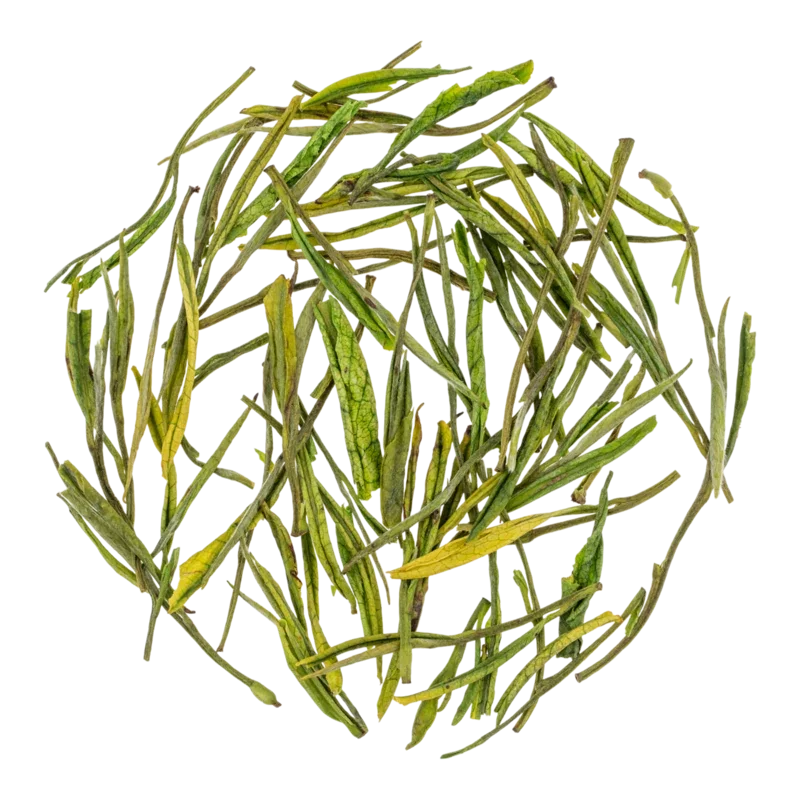
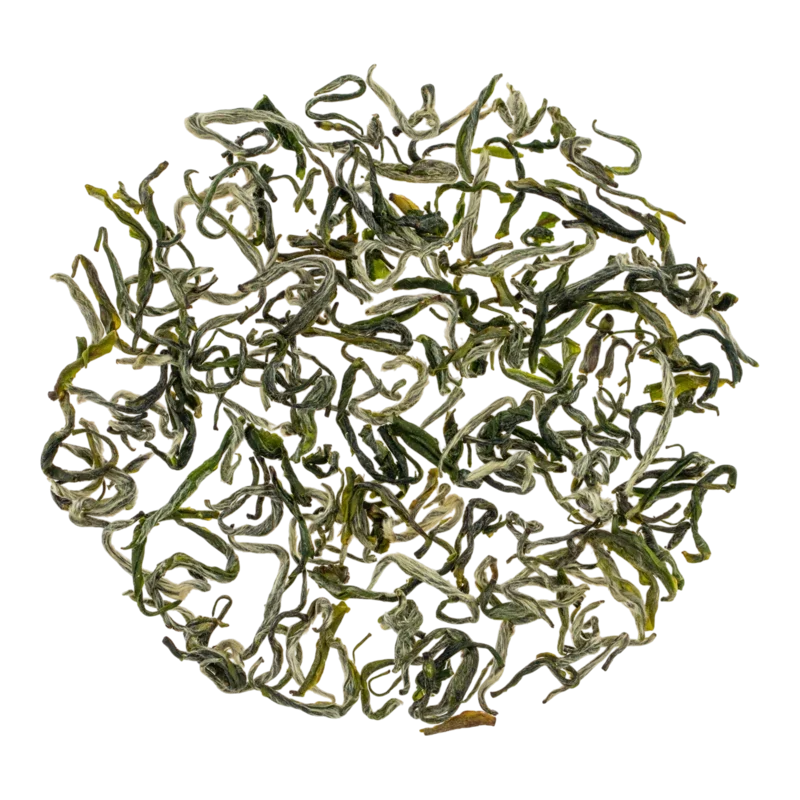
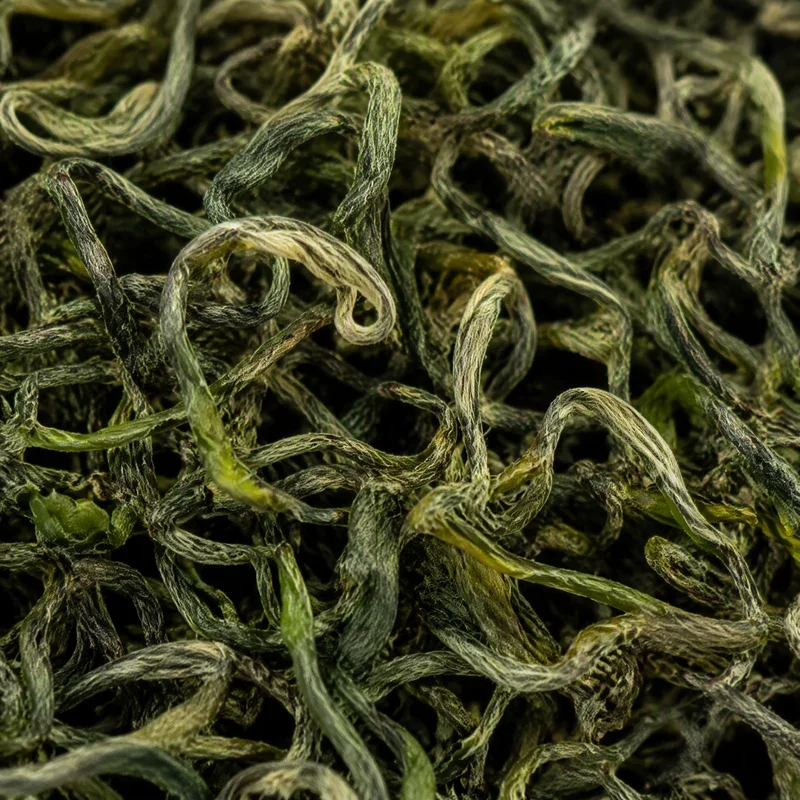
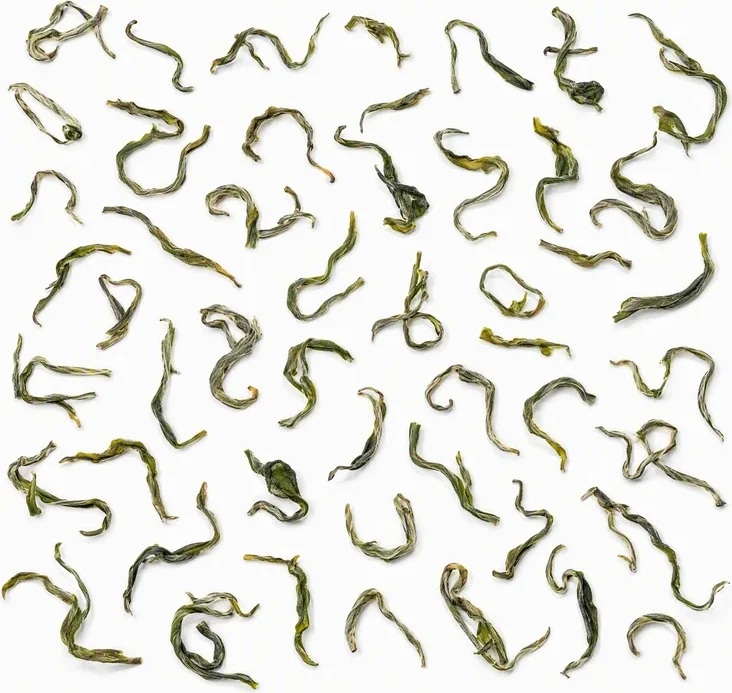
Dry Leaf Appearance: Fine, tightly twisted shoots with characteristic curled form (细紧卷曲). Color is bright emerald-green (绿翠) with abundant silvery down (显毫). In supreme grades — uniform, elegant, graceful tea leaves.
Dry Leaf Aroma: Delicate aroma of young buds (嫩香, nèn xiāng), chestnut note (板栗香, bǎnlì xiāng), orchid overtone (兰花香, lánhuā xiāng). Aroma is clean, without grassiness.
Liquor Aroma: Persistent, high, with chestnut-orchid profile. Unfolds gradually from steeping to steeping.
Liquor Color: Tender green, clean, bright and clear (嫩绿莹亮).
Spent Leaves: Tender, whole shoots gathered in "buds" (细嫩成朵). Color is even, light green. Leaves are elastic, lively.
Taste: Fresh and brisk (鲜爽, xiānshuǎng), mellow and sweet (甘醇, gānchún), with long returning sweetness (回甘, huígān). Body is medium-dense, rounded. Astringency is minimal. Classic formula: "First steeping — light and clean, second — rich and aromatic, third — mellow and harmonious" (首泡清淡,二泡浓郁,三泡醇和).
Alkaloids: Caffeine — moderate content. Theobromine, theophylline.
Amino Acids: Elevated content — key factor for freshness, sweetness, and umami note. For tea from shaded raw material (niancha/matcha), amino acid content is even higher.
Elevated content in shaded raw material — ensures intense green color of matcha.
Minerals: Potassium, magnesium, zinc, manganese — profile determined by acidic mountain soils enriched with bamboo litter.
Polyphenols: Moderate content — result of abundant diffused light. Provides light structural depth of taste without harsh astringency.
Vitamins: Vitamin C, B-group vitamins, carotenoids.
Caffeine and L-theanine provide gentle, focused alertness.
Catechins and polyphenols neutralize free radicals.
Complex of polyphenols, vitamins, and trace elements supports immune function.
Stimulation of digestive enzyme secretion.
The infusion quenches thirst and reduces internal heat.
the listed properties are based on publicly available data and are not medical recommendations.
First fill the glass with water (80–85°C) to 7/10 volume, then add tea. Recommended for supreme grades — allows observing how tea leaves slowly sink and unfold.
Pour water to 1/3, add tea, wait for wetting, fill to 7/10.
Add tea, pour water. Classic method for daily tea drinking.
Do not over-steep to avoid increasing astringency. Not recommended to drink on empty stomach.
Tea Amount: 3 g per 150 ml water (1:50 ratio).
Teaware: Glass cup (玻璃杯) — for observing the unfolding of twisted shoots and evaluating liquor color.
Water Temperature: 80–85°C.
Fellow from Hangzhou. Flat leaf, chestnut-bean aroma. Longjing is more "structural" and umami-oriented; Jingshan Cha is more twisted, downy, with more pronounced orchid note.
From northern Zhejiang. Green tea from albino shoots with record amino acid content. Anji is "pure sweetness and umami"; Jingshan Cha is more classic "mao feng" with chestnut character.
From western Zhejiang. Twisted green tea with floral aroma. Longding is lighter; Jingshan Cha is more historically deep and connected to Chan tradition.
characteristic twisted "mao feng" shape with abundant down. Loose, uneven tea leaves are signs of counterfeits.
clean chestnut-orchid tone. Absence of floral character is cause for doubt.
tender green, bright, clear.
tea from the core zone cannot be cheap.
No reviews yet. Tell us what you think of this tea.
Rate this tea and share your impressions. We review each submission before publishing it.