Brewing
Gongfu brewing
- Water temperature
- 75 °C
- Tea amount
- 5 g
- Water volume
- 100 ml
- First steep
- 10 s
- Time added per infusion
- 5 s
- Infusions
- 3

Guǎngxī xuě yá
Choose a brewing method. Start with the recommended quantities and time, then adjust to taste.
Brewing
Brewing
Taste
Tea encyclopedia
Category: Modern artisanal green tea from buds and young leaves; loose leaf (散茶, sǎnchá), without pressing or flavoring. Belongs to "hybrid" tea products, combining a white tea cultivar with green tea technology.
Category: Modern artisanal green tea from buds and young leaves; loose leaf (散茶, sǎnchá), without pressing or flavoring. Belongs to "hybrid" tea products, combining a white tea cultivar with green tea technology.
Coordinates: ≈ 23.9° N, 106.6° E (Baise region; plantations distributed across the mountain belt to the northwest).
Origin: China, Guǎngxī Zhuāng Autonomous Region (广西壮族自治区, Guǎngxī Zhuàngzú Zìzhìqū), Bǎisè region (百色, Bǎisè). Tea gardens are located in mountainous areas at altitudes of 800–1,200 m, with some plots (for example, Nanling, 南岭) reaching up to 1,500 m above sea level. The region borders the tea-growing zone of Língyún County (凌云县, Língyún Xiàn), famous for its Língyún Báiháo (凌云白毫, Língyún Báiháo) tea — a national geographical indication.
Type: Green tea (绿茶, lǜchá) — unoxidized, oxidation level less than 10%. Enzyme fixation by heat (杀青, shāqīng).
Cultural Significance: The Baise region is one of the centers of Zhuang culture in southwestern China, historically known as the birthplace of Língyún Báiháo and plantations capable of producing raw material for all six classes of Chinese tea (绿、红、白、黄、黑、青 — "one tree — a thousand transformations", 一茶千化, yī chá qiān huà). The emergence of Guangxi Xue Ya demonstrates the creative potential of regional producers: using familiar "white tea" raw material, they created a fundamentally new product that expands the boundaries of familiar categories.
History: The idea of creating Guangxi Xue Ya emerged in the 2010s as a response to the growing interest of the global market in "hybrid" and non-traditional tea products. Producers in the Baise region, who had access to plantings of the Fuding Da Bai Hao cultivar (originally introduced from Fujian Province for white tea production), experimented with applying green tea technology to "white tea" raw material. The result was a product with a unique flavor profile, combining sweetness and fresh vegetal notes unattainable with classical processing.
Cultivar: Fúdǐng Dǎ Bái Háo (福鼎大白毫, Fúdǐng Dàbái Háo), also known as Fúdǐng Dǎ Bái Chá (福鼎大白茶, Fúdǐng Dàbái Chá) — Camellia sinensis var. sinensis, Chinese variety. The cultivar was developed in Fúdǐng County (福鼎, Fúdǐng) of Fújiàn Province and traditionally serves as the basis for Bái Háo Yín Zhèn (白毫银针, Báiháo Yínzhēn — "Silver Needles"). Under Guangxi conditions, it forms a semi-woody form reaching 1.5–2 m in height. The leaf is wedge-shaped, up to 15×7 cm in size. Young buds are densely covered with silvery down (白毫, báiháo). Slow growth at altitudes of 800–1,500 m promotes accumulation of L-theanine (up to 2%) and catechins (up to 18%).
Picking: Exclusively early spring — March, before the Qīngmíng festival (清明, Qīngmíng). Harvest standard — one bud and first young leaf (一芽一叶, yī yá yī yè), "flush". The yield of such tender raw material is low, which determines the premium cost of the tea.
Raw Material: Whole, resilient buds and leaves without damage; uniform silvery down; absence of "yellow" aging; immediate delivery to production to prevent uncontrolled oxidation.
Altitude: 800–1,200 m (main plantations); up to 1,500 m (individual plots, for example Nanling). High altitude provides significant daily temperature variation, critically important for forming sweetness and complexity of bouquet.
Soil: Red-yellow ferrallitic soils (红黄壤, hónghuáng rǎng), rich in organic matter; good drainage on mountain slopes.
The mountainous Baise region is located on the southeastern edge of the Yunnan-Guizhou Plateau. Average annual temperature — about 16°C; high relative humidity — about 85%; annual precipitation — 1,800–2,000 mm. Insolation — about 1,700 hours per year, a significant portion of which is diffused light due to frequent fogs. These conditions are ideal for slow growth of tea bushes and accumulation of valuable amino acids and aromatic compounds.
A number of farms in the region adhere to organic farming principles: natural fertilizers (compost from local plant residues), absence of synthetic pesticides, mechanical pest control methods. However, the degree of certification varies between producers — when purchasing, it is recommended to clarify the presence of specific organic certification.
The transition of the Fuding Da Bai Hao cultivar from coastal Fujian to the mountain subtropics of Guangxi changes its sensory "signature": red-yellow ferrallitic soils instead of coastal ones, higher average annual humidity, different spectrum of diffused light. These factors, according to producer observations, enhance the tropical fruity component of the bouquet and soften the "cool honey" character typical of Fujian raw material.
Harvested leaves are carefully spread on bamboo trays in a ventilated room at about 20°C for up to 24 hours. The leaf loses about 30% moisture, becomes softer and prepares for fixation. This stage is longer than for most green teas — it preserves the "white tea" delicacy of handling tender raw material.
The key moment distinguishing Guangxi Xue Ya from white tea. Leaves are quickly pan-fired in wood-fired woks (锅炒, guōchǎo) at about 180°C for approximately 30 seconds. High temperature inactivates polyphenol oxidase and peroxidase, stopping oxidation and preserving the green color of the leaf and up to 80% of polyphenols.
Manual, delicate — the leaf is given a characteristic spiral shape without damaging tender buds. Minimal mechanical impact — another inheritance of the "white tea" approach.
Gradual, at progressively increasing temperature from 50 to 90°C; residual moisture — less than 5%. Smooth temperature gradient ensures stability during storage and prevents "burning" of delicate aromatic notes.
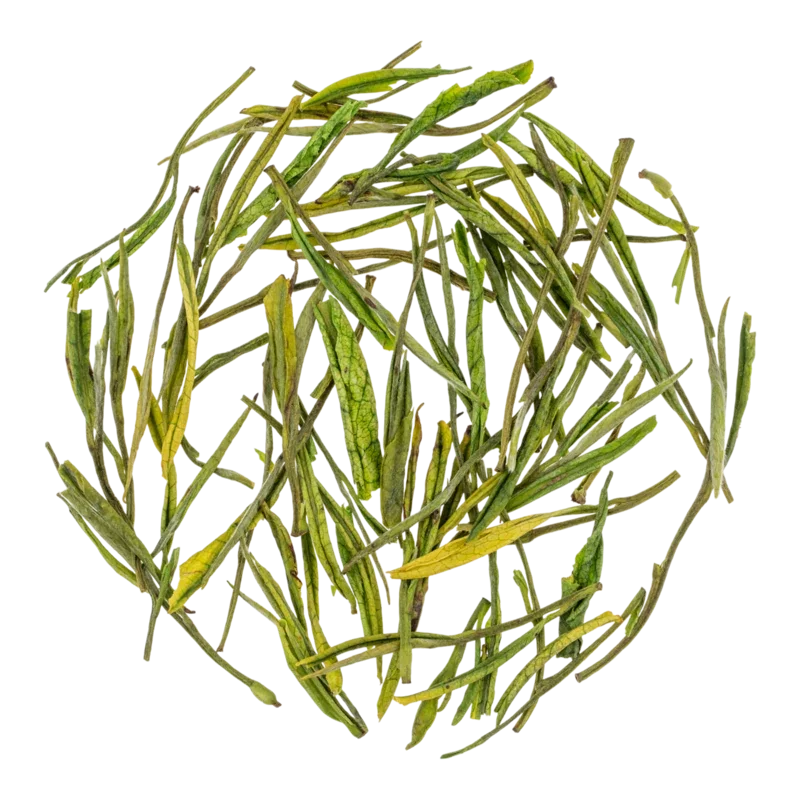
Dry Leaf Appearance: Slightly twisted spirals of silvery buds and tender young leaves; color — greenish-silver, with abundant white down.
Dry Leaf Aroma: Fresh, with notes of meadow grasses, hay, wet stones and light floral undertone reminiscent of jasmine.
Liquor Aroma: Delicate, fresh, floral-grassy with a "warm" sweet base.
Liquor Color: Very light, pale amber with greenish tinge; clear.
Long-lasting, refreshing, with a sensation of light "coolness" in the mouth — "minty-almond" final note, gradually transitioning to clean sweetness. It is precisely in the aftertaste that the character of the Fuding Da Bai Hao cultivar is most vividly expressed: softness and "fluffiness" unavailable to ordinary green teas.
"Gliding", silky texture of the liquor — without dry puckering at correct water temperature.
Spent Leaves: Tender, whole buds and young leaves — light green, resilient, uniform in fraction.
Taste: Soft, sweetish; dominated by tropical fruit notes (mango), light acidity (sea buckthorn) and refreshing grassy finish. Body — silky, "enveloping", without coarse astringency.
Amino Acids: Elevated content of L-theanine (about 2%), significantly higher than most green teas. It is precisely theanine that is responsible for the characteristic sweetness (umami) and relaxing component of the tea effect.
About 5% — a polyphenolic compound with antioxidant and mild hypoglycemic potential.
Elevated content of β-ionone (floral notes) and methyl salicylate is noted — the latter, according to producer data, is approximately four times higher than in standard green teas, which is related to the specificity of enzymatic activity of the Fuding Da Bai Hao cultivar.
Moderate content, providing a mild tonic effect without sharp "peaks".
Minerals: Set typical for red-yellow ferrallitic soils of Guangxi: potassium, calcium, magnesium, manganese.
Polyphenols: High content of catechins (up to 18%), of which the main one is epigallocatechin gallate (EGCG, about 12% of dry mass) — one of the most active natural antioxidants.
Vitamins: C, E, B group; high-altitude origin promotes preservation of thermolabile vitamin C.
High EGCG content provides powerful neutralization of free radicals; according to some data, the ORAC value (antioxidant capacity) for tea of this type can reach 12,000 μmol TE/g.
L-theanine in high concentration promotes relaxation without drowsiness, improves concentration and may have neuroprotective effects.
Combination of caffeine and L-theanine — smooth alertness without anxiety; ideal "morning" tea.
In vitro studies indicate the ability of green tea components to inhibit alpha-glucosidase, which may be useful for blood sugar control.
Catechins promote maintenance of vascular elasticity and normalization of lipid profile.
Polyphenols protect skin from oxidative stress and photoaging.
Tannins may slightly reduce non-heme iron absorption; it is recommended to separate tea consumption and iron-rich food by 30–60 minutes.
When taking antidepressants (SSRIs) or other drugs interacting with monoamine oxidase, consultation with a doctor is recommended.
In the third trimester, it is recommended to limit consumption to 200 ml per day due to caffeine content.
Do not drink on empty stomach; start with small volumes.
If you are accustomed to brewing green tea at 80°C — reduce temperature by 10–15 degrees. Guangxi Xue Ya "rewards" patience: at 65°C it gives its best sweetness and fruitiness.
Tea Amount: 3–4 g per 150 ml (gaiwan); or 1 g per 50 ml (for more concentrated tasting).
Teaware: Porcelain gàiwǎn (盖碗, gàiwǎn) or Yíxīng clay teapot (紫砂壶, zǐshā hú) — for optimal heat retention. Glass teaware — for visual enjoyment of silvery buds in clear liquor. Avoid metal strainers — they may affect taste.
Water Temperature: 65–70°C. This is one of the "coolest" green teas by optimal temperature — hotter water (above 75°C) provokes bitterness and destroys delicate aromatic notes.
The main green tea of the Baise region. Grows from its own indigenous cultivar (乔木大叶种, qiáomù dàyè zhǒng), not from Fuding Da Bai Hao. More "classical" green tea: pronounced chestnut note (板栗香, bǎnlì xiāng), dense body, high resistance to multiple brewing. Guangxi Xue Ya is more delicate, sweeter, with more pronounced fruity-floral component.
Also a green tea from a "white" cultivar, but fundamentally different — from a mutant variety with reduced chlorophyll (Zhejiang). Anji Bai Cha is ultra-soft, with amino acid sweetness up to 10%. Guangxi Xue Ya is more structured, with noticeable fruity acidity and "tropical" character absent in Anji.
White tea from the same cultivar (Fuding Da Bai Hao), but processed using white tea technology (without fixation). Yin Zhen is "minimal processing": honey sweetness, floral-hay aroma, very light body. Guangxi Xue Ya, having undergone fixation and rolling, is more "green" in character: fresher, more grassy, with more pronounced structure in taste.
Historical name associated with the mother tree of white tea on Mount Tàimǔ (太姥山); now — a white tea brand from Fuding. Despite similar sound, Fuding Lü Xue Ya and Guangxi Xue Ya are fundamentally different products: the first is classical white tea, the second is artisanal green tea.
Price Category: Guangxi Xue Ya is positioned as a premium tea: tender spring raw material, hand picking, low yield. Approximate retail cost — about $80–120 per kg (as of 2025). The price is significantly higher than mass-market green teas from Guangxi, but comparable to high-grade Lingyun Baihao.
Tea from other regions (Hunan, Sichuan) from cheaper raw material, sometimes using dyes (chlorophyllin) to imitate fresh greenness. Counterfeit prices — $20–40 per kg.
No reviews yet. Tell us what you think of this tea.
Rate this tea and share your impressions. We review each submission before publishing it.