Brewing
Gongfu brewing
- Water temperature
- 75 °C
- Tea amount
- 5 g
- Water volume
- 100 ml
- First steep
- 10 s
- Time added per infusion
- 5 s
- Infusions
- 3

gǒugǔnǎo chá
Choose a brewing method. Start with the recommended quantities and time, then adjust to taste.
Brewing
Brewing
Taste
Tea encyclopedia
Category: Famous regional green tea of China; product with geographical indication protection (国家地理标志产品, Guójiā Dìlǐ Biāozhì Chǎnpǐn); included in the list of "Time-Honoured Chinese Brands" (中华老字号, Zhōnghuá Lǎo Zìhào) by the Ministry of Commerce of the PRC (2011). The production technique is included in the registry of intangible cultural heritage of Jiangxi Province (2008).
Category: Famous regional green tea of China; product with geographical indication protection (国家地理标志产品, Guójiā Dìlǐ Biāozhì Chǎnpǐn); included in the list of "Time-Honoured Chinese Brands" (中华老字号, Zhōnghuá Lǎo Zìhào) by the Ministry of Commerce of the PRC (2011). The production technique is included in the registry of intangible cultural heritage of Jiangxi Province (2008).
Coordinates: ≈ 26.3° N, 114.5° E (by Suichuan county center; main plantations are located in the mountain belt in the southwest of the county, at the foot of the Luoxiao Range).
Origin: China, Jiāngxī Province (江西, Jiāngxī), Ji'an Prefecture (吉安, Jí'ān), Suìchuān County (遂川, Suìchuān). The core production area is Mount Gougounao (狗牯脑山, Gǒugǔnǎo Shān) near Tānghú Town (汤湖镇, Tānghú Zhèn). The protected production zone covers the entire administrative district of Suichuan County; the total area of tea plantations in the county reaches approximately 200,000 mu (≈ 13,300 hectares).
Type: Green tea (绿茶, lǜchá) — non-oxidized, oxidation degree less than 5%. Enzyme fixation is achieved by heating (杀青, shāqīng).
Cultural Significance: In Suichuan County there is a saying about "三宝" (three treasures of Suichuan): golden kumquats (金桔, jīnjú), duck cutting board (板鸭, bǎnyā) and Gougounao tea. The tea is the county's calling card, an important element of the local economy and rural revival: plantations are located on all mountain slopes of the Luoxiao Range, and sales are conducted both traditionally and through e-commerce. As early as the Northern Song era, poet Sū Shì (苏轼, Sū Shì), passing through Suichuan lands, praised local tea in verse, leaving lines about "stones boiling in a stone tripod."
History: The origins of Gougounao Chá date back to the Qīng dynasty (清, Qīng). During the reign under the Jiāqìng era name (嘉庆, Jiāqìng), around 1796, a log rafter named Liáng Wéiyì (梁为镒, Liáng Wéiyì) ended up in Nánjīng after a raft wreck and married a local girl surnamed Yáng (杨氏), skilled in tea craft. The couple brought tea seeds from Nanjing to Suichuan, settled on Mount Gougounao and established a tea garden — thus the tea tradition of these places was born. The production mastery was passed down in the Liang family from generation to generation and for a long time remained a "family secret."
Cultivar: The basis of highest quality is the local group population Gougounao (狗牯脑本地群体种, Gǒugǔnǎo běndì qúntǐ zhǒng) — Camellia sinensis var. sinensis, shrub form (灌木型, guànmù xíng), medium leaf size (中叶类, zhōngyè lèi), medium vegetation period (中生种, zhōngshēng zhǒng). The bush is distinguished by a spreading crown with dense branching, abundant pubescence of young shoots and good frost resistance. Buds and young leaves are light green, the leaf is elliptical, dark green, thick and dense. The cycle from bud appearance to harvest readiness is 18–21 days, which ensures slow accumulation of aromatic and flavor substances.
Picking: Begins in early April. For elite batches, harvesting is conducted strictly by hand. Rules: do not harvest in dew, do not harvest in rain, do not harvest in midday heat. After harvest, leaves are carefully sorted, removing purple shoots (紫芽, zǐyá), single plates and "fish leaves" (鱼叶, yúyè).
Pluck Standard: Highest grades — single bud (单芽, dānyá) until Qīngmíng Festival (清明, Qīngmíng); medium — one bud with one unfolded leaf (一芽一叶, yī yá yī yè); mass — one bud with two leaves (一芽二叶, yī yá èr yè). Each batch must be uniform in tenderness, purity and freshness.
Altitude: Main plantations are located at altitudes of 400–1,000 m above sea level. The core — slopes of Mount Gougounao (≈ 900 m), where tea gardens are concentrated in the middle part of the mountain belt.
Soil: Slightly acidic (pH ≈ 5.2) sandy-loamy soils (麻沙泥土, máshā nítǔ), formed by granite weathering; rich in organic matter. At the foot of the mountain there are thermal springs — a unique element of terroir, creating a stable microclimate.
Mount Gougounao, over 900 meters above sea level, rises in the southern foothills of the Luóxiāo Range (罗霄山脉, Luóxiāo Shānmài). From the south it is bounded by Five Fingers (五指峰, Wǔzhǐ Fēng), from the north — by Lǎohǔ Rock (老虎岩, Lǎohǔ Yán). The climate is subtropical monsoon, humid, mild. Average annual temperature — about 18.5°C (according to county meteorological station data — 19.1°C); frost-free period — over 250 days (on average about 350 days); average annual precipitation — about 1,525 mm. The mountains are shrouded in clouds and mists year-round; short daylight hours and abundant diffused light contribute to the accumulation of amino acids, caffeine and aromatic substances in the leaf.
Forest cover of Suichuan County reaches 78–79%. Concentration of negative air ions — over 5,600 per cm². The famous "thousand-year bird path" (千年鸟道, Qiānnián Niǎodào) — a bird migration route of world significance — passes through the county. The absence of industrial pollution and high forest cover create conditions for high-altitude organic tea cultivation.
Early morning, strictly according to fraction standard. Harvested shoots are immediately delivered to the factory.
Fresh leaf is evenly spread in a ventilated room for moisture equalization and initial reduction of "grassy harshness." Duration depends on weather and raw material moisture.
Pan-firing in a wok over wood or charcoal fire. High temperature inactivates oxidases, fixing green color and fresh aroma. Key moment — precise temperature control: overheating gives bitterness and "roasted" taste, underheating leaves "raw grassiness."
Moderate hand rolling for initial formation of cell juice on the leaf surface.
Repeated pan-firing at somewhat reduced temperature — deepens aroma and "dries" the leaf to the needed plasticity.
More intensive rolling to give final shape and enhance liquor "body."
Delicate hand operation: the leaf is given characteristic "eyebrow-shaped" or slightly curled form, simultaneously releasing silvery down (白毫, báiháo) on the surface.
Slow drying to residual moisture ≤ 6%, ensuring stability during storage. Charcoal or mixed firewood is traditionally used as fuel, avoiding resinous species that give foreign odor.
Removal of coarse fragments, control of batch uniformity; packaging and storage are carried out according to proprietary methods different from standard ones — part of local heritage.
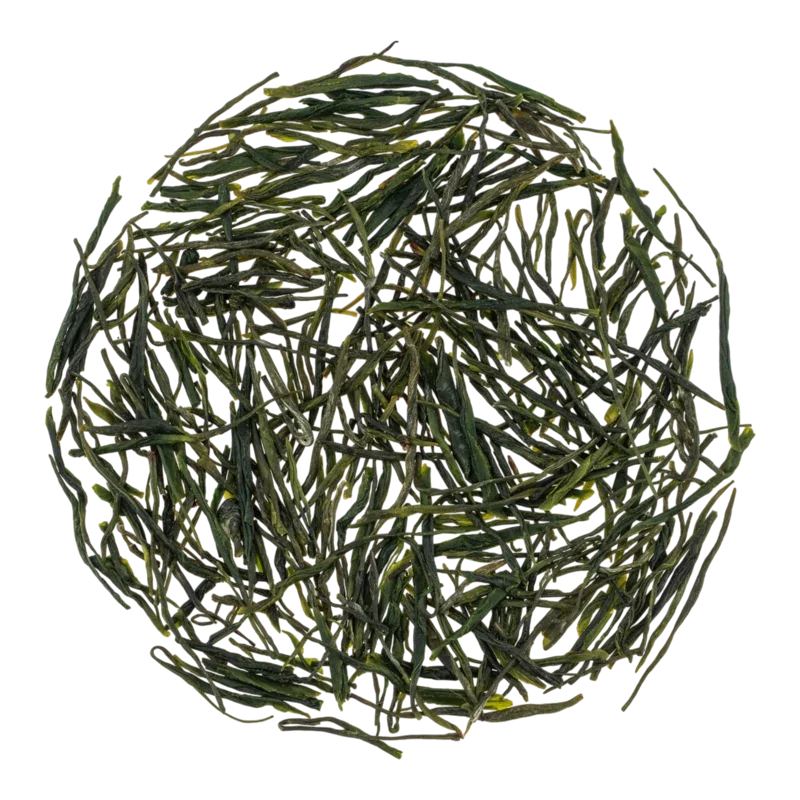
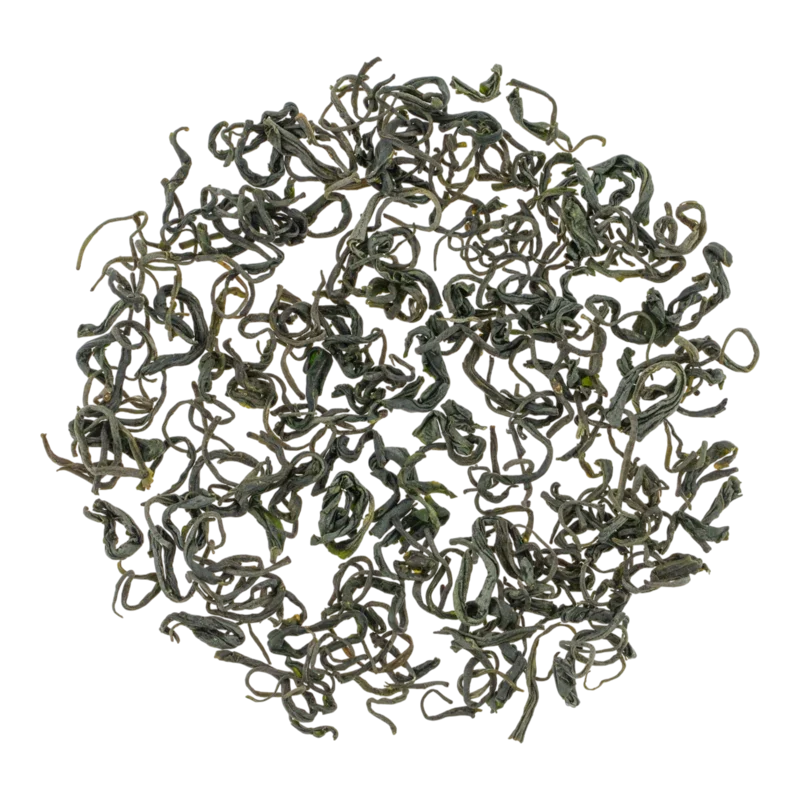
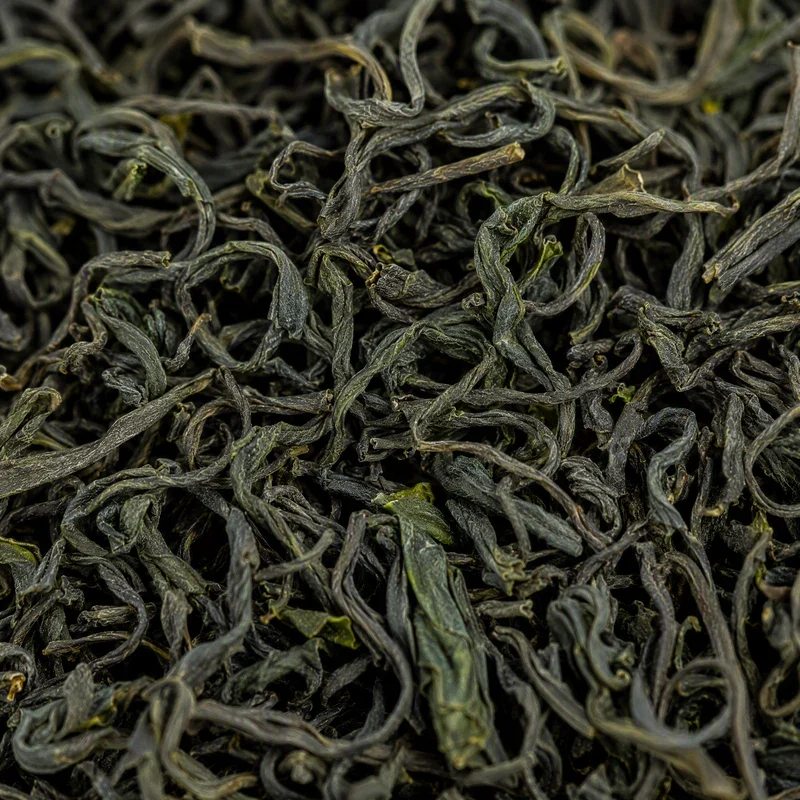
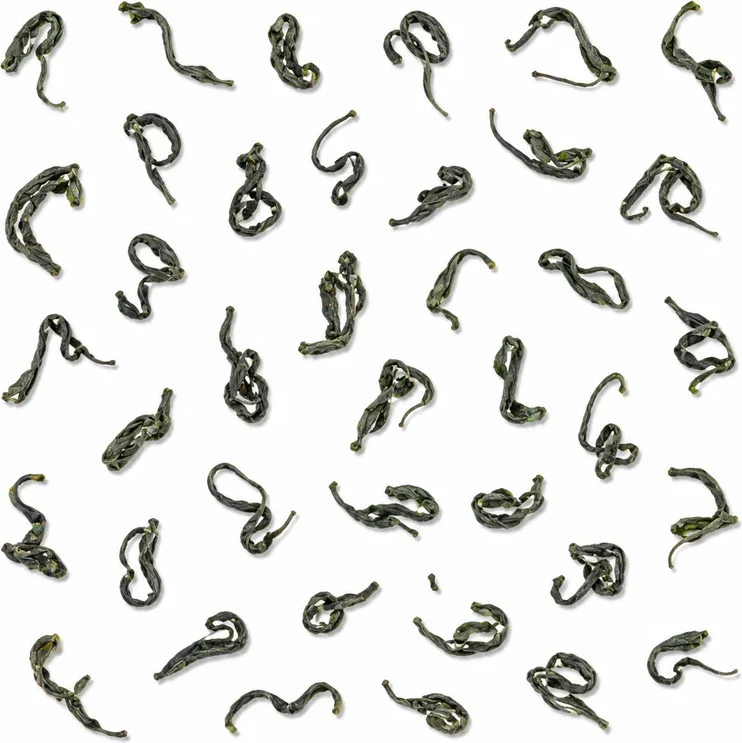
Dry Leaf Appearance: Shape — "eyebrow-shaped" (眉形, méixíng), slightly curled; twist tight and elegant (紧结秀丽, jǐnjié xiùlì). Color — dark green with emerging ink-jade (黛绿, dàilǜ) shade; surface covered with delicate silvery down (白毫, báiháo), giving the leaf characteristic luminescence.
Dry Leaf Aroma: Pure, high (清高, qīnggāo). Orchid notes (兰花香, lánhuā xiāng) and roasted chestnut (栗香, lìxiāng) dominate; in the background — subtle fruity and woody shades.
Liquor Aroma: Elegant, fresh; the orchid line unfolds more voluminously, complemented by a delicate floral-grassy veil.
Liquor Color: Transparent, from light golden to orange-golden (橙亮清碧, chéng liàng qīng bì). Surface without bubbles; tea particles quickly settle to the bottom.
Spent Leaves: Tender, whole leaves and buds — bright green, fresh, resilient; uniform fraction confirms harvest quality.
Taste: Fresh and brisk (鲜爽, xiānshuǎng), gently sweet (甘, gān), with dense "body" (醇厚, chúnhòu). Bitterness is practically absent with correct water temperature. Pronounced "returning sweetness" (回甘, huígān) — long and pure, with a sensation of coolness.
Amino Acids: Content — about 3.8%, including L-theanine — key component responsible for flavor mildness (甘, gān) and synergistic "alerting without anxiety" effect paired with caffeine.
Content in spring leaf — about 28%; main components — catechins, including epigallocatechin gallate (EGCG), providing antioxidant potential.
Moderate content; in combination with theanine provides smooth stimulation without sharp peak and decline.
Distinctive feature — elevated microelement content. According to data from the Jiangxi Product Quality Control Center, Gougounao Cha contains selenium (Se) — about 0.2 mg/kg and zinc (Zn) — about 54 mg/kg, which significantly exceeds indicators of most similar green teas. High content of calcium (Ca) and magnesium (Mg) is also noted.
Thanks to the high-altitude environment with diffused light and significant daily temperature fluctuations, the leaf accumulates increased amounts of volatile aromatic substances forming the characteristic orchid-chestnut bouquet.
Vitamins: C, B₁, B₂, E, K; vitamin C content higher than average for green teas thanks to high-altitude slow growth.
Caffeine combined with L-theanine provides gentle, prolonged alertness and improves concentration without causing anxiety.
High catechin content (especially EGCG) neutralizes free radicals, slowing oxidative stress in cells.
Traditionally tea is drunk after fatty food to ease digestion and eliminate feeling of heaviness.
Polyphenols contribute to strengthening microcapillary walls, may help regulate cholesterol levels and blood pressure.
L-theanine stimulates alpha-wave production in the brain, promoting relaxation while simultaneously increasing attentiveness.
Antioxidant polyphenols support skin tone and slow photoaging processes.
Elevated selenium and zinc content — important elements for immune function and antioxidant enzyme systems of the body.
If tea is bitter — reduce temperature and decrease amount, don't "blame the tea." For delicate spring batches of "Special Grade" (特级), optimal temperature is 80°C.
Tea Amount: 3 g per 150 ml (glass cup or gaiwan).
Teaware: Transparent glass cup (玻璃杯, bōlí bēi) — for visual enjoyment of "leaf dance"; porcelain gaiwan (盖碗, gàiwǎn) — for fuller aroma development. A small porcelain teapot is also acceptable.
Water Temperature: 80–90°C (cool boiled water for 2–3 minutes). Boiling water is contraindicated — it enhances bitterness and destroys delicate aromatic notes.
The most famous green tea of Jiangxi; grows in Lushan Mountains in the north of the province. Common feature — misty high-altitude terroir. Lushan Yun Wu is generally more "dense" and grassy, while Gougounao Cha is more elegant and sweet thanks to the chestnut-orchid bouquet.
Green tea from neighboring Jǐnggāngshān district (井冈山); similar mountain terroir of Luoxiao Range. Distinguished by simpler, grassy profile; Gougounao Cha wins in aroma complexity and aftertaste duration.
Famous green tea from Henan Province. Both teas — from young buds with abundant down; both received gold at the 1915 exhibition. Xinyang Mao Jian is often more astringent and "sharp"; Gougounao Cha — milder and sweeter, with more pronounced "returning sweetness."
Steamed green tea from Hubei Province. Completely different technological profile: steam fixation vs. wok pan-firing. Enshi Yulu stands out with bright "grassy-marine" taste (umami); Gougounao Cha — more floral, chestnut, with complex structure of pan-fired tea aroma.
Green tea from Zhejiang with anomalously high amino acid content (5–10%). Anji Bai Cha is ultra-mild and "brothy"-sweet; Gougounao Cha is more structured, with noticeable chestnut and orchid component in the bouquet.
Cost varies greatly depending on grade and season. Early spring batches of "Special Tribute — Special Grade" (特供特级, tègōng tèjí) — most expensive. Mass grades (壹级 / 统级, yījí / tǒngjí) significantly more affordable.
Before Qingming, single bud; appearance impeccably even; pronounced orchid aroma; highest price.
Before Gǔyǔ (谷雨, Gǔyǔ), single bud; tight twist; rich chestnut aroma.
Before Lìxià (立夏, Lìxià); one bud, one leaf in initial unfolding stage; fresh taste.
Before Lixia; one bud, one unfolded leaf; transparent liquor.
From Qīngmíng to Chǔshǔ (处暑, Chǔshǔ); one bud, two leaves; high resistance to multiple brewing; affordable price.
Tea from neighboring counties or provinces sold under "Gougounao" brand; mixture of coarse leaf with added down; "refreshing" last year's tea with flavorings.
No reviews yet. Tell us what you think of this tea.
Rate this tea and share your impressions. We review each submission before publishing it.