Brewing
Gongfu brewing
- Water temperature
- 93 °C
- Tea amount
- 5 g
- Water volume
- 100 ml
- First steep
- 10 s
- Time added per infusion
- 5 s
- Infusions
- 4

Cháyù Hóngchá
Choose a brewing method. Start with the recommended quantities and time, then adjust to taste.
Brewing
Brewing
Taste
Tea encyclopedia
Category: High-altitude Tibetan red tea; modern regional hong cha produced on the territory of the "roof of the world."
Category: High-altitude Tibetan red tea; modern regional hong cha produced on the territory of the "roof of the world."
Coordinates: approximately 28°30′ N, 97°00′ E (Lower Chayu area); tea gardens are located at altitudes of 1,100–2,800 m.
Origin: China, Tibet Autonomous Region (西藏自治区, Xīzàng Zìzhìqū), Nyingchi City (林芝市, Línzhī Shì), Cháyù County (察隅县). The main tea zone is located in Lower Cháyù (下察隅, Xià Cháyù) — the lower reaches of the Cháyù River (察隅河), a tributary of the Brahmaputra, in the area of Rìmǎ Township (日马乡, Rìmǎ Xiāng) and adjacent territories. This is the southeastern tip of Tibet, where the Himalayan ranges create a "rain shadow," and moist monsoons from the Indian Ocean penetrate through river valleys, forming a warm and humid microclimate unique to the Tibetan Plateau.
Type: Chinese red tea (black tea) (红茶, hóngchá), fully oxidized.
Cultural Significance: Chayu Hong Cha symbolizes a historical change: Tibet — a region whose culture is unthinkable without tea (酥油茶, sweet tea, monastic tea rituals) — has for the first time become a tea producer. For the local population — Tibetans, the Loba people (珞巴族), and Dèng people (僜人) — tea has become not only cultural heritage but also a source of income. Nyingchi is called the "Eastern Switzerland" and "Highland Jiangnan" (高原江南): tea plantations framed by snowy peaks and bamboo forests form a unique tea-tourism route. The county government conducts regular cultural events — tea festivals, master classes on preparing butter tea and sweet tea, courses on traditional Tibetan tea crafts — attracting young people and tourists to tea culture. By the 2020s, tea had firmly entered the list of the county's "calling cards" alongside rice and tropical fruits.
History: Tibet is one of the world's most ancient tea-consuming cultures: archaeological finds in Gar County (噶尔县) testify to the presence of tea on the plateau 1,800 years ago. For millennia, tea entered the plateau via the Ancient Tea Horse Road (茶马古道, Chámǎ Gǔdào) from Sichuan and Yunnan, but Tibet had no tea production of its own — historically, all attempts were suppressed by central authorities interested in control through "tea for horses" (茶马互市). The first successful breakthrough occurred in 1956, when a PLA unit stationed in Chayu brought tea plant seeds from Yunnan (large-leaf and small-leaf varieties) and planted them in Rima Township. Of several thousand seedlings, more than 2,000 survived — these were the first tea plants grown on Tibetan soil. In 1964, seven varieties of red and green tea were produced from the leaves of these plants; samples were sent for evaluation to the Tea Research Institute of the Chinese Academy of Sciences. The experts' conclusion: "Excellent tenderness, tight and strong rolling, pure aroma, rich taste" — the production met the standards of high-quality red and green tea. This event marked the beginning of a new era: Tibet, which had consumed imported tea for millennia, began producing its own. From 1971, the Agricultural Bureau of the TAR and production units of the Tibet Military District imported more than 100,000 kg of tea seeds from Sichuan, Yunnan, Hunan, and Zhejiang, planting territories in 20+ counties at altitudes of 1,570–3,700 m. Succ
Name Breakdown: 察隅 (Cháyù) — transcription of a Tibetan toponym meaning "place where people meet"; 红茶 (hóngchá) — "red tea." The name is straightforward: "red tea from [Chayu] County."
Cultivar: The raw material base consists of Yunnan large-leaf varieties (Camellia sinensis var. assamica), brought from Yunnan Province in 1956 and adapted over 70 years to Tibetan subtropical conditions, as well as small-leaf varieties (C. sinensis var. sinensis) brought from Sichuan (Mengding Mountain area). Additional cultivars were introduced from Hunan and Zhejiang. In recent years, work has been conducted on selecting and breeding locally adapted forms in collaboration with the Chinese Academy of Agricultural Sciences Tea Research Institute (中国农科院茶叶研究所).
Picking: Spring harvest is primary (March–April); thanks to the subtropical microclimate and sufficient moisture, summer harvest is also possible. Early spring batches provide maximum amino acids and aromatic compounds.
Pluck Standard: 1 bud + 1–2 young leaves for premium grades; 1 bud + 2–3 leaves for standard batches.
Raw Material: Freshly picked leaves must be tender, whole, without mechanical damage; delivery to the factory must be immediate. Thanks to the high-altitude location and atmospheric purity of Tibet, the raw material is distinguished by exceptional ecological cleanliness.
Altitude: 1,100–2,800 m above sea level — one of the widest altitude ranges among world tea regions. The lower part of the Chayu River valley (ca. 1,100–1,500 m) has a subtropical character; upper sections (up to 2,800 m) approach the temperate mountain belt.
Climate: Unique for Tibet: warm and humid subtropical in the lower zone, transitioning to temperate-mountain. Average annual temperature — about 17°C (in the lower valley); annual precipitation — 1,000–2,000 mm; frost-free period — over 300 days. Warm humid monsoons from the Indian Ocean penetrate through the Chayu River gorge — a tributary of the Brahmaputra — creating an "oasis" among snow-covered ranges. Cloudiness and fog are frequent phenomena, providing diffused lighting favorable for amino acid accumulation.
Soil: Yellow soils (黄壤) and yellow brick-red soils (黄色砖红壤) with acidic reaction (pH 4.5–5.5) predominate, typical for the transition zone from tropics to subtropics. A rich organic layer is formed by dense natural vegetation — subtropical broad-leaved forests and quasi-tropical rainforests.
The territory is distinguished by exceptional atmospheric and soil purity — industrial pollution is absent; Chayu is part of one of the most ecologically preserved regions on the planet. Tea gardens are surrounded by virgin forests, bamboo groves, and mountain streams. Pesticides and mineral fertilizers are not used; only organic care methods are employed (manure, compost). The unique location — at the junction of Palearctic and Indo-Malayan biogeographic zones — ensures exceptional biodiversity: tea bushes grow side by side with tropical orchids, rhododendrons, and bamboo. Tea from Chayu is positioned as a "high-altitude ecologically clean product of world class." Of particular interest is the influence of extreme ultraviolet radiation at high altitudes: in response to intensified UV flux, tea bushes produce increased amounts of polyphenols and aromatic compounds — a natural protective mechanism that becomes an advantage for tea leaves.
1 bud + 1–2 leaves, hand-picked.
Reducing leaf moisture to softness and elasticity; both natural (日光萎凋 or 室内萎凋) and combined withering are used, depending on weather conditions.
Forming tight rolling and bringing cellular juice to the surface for uniform oxidation.
Controlled fermentation at 22–28°C until achieving copper-red leaf color and the appearance of characteristic honey aroma. High-altitude raw material, rich in amino acids, forms a particularly expressive sweet profile during fermentation.
Fixing aroma and stopping oxidation; gentle heating is applied.
Equalizing batches by fractions and removing coarse inclusions.
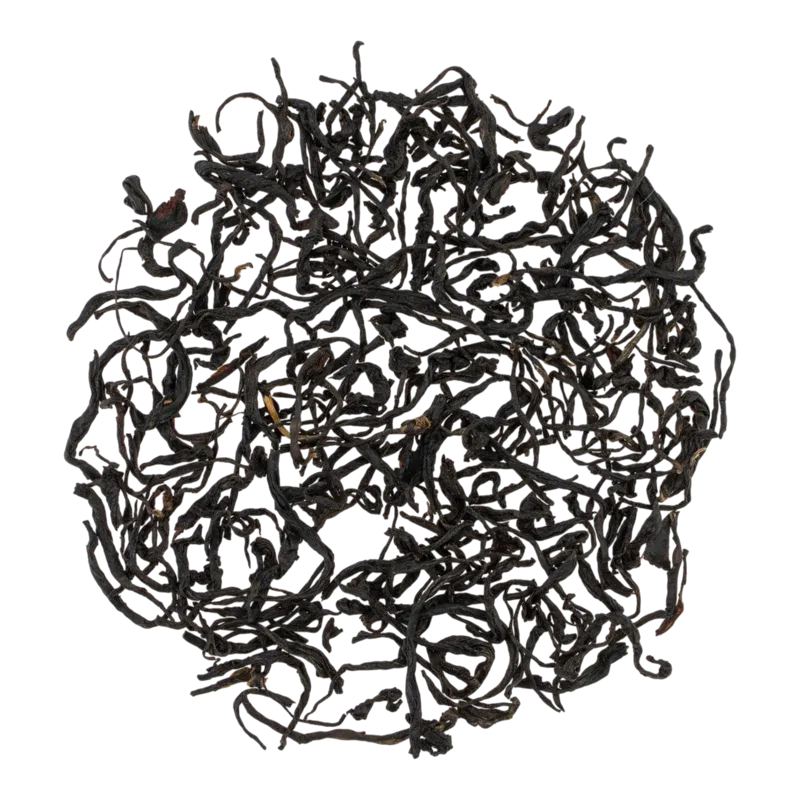
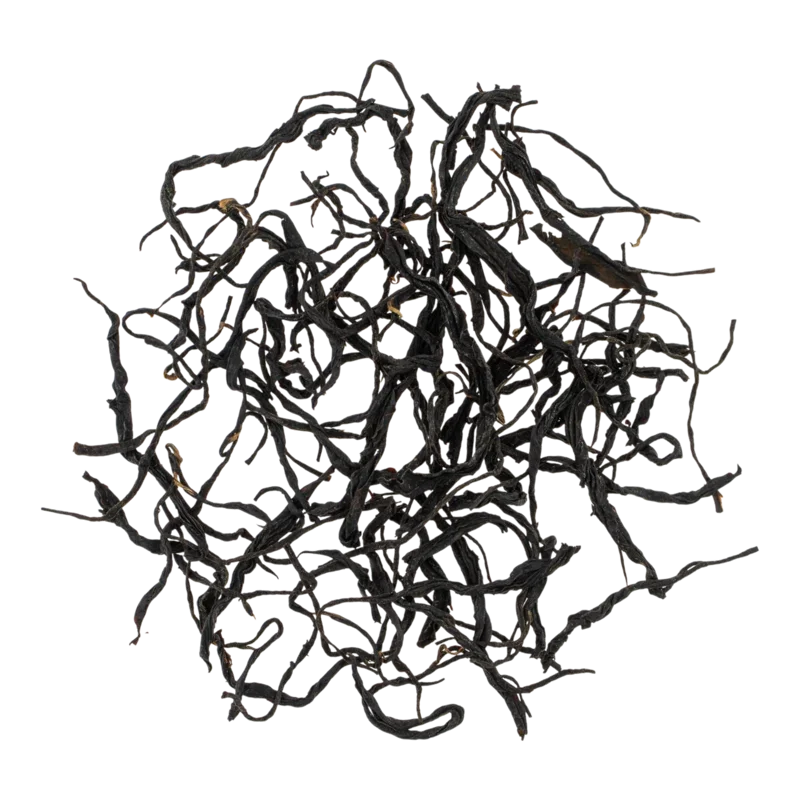
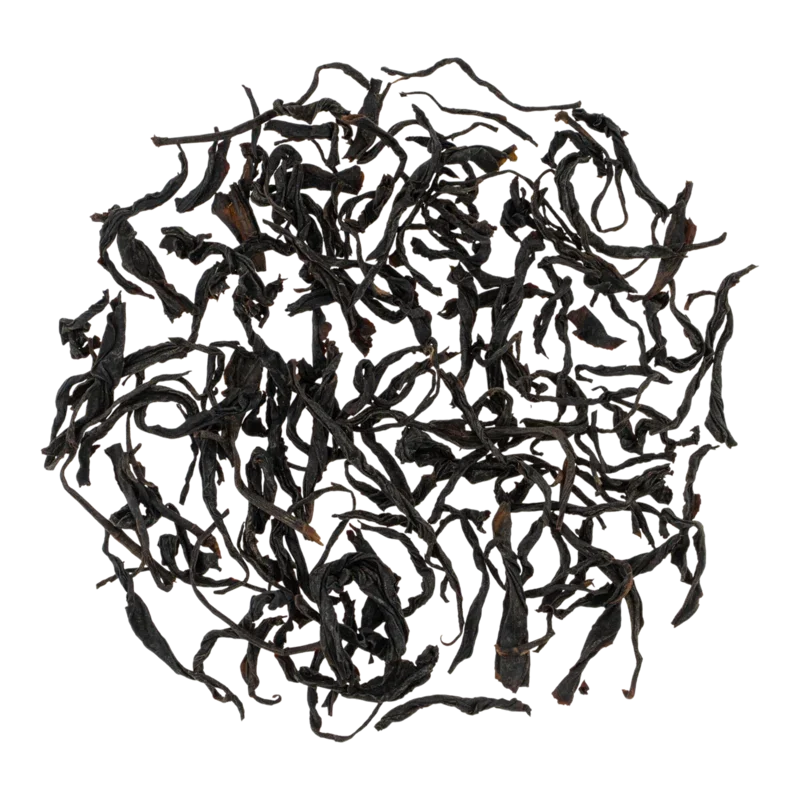
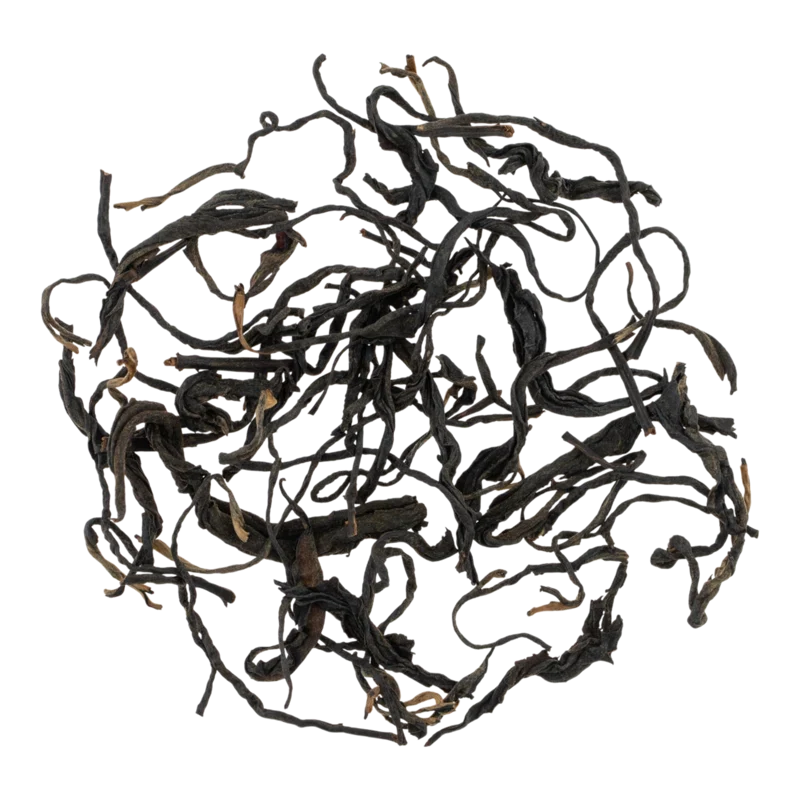
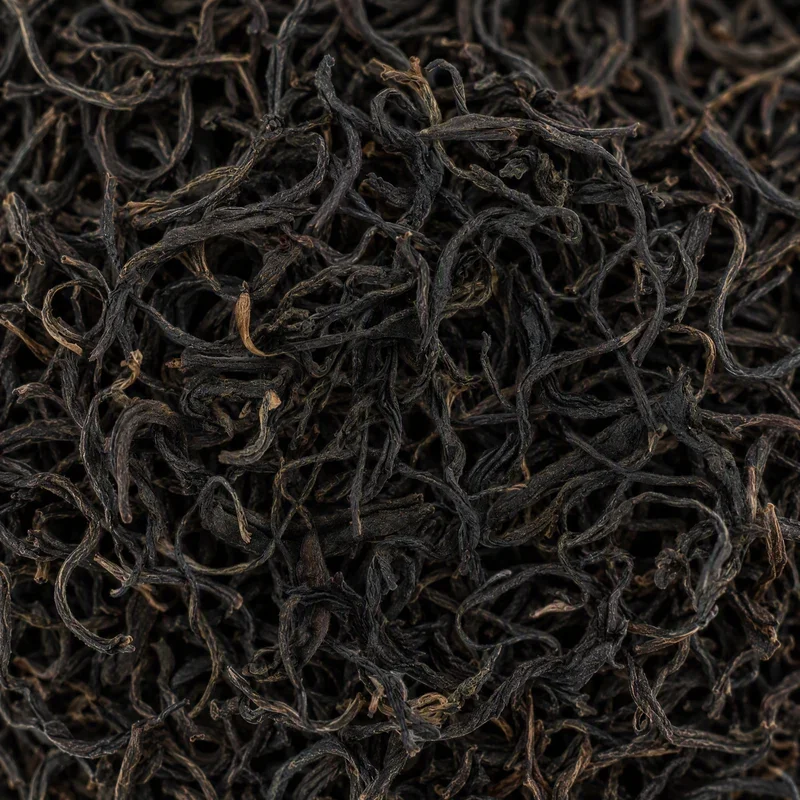
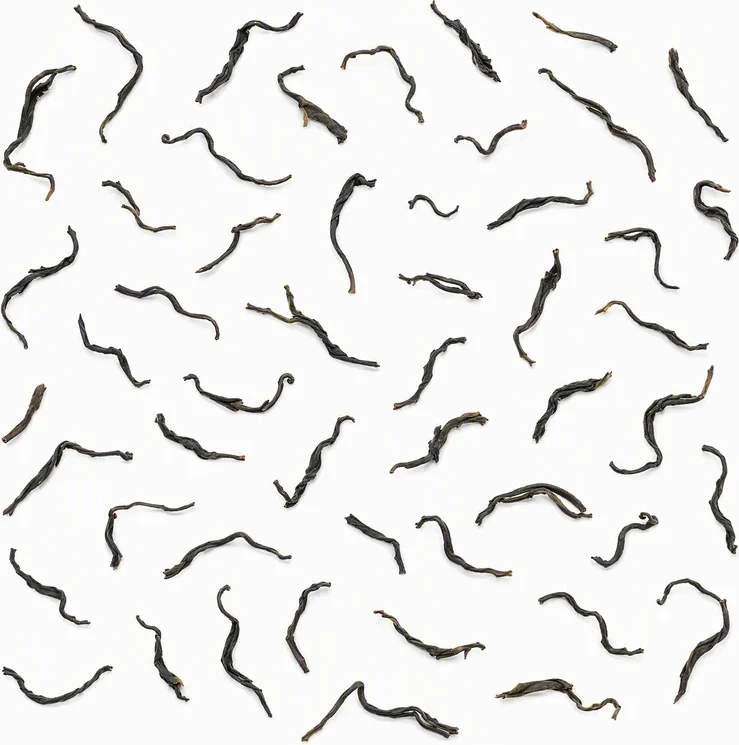
Dry Leaf Appearance: Tight rolling (紧结肥壮, jǐnjié féizhuàng — "tight and strong"); dark leaf with oily luster, premium grades have abundant golden tips.
Dry Leaf Aroma: Honey-like, expressive (甜香高锐, tiánxiāng gāoruì — "sweet aroma, high and bright"), with floral-fruity notes and characteristic "high-altitude freshness" — a sensation of coolness and purity reminiscent of melted glacial water.
Liquor Aroma: Pure, honey-floral, with nuances of dried fruits and a light "mineral" shade characteristic of teas of extremely high-altitude origin. The aroma is persistent and "transparent."
Liquor Color: Rich red, bright and clear, with good "deep" tone.
Spent Leaves: Red-copper, elastic, with well-opened whole leaves.
Taste: Full-bodied and rounded (醇香甜润, chúnxiāng tiánrùn — "pure, aromatic, sweet, smooth"), with pronounced honey sweetness and soft, velvety texture. Astringency is minimal. Long "sweet return" (回甘) with a sensation of mountain freshness. Distinctive feature — unusually high extractability (水浸出物 — up to 47% and higher) and increased content of tea polyphenols (up to 34%), which significantly exceeds average indicators for similar teas from lowland regions.
Alkaloids: Caffeine (2.5–4%), theobromine, theophylline.
Amino Acids: Increased L-theanine content — a consequence of high-altitude origin, abundant fog, and diffused light. Provides pronounced natural sweetness and "silkiness" of taste.
Up to 47.4% — one of the highest indicators among Chinese red teas, testifying to the richness of soluble substances.
Essential Oils: Linalool, geraniol, β-ionone — form the honey-floral aroma with "mountain" freshness.
Minerals: Potassium, magnesium, manganese, zinc, selenium — reflect the mineral composition of Himalayan region mountain soils.
Polyphenols: Tea polyphenol content — up to 34.4% (according to data from the Ministry of Agriculture Tea Quality Control Center of the PRC), which is noticeably higher than the average level for similar red teas. Theaflavins and thearubigins form the rich red color and velvety texture.
Vitamins: Vitamin C, B-group vitamins, β-carotene.
Tea Amount: 4–5 g per 100–120 ml (gongfu); 2–3 g per 200–250 ml (cup steeping). Due to high extractability (up to 47%), slightly less leaf can be used than for lowland red teas.
Teaware: White porcelain gàiwǎn (盖碗) 100–120 ml — optimal for evaluating color and aroma; porcelain teapot; glass teapot.
Water Temperature: 90–95°C; for delicate spring batches with abundant buds — 85–90°C.
Red tea from Tibet's largest tea farm — Yìgòng (波密县易贡茶场, 2,200 m). Yigong tea is produced from medium-leaf Sichuan varieties (Mengding group); compared to it, Chayu Hong Cha, based predominantly on Yunnan large-leaf varieties, differs in fuller body, increased extractability, and more intense honey aroma.
Yunnan red tea from the same large-leaf var. assamica varieties. Dian Hong, grown at altitudes of 1,000–2,000 m, possesses a bright "honey-peppery" palette; Chayu Hong Cha is its "Tibetan cousin," which with similar varietal composition demonstrates more pronounced "mineral" freshness and unusually high concentration of beneficial substances.
General marketing name for Tibetan red teas of the Nyingchi region (including products of "Zhengshan Tang" company / 正山堂). Chayu Hong Cha is a specific geographical indication within this broad family, with emphasis on Lower Chayu terroir.
Indian "champagne among teas," grown on the opposite macroslope of the same Himalayas (1,500–2,200 m). Both teas share mountain terroir and muscatel notes, but Darjeeling is more "dry" and tannic, while Chayu Hong Cha is sweet, full-bodied, and velvety. Geographically they are "neighbors across the ridge," but fundamentally different: Darjeeling uses hybrids of Assam and Chinese tea, while Chayu uses directly Yunnan large-leaf varieties adapted to Tibetan conditions.
Red tea from Tibet's most inaccessible county — Medog, where in the Yarlung Tsangpo valleys tropical climate allows tea cultivation at altitudes of only 700–1,200 m. Medog red tea possesses a more "tropical" profile — with pronounced fruity acidity and rich body. Chayu Hong Cha, growing at greater altitudes, demonstrates a more refined, "cool" mineral shade and greater aroma complexity.
No reviews yet. Tell us what you think of this tea.
Rate this tea and share your impressions. We review each submission before publishing it.