Brewing
Gongfu brewing
- Water temperature
- 75 °C
- Tea amount
- 5 g
- Water volume
- 100 ml
- First steep
- 10 s
- Time added per infusion
- 5 s
- Infusions
- 3

Cāngshān xuě lǜ
Choose a brewing method. Start with the recommended quantities and time, then adjust to taste.
Brewing
Brewing
Taste
Tea encyclopedia
Category: Yunnan large-leaf green tea; provincial famous tea of Yúnnán (云南省级名茶).
Category: Yunnan large-leaf green tea; provincial famous tea of Yúnnán (云南省级名茶).
Coordinates: Approximately 25°35′–25°45′ North latitude, 100°05′–100°15′ East longitude.
Origin: China, Yúnnán Province (云南, Yúnnán), Dàlǐ Bái Autonomous Prefecture (大理白族自治州, Dàlǐ Báizú Zìzhìzhōu), Cangshan mountain range and coastal zone of Erhai Lake.
Type: Green tea (non-oxidized). Hōngqīng (烘青) — fire-drying; by form — twisted-curved (曲条形, qū tiáo xíng).
Cultural Significance: The tea is inseparably linked with the culture of the Bái people (白族, Báizú) and with the tradition of "Three Cups of Tea" (三道茶, sān dào chá) — ritual hospitality of the Bai, where the first cup is bitter roasted tea, the second is sweet tea, the third is "aftertaste of life" tea with spices. Although different varieties are traditionally used for Sandao Cha, Cangshan Xue Lü is one of the most respected representatives of Dali green tea and often serves as the base for the first cup.
History: Dali's tea culture spans over a thousand years. Tāng poet Jiǎ Dǎo (贾岛, Jiǎ Dǎo) in his poem "Seeing off Zhu Xu returning to Jiannan" wrote about "young shoots of snow tea" (芽新抽雪茗), which allows dating the consumption of Cangshan "snow teas" to at least the Tang era (618–907). Dali is a city with deep connections to tea trade: during the Míng and Qīng periods it was the main transit point on the southwestern section of the Ancient Tea Horse Road (茶马古道, Chámǎ Gǔdào).
Name Breakdown: "Cangshan" (苍山) — the name of the mountain range dominating over Dali; "Xue" (雪) — "snow" — refers to the snow-capped peaks of Cangshan and to the abundance of white down on the tea leaf, resembling snow; "Lü" (绿) — "green" — the color of the tea itself. Thus, the name can be translated as "green snow from Cangshan mountains" — a poetic image in which white down is associated with snow on the peaks, and greenness — with living slopes at their foot.
Cultivar: Main — Yúnnán Shuāngjiāng Měngkù Large Leaf (云南双江勐库大叶种, Yúnnán Shuāngjiāng Měnkù Dàyè Zhǒng) — a national-level large-leaf variety (Camellia sinensis var. assamica), distinguished by powerful, downy buds with high tenderness retention (持嫩性). Polyphenol content > 20%, amino acids ≥ 3.5%, ensuring concentrated and fresh liquor taste. Auxiliary cultivar — Fúdǐng Dàbái Chá (福鼎大白茶, Fúdǐng Dàbái Chá).
Picking: Spring picking begins before the Qīngmíng festival (清明, Qīngmíng, early April) for special grade; before Gǔyǔ (谷雨, Gǔyǔ, mid-April) — for first grade. A total of 12–20 picking cycles are conducted throughout the year. Summer-autumn picking goes to mass varieties.
Pluck Standard: Special grade (明前特级, míngqián tèjí) — bud with one leaf in initial opening stage; first grade (雨前一级, yǔqián yījí) — bud with two leaves; summer-autumn picking — opened leaves for everyday tea.
Altitude: 1500–2000 m; ancient tea trees (古树, gǔshù) are concentrated in the 1500–2000 m belt.
Climate: Average annual temperature 15–16 °C; annual precipitation 1000–1300 mm. In summer and autumn, cloudiness and fog reach 80%, ensuring predominance of diffused light and slowing shoot growth, promoting intensive accumulation of amino acids, caffeine and aromatic oils.
Soil: Slightly acidic yellow-brown soils and sandy loams with pH 4.5–6.0, rich in organic matter and minerals — potassium (K) and selenium (Se).
The Cangshan range — a southern spur of the Héngduàn Mountains (横断山脉, Héngduàn Shānmài) — rises above the city of Dali and Erhai Lake. Tea gardens are located on mountain slopes and in the coastal zone. A unique feature is the combination of snow-capped peaks (highest point Madengfeng — 4122 m) with subtropical climate at the foot: in winter snow lies on the peaks, while camellias bloom on the slopes.
Southern slope of Cāngshān in Nánjiàn County (南涧县, Nánjiàn Xiàn) and tea gardens at the foot of Tàilǎoshān (太姥山, Tàilǎoshān), supplying about 70% of raw material. Groups of ancient tea trees are concentrated here.
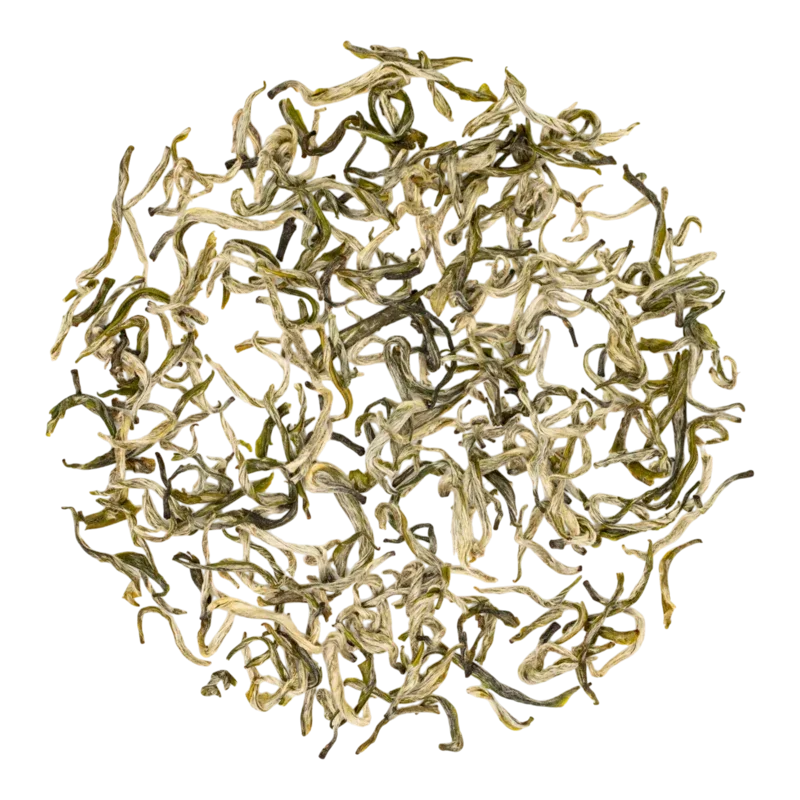
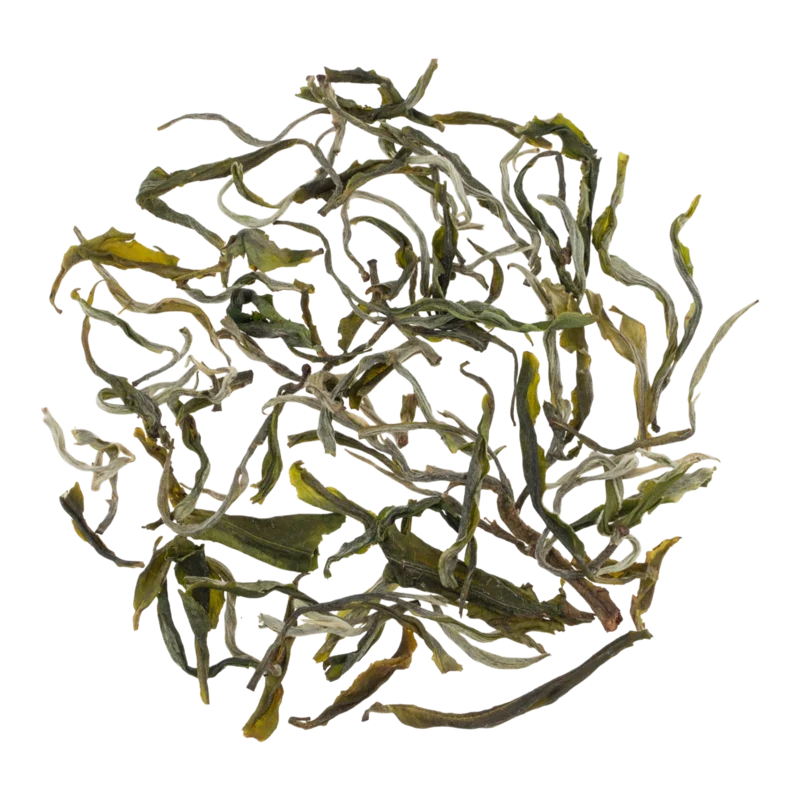
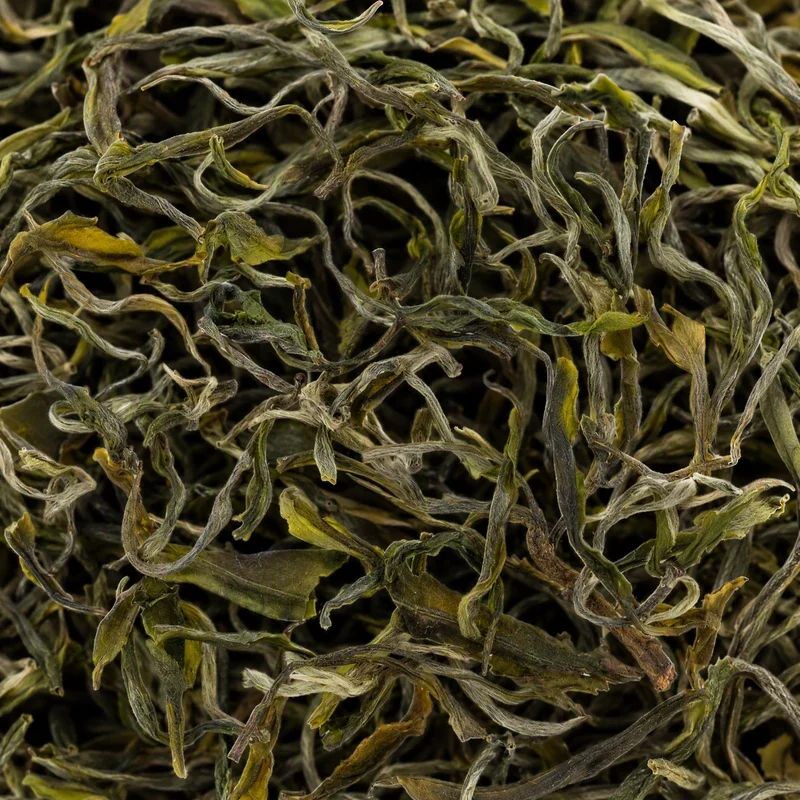
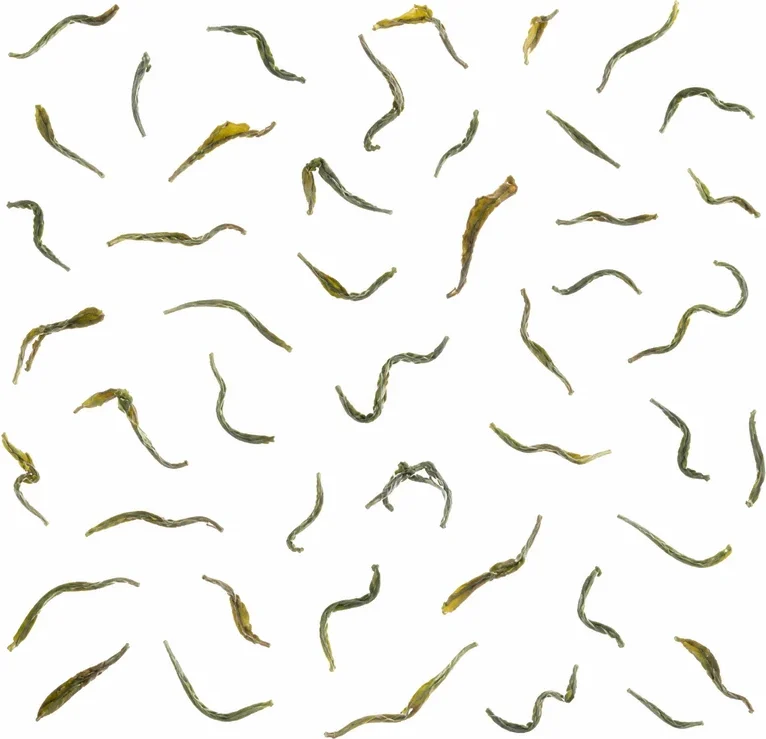
Dry Leaf Appearance: Twisted-curved form (卷曲形); dense, finely twisted leaves of dark green color with oily luster (墨绿油润); tender green shoots show through in places; abundant white down covers the surface like snow coating.
Dry Leaf Aroma: High, clean and noble (清香高雅), with young corn tones from abundant down (毫香, háo xiāng); a "wild" mountain note is felt — trace of high-altitude ecological terroir (原野香, yuányě xiāng).
Liquor Aroma: Develops toward creamy sweetness and deeper chestnut register; cooled cup long retains subtle "cold" aroma — result of triple drying.
Liquor Color: Tender yellow, clear and bright (嫩黄透亮) for special grade; yellow-green and clean for first grade.
Spent Leaves: Yellow-green color, uniform; shoots elastic and intact.
Taste: Pronounced freshness (鲜爽, xiān shuǎng) thanks to high amino acid content; dense "body" with oily sensation (醇厚, chúnhòu) from high polyphenol level; quick and intense returning sweetness (huí gān) (回甘) — sweet aftertaste unfolding from tongue root.
Amino Acids: ≥ 3.5% — one of the highest indicators among Yunnan green teas; due to large-leaf Mengku cultivar and high-altitude terroir with slow shoot growth.
Typically 3.5–4.5% for large-leaf raw material.
Essential Oils: Responsible for multi-layered aroma — pyrazines (chestnut notes from drying), linalool and geraniol (floral-fruity overtones from Mengku cultivar).
Minerals: Potassium, selenium, manganese, fluorine.
Polyphenols: > 20% — ensure taste density and concentration; large-leaf Yunnan tea is characterized by simultaneously high content of both polyphenols and amino acids, giving rare combination of "strength and freshness."
Vitamins: Vitamin C (up to 200 mg/100 g in fresh raw material), vitamins B₁, B₂, K.
High polyphenol content; according to some data, free radical neutralization effectiveness is higher than average green tea, due to concentrated catechin profile of large-leaf raw material.
Caffeine combined with L-theanine gives smooth, sustained alertness without anxiety.
Catechins and gallated epigallocatechins accelerate fatty acid oxidation.
In traditional Chinese medicine, green tea is classified as "cool" (性凉, xìng liáng) — it's drunk to relieve heat and refresh in summer months.
Catechins and vitamin B₂ help relieve visual fatigue.
Polyphenols stimulate GI tract function and promote microflora normalization.
L-theanine supports brain alpha-activity, promoting concentration.
Optimal tasting temperature — around 60 °C: at this temperature amino acid freshness manifests most vividly. Not recommended on empty stomach. People with sensitive stomach can add ginger slice. For insomnia — avoid consumption after noon.
Tea Amount: 5 g per gaiwan or teapot of 100–120 ml volume (approximately 1/5 vessel volume).
Teaware: Thin-walled porcelain gaiwan (best option for extraction control and enjoying lid aroma); Yixing teapot from porous clay suits for emphasizing body density.
Water Temperature: 95 °C — notably higher than for most green teas. Large-leaf Yunnan raw material from 2000 m altitude requires high temperature for full flavor and aroma development.
General term for Yunnan green teas from large-leaf raw material. Xue Lü is one of the most prestigious representatives of this group, distinguished by origin from high-altitude Cangshan slopes and original triple drying.
Sichuan green tea from small-leaf raw material — significantly more delicate, with floral-bean profile and brewed at 75–80 °C. Xue Lü is denser, more oily, stronger and hotter in extraction regime.
Jiangsu twisted green tea from small-leaf raw material — light, floral, fruity. Xue Lü with similar twisted form differs in fundamentally different taste scale: large-leaf Yunnan leaf gives density unavailable to Biluochun.
Hubei green tea with chestnut profile and charcoal finish drying. Similar in nutty note, but Bifeng is thinner, more delicate; Xue Lü is more powerful and dense thanks to large-leaf Yunnan raw material.
Jiangxi mountain green tea from analogous misty terroir. Yunwu gives soft, tender, floral-sweet profile when brewed at 80 °C. Xue Lü at higher extraction temperature reveals completely different scale — dense, oily, with palpable "bony" structure characteristic of Yunnan large leaf.
Price Category: Wide range. Xiàguān Factory (下关茶厂) — original producer — offers special grade mingqian from whole buds for approximately 260 yuan/50 g. Tea from 300-year-old tree raw material from specialized producers (e.g., "Wangfu Yuncha," 王府云茶) — around 619 yuan/150 g. Rain grade — from 150 yuan/250 g.
Price Factors: Tree age (ancient tree raw material significantly more expensive), picking season, grade, producer brand.
No reviews yet. Tell us what you think of this tea.
Rate this tea and share your impressions. We review each submission before publishing it.