Classification and Origin
Category: Famous teas of China; product with national geographical indication (国家地理标志产品, Guójiā Dìlǐ Biāozhì Chǎnpǐn). One of the key representatives of Hunan Hei Cha and the most important center for dark tea production on a national scale in China.
Coordinates: Approximately 27°58′–28°38′ North latitude, 110°43′–111°58′ East longitude.
Origin: China, Húnán Province (湖南省, Húnán Shěng), Yiyang Prefecture-level City (益阳市, Yìyáng Shì), Ānhuà County (安化县, Ānhuà Xiàn). The geographical indication zone covers the entire territory of Anhua County, as well as individual townships of Taojiang County (桃江县), Hèshān District (赫山区) and Zǐyáng District (资阳区) — a total of 32 administrative units.
Type: Post-fermented tea (后发酵茶, hòu fājiào chá), belongs to the Hēi Chá (黑茶, Hēichá — "Dark tea") category. The degree of fermentation varies depending on the subtype and aging period, but is based on microbiological post-fermentation occurring both during production (the "Wo Dui" stage — 渥堆, wòduī) and during subsequent storage.
Facts
This famous phrase describes the uniqueness of Qian Liang Cha — the only tea in the world that is still made exclusively by hand by a team of seven masters using technology that cannot be mechanized. The process of "five hangings, five steamings, five pourings" takes a whole day and requires years of experience.
Several key technologies for producing Anhua Hei Cha (including the "Fa Hua" process) are officially classified as state secrets of the second level — an exceptional case for the tea industry.
In 1972–1974, during excavations of Hàn burials at Mawangdui (马王堆) in Changsha, bamboo tags with the inscription "one basket [of tea]" and black granules were discovered, identified under microscopic examination as tea. Several experts believe this is precisely Anhua tea, which pushes back the history of local tea cultivation by 2300 years.
For making a Qian Liang Cha basket, exclusively freshly cut Nánzhú bamboo (楠竹) is used, and from one trunk only one basket can be woven — such are the technology requirements.
Unlike green tea, which can irritate the mucosa on an empty stomach, Anhua Hei Cha due to deep fermentation contains significantly fewer free catechins and not only does not harm the stomach, but also has a protective effect on the mucous membrane.
History and Culture
Cultural Significance: Anhua Hei Cha for centuries was a strategic commodity that was exchanged for horses (the "Cha Ma Hushi" system — 茶马互市) and provided vitamins and microelements to peoples whose diet consisted almost exclusively of meat and dairy products. Nomads said: "Better three days without food than one day without tea" (宁可三日无粮,不可一日无茶). Anhua tea is an integral part of the "Tea Route" alongside the silk route, and is rightfully called the "Mysterious tea of the ancient Silk Road" (古丝绸之路的神秘之茶) and "Drink of life" (生命之茶). Key technologies for producing Anhua Hei Cha to this day are classified as protected state secrets of the second level.
History: The history of tea cultivation in Anhua spans more than a thousand years. The earliest documentary evidence is considered to be the mention of "Qujiang Bopian" (渠江薄片, Qújiāng Bópiàn — "Thin slices from Qujiang") in a Tang text from 856. During the Five Dynasties period (五代, Wǔdài, 10th century), local tea was already among the tributes to the court. Under the Sōng dynasty (宋, Sòng, 960–1279), an exchange market Boijiang (博易场) was established on the northern bank of the Zī River (资水, Zī Shuǐ), where tea was exchanged for rice, salt, and fabrics.
Botany and Raw Material
Cultivar: The main raw material consists of leaves from Ānhuà Qúntǐ Zhǒng (安化群体种, Ānhuà Qúntǐ Zhǒng) — a local population of tea plants with rich genetic diversity. The most characteristic and famous representative is Yúntáishān Dàyè Zhǒng (云台山大叶种, Yúntáishān Dàyè Zhǒng — "Large-leaf variety from Yuntai Mountain"), included in the first group of 21 elite tea bush varieties approved at the national level. From this population, cultivars Zhule Qí (槠叶齐), Báimáo Zǎo (白毫早) and Xiangbo Lü (湘波绿) were subsequently selected, becoming national elite varieties.
Picking: Main harvest period — from spring to autumn (April — October). For higher grades (Tian Jian), spring harvest is preferable; for brick and pressed teas, summer and autumn raw material is used.
Pluck Standard: One bud and three to four leaves (一芽三叶至四叶), less often — one bud and two leaves for higher grades. The degree of raw material maturity is significantly higher than for green teas, which provides the necessary base for successful microbial fermentation during the "Wo Dui" stage.
Raw Material: Strictly regulated by standard DB43/T 657. For Qian Liang Cha: exclusively authentic Anhua tea, without stems and foreign impurities. For Tian Jian: select, whole, juicy leaves and buds of first grade, harvested in dry weather.
Terroir
Altitude: 400–800 m above sea level in main tea zones; individual plantations are located up to 1000 m.
Climate: Subtropical monsoon, with clearly defined seasons. Average annual temperature 16–18°C, annual precipitation 1200–1700 mm, relative humidity about 80%. Tea plantations are enveloped in clouds and mists year-round, which limits direct insolation and promotes accumulation of amino acids and aromatic substances.
Soil: A unique feature of Anhua is the presence of extensive massifs of tillite (glacial) deposits (冰碛岩, bīngqí yán), formed about 600–700 million years ago. It is estimated that Anhua territory accounts for about 85% of the world's tillite reserves. Weathering of these rocks has formed red and red-yellow soils (红壤, hóng rǎng) with pH 4.5–6.5, exceptionally rich in organic matter, as well as selenium, zinc and other microelements. It is precisely the high selenium content in the soil that determines the increased concentration of this element in tea leaves.
Anhua County is located in the central-northern part of Hunan, at the northern foothills of the Xuěfēng Mountains (雪峰山, Xuěfēng Shān). The county area is 4950 km², making it the third largest county in the province. The terrain is mountainous, with deeply dissected ridges, narrow valleys and a dense network of watercourses. The Zǐ River (资水) crosses the county from west to east, providing a natural transport artery and creating a special microclimate in riverside tea gardens. Forest coverage is about 70%.
The historical production core — "Two streams, six caves, two mountains" (二溪六洞二山): Majiaxi (马家溪) and Gaojiaxi (高家溪); Huoshaodong (火烧洞), Tiaoyudong (条鱼洞), Piaoshuidong (漂水洞), Tanxiangdong (檀香洞), Shenshuidong (深水洞), Xiangangdong (仙缸洞); Furongshan (芙蓉山) and Yúntáishān (云台山) mountains. Tea from Tiaoyudong cave is traditionally considered the quality standard. The expression "mountain cliffs and stream banks — not planted, but grows by itself" (山崖水畔,不种自生) became the poetic motto of Anhua terroir.
Production
Hand-picking of leaves to the standard "one bud and three to four leaves." For brick teas, more mature raw material is acceptable.
Pan-firing in a wok or high-temperature steam treatment to inactivate enzymes. Unlike Sichuan "Wucha," which used steaming, the Anhua method uses pan-firing, which eliminates grassy taste and lays the foundation for a fuller and softer flavor.
Leaves are rolled by hand or on rollers, damaging cell walls and releasing cell juice necessary for subsequent fermentation.
Key and unique stage. Rolled leaves are gathered into piles 0.5–1 m high and held under controlled temperature and humidity for 20–30 hours. In the pile thickness, microorganisms actively multiply (mold fungi of the genus Aspergillus, Eurotium, bacteria), whose extracellular enzymes catalyze polyphenol oxidation, protein and pectin hydrolysis, cellulose breakdown. This process forms the characteristic dark color, smooth and round taste, and specific "post-fermented" aroma of Anhua Hei Cha.
After "Wo Dui," leaves are rolled again to compact the shape and additional juice extraction.
Tea is dried over open pine log flames on a multi-tier "Qixingzao" stove. This stage is the "calling card" of Anhua Hei Cha: it gives the tea its characteristic pine smoke aroma (松烟香, sōng yān xiāng). Temperature and drying duration are strictly controlled.
The resulting raw tea Hei Mao Cha is sorted by size, shape and quality into various grades.
Each final product has its own blend selected. Brick formation (砖, zhuān) — hot steam treatment and mechanical or manual pressing. Qian Liang Cha cylinder formation — unique manual process of "five hangings, five steamings, five pourings" (五吊、五蒸、五灌) with placement in bamboo baskets lined with Polygonum leaves and palm fiber, and final tamping with wooden levers by a team of seven people.
Freshly pressed bricks are placed in a special room with controlled temperature (~25–28°C) and humidity, where over several weeks colonies of beneficial fungus Guantoushan Nanjijun (冠突散囊菌, Guāntū Sànnáng Jūn, Eurotium cristatum) develop on the surface and inside the tea, forming characteristic golden-yellow spore bodies called "Jin Hua" (金花, Jīn Huā — "Golden flowers"). The more abundant the "Golden flowers," the higher the tea quality is rated.
Finished pressed products are dried and sent for storage, during which slow natural post-fermentation continues, deepening and complicating the flavor-aromatic profile over the years.
Organoleptic Profile
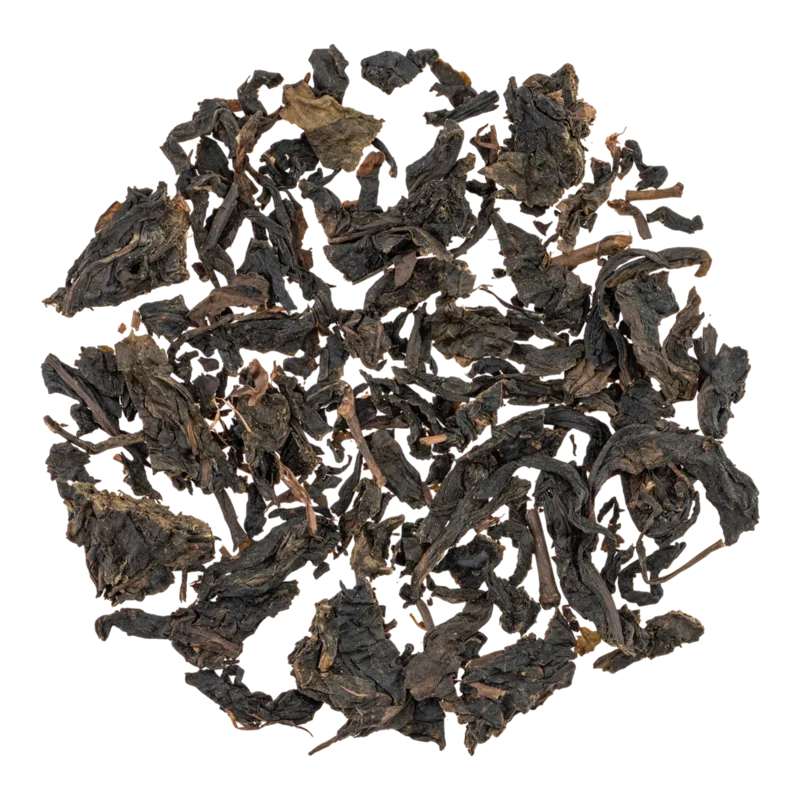
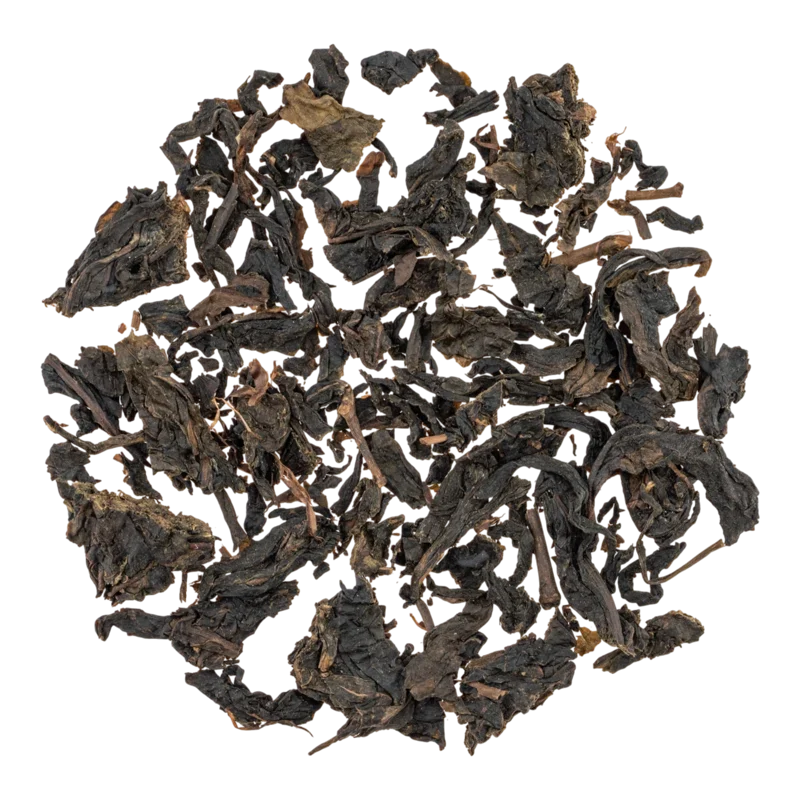
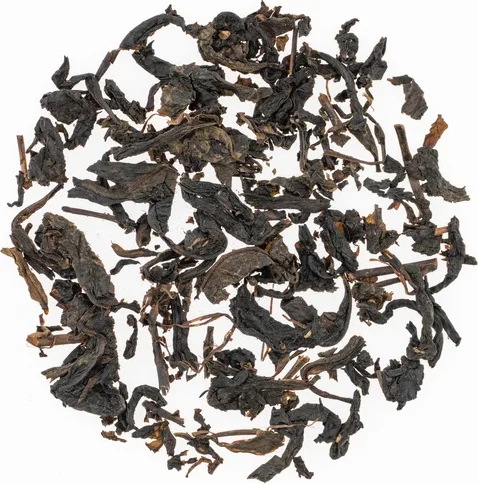
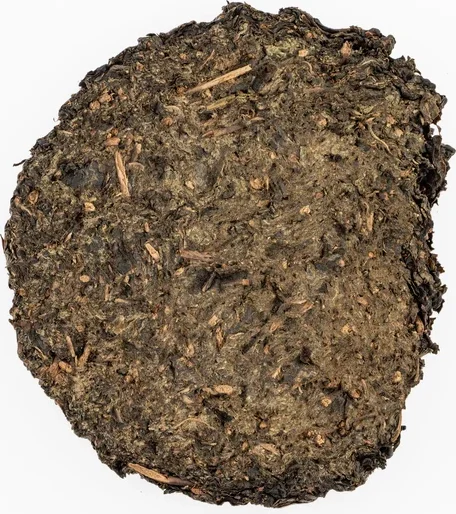
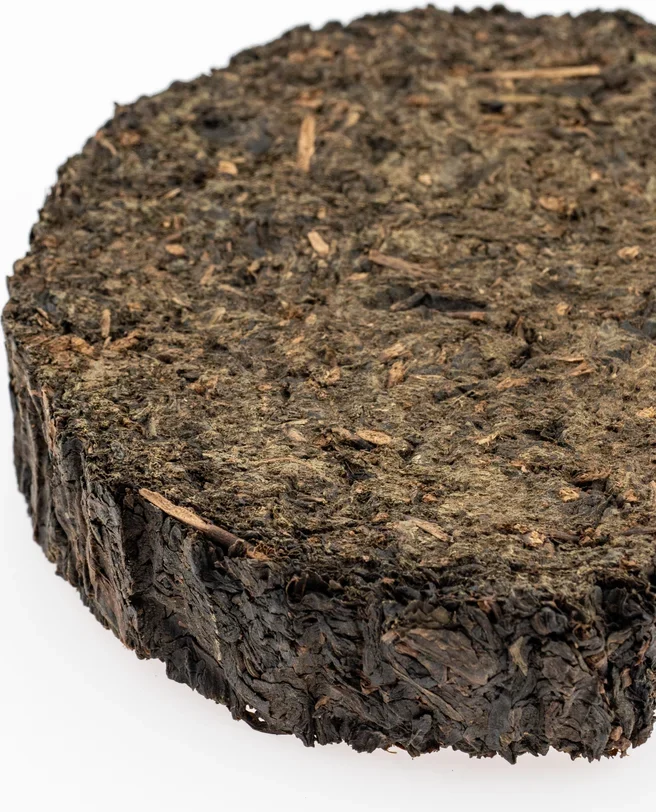
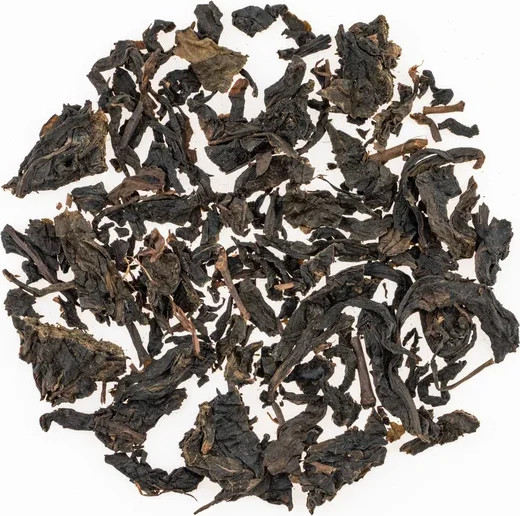
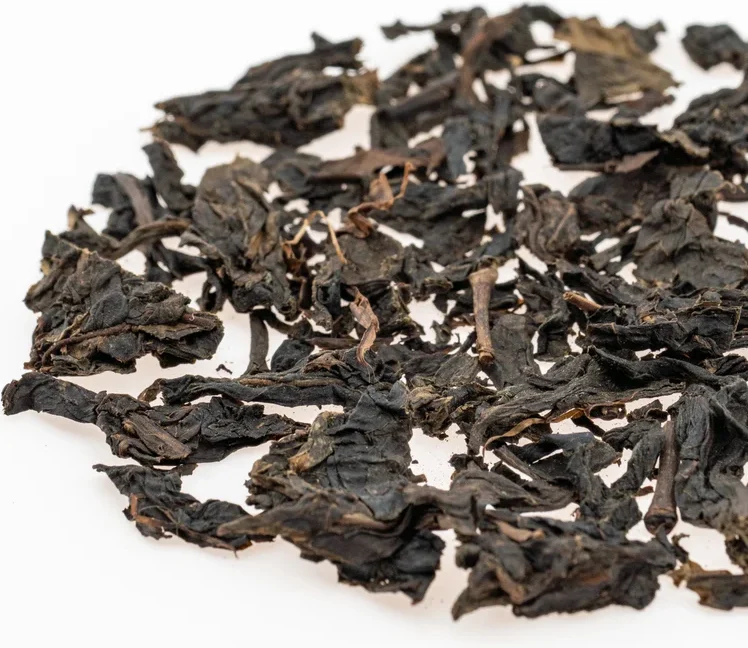
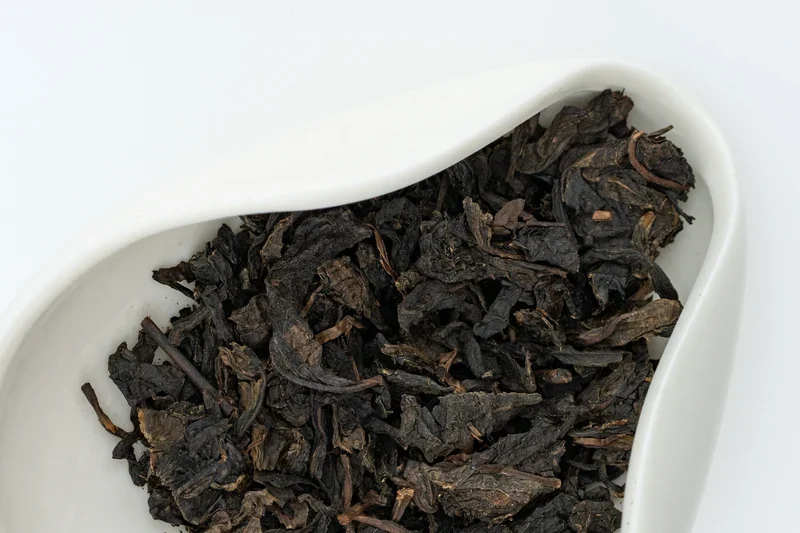
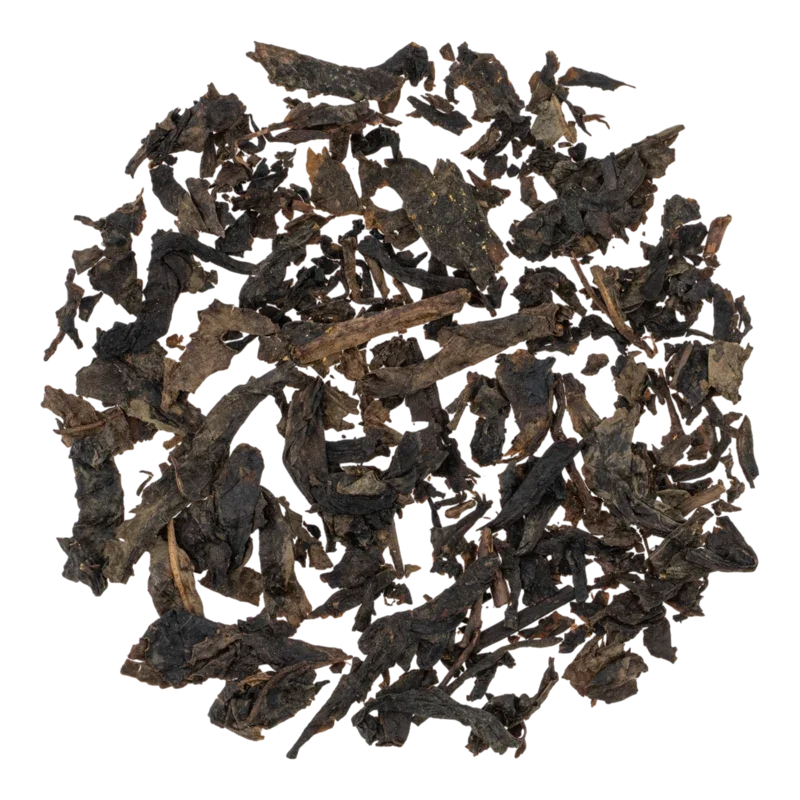
Dry Leaf Appearance: Depends on product type. Dry Hei Mao Cha — twisted strip-like leaves of dark brown or black-brown color with oily luster (黑褐油润). Tian Jian — relatively small, tightly twisted leaves with golden tip inclusions. Brick teas — tightly pressed briquettes: Hei Zhuan — smooth, glossy-black surface; Hua Zhuan — relief floral ornament on the edges; Fu Zhuan when broken reveals numerous golden dots — "Jin Hua." Qian Liang Cha — massive cylinder in bamboo wrapping.
Dry Leaf Aroma: Pine smoke (松烟香) — base note, especially pronounced in Hei Zhuan and Tian Jian. In Fu Zhuan — characteristic mushroom, "floral" aroma (菌花香, jūn huā xiāng), caused by "Golden flowers." With aging, chenxiang notes develop (陈香 — "aroma of antiquity"): dried fruits, nuts, wood, earth.
Liquor Aroma: Complex, multi-layered. Base tones — pine smoke and wood. In Fu Zhuan — pronounced mushroom aroma with yellow flower overtones. In aged samples — medicinal and "pharmaceutical" notes (药香, yào xiāng): camphor, dried herbs, prunes.
Liquor Color: From bright amber (橙黄, chéng huáng) to rich reddish-brown (橙红, chéng hóng) depending on subtype and aging. The liquor is transparent, clear (透亮, tòu liàng).
Spent Leaves: Whole, resilient leaves of dark brown color, well-opening after several steeps. In Tian Jian, unopened buds may be noticeable. In brick teas — more mature leaf, with presence of stem fragments.
Taste: Dense, rich, round (醇厚, chún hòu). Sweet and smooth (甘滑, gān huá) in the main body. Young teas may show slight astringency (微涩, wēi sè), which completely smooths out over the years. Aftertaste — prolonged, with returning sweetness (回甘, huí gān). Characteristic "oiliness" of texture, sensation of enveloping density. Connoisseurs describe taste evolution with the formula "first astringency — then sweetness — then mellowness" (先涩、后甘、再醇).
Chemical Composition
Alkaloids: Caffeine (咖啡碱) — 80–98 mg/g extract (lower than shu pu-erh, ~117 mg/g), theobromine, theophylline. Relatively low caffeine level makes Anhua Hei Cha milder in terms of stimulating effect.
Amino Acids: Including L-theanine (茶氨酸) — an amino acid promoting relaxation and attention concentration. Total free amino acid content in Anhua Hei Cha is moderate (about 9.5–16 mg/g extract).
Content significantly higher than in most other tea categories, since mature raw material with high structural carbohydrate content is used. Tea polysaccharides have proven hypoglycemic action similar to insulin-like effect.
Minerals: Potassium, magnesium, manganese, iron, zinc, fluorine. Special mention should be made of selenium (硒, xī): content in Anhua tea reaches 0.25–6.4 mg/kg with average value about 0.22 ppm, which is twice the average indicator for tea leaves in China. Fluorine promotes caries and osteoporosis prevention.
Polyphenols: Content in fresh leaf — over 35%. During "Wo Dui," part of the catechins oxidizes into theaflavins, thearubigins and theabrownins, ensuring taste mellowness and dark liquor color. According to research, polyphenol content in Tian Jian extract is about 373.77 mg/g — the highest indicator among studied heicha; in Fu Zhuan and Bai Liang Cha — somewhat lower.
Vitamins: Vitamins C, B group (B1, B2, B6), E, K, PP. Since raw material includes mature leaves and stems, content of several vitamins and minerals is higher than in teas from young leaves.
Health Notes
The most famous property of Anhua Hei Cha. Polyphenols and their oxidized derivatives actively dissolve fats and promote lipid removal from the bloodstream. Eurotium cristatum metabolites additionally enhance fat tissue breakdown. This is precisely why nomadic peoples, feeding predominantly on meat and milk, relied on this tea for centuries.
Clinical studies confirm Anhua Hei Cha's ability to lower cholesterol (LDL), blood triglyceride levels (降血脂), blood pressure (降血压) through theanine and catechin action on vascular tone, as well as blood glucose levels (降血糖) due to insulin-like action of tea polysaccharides.
Caffeine, amino acids and phospholipids stimulate gastric juice secretion and intestinal peristalsis. Probiotic cultures (especially in Fu Zhuan) improve intestinal microbiome. Traditional medicine has traditionally used aged Hei Cha for bloating, diarrhea and indigestion.
Despite reduced catechin content during fermentation, Anhua Hei Cha retains substantial antioxidant activity due to formation of complex flavonoids and tea pigments. Studies show that in free radical neutralization ability (DPPH, ORAC), Hunan heicha surpass pu-erh and liu bao.
Tea pigments (theabrownins, tea yellows) possess anticoagulant effect, prevent platelet aggregation, promote fibrin dissolution and prevent atherosclerotic plaque formation.
High selenium content stimulates immune protein and antibody production, has anti-radiation action and, according to several studies, suppresses tumor cell development.
Caffeine stimulates renal filtration. Polyphenols adsorb heavy metals and promote their elimination.
Hei Cha belongs to "warm" teas in Chinese medicine terminology, warms in cold weather and gently invigorates.
Brewing
Tea Amount: 7 g per 210 ml water (1:30 ratio). For brick teas: 5–8 g per 150–200 ml.
Teaware: Yíxīng purple clay teapot (紫砂壶, zǐshā hú) — ideal option, clay absorbs and "remembers" heicha aroma. Gàiwǎn (盖碗, gàiwǎn) — convenient for tasting and steeping time control. For daily tea drinking — large porcelain or glass teapot.
Water Temperature: 95–100°C (boiling water). For pressed teas and aged samples — strictly 100°C.
Storage
Container: Original packaging (bamboo basket, kraft paper) or unglazed ceramic/clay vessel. Hermetic storage in glass or metal is not recommended — tea should "breathe."
Enemies: Foreign odors (store separately from spices, perfumery, household chemicals); excessive humidity (leads to mold appearance); direct sunlight.
Dry, dark, well-ventilated room. Moderate ventilation is necessary to maintain microorganism activity participating in post-fermentation.
Do not confuse "Jin Hua" (golden, evenly distributed Eurotium cristatum spore bodies) with mold (黄曲霉): "Golden flowers" are separate rounded, full-bodied colonies of rich golden color, while pathogenic mold looks like uneven greenish-gray or black coating.
Temperature: Room temperature, without sharp fluctuations. Avoid direct sunlight and heating.
Comparison
Highest grade; raw material — first grade, tender buds and upper leaves. Pronounced pine aroma, clear orange-yellow liquor. During the Qing era, it was presented to the court as tribute.
Second grade; raw material — second grade with a small portion of first and third grades. Rich, full-bodied taste. During the Ming dynasty and Republican period — tea for officials and major merchants.
Third grade; coarser raw material with stems. Intense, slightly astringent taste. Historically — mass everyday tea.
Without "Golden Flowers." Pronounced pine aroma, glossy black smooth surface. Raw material — third to fourth grade black mao cha. Divided into premium (特制) and regular (普通) grades.
Developed from "Hua Juan Cha" (花卷茶). Pressing technology similar to Hei Zhuan, but slightly better raw material (entirely third grade), and decorative patterns are imprinted on the brick's side faces. Pronounced "chenxiang" — aged aroma. Divided into premium (特制) and regular (普通) grades.
Cylinder weighing 36.25 kg (1000 old liang), approximately 166.5 cm long, ~56 cm in circumference. Wrapped in Polygonum leaves and palm fiber, placed in a fresh bamboo basket. Combines bamboo aroma, palm fiber, pine smoke, and deep "chenxiang." Not subdivided into grades. Also produced in formats of 500 liang, 300 liang, 100 liang, and 10 liang.
Price and Authenticity
Specialized tea shops with stable reputation, official stores of certified factories. Pay attention to geographical indication logo presence on packaging.
Dry leaf should be dark brown with oily luster, without excess dust, foreign inclusions and broken leaf. Brick pressing — dense, even, without cracks. For Qian Liang Cha — bamboo wrapping whole, without damage.
Characteristic pine smoke and/or mushroom aroma of "Golden flowers." Absence of mustiness, sourness, burnt smell.
Transparent, rich, amber or red-brown color. Muddy, dull liquor — sign of low quality or improper storage.
Authentic Anhua Hei Cha from quality raw material cannot be cheap. Special caution should be exercised when buying "aged" and "vintage" samples — counterfeiting old teas is especially profitable.