Classification and Origin
Category: PRC Geographical Indication Product (国家农产品地理标志产品, Guójiā Nóngchǎnpǐn Dìlǐ Biāozhì Chǎnpǐn, 2022). Gold medal at Chéngdū International Tea Exhibition (成都国际茶博会金奖, Chéngdū Guójì Chá Bóhuì Jīn Jiǎng, 2011 — "Baimaocha" line). Silver medal — "Cuipiancha" line. Annual production volume (by 2025) — approximately 2250 tons.
Coordinates: Approximately 25°00′ N, 107°30′ E.
Origin: China, Guǎngxī Zhuāng Autonomous Region (广西壮族自治区, Guǎngxī Zhuàngzú Zìzhìqū), Héchí City (河池市, Héchí Shì), Nándān County (南丹县, Nándān Xiàn). The production zone covers 5 townships and 70 villages. The core — Liùzhài Town (六寨镇, Liùzhài Zhèn) and Lóngmǎ Village (龙马村, Lóngmǎ Cūn, "Dragon and Horse Village") — considered the "cradle" of Liulong Lu Cha.
Type: Green tea (绿茶, lǜchá), unfermented. Combined technology: pan-firing + drying (烘炒结合, hōng chǎo jiéhé). Five forms of production: flat (扁形, biǎnxíng — "Gongpincha" and "Cuipiancha"), needle-shaped (针形, zhēnxíng — "Yu Yacha"), spiral (卷曲形, juǎnqū xíng — "Baimaocha"), fine spiral (细卷形, xì juǎn xíng — "Yunjiancha"). Degree of oxidation — 0%.
Botany and Raw Material
Fully manual production, flat form. Aroma — beany (豆香, dòuxiāng). Considered "head tea" (头茶, tóuchá) — the first, most valuable picking. The most premium line.
Single bud, needle-shaped form. When brewed in a glass cup demonstrates "三起三落" (sān qǐ sān luò, "three rises — three falls"): buds three times float to the surface and sink, then stand vertically at the bottom of the cup — a spectacle comparable to Jūnshān Yínzhēn (君山银针) from Hunan. Taste — sweet.
Flat, emerald form. Aroma persistent, fresh. Silver medal at international exhibitions.
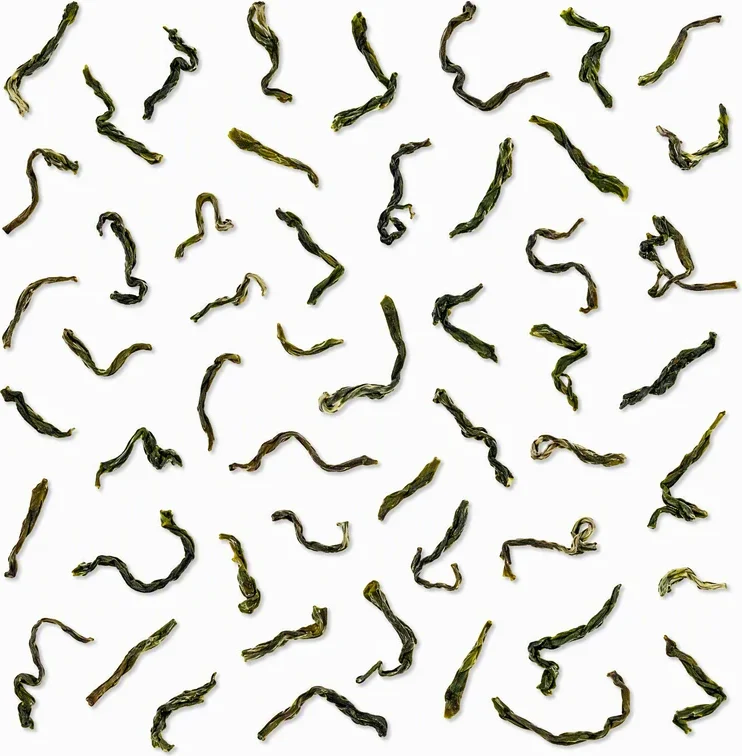
Spiral form, abundant white down. Liquor — emerald-green. Gold medal at Chengdu Exhibition 2011.
Fine spirals. Aroma — orchid (兰花香, lánhuā xiāng). The most refined line in aromatic profile.
Cultivar: Yúnnán Dàyè Zhǒng (云南大叶种, Yúnnán Dàyè Zhǒng) — share in plantings ~80%. Tree type (乔木型, qiáomù xíng), large-leaf (大叶, dàyè). Tea trees aged 30+ years and more. Distinguished by high polyphenol content (≥28.3% in fresh leaf) and powerful, large buds with abundant white down. Plantation management: complete pesticide ban, feeding only with organic fertilizers (bran, ash). Ancient trees are used for premium grade production.
Picking: Early spring, main period — before Gǔyǔ (谷雨, Gǔyǔ). Picking standard depends on the line: for "Gongpincha" — single buds or one bud + one leaf; for "Baimaocha" and "Yunjiancha" — one bud + one-two leaves. Raw material is hand-picked.
Terroir
Altitude: 800–1000 m — high-mountain tea by Guangxi standards.
Climate: Southern slope of the Yunnan-Guìzhōu Plateau (云贵高原). Average annual temperature — 17.2°C. Annual precipitation — 1470 mm. Cloud cover — more than 180 days per year. Diffused light comprises ~70% of total — a high indicator promoting amino acid accumulation. Daily temperature difference — more than 10°C — a key factor for sugar and aromatic compound accumulation.
Soil: Red sandy-gravelly (赤色砂砾岩风化土, chìsè shālì yán fēnghuà tǔ), formed on weathered red sandstones. pH 4.5–6.5. Selenium (Se) content — 0.018–0.066 mg/kg — 1.3 times higher than average for Chinese green teas. The unique mineral profile of soils contributes to the characteristic "rock rhyme" (岩韵, yányùn) — a light mineral note in taste, more typical of Wuyi oolongs, but present here in green tea.
Forest cover — 90% — one of the highest indicators among all tea regions of China. Absence of industrial pollution. Biological pest protection (without pesticides, attracting natural predators) increases biodiversity on plantations by ~50%.
Production
Freshly picked raw material is spread on bamboo sieves. Duration — 4–16 hours — unusually long for green tea. Extended spreading promotes deep protein hydrolysis with release of free amino acids and development of sweetness. This stage lays the foundation for the characteristic mellow-sweet (甘醇, gānchún) taste.
High-temperature (about 300°C) rapid pan-firing on the principle of "高温短时" (gāowēn duǎnshí, "high temperature — short time"). Inactivates oxidases, fixes green color. Reduction of grassy note — by ~30%.
On the principle of "light → heavy → light" (轻→重→轻, qīng → zhòng → qīng). First phase — careful release of cell juice without destroying leaf integrity; second — intensive shaping; third — pressure equalization for final form.
At 120°C — removal of main moisture mass and fixation of aromatic profile.
At 90°C to moisture ≤6%. Ensures storage stability.
Organoleptic Profile
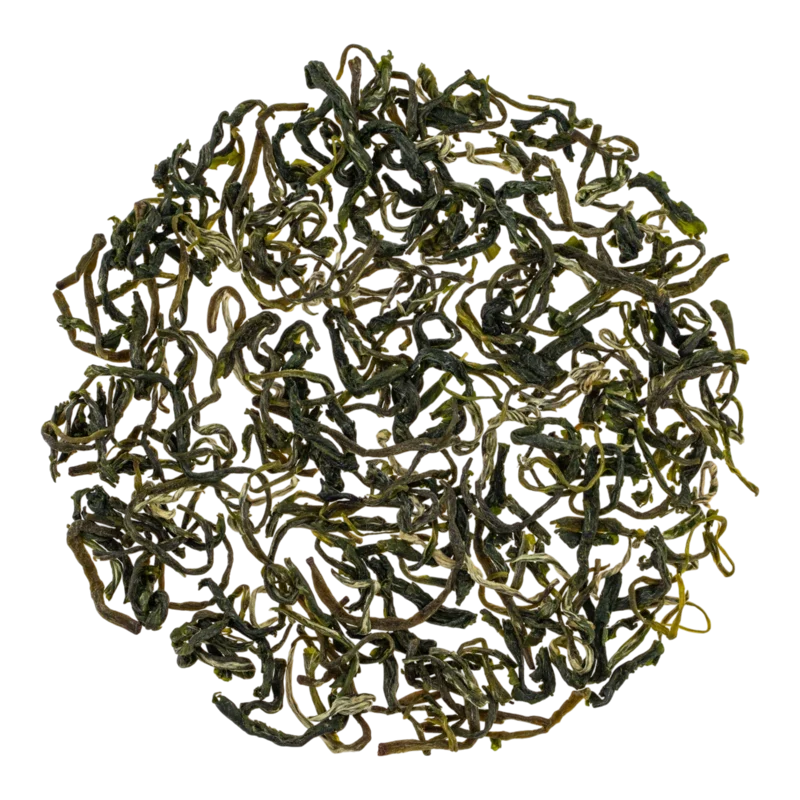
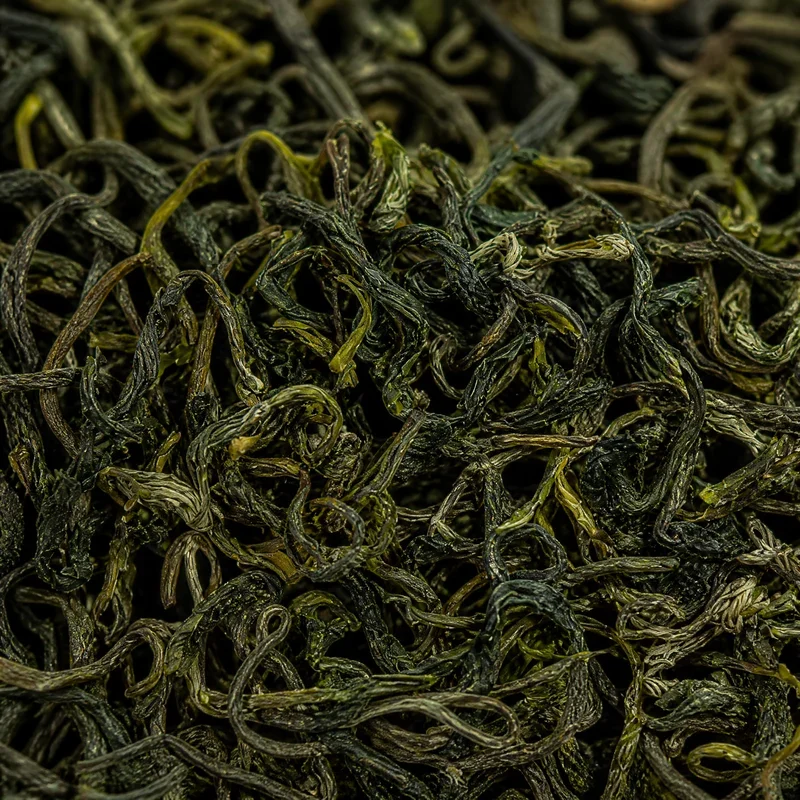
Dry Leaf Appearance: Depends on line (5 forms). Common feature — emerald-green color (翠绿, cuìlǜ) with abundant white down (显毫, xiǎnháo). "Gongpincha" — flat, glossy "slices"; "Yu Yacha" — straight needles; "Baimaocha" — tight spirals covered with down; "Yunjiancha" — fine, elegant spirals.
Dry Leaf Aroma: Pure (清香, qīngxiāng) — general characteristic. Beany (豆香, dòuxiāng) — in "Gongpincha". Orchid (兰花香, lánhuā xiāng) — in "Yunjiancha". Chestnut (栗香, lìxiāng) — in first grade. Aroma on cold cup persists more than 15 minutes — indicator of high quality.
Liquor Aroma: Multi-layered, depending on line. Dominance — pure fresh greenness with nuances varying from beany to orchid. Aroma persistence is high.
Liquor Color: Emerald-green (碧绿明亮, bìlǜ míngliàng) — for premium grade. Yellow-green — for first grade. Clarity is high.
Spent Leaves: Tender-green, fleshy, in "bouquets" (嫩绿匀亮,肥壮成朵, nèn lǜ yún liàng, féizhuàng chéng duǒ). The large-leaf character of the Yunnan variety is clearly visible in the unfolded leaves — they are thicker and more succulent than small-leaf teas.
Taste: Fresh and brisk (鲜爽, xiānshuǎng). Mellow-sweet (甘醇, gānchún). Returning sweetness (回甘) — persistent and prolonged, with characteristic "high-mountain coolness" (高山韵清凉感, gāoshān yùn qīngliáng gǎn) — sensation of light menthol freshness on the tongue, typical of high-mountain teas. Light "岩韵" (yányùn, "rock rhyme") — mineral note caused by red gravelly soils. Bitterness is minimal due to high amino acid content (≥5.2%).
Chemical Composition
Amino Acids: ≥5.2% — 15% higher than low-altitude green teas. Result of combining high-mountain microclimate (daily difference >10°C, diffused light 70%) and prolonged spreading (up to 16 hours). Main component — L-theanine, providing pronounced umami taste and mellow sweetness.
0.018–0.066 mg/kg — 1.3 times higher than average for green teas. Due to geochemical composition of red sandy-gravelly soils of Nandan.
3–4% dry weight — somewhat higher than small-leaf green teas, which is characteristic of large-leaf variety. Provides pronounced but mild tonic effect.
Essential Oils: Rich profile, differing by lines. Linalool, geraniol (orchid notes of "Yunjiancha"), cis-3-hexenol (green freshness), furfural (chestnut shades), 2-acetylpyrrole (beany aroma of "Gongpincha").
Minerals: Potassium, calcium, magnesium, iron, manganese, zinc. Selenium — elevated (see above).
Polyphenols: ~28.3% in fresh leaf; after pan-firing processing — up to ~38% calculated on extractive substances (for pan-fired forms). High indicator characteristic of large-leaf Yunnan variety (C. sinensis var. assamica). Main fraction — catechins, providing powerful antioxidant potential.
Vitamins: Vitamin C — significant content, preserved due to minimal oxidation. B vitamins (B1, B2), vitamin E (tocopherols).
Brewing
Tea Amount: 3 g per 150 ml water (1:50 ratio).
Teaware: For "Yu Yacha" (needle-shaped) — mandatory transparent glass cup to observe "three rises — three falls" (三起三落). For other lines — glass cup or porcelain gaiwan (盖碗, gàiwǎn).
Water Temperature: 80–85°C (premium grade — 75°C for maximum delicacy). Large-leaf Yunnan variety is more sensitive to overheating than small-leaf varieties.