Brewing
Gongfu brewing
- Water temperature
- 80 °C
- Tea amount
- 5 g
- Water volume
- 100 ml
- First steep
- 10 s
- Time added per infusion
- 5 s
- Infusions
- 3

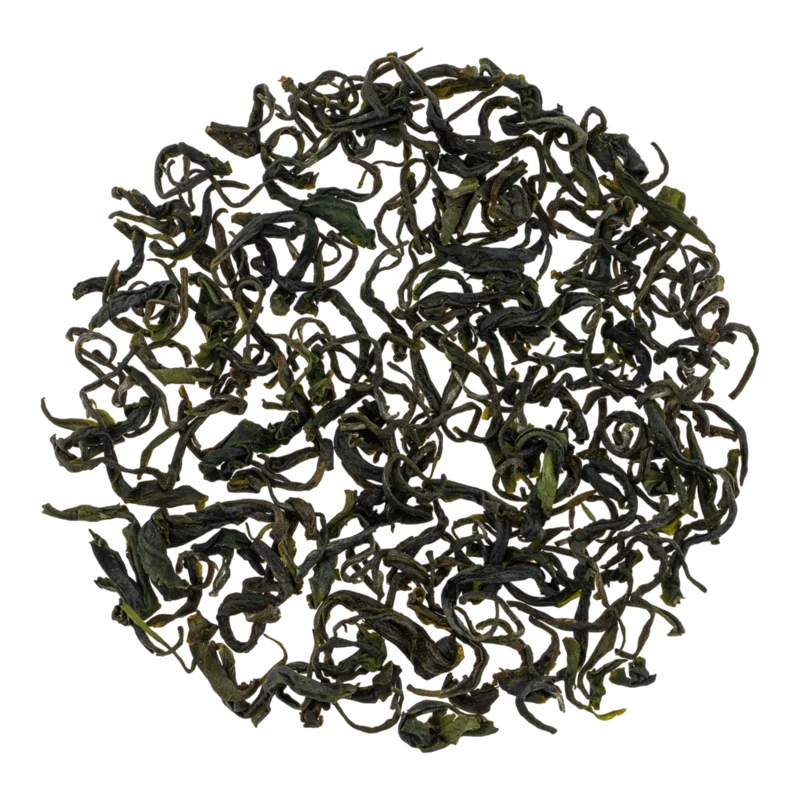
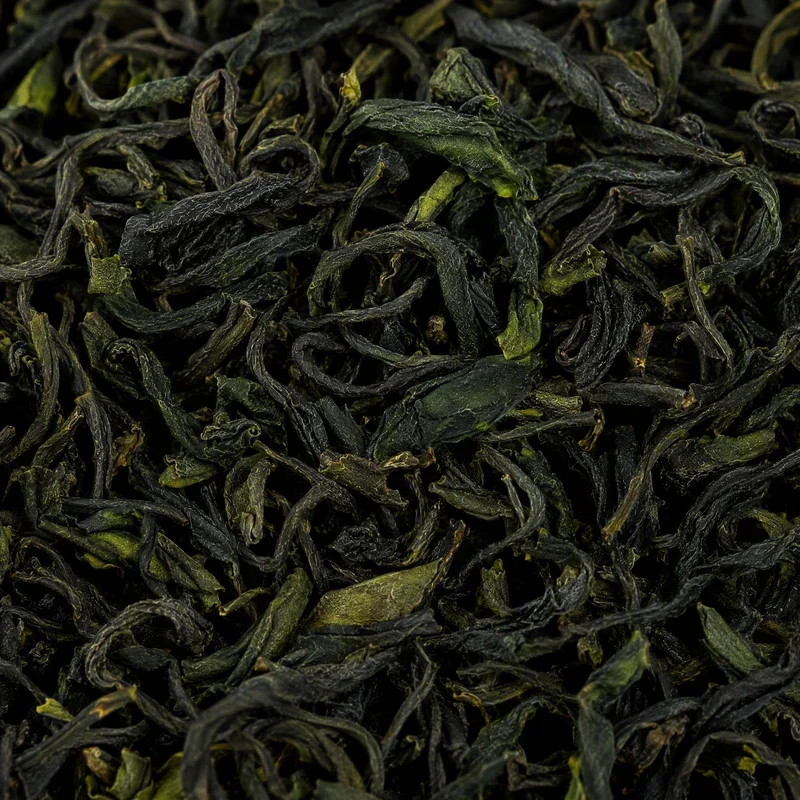
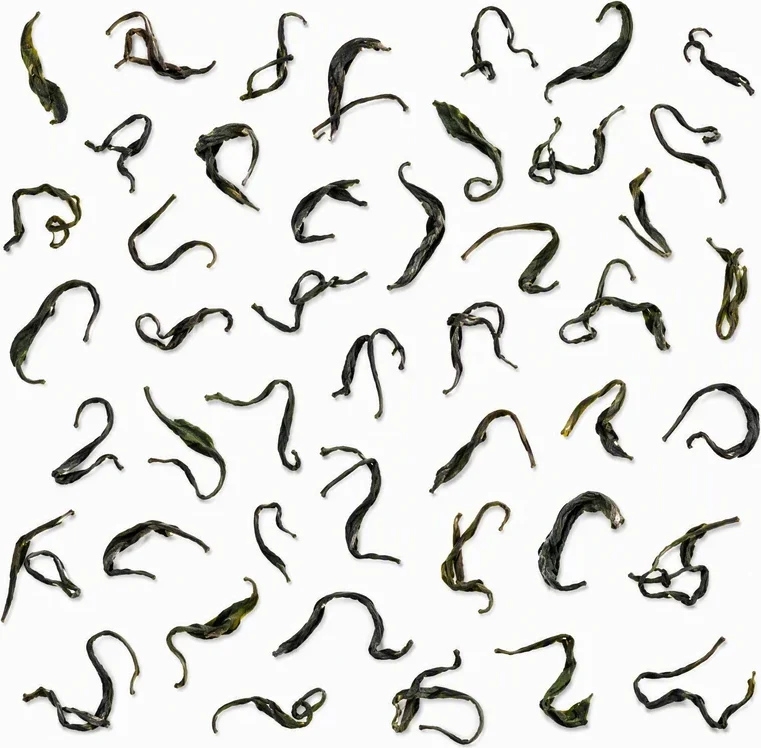
Zūnyì máofēngchá
Choose a brewing method. Start with the recommended quantities and time, then adjust to taste.
Brewing
Brewing
Taste
Tea encyclopedia
Category: Guizhou famous green teas; product with national geographical indication (since 1983 — one of the first teas to receive national quality awards).
Category: Guizhou famous green teas; product with national geographical indication (since 1983 — one of the first teas to receive national quality awards).
Coordinates: approximately 27°45′ North latitude, 107°30′ East longitude.
Origin: China, Guìzhōu Province (贵州省, Guìzhōu shěng), Zūnyì City (遵义市, Zūnyì shì), Méitán County (湄潭县, Méitán xiàn). The core production area is the experimental tea gardens of the Guìzhōu Tea Research Institute (贵州省茶叶研究所, Guìzhōu shěng Cháyè Yánjiūsuǒ) in Méijiāng Township (湄江镇), which accounts for up to 90% of special grade production.
Type: Green tea (绿茶, lǜchá), unoxidized.
Cultural Significance: Zunyi Maofengcha occupies a unique place in Chinese tea culture as a tea with a direct ideological programme — a phenomenon with virtually no analogues. Each element of the tea's external appearance is consciously linked to revolutionary symbolism, and this "embedded narrativity" makes it simultaneously a beverage and a memorial object. Meitan, nicknamed "Little Jiangnan" (小江南) for its mild climate and picturesque landscapes, is Guizhou's largest tea-producing county and one of China's leaders: the county houses "Zhongguo Chacheng" (中国茶城, "China Tea City") — the largest tea market in southwest China. Besides Zunyi Maofengcha, famous Méitán Cuìyá (湄潭翠芽), Lanxin Quèshé (兰馨雀舌) and red tea "Zunyi Hong" (遵义红) are produced here.
History: The tea history of Meitan County reaches back to ancient times. Lù Yǔ (陆羽, Lù Yǔ) in the "Cha Jing" (茶经, Chá Jīng, "The Classic of Tea", 8th century) mentions: "Tea grows in Sizhou, Bozhou, Feizhou, Yizhou... there it is frequently harvested, and its taste is excellent" — "Yizhou" (夷州) refers to territory including modern Meitan. During the Ming and Qing dynasties, local tea was supplied to the court as tribute tea (贡茶, gòngchá).
Name Breakdown: 遵义 (Zūnyì) — the name of the city, inextricably associated with the 1935 Zunyi Conference. 毛峰 (Máofēng) — "downy peak" — a classic designation for the category of green teas with abundant white down and pointed shoot tips forming a "peaked" silhouette of the tea leaf. 茶 (Chá) — tea.
Cultivar: The main cultivar is Fúdǐng Dà Bái Chá (福鼎大白茶, Fúdǐng Dà Bái Chá), clonal, medium-leaf, with high shoot-forming ability and good cold resistance. Distinguished by thick, downy shoots providing abundant white down on the finished tea. Biochemical profile: polyphenols ≥25%, amino acids ≥3.0%, water extract ≥43% — a combination ensuring high aromatics and resistance to multiple infusions.
Picking: Annually during the period around Qingming Festival — approximately 10–15 days before and after (late March to mid-April). Tea bushes that have accumulated plastic substances over winter produce the most tender shoots with maximum down density during this period.
Pluck Standard: Special grade (特级) — one bud and one leaf at initial opening stage, shoot length ≤2.5 cm; producing 500g of special grade tea requires approximately 50,000 buds. First grade — one bud and one leaf, length 2.5–3.0 cm. Third grade — one bud and two leaves, length 3.0–3.5 cm.
Raw Material: Shoots must be fresh, uniform, without damage or impurities.
Altitude: 800–1,200 m above sea level.
Soil: Acidic yellow soils (黄壤, huáng rǎng), pH 4.5–5.5, organic matter content ≥1.5%. Soils are rich in zinc and selenium — a characteristic feature of karst Guizhou that increases the mineral value of tea. Water resources are provided by the Méijiāng River (湄江, Méi Jiāng), which crosses the entire county; water quality meets national standard category I.
Méitán is located in a zone of gentle hills on the spurs of the Dàlóu Mountains (大娄山, Dàlóu Shān), at elevations of 800–1,200 m. Average annual temperature — 16–18°C, annual precipitation — 1,200–1,500 mm. Number of foggy days — over 180, proportion of diffused light — more than 70%. It is precisely the combination of high humidity, moderate temperatures and diffused lighting that forms the delicate aromatic profile and high amino acid content.
A unique characteristic of Meitan plantations is the "aromatic protective belt" (芳香隔离带): around tea gardens are planted osmanthus (桂花, guìhuā), pomelo (柚子, yòuzi), crape myrtle (紫薇, zǐwēi — Lagerstroemia) and other aromatic plants. They perform a dual function: repel pests and promote accumulation of delicate aromatic substances in tea leaves through "cross-pollination of aromas" — a phenomenon described by Meitan tea agronomists. The karst topography of Guizhou creates natural drainage: underground cavities and porous limestone prevent moisture stagnation at roots while ensuring stable mineralization of soil waters. This natural mechanism is one reason why Guizhou green teas are distinguished by "mineral transparency" of taste.
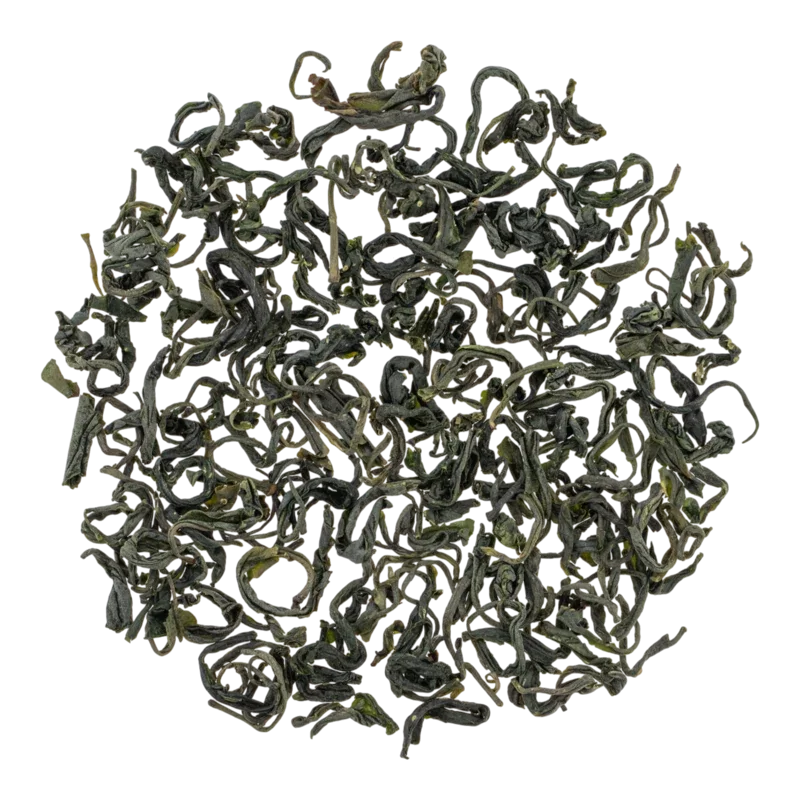
Dry Leaf Appearance: Tea leaves thin, dense, straight, round in cross-section (紧细圆直), emerald-green with oily lustre (翠绿油润). White down abundant, silvery sparkling (银毫显露). Shoot tips preserved — sharp and distinct.
Dry Leaf Aroma: Delicate, young (嫩香, nèn xiāng) — aroma of fresh buds, typical of high-class spring green teas. With light greenness and subtle notes of freshly cut grass.
Liquor Aroma: High and persistent, with clean greenness and notes reminiscent of spring flowers. Aroma in cold cup persists more than 8 minutes — an indicator significantly exceeding the average level for green teas.
Liquor Color: Bright emerald-green, clear and transparent (碧绿明净), with characteristic lustre.
Spent Leaves: Tender green, uniform, with preserved sharp bud tips opening into "flowers" (芽尖鲜活成朵).
Taste: Clean, mellow (清醇, qīng chún), fresh and brisk (鲜爽, xiān shuǎng), with minimal bitterness and astringency. Aftertaste — pronounced returning sweetness (回甘, huí gān), smoothly transitioning to prolonged sweetness. High amino acid content (≥3.0%) gives the taste soft "body" without heaviness.
Amino Acids: ≥3.0% — high level forming sweetness, freshness and taste "body". Favorable amino acid to polyphenol ratio explains absence of harsh bitterness.
≥43% — high extractability ensuring resistance to multiple infusions.
According to sources, caffeine content in Zunyi Maofengcha is 15% higher than average for green teas of the same class, providing pronounced tonic effect.
Zinc and selenium — result of karst geological conditions in Guizhou that mineralize soil waters. These elements increase the nutritional value of tea.
Essential Oils: Delicate, "young" aromatic compounds forming the characteristic "nèn xiāng" (嫩香) — aroma of young shoots.
Polyphenols: ≥25% — moderate for green tea, ensuring taste mellowness without excessive astringency.
Vitamins: Vitamin C, B-group vitamins, vitamin K.
Not recommended on empty stomach (tannins may irritate gastric mucosa); optimal time — one hour after meals. Daily limit — no more than 600ml. When taking iron supplements, maintain pause of at least 2 hours.
Tea Amount: 3g per 150ml (1:50 ratio).
Teaware: Transparent glass tumbler for observing bud opening (观茶舞) or white porcelain gaiwan for aroma concentration.
Water Temperature: 80°C (for special grade — 75°C). Boiling water should be cooled approximately 90 seconds.
Container: Airtight packaging, protection from light, odors and moisture. Aluminum bags with vacuum sealing or tin cans with tight lids.
Store in refrigerator in tightly closed container; do not remove frequently. Recommended to separate portions for 1–2 weeks while keeping main supply untouched.
Before opening, bring package to room temperature while closed.
Temperature: 0–5°C (refrigerator); shelf life — 12 months.
Same Meitan County, but fundamentally different form — flat, resembling sunflower seed, with hidden down and oily lustre (resembles Longjing). Aroma — chestnut, taste — denser and heavier. If Zunyi Maofengcha is "spring wind", then Meitan Cuiya is "autumn forest" in the same terroir.
Guizhou Province (Qiannan Autonomous Prefecture). "Ten Famous Teas of China". Small-leaf mountain cultivars, elevations over 1,000m. Form — "hooks" with silvery down; taste — even lighter and sweeter, aroma — more delicate. Polyphenol content — about 20%, lower than Zunyi Maofengcha (≥25%), determining less concentrated, "airy" profile.
Guizhou Province (Fenggang County). Green tea with accentuated high zinc and selenium content — main marketing feature. Form — needle-like or flat depending on line; taste — clean, mellow, with "mineral" undertone. Less known outside the province than Zunyi Maofengcha.
Guizhou Province (Shiqian County). Produced from local cultivar "苔茶" (tái chá — "moss tea"), distinguished by thick, "fleshy" shoots. Taste denser and richer, with pronounced chestnut accent; astringency more noticeable than in delicate Zunyi Maofengcha.
Special grade — from 800 yuan/jin and higher (manual processing, raw material from research institute experimental gardens). First grade — 300–600 yuan/jin. Third grade — from 80–150 yuan/jin (mass production, raw material for bagged teas).
Price Factors: Picking standard (50,000 buds per 500g special grade — extremely labor-intensive process), manual or machine labor, season, producer reputation.
No reviews yet. Tell us what you think of this tea.
Rate this tea and share your impressions. We review each submission before publishing it.