Brewing
Gongfu brewing
- Water temperature
- 75 °C
- Tea amount
- 5 g
- Water volume
- 100 ml
- First steep
- 10 s
- Time added per infusion
- 5 s
- Infusions
- 3

Fènggāng xīn xī chá
Choose a brewing method. Start with the recommended quantities and time, then adjust to taste.
Brewing
Brewing
Taste
Tea encyclopedia
Category: Regional tea with protected geographical indication (地理标志产品, dìlǐ biāozhì chǎnpǐn). Listed among the "Ten Famous Teas of Guizhou" (贵州十大名茶). Since 2020, included in the first list of mutually recognized geographical indications under the China-EU Agreement (《中欧地理标志协定》).
Category: Regional tea with protected geographical indication (地理标志产品, dìlǐ biāozhì chǎnpǐn). Listed among the "Ten Famous Teas of Guizhou" (贵州十大名茶). Since 2020, included in the first list of mutually recognized geographical indications under the China-EU Agreement (《中欧地理标志协定》).
Coordinates: 27°32′–28°21′ N, 107°31′–107°56′ E. The county administrative center is approximately 27.95° N, 107.72° E.
Origin: China, Guìzhōu Province (贵州, Guìzhōu), Zūnyì City (遵义市, Zūnyì shì), Fènggāng County (凤冈县, Fènggāng xiàn). The protected origin zone covers 12 townships of the county: Yong'an (永安), Xinjian (新建), Tuxi (土溪), Suiyang (绥阳), Huaping (花坪), Longquan (龙泉), Yǒnghé (永和), Fèngyǎn (蜂岩), Jīnhuā (进化), Yaochuan (琊川), Heba (何坝), Shijing (石径) — with a total area of 1,569.5 km².
Type: Green tea (non-oxidized, 绿茶, lǜchá). Red tea (红茶, hóngchá) is also produced under the same brand, but green tea remains the primary and most widespread category.
Cultural Significance: Fenggang's tea culture is deeply woven into the county's daily life: more than 50 villages bear "tea" names, wedding ceremonies preserve the custom of "three teas" (三道茶), and every year on the nineteenth day of the second lunar month (农历二月十九), the Tea Worship Festival (祭茶大典) is held, which has been continuously celebrated for over 20 years. Tea cuisine — especially oil tea soup (油茶汤, yóuchá tāng), popular among the Tujia (土家族) and Gēlǎo (仡佬族) ethnic groups — is included in Guizhou Province's intangible cultural heritage list. The concept "East has Longjing, West has Fenggang" (东有龙井·西有凤冈) has become a marketing slogan emphasizing the region's ambitions. The national 4A-category tourist area "Heart of the Tea Sea" (茶海之心, "Cháhǎi zhī xīn") in Yong'an township annually attracts tens of thousands of visitors, and the "tea + tourism" integration model (茶旅一体化) is recognized as exemplary at the national level.
History: Fenggang's tea history reaches back to ancient times. During the Hàn dynasty (汉代), the "Records of the Grand Historian" (《史记》) and "Book of Han" (《汉书》) mention that the Hàn envoy Táng Méng (唐蒙, Táng Méng), traveling to the Yèláng kingdom (夜郎, Yèláng), discovered tea among local products. The territory of present-day Fenggang was then located on the northeastern periphery of the Yelang state. During the Eastern Jīn dynasty (东晋), Cháng Qú (常璩, Cháng Qú) recorded in "Records of the States South of Mount Hua" (《华阳国志》): "Pingyi produces tea and honey" (平夷产茶蜜) — the Pingyi area included the lands of modern Fenggang. During the Tāng dynasty (唐代), Lù Yǔ (陆羽, Lù Yǔ) noted in "The Classic of Tea" (《茶经》): "Tea grows in Qianzhong — in Sizhou, Bozhou, Feizhou, Yizhou... when it can be obtained, the taste is excellent" (茶之出,黔中生思州、播州、费州、夷州……往往得之,其味极佳). According to historical research, Yizhou prefecture (夷州) was located precisely on the territory of present-day Suiyang township in Fenggang County, and Suiyang county administration was in present-day Yong'an. During the Sōng dynasty (宋代), "Taiping Imperial Encyclopedia" (《太平寰宇记》) lists tea among the main products of Yizhou.
Name Breakdown: Fènggāng (凤冈) — the county name, literally "Phoenix Hill": 凤 (fèng) — "phoenix," 冈 (gāng) — "hill, elevation"; derives from the toponym "Fengming Gaogang" (凤鸣高冈) — "Phoenix sings on the high hill." Xīn (锌, xīn) — "zinc." Xī (硒, xī) — "selenium." Chá (茶, chá) — "tea." Thus, the full name literally means "Zinc-Selenium Tea from Fenggang" and directly indicates the main distinguishing feature of the product — the natural content of two trace elements.
Cultivar: Main planted cultivars are Fúdǐng Dà Bái Chá (福鼎大白茶, Fúdǐng Dà Bái Chá) and lines of the Qiánméi series (黔湄系列, Qiánméi xìliè), as well as Lóngjǐng (龙井), Míngshān (名山), and several local population plantings. Fuding Da Bai Cha provides large, downy buds and high amino acid content; Qianmei lines are adapted to local conditions and possess good cold resistance. Planting density is 4,500–5,000 bushes per mu (approximately 67,500–75,000 bushes/ha), double-row scheme: row spacing 1.5 m, distance between rows 0.45–0.50 m, between bushes 0.30–0.35 m, 2 seedlings per planting hole.
Picking: Main harvest season is from late March to late May (spring tea, 春茶). Summer and autumn tea (夏茶, 秋茶) are also harvested — from June to September — primarily for export batches. The harvest season encompasses up to 9 months per year.
Pluck Standard: Special grade (特级) — one bud and one leaf at initial opening stage (一芽一叶初展), shoot length 2.5–3.0 cm. First grade (一级) — one bud and two leaves (一芽二叶), length 3.0–3.5 cm. Second grade (二级) — one bud and three leaves (一芽三叶), length 3.5 cm. For certain types (扁形茶 — flat tea like sparrow tongue), picking exclusively buds (独芽, dúyá) is permitted.
Raw Material: Shoots must be tender, uniform in size and clean, without traces of pest damage. Picking method — "lifting" (提采, tícǎi) and "spring" (弹采, táncǎi), ensuring bud and leaf integrity without mechanical damage. Freshly picked raw material is immediately delivered to the factory to avoid overheating.
Altitude: 600–1,200 m above sea level. Main tea plantations are concentrated at elevations of 700–1,000 m.
Climate: Mid-subtropical humid monsoon (中亚热带湿润季风气候). Average annual temperature is 15.2°C, absolute maximum 37.8°C, absolute minimum −7.4°C. Frost-free period is 257–302 days. Average annual precipitation is 1,257 mm. Average annual sunshine is approximately 1,139 hours (寡日照, "little sun"), which is a characteristic feature of Guizhou terroir: reduced direct sunlight promotes slow shoot growth and amino acid accumulation. The terroir formula adopted by local specialists: "low latitude, high altitude, little sun" (低纬度、高海拔、寡日照).
Soil: Yellow (黄壤, huáng rǎng) and yellow-brown mountain soils predominate, with acidic reaction and high organic matter content (>1% in the topsoil). Critically important feature: the county's soils are located in a geochemical anomaly zone simultaneously enriched with zinc (average Zn content in soil — 95.3 mg/kg) and selenium (Se — 2.5 mg/kg). Soil profile depth suitable for tea is at least 80 cm.
Fenggang County is located in northeastern Guizhou, at the foot of the Dàlóu Mountains (大娄山, Dàlóu Shān) on the northern bank of the Wǔ River (乌江, Wūjiāng). The topography is typical karst mid-mountain hilly landscape with numerous valleys and ravines. Average county elevation is 720 m above sea level, with maximum elevations reaching 1,200 m.
Forest coverage in tea zones reaches 80–90%. Plantations are arranged according to the "forest among tea, tea among forest" model (林中有茶、茶中有林、林茶相间): trees are planted between tea bush rows — camphor laurel (香樟), osmanthus (桂花), maple (红枫), cherry, and others, creating mosaic shading and supporting biodiversity. Frequent fogs and high humidity are typical factors characteristic of Guizhou's high-mountain tea zones.
The county adheres to a "double organic standard" strategy (双有机): complete rejection of glyphosate, growth stimulants, and synthetic fertilizers. Biological and physical pest protection is applied: traps, natural predators, grass cover (以草抑草). More than 60,000 mu of plantations are certified organic, with another 100,000+ mu meeting EU standards. All tea undergoes pesticide residue testing for 463 parameters, including EU regulations.
Hand picking using "ticai" and "tancai" methods ensures shoot integrity. Fresh leaves are delivered to the factory within 2–3 hours.
Raw material is spread in thin layers (1–4 cm) on bamboo sieves in clean, ventilated rooms. Duration is 4–6 hours. Goal is to reduce moisture from ~75% to 66–68%, slight shoot softening, and appearance of first fresh aroma tones. Readiness criterion: shoots slightly softened, color darkened to dark green, light clean aroma is perceptible.
Performed in rotary drums (滚筒杀青). High temperature inactivates oxidative enzymes (polyphenol oxidase), fixing the green character of the leaf and establishing the foundation for chestnut aroma. Residual moisture after fixation is 60–64%. Criterion: leaf is soft, color is dark green, aroma is clean without "raw" grassy tones.
Pressure increases according to the "light — heavy — light" scheme (轻—重—轻). Cell wall destruction releases juice, which is evenly distributed over the leaf surface, ensuring full extraction during brewing and forming characteristic twist.
This stage determines the commercial tea type. For flat tea (扁形茶, biǎnxíng chá) — like cuipian (翠片) or 翠芽 (cuiya) type — the leaf is pressed and smoothed to flat form. For curled tea (卷曲形茶, juǎnqū xíng chá) — like maofeng (毛峰) or 毛尖 (maojian) type — tight spirals are formed. For granulated (颗粒形茶, kēlì xíng chá) — like zhucha (珠茶) type — the leaf is rolled into dense balls.
Two-stage process. Preliminary drying (烘坯) at ~120°C reduces moisture to ~30%. Final drying with "aroma lifting" (提香) is conducted at gentler temperature to final moisture of 4–6%. Readiness is determined by touch: when rubbed, tea particles crumble into powder.
Removal of broken particles, dust, darkened tea pieces. Batch standardization by color and size.
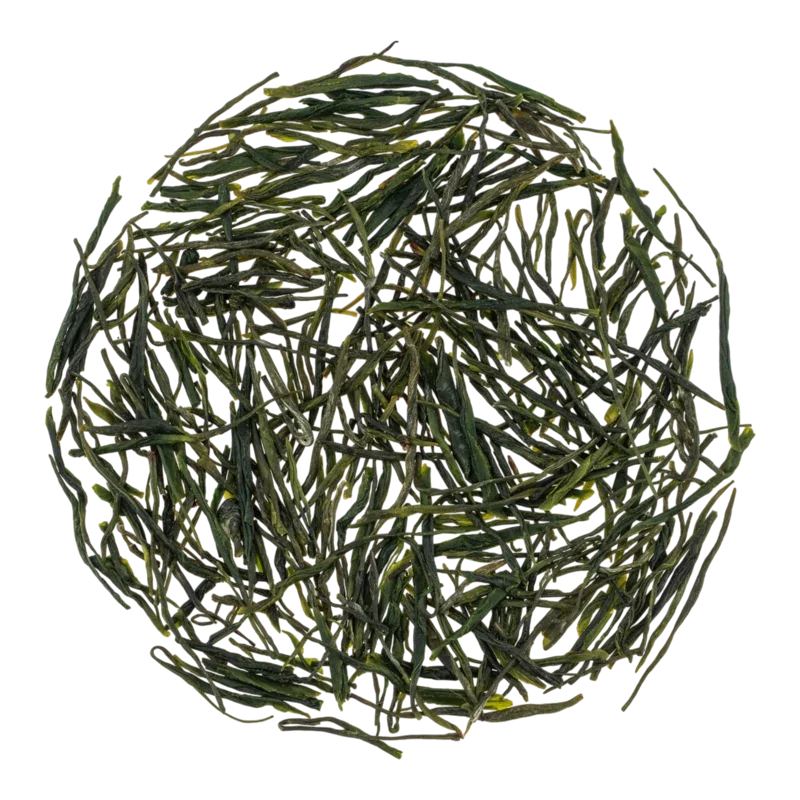
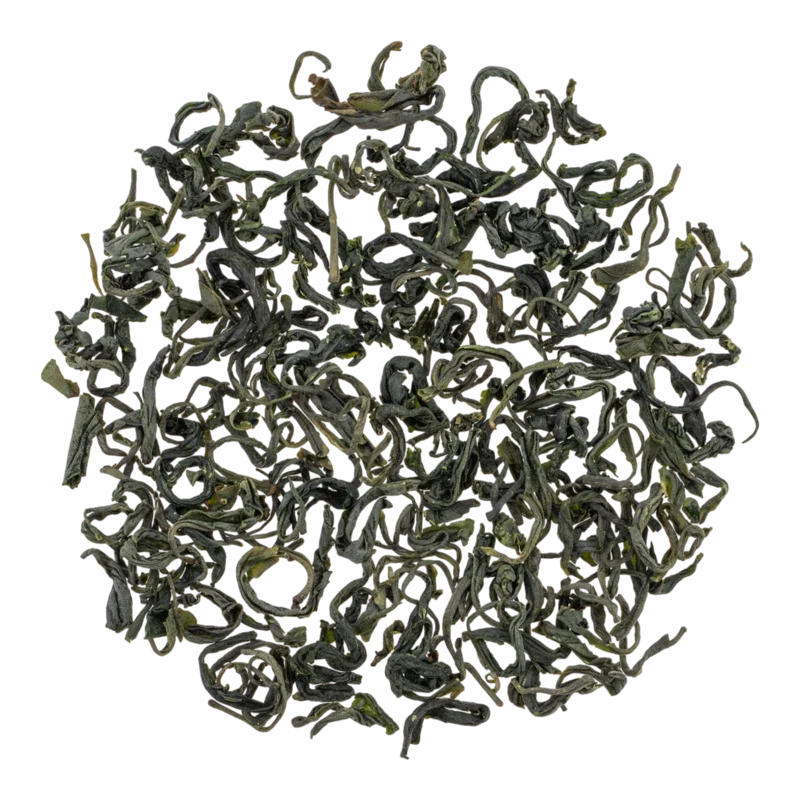
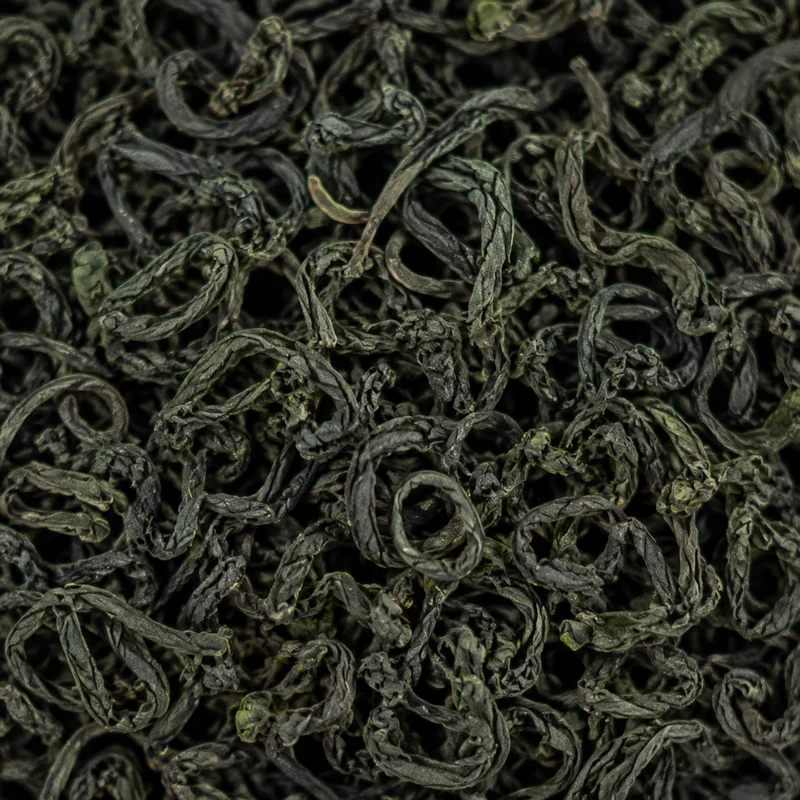
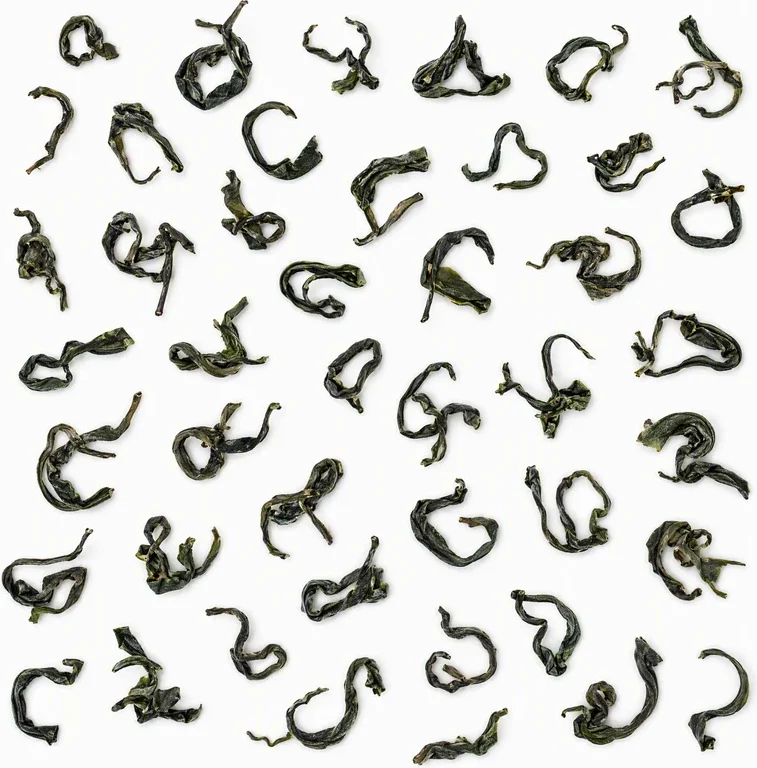
Dry Leaf Appearance: Varies depending on type. Flat tea (翠芽/翠片): even, smooth, flat tea pieces, color is jade-green or greenish-yellow. Curled (毛峰/毛尖): dense, tight spirals with noticeable silvery down on buds, color is gray-green with oily luster (色泽灰绿油润). Granulated (珠茶): compact dark green balls. In all types, shoot integrity and batch uniformity are mandatory.
Dry Leaf Aroma: Pronounced chestnut notes (栗香高长, "chestnut aroma, high and lasting"), transitioning to clean vegetal and light floral nuances. In granulated tea, the chestnut tone is denser and more saturated.
Liquor Aroma: High, persistent chestnut aroma (栗香高长沁脾 — "penetrating to the depths"), complemented by fresh green notes, light sweetness of roasted nuts, and a delicate floral trail. The aroma persists through several infusions.
Liquor Color: Yellow-green, bright and clear (汤色黄绿锃亮), with noticeable luster. In curled types, the liquor is slightly more saturated green shade.
Spent Leaves: Tender green, resilient, uniform (叶底嫩绿耐泡). Shoots open completely, demonstrating bud and leaf integrity. Characteristic "living" green confirms proper fixation.
Taste: Rich but without heaviness — the formula "浓而不苦、青而不涩、鲜而不淡、醇厚回甜" precisely describes the profile: dense but not bitter; fresh but not astringent; bright but not watery; full-bodied with returning sweetness. Characteristic juiciness and freshness (鲜爽, xiānshǔang) are due to high amino acid content.
Alkaloids: Caffeine (咖啡碱) — 5.0–7.0%, providing moderate tonic effect. Theobromine and theophylline are present in trace amounts.
Amino Acids: Total content is at least 3.1%, of which a significant portion is L-theanine (茶氨酸, chá ānjīsuān) — 2.0–2.8 g/100 g. Also detected are glutamic acid (0.2–0.3 g/100 g), asparagine (0.5–1.0 g/100 g), arginine (0.2–0.3 g/100 g), tyrosine (0.05–0.1 g/100 g). A total of 17 amino acids necessary for the human body have been found. The elevated amino acid to polyphenol ratio ensures pronounced sweetness and juiciness (鲜爽) without excessive bitterness.
At least 36.0%.
Essential Oils: Components responsible for chestnut aroma include pyrazines and furan derivatives, formed during fixation and final drying stages.
Minerals: Potassium, magnesium, phosphorus, manganese, fluorine.
Polyphenols: 18–22% (somewhat lower than typical green teas from more southern provinces, explained by reduced sunlight and growing altitude). Main catechins — EGCG (epigallocatechin gallate), EGC, ECG — provide antioxidant activity and moderate astringency.
Vitamins: Vitamin C (ascorbic acid), B-group vitamins (B₁, B₂), vitamin E.
Catechins (especially EGCG) neutralize free radicals and reduce cellular oxidative stress. Selenium enhances this effect, being a cofactor of glutathione peroxidase — one of the body's key antioxidant enzymes.
Zinc plays a central role in immune system function — from T-lymphocyte maturation to antibody synthesis. Regular consumption of tea with natural zinc content promotes immune balance maintenance.
The combination of caffeine and L-theanine provides "gentle" tone without sharp excitement peaks: caffeine activates while theanine smooths, promoting concentration and calm alertness.
Selenium is necessary for thyroid hormone synthesis (being a component of deiodinases). Its adequate intake is important for normal thyroid function.
Green tea polyphenols help maintain vascular elasticity and normalize cholesterol levels. Selenium additionally protects vascular endothelium from oxidative damage.
Zinc participates in collagen synthesis and tissue healing; catechins' antioxidant properties slow skin photoaging.
Moderate polyphenol content stimulates peristalsis and gastric juice secretion without causing excessive mucosal irritation.
Individual caffeine sensitivity varies; people with increased excitability or gastrointestinal diseases are recommended to consume tea after meals and in moderate quantities.
Tea Amount: 3 g per 150 ml (gaiwan method / short infusions); 5–7 g per 200–250 ml (steeping method in glass cup).
Teaware: Porcelain gàiwǎn (盖碗, gàiwǎn) — optimal choice for revealing chestnut aroma and controlling extraction. Glass cup (玻璃杯, bōlí bēi) — allows observing the "dance" of opening shoots, especially effective with flat tea. Porcelain teapot — for larger volumes.
Water Temperature: 75–85°C. For tender special grade raw material (独芽, 一芽一叶) — 75–80°C; for more mature second grade leaf — up to 85°C.
Container: Vacuum aluminum bags (most practical option), tin cans with tight lids, ceramic containers. Inner packaging layer must be opaque for UV protection.
Enemies: Light, moisture, high temperature, foreign odors, oxygen. When airtightness is compromised, chestnut aroma quickly degrades, leaf yellows, liquor loses brightness.
6–12 months from production date. After 12 months, tea remains safe but loses freshness and aroma intensity. Green tea is not intended for aging.
Temperature: Optimally 0–5°C (refrigerator). Acceptable up to 10°C. When storing in refrigerator, packaging must be absolutely airtight to exclude absorption of foreign odors and moisture condensation.
Umbrella brand uniting green teas of the entire province. Fenggang Zinc-Selenium Tea is one of its flagship representatives, distinguished precisely by its trace element profile. Other Guizhou green teas (Duyun Maojian, Meitan Cuiya) may surpass in aroma refinement but do not possess such pronounced zinc and selenium content.
Famous selenium-containing green tea from Hubei Province. Main difference — Ēnshī Jade Dew is produced by steaming method (蒸青, zhēngqīng), giving a more "Japanese" flavor profile with pronounced umami, while Fenggang is classic pan-fired tea (炒青/烘青) with chestnut aroma. Additionally, Fenggang contains both zinc and selenium simultaneously, while Enshi contains predominantly selenium.
Standard of flat green tea. Fenggang's flat variant (翠芽) resembles Longjing in form but differs with less intense "beany" aroma, more pronounced chestnut tones, and of course, trace element composition. Longjing is classic refinement; Fenggang is functionality and health.
Famous curled green tea from Henan Province. In form, Fenggang's curled variant (毛尖) is close to Xinyang Maojian, however the latter is distinguished by more delicate "lily-of-the-valley" aroma and delicate body, while Fenggang is denser, "meatier" with more pronounced returning sweetness.
Green tea with anomalously high amino acid content (up to 6–8%). Fenggang yields in absolute amino acid content but compensates with unique trace element profile (Zn + Se), which Anji lacks.
Price Category: Wide range. Mass-market granulated tea (珠茶) and summer-autumn curled tea — budget segment, oriented partly for export. Spring flat tea of special grade (翠芽, 雀舌) — premium category. Cost is determined by season (early spring harvest is significantly more expensive), shaping type, raw material grade, and producer status. "Fenggang Zinc-Selenium Tea" brand value in 2025 was assessed at 74.19 billion yuan, however retail prices of specific batches remain accessible — a significant portion of production is positioned as quality everyday tea.
No reviews yet. Tell us what you think of this tea.
Rate this tea and share your impressions. We review each submission before publishing it.