Brewing
Gongfu brewing
- Water temperature
- 75 °C
- Tea amount
- 5 g
- Water volume
- 100 ml
- First steep
- 10 s
- Time added per infusion
- 5 s
- Infusions
- 3

Zhèjiāng sōngzhēn
Choose a brewing method. Start with the recommended quantities and time, then adjust to taste.
Brewing
Brewing
Taste
Tea encyclopedia
Category: Chinese premium green tea of needle shape (松针形绿茶, sōngzhēnxíng lǜchá).
Category: Chinese premium green tea of needle shape (松针形绿茶, sōngzhēnxíng lǜchá).
Coordinates: Approximately 29°30′ North latitude, 118°55′ East longitude. Plantation altitude — 800–1200 meters above sea level.
Origin: China, Zhèjiāng Province (浙江, Zhèjiāng), Chun'an County (淳安县, Chún'ān Xiàn), Thousand Island Lake region.
Type: Green tea (unfermented, oxidation level <5%). Fixation method — pan-firing (炒青, chǎoqīng).
Cultural Significance: Chun'an "Song Zhen" is symbolically connected to the mountain pine forests of the Qiandaohu area — one of the largest forest massifs in Eastern China (national forest park, over 634 plant species). The tea's shape refers to this natural environment: tea needles — like pine needles on the lake shores. For the Chun'an region, traditionally associated with Jiukeng and Qiandao Yüye, "Song Zhen" represents an innovative direction — an attempt to expand the palette of Zhejiang tea production beyond familiar flat and twisted shapes.
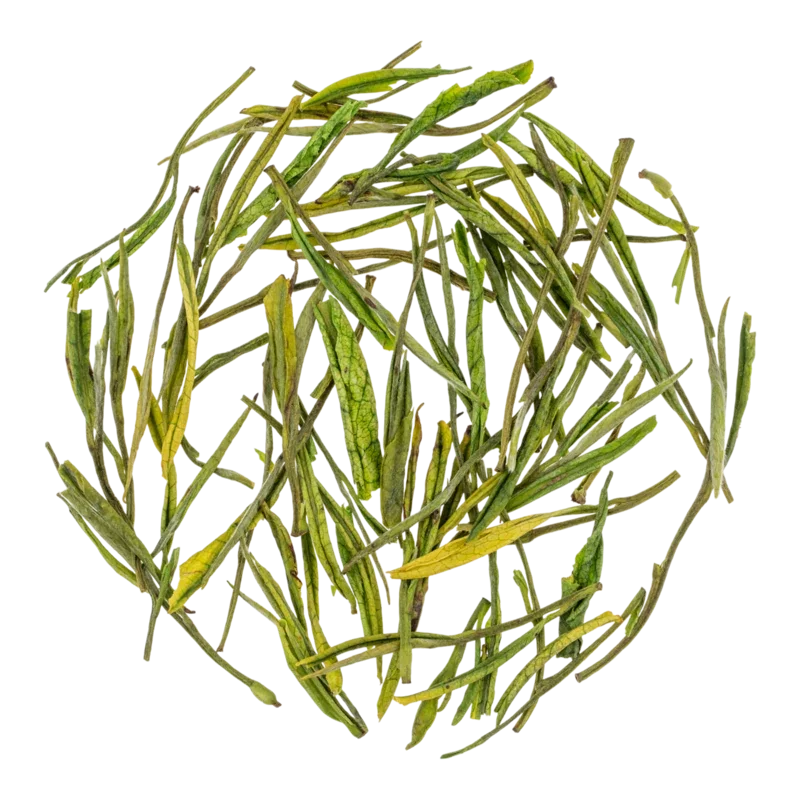
Name Breakdown: "Song" (松) — pine; "Zhen" (针) — needle. The name precisely describes the appearance of tea leaves — long, flat, straight, pointed, resembling pine needles. The "pine needle" shape (松针形) is one of several classical "figured" forms of Chinese green tea, alongside "sparrow tongues" (雀舌形), "spirals" (螺形), "blades" (扁形), and "pearls" (珠形).
Cultivar: Hybrid Camellia sinensis var. assamica × Chǎng Yè Bái Háo (长叶白毫, Chángyè Báiháo) — "Long-leaf White Down." This is an atypical choice for Zhejiang Province: the vast majority of Zhejiang green teas (Longjing, Anji Bai Cha, Jiukeng Mao Jian, Jingshan) are produced from small-leaf var. sinensis cultivars. Using an assamica hybrid brings several fundamental differences:
Picking: For this specific tea, whole young leaves are used, including summer harvest (third flush, 三水茶). For highest grades — spring harvest (春茶). Standard — bud and one-two top leaves.
Raw Material: Young, undamaged leaves of specific size (sufficiently long for needle formation) are selected. Uniformity of length and thickness is a key requirement.
Altitude: 800–1200 meters above sea level — significantly higher than Xi Hu Longjing (200–400 m) or Anji Bai Cha (300–600 m).
Climate: Temperate subtropical, with high humidity (influence of lake waters), average annual temperature around +18°C, abundant precipitation. Mountain topography provides frequent fogs and natural diffusion of sunlight.
Soil: Predominantly acidic (pH 4.5–5.5), iron-rich (红壤/黄壤, red/yellow soils). Elevated iron content may influence the tea's mineral profile. Good natural drainage from mountain topography.
Chun'an County (淳安县) in the western part of Zhejiang Province. Located on the shores of Thousand Island Lake (千岛湖) — the largest artificial freshwater body in Eastern China, formed by the Xin'anjiang River dam (新安江) in 1959. The lake with more than 1078 islands creates a unique microclimate: the huge water mass moderates temperature fluctuations and maintains high humidity.
Possible application of natural or partial shading (遮阴, zhēyīn), promoting increased L-theanine and chlorophyll content. Proximity to pine forests of Qiandaohu National Park creates a clean ecological environment (absence of industrial pollution, high level of phytoncides).
Brief withering (4–8 hours) to reduce leaf moisture and provide elasticity necessary for subsequent shaping. Moisture loss — about 15–20%.
Pan-firing in a heated wok (锅炒, guōchǎo) at high temperature (~180–200°C) for rapid enzyme inactivation. Classical Zhejiang method, analogous to Longjing production.
Light rolling to extract cell juices and prepare for shaping. Delicate — to avoid damaging long leaves.
Key and most labor-intensive stage, determining the character of "Song Zhen." Leaves are repeatedly pressed and straightened — by hand or with special tools — to achieve the characteristic flat, straight, needle-like shape. Each leaf is stretched longitudinally and pointed, requiring high skill: tea leaves must be thin, even, 20–25 mm long, without cracks or breaks. This stage distinguishes "Song Zhen" from most other green teas: shaping "needles" is significantly more complex than rolling spirals (Bi Luo Chun) or pressing "blades" (Longjing).
Final drying with hot air to reduce moisture to <5%, fix shape and stabilize aroma.
Finished tea is sorted by length, uniformity and integrity of "needles." Broken and uneven needles are sifted out.
Dry Leaf Appearance: Long (20–25 mm), flat, straight tea leaves of silvery-green color, resembling pine needles. Whole, even, without breaks. Smooth surface with light luster.
Dry Leaf Aroma: Fresh, grassy, with light notes of seaweed and freshly cut grass. Subtle "coniferous" coolness — associative, more due to shape and context than literal presence of terpenes.
Liquor Aroma: Delicate, fresh, grassy-floral, with distinct chestnut overtone (栗香, lìxiāng) — characteristic note of Zhejiang pan-fired green teas.
Liquor Color: Clear, light green with yellowish tint (黄绿明亮, huánglǜ míngliàng).
Spent Leaves: Bright green, whole, elongated leaves maintaining needle-like shape. Larger than typical Zhejiang teas — heritage of assamica cultivar.
Taste: Smooth, soft, sweetish, with pronounced umami (旨味) — deep, "brothy" taste due to high L-theanine content. Notes of raw chestnut, hazelnut, fresh greens. Creamy texture (奶滑, nǎihuá). Aftertaste — long, sweetish, with light minerality.
Alkaloids: Caffeine — provides mild, sustained tonic effect. Synergy with L-theanine creates "calm alertness" without anxiety.
Amino Acids: Elevated L-theanine content (responsible for umami and sweetness). High-altitude slow maturation and possible shading promote amino acid accumulation.
Elevated content (assamica cultivar + possible shading) — ensures intense green color of dry leaf and liquor.
Minerals: Fluorine, potassium, manganese. Iron from soils may be present in trace amounts, contributing to the mineral character of aftertaste.
Polyphenols: High content, with EGCG dominance. The assamica hybrid provides potentially higher catechin levels than small-leaf var. sinensis Zhejiang cultivars.
Vitamins: Vitamin C, B-group vitamins.
High EGCG and other catechin content (potentially higher than var. sinensis from the same region) provides powerful free radical neutralization.
Pronounced L-theanine and caffeine synergy promotes relaxed concentration — a state of "calm alertness" that enhances productivity without nervous excitement.
Fluorine and antibacterial properties of catechins suppress growth of cariogenic bacteria.
Catechins and caffeine contribute to accelerated metabolism and thermogenesis.
L-theanine contributes to anxiety reduction, improved sleep quality with daytime consumption.
3 g per 250 ml at 80°C, steeping 3–4 minutes. Ideal for daily tea drinking and contemplating the "dance of needles."
Tea Amount: 3–5 g per 150–200 ml water. For flash steeping method — 4–5 g per 150 ml.
Teaware: Glass or porcelain gaiwan, glass teapot. Glass is especially recommended for "Song Zhen": observing the unfolding of long "needles" is a separate aesthetic pleasure. Yixing clay not recommended: it absorbs delicate aromas.
Water Temperature: 75–85°C. Range wider than for steamed teas (70°C), but below boiling. Pan-fired Zhejiang teas are more temperature-resistant, however overheating still causes bitterness.
Zhejiang's most famous tea. Flat "blade" shape, var. sinensis cultivar (Longjing 43, Quntitzhong). Aroma — nutty-pumpkin (豆花香, "bean flower aroma"), "roasted." Taste — clean, refreshing, with characteristic "bean" sweetness. "Song Zhen" — heavier in "body," with more pronounced umami and creamy texture; less "light" and "transparent" than Longjing.
Unique "white-leaf" green tea from albino cultivar Bái Yè Yī Háo (白叶一号). Aroma — orchid, floral. Taste — maximally "amino acid": umami dominates, bitterness practically absent. "Song Zhen" is closer to Anji Bai Cha in umami expression, but differs in chestnut notes and denser "body" (assamica influence).
Yunnan red tea in the same "pine needle" shape. Cultivar — Yunnan Da Ye Zhong (var. assamica). Taste — honey-chocolate, rich, sweet. Green "Song Zhen" — fresh, grassy, with umami; they share shape and "large-leaf DNA" of assamica, but processing type creates diametrically opposite flavor profiles.
Classic tea from the same Chun'an County, but from local Jiukeng cultivar (var. sinensis). Small, straight, downy needles. Aroma — persistent, clean. Taste — dense, with characteristic Chun'an minerality. "Song Zhen" — larger, softer, with more pronounced umami and creamy texture; Jiukeng Mao Jian — stricter, "drier," more classical.
No reviews yet. Tell us what you think of this tea.
Rate this tea and share your impressions. We review each submission before publishing it.