Brewing
Gongfu brewing
- Water temperature
- 95 °C
- Tea amount
- 7 g
- Water volume
- 100 ml
- First steep
- 10 s
- Time added per infusion
- 5 s
- Infusions
- 10

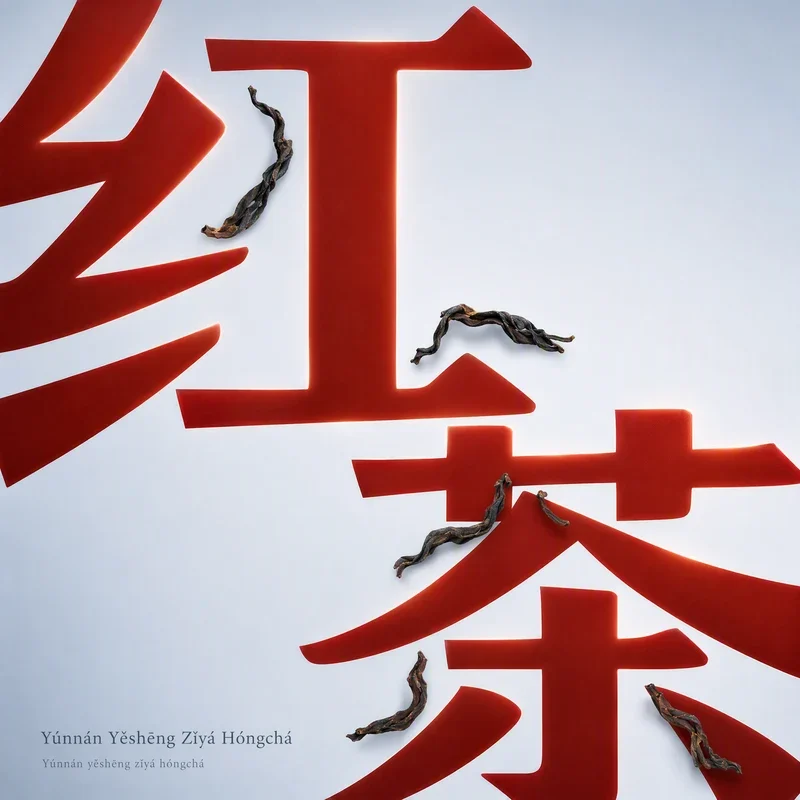
Yúnnán yěshēng zǐyá hóngchá
Choose a brewing method. Start with the recommended quantities and time, then adjust to taste.
Brewing
Brewing
Taste
Tea encyclopedia
Category: Wild purple-bud red tea (野生紫芽红茶, yěshēng zǐyá hóngchá). Premium niche product combining the value of wild raw material and unique biochemical profile of purple-leaf tea trees.
Category: Wild purple-bud red tea (野生紫芽红茶, yěshēng zǐyá hóngchá). Premium niche product combining the value of wild raw material and unique biochemical profile of purple-leaf tea trees.
Coordinates: Fengqing area — approximately 24°35′ N, 99°55′ E.
Origin: China, Yúnnán Province (云南省, Yúnnán shěng), predominantly high-altitude areas of Fèngqìng County (凤庆县, Fèngqìng xiàn) in Líncāng City (临沧市, Líncāng shì). Fengqing is the historical birthplace of Yunnan red tea Dianhong, where industrial production of this category began in 1938–1939. Wild purple-leaf populations are also found in other areas of southwestern Yunnan — Měnghǎi (勐海), Jǐnggǔ (景谷) and Pu'er (普洱).
Type: Red tea (black tea) (红茶, hóngchá) — fully oxidized. According to European classification corresponds to black tea. Belongs to the group of Yúnnán red teas Diānhóng (滇红, Diānhóng).
Cultural Significance: In the traditional culture of the Bái people (白族, Báizú), purple tea was used in ancestor veneration rituals — it was believed that its unusual color symbolized the connection between the world of the living and the world of spirits. In the scientific community, purple-leaf forms of tea trees are of enormous interest as a natural source of anthocyanins and as a valuable genetic resource. In 1985, the Yúnnán Academy of Agricultural Sciences isolated from wild populations and registered the cultivar Zǐjuān (紫娟, Zǐjuān) — the first breeding variety with stable purple pigmentation of shoots, leaves and stems. However, wild purple tea (野生紫芽) and the Zijuan cultivar are different phenomena: wild trees differ in significantly greater genetic diversity and more complex biochemical profile.
History: Wild purple-leaf tea trees are part of the ancient gene pool of the tea plant preserved in the mountain forests of southwestern China. Yunnan Province is considered one of the centers of origin of the genus Camellia, and purple-leaf forms represent natural mutations existing in the wild for centuries. The first written mentions of purple tea (紫茶, zǐchá) are contained in the "Chajing" (茶经, Chájīng) — the classic treatise by Lù Yǔ (陆羽, Lù Yǔ, 8th century), where purple leaves were noted as a sign of high-quality raw material. Local peoples — Yī (彝族, Yízú) and Dǎi (傣族, Dǎizú) — used leaves from wild purple trees for medicinal purposes long before the formation of modern tea production technologies. Industrial production of red tea in Fengqing began in 1938–1939, when during the Second Sino-Japanese War the tea industry was relocated from eastern provinces to the southwest. However, purposeful use of purple-leaf wild raw material for premium red teas intensified only in the 2000–2010s, when the market appreciated the rarity and unique properties of such raw material. In the 2010s, interest in wild purple tea on the international market grew rapidly — largely thanks to scientific publications on the biological activity of tea leaf anthocyanins.
Name Breakdown: Yúnnán (云南) — "south of the clouds"; Yěshēng (野生) — "wild-growing"; Zǐyá (紫芽) — "purple bud" (紫 — violet, purple; 芽 — bud, shoot); Hóngchá (红茶) — "red tea". The name accurately reflects the origin and botanical feature of the raw material.
Wild trees of arborescent form, reaching heights of 8–15 meters in natural conditions. Crown spreading, trunk powerful. Trees grow in mountain forest ecosystems without any agrotechnical intervention.
Leaf blade large, elliptical, 12–18 cm long, with pinnate venation and weakly serrated edge. Young shoots and buds have characteristic violet-burgundy coloration of varying intensity. Buds are covered with silvery trichomes (hairs). As the leaf matures, purple coloration weakens, and mature leaves acquire normal green color.
Cultivar: Wild forms of Camellia sinensis var. assamica with natural purple mutation. In scientific literature sometimes designated as Camellia sinensis var. assamica f. purpurea, although this taxon is not generally accepted. Purple coloration is due to increased expression of the CsMYB75 gene, which activates the anthocyanin biosynthesis pathway in young shoots.
Picking: Hand-picking according to the "one bud and two young leaves" standard (一芽二叶, yī yá èr yè). Main seasons — spring (March–April) and early autumn (September). Raw material from trees over 100 years old is especially valued, distinguished by increased L-theanine content and more complex mineral profile.
Altitude: 1600–2300 meters above sea level. Significant altitude ensures slowed shoot growth and intensive accumulation of aromatic substances, amino acids and anthocyanins.
Climate: Subtropical monsoon with abundant precipitation — about 1800 mm per year. Characterized by significant diurnal temperature variations — up to 15°C between day and night temperatures, which stimulates anthocyanin synthesis (low night temperatures activate the ANS gene — anthocyanidin synthase).
Soil: Acidic lateritic soils (红壤, hóng rǎng) with pH 4.5–5.5 and increased iron and aluminum content. Acidic environment promotes microelement uptake by tea trees and favorably affects polyphenol synthesis.
High-altitude areas of Fengqing County and other parts of Lincang City, Yunnan Province. Fèngqìng is located on the western bank of the Láncāng River (澜沧江, Láncāngjiāng, upper reaches of the Mekong) and is one of the oldest tea-producing areas of Yunnan.
Wild trees grow in natural forest ecosystems without pruning, fertilizers and pesticides. Minimal human intervention preserves the natural biochemical profile of raw material. Symbiotic relationships of trees with forest microbiota, forming a unique rhizosphere microclimate, play an important role. The Fengqing region is famous for its "cloud" mountains — dense fogs rising from the Lancang River valley provide diffused lighting, which slows shoot growth and promotes accumulation of amino acids and aromatic substances. It is precisely this balance of altitude, humidity and tree antiquity that forms the unique character of the raw material.
Hand-picking of young purple shoots in early morning hours when aromatic substance content is maximum.
Picked leaves are spread in layers about 10 cm thick on bamboo mats. Withering is conducted in sun or in ventilated rooms at temperature around 25°C until leaf moisture decreases to approximately 68%. Duration — 10–16 hours. During withering, primary enzymatic changes begin, floral aroma develops.
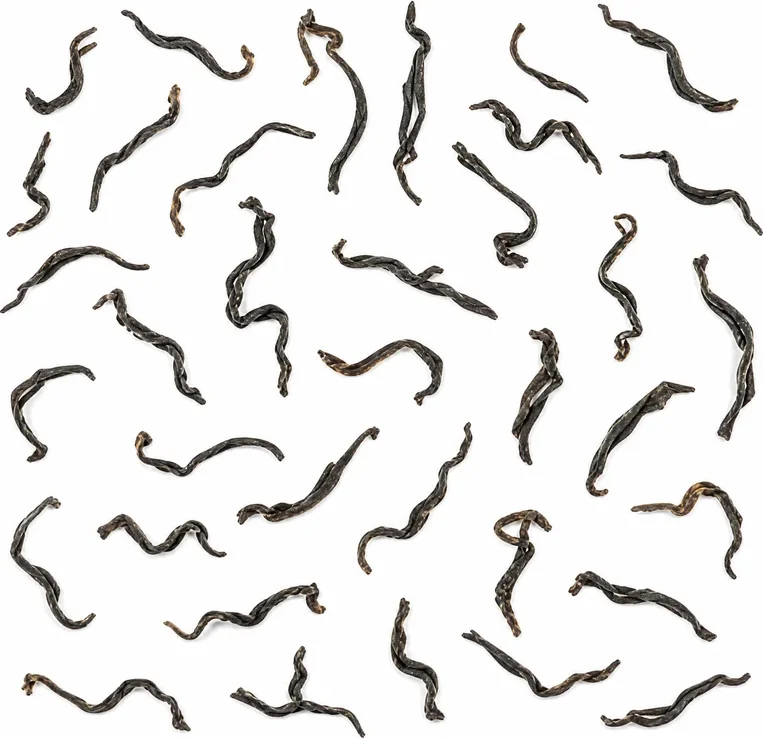
Withered leaves are rolled to break cell walls and release cell sap. Due to large leaf size, moderate pressure is applied to preserve raw material integrity. Characteristic longitudinally twisted strands are formed.
Key stage. Conducted at controlled temperature around 28°C and high humidity for approximately 14 hours. Catechin polymerization degree reaches 85% — deep oxidation forms the characteristic set of theaflavins and thearubigins typical of red tea. Anthocyanins are partially preserved, contributing specific berry and fruit notes to the tea profile.
Conducted in two stages for reliable fixation of achieved changes and moisture reduction to storage level (less than 5%). Modern productions often use infrared drying, allowing better preservation of volatile aromatic compounds compared to traditional wood-fired drying.
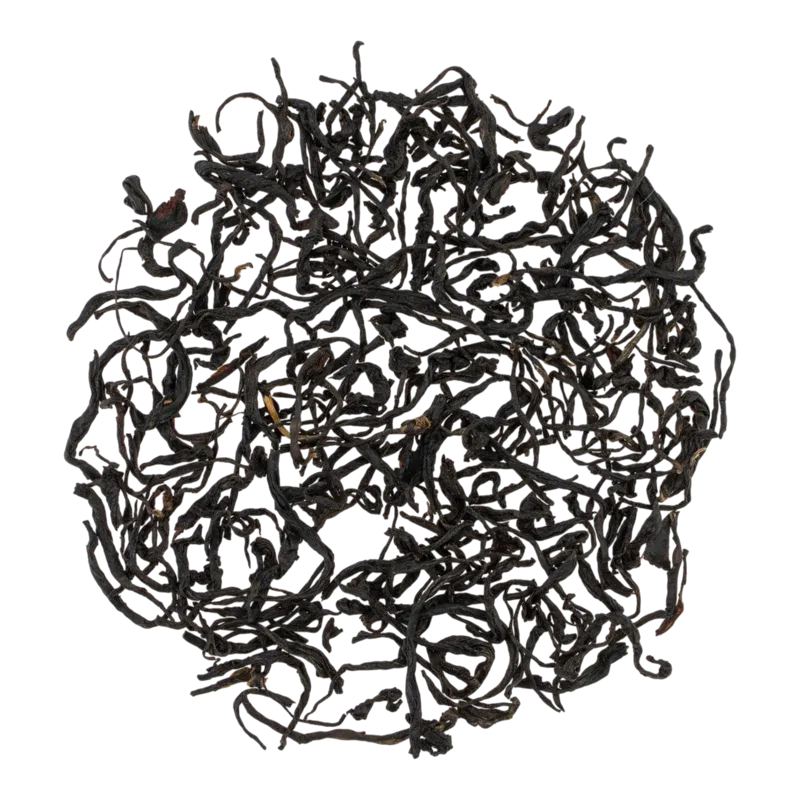
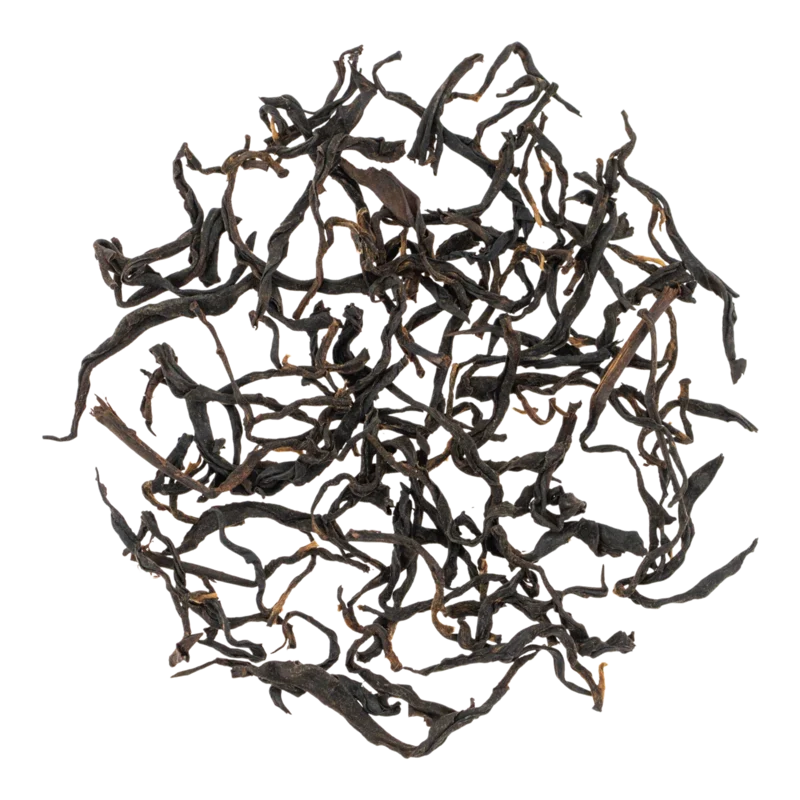
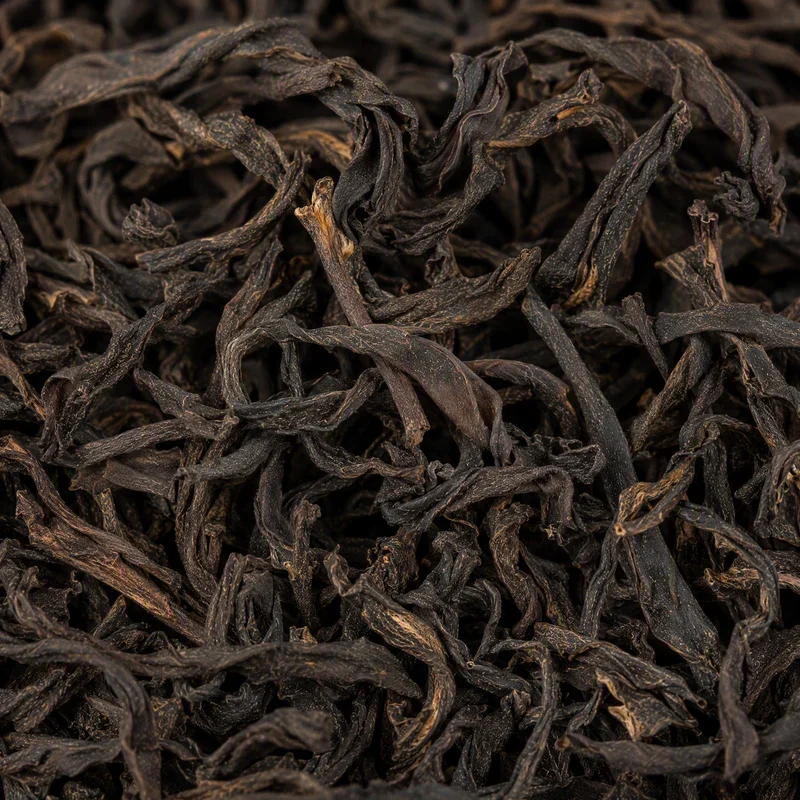
Dry Leaf Appearance: Large, longitudinally twisted strands of dark brown, almost black color with noticeable purple tinge. Against the dark leaf background, inclusions of golden buds (tips) covered with fine down stand out.
Dry Leaf Aroma: Complex, warm, with notes of burnt sugar, prunes, dark berries (blackberry, black currant) and light floral shades reminiscent of withered rose.
Liquor Aroma: Intense, sweet, fruity-berry with deep woody and spicy nuances. Upon cooling, honey and balsamic notes appear.
Liquor Color: Bright, clear, rich amber-red or ruby color with oily texture and pronounced gloss.
Long-lasting, warming, sweet-astringent with refreshing finish. Characteristic "throat sensation" (喉韵, hóuyùn) typical of raw material from old trees.
Spent Leaves: Soft, elastic leaves of reddish-brown color with persisting purple tinge. Leaves large, whole, well-preserved in form.
Taste: Rich, smooth, velvety, without excessive astringency — a distinctive feature of raw material from wild trees. Notes of mulberry, honey pear, tropical fruits dominate. Middle tones reveal shades of cardamom and oak bark, and the finish shows almond praline.
Alkaloids: Caffeine — moderate content (about 9–12 mg/g), lower than plantation teas, due to shading in forest ecosystem. Theobromine and theophylline in trace amounts.
Increased content — from 0.5% to 2–3% of dry weight, which is 50–300 times higher than in ordinary tea leaf (about 0.01%). Main components — cyanidin-3-O-glucoside, delphinidin-3-O-galactoside and their acylated derivatives. Anthocyanins determine purple coloration of raw material, contribute to antioxidant properties and form berry notes in taste.
Increased content — up to 5 mg/g in raw material from old trees. Responsible for sweet umami-like taste and relaxing effect.
Essential Oils: Linalool, geraniol, nerol, phenylethanol and other terpenoid compounds form complex floral-fruity aroma.
Minerals: Increased content of iron, manganese and zinc thanks to acidic lateritic soils rich in these elements.
Polyphenols: Total content — 15–22% of dry weight. During full oxidation, a significant part of catechins transforms into theaflavins and thearubigins, however sufficient level of residual polyphenols remains to ensure antioxidant activity.
Vitamins: Vitamin C (in residual amounts), B1, B2, P (rutin).
Synergy of anthocyanins, theaflavins and residual catechins provides powerful antioxidant action — neutralization of free radicals and reduction of oxidative stress. Studies show significant correlation between anthocyanin content and tea's ability to neutralize DPPH free radicals.
Anthocyanins promote improvement of vascular elasticity and may contribute to blood pressure normalization with regular moderate consumption.
Anthocyanins, particularly cyanidin-3-O-glucoside, show ability to inhibit α-amylase, which may help regulate blood sugar levels.
Red tea polyphenols combined with anthocyanins may contribute to acceleration of fat metabolism.
Anthocyanins demonstrate neuroprotective activity in laboratory studies, while L-theanine promotes a state of calm concentration.
Moderate caffeine content provides gentle stimulation without sharp spikes.
Anthocyanins, especially delphinidin-3-O-galactoside, in several studies demonstrated ability to reduce eye fatigue.
People with hypertension and insomnia are recommended to limit consumption, especially in the second half of the day.
Moderate consumption recommended due to caffeine; should consult with doctor.
With gastritis with increased acidity and peptic ulcer in acute stage, strong tea is not recommended on empty stomach.
Polyphenols may reduce absorption of non-heme iron from food — recommended to maintain 30–60 minute interval between meals and tea drinking.
When taking anticoagulants and drugs affecting blood clotting, should maintain interval of at least one hour between medication and tea.
5 g per 100 ml water.
3 g per 250 ml water.
2–3 minutes. 2–3 re-steepings allowed.
Teaware: Porcelain gàiwǎn (盖碗, gàiwǎn) — optimal choice for revealing aroma nuances. Glass teapot (allows admiring ruby liquor color) or Yixing clay teapot for enhancing taste density also suitable.
Water Temperature: 90–95°C. Use fresh filtered water.
Container: Airtight — ceramic tea caddy, tin can, vacuum foil bag. Away from strong odors.
Humidity: Relative humidity no higher than 60%, to avoid mold development and quality loss.
Light: Store in complete darkness. Light causes photo-oxidation of polyphenols and anthocyanins, leading to color and aroma loss.
Shelf Life: Under proper conditions — 2–3 years without significant quality loss. Tea from purple raw material is not intended for long aging, unlike sheng pu-erhs.
Temperature: Stable room temperature — around 20°C (±5°C). Avoid sharp fluctuations.
Classic Yunnan red tea from plantation C. sinensis var. assamica raw material. Has pronounced malty and honey notes, noticeable astringency. Ziya Hongcha is softer, more complex, with characteristic berry notes and deeper mineral aftertaste.
Also wild Yunnan red tea, but from ordinary (green-leaf) raw material. Distinguished by "forest" character with chocolate-nutty notes. Ziya Hongcha additionally brings unique berry-fruit profile due to anthocyanins.
The only industrially scaled analog — tea from cultivar TRFK 306/1 with increased anthocyanin content. Kenyan tea is usually produced by CTC method, giving completely different flavor profile — sharp and bright. Yunnan wild purple tea is orthodox, velvety, multi-layered, with depth unavailable to industrial CTC.
Elite Fujian red tea from small-leaf raw material. Delicate, floral, elegant. Ziya Hongcha, in contrast, is more powerful in body, with more pronounced structure, berry notes and minerality.
Price Category: Premium and super-premium segment. Cost determined by tree age (over 100 years — significant markup), harvest season (spring valued higher), variety purity and producer.
High-quality tea from old wild trees — from 300 to 450 USD per kilogram and higher.
More accessible variants, often using mixed raw material — 120–200 USD per kilogram.
Due to high cost, purple tea market is subject to falsification:
Authentic purple leaf has natural, uneven purple tinge, not uniform coloration.
Liquor should be clear, bright, ruby-amber. If liquor has unnatural purple or bluish tinge — possible artificial coloring.
Purple tinge should persist in spent leaves. Leaf should be large, whole, elastic.
Quality wild purple tea cannot be cheap.
No reviews yet. Tell us what you think of this tea.
Rate this tea and share your impressions. We review each submission before publishing it.