Brewing
Gongfu brewing
- Water temperature
- 93 °C
- Tea amount
- 5 g
- Water volume
- 100 ml
- First steep
- 10 s
- Time added per infusion
- 5 s
- Infusions
- 4

Yúnnán wúliàng hóngchá
Choose a brewing method. Start with the recommended quantities and time, then adjust to taste.
Brewing
Brewing
Taste
Tea encyclopedia
Category: Yúnnán red teas Diānhóng (滇红, Diānhóng). High-altitude gongfu hong cha (工夫红茶, gōngfu hóngchá).
Category: Yúnnán red teas Diānhóng (滇红, Diānhóng). High-altitude gongfu hong cha (工夫红茶, gōngfu hóngchá).
Coordinates: ≈ 24.45° N, 100.85° E (central part of the Wuliang Mountains range within Jingdong County).
Origin: China, Yúnnán Province (云南省, Yúnnán Shěng), Pu'er City (普洱市, Pǔ'ěr Shì), Jǐngdōng Yī Autonomous County (景东彝族自治县, Jǐngdōng Yízú Zìzhìxiàn). Tea gardens are located on the western and eastern slopes of the Wuliang Mountains range, along the banks of the Láncāng River (澜沧江, Láncāng Jiāng, upper reaches of the Mekong).
Type: Red tea (black tea) (红茶, hóngchá) — fully fermented (oxidized). Oxidation degree 90–95%.
Cultural Significance: Tea from Wuliang Mountains embodies the profound connection of Yunnan tea civilization with its botanical origins. The Jingdong-Jinggu-Zhenyuan region (景东-景谷-镇沅, "jing-jing-zhen") is considered the core of Yunnan's most ancient tea culture: here intersected the trade routes of "Chamagudao" (茶马古道, Chámǎ Gǔdào, "Ancient Tea Horse Road"), connecting Pu'er with Dali, Tibet, and Southeast Asia. Red tea from these places is a product where the ancient tea tree meets the relatively young (by Yunnan standards) Dianhong technology.
History: The Wuliang Mountains are part of the so-called "silver region" (银生, Yínshēng) — territory of the medieval Nánzhào Kingdom (南诏, Nánzhào, 8th–9th centuries), where, according to the Tang source "Manshu" (蛮书, Mánshū, 863 CE), the first mention of tea in Yunnan was recorded: "Tea is born in the mountains surrounding Yinsheng city" (茶出银生城界诸山). Jingdong is one of the key counties of the historical Yinsheng territory, and local tea tree populations are direct descendants of those very "teas from the Yinsheng mountains."
Name Breakdown: Yúnnán (云南) — "south of the clouds," the province's name. Wúliàng (无量) — "immeasurable, boundless," the mountain range's name, tracing back to Buddhist tradition (Wuliangshou Fo, 无量寿佛 — Buddha of Infinite Life, Amitabha). Hóng Chá (红茶) — "red tea." The full name reads as "Yunnan red tea from the Immeasurable Mountains" — a poetic name reflecting the scale and spiritual significance of the landscape.
Cultivar: Yunnan large-leaf variety Camellia sinensis var. assamica (云南大叶种, Yúnnán dàyè zhǒng). On the slopes of Wuliang Mountains grow both cultivated plantations and semi-wild and wild tea trees (古树, gǔshù; 野生, yěshēng) aged from several decades to several hundred years. Leaves of mature trees reach 10–15 cm in length, buds are large, covered with dense golden down (up to 60–70% of the young bud surface). The large-leaf Yunnan variety is distinguished by high polyphenol content (28–38% in fresh leaf), making it exceptionally suitable for red tea.
Picking: Most valuable — spring picking (March — early April); summer and autumn tea are also picked. In high-altitude zones of Wuliang Mountains (above 1,800 m), the picking season begins later than in valley areas.
Pluck Standard: Bud and two upper leaves (一芽二叶, yī yá èr yè) — standard for main batches. Premium lines — bud and one leaf (一芽一叶, yī yá yī yè) or pure bud picking (单芽, dān yá).
Raw Material: Bud length not less than 18–22 mm, freshly picked leaves must be delivered to the factory within 2–4 hours to preserve enzymatic activity. Tree age significantly affects the profile: leaves from century-old trees (老树, lǎo shù) produce more pronounced honey tones and oily texture, while raw material from young plantations enhances floral accents.
Altitude: 1,800–2,200 m a.s.l. for premium batches; plantation tea — from 1,400 m. Wuliang Mountains is one of the highest tea-growing regions in Yunnan.
Climate: Average annual temperature at tea garden altitudes — about 11–15°C, significantly lower than in valley Dianhong areas. Daily temperature fluctuations reach 12–15°C, stimulating synthesis of aromatic compounds and amino acids. Frequent fogs (more than 200 days per year), abundant precipitation (1,200–1,600 mm), high humidity (80–85%).
Soil: Acidic red-yellow soils (红黄壤, hóng huáng rǎng) with pH 5.0–5.5 and high humus content (≥ 4%). Selenium presence noted (up to 0.24 mg/kg). Deep organic layer forms thanks to preserved forest cover between tea plots.
The Wuliang Mountains range extends north to south for approximately 83 km, dividing the basins of the Lancang River (Mekong) and Bazhang River (把边江). This is a zone at the junction of subtropical and tropical belts with pronounced altitudinal zonation.
Traditional "sanjia zaoshu" system (三嫁造树, "forest-tea farming"): tea bushes and trees are interspersed with natural forest vegetation, ensuring biodiversity, natural shading, and minimizing pesticide needs. Terraced arrangement of plantings on mountain slopes. Many gardens are managed according to organic farming principles.
Hand picking. Assam-type leaves are larger and more succulent than small-leaf varieties, requiring more careful handling during transport.
Conducted at reduced temperature (26–30°C) compared to standard Dianhong, with increased duration — up to 16–18 hours. Slow withering in mountain climate conditions promotes gradual development of floral and honey notes in aromatics.
Large Assam-type leaves undergo more intensive rolling for complete destruction of cell walls. Rolling may be conducted in several cycles with breaks for leaf "rest," allowing even distribution of juice and enzyme activation.
Controlled oxidation at 25–30°C and humidity ≥ 90%. High polyphenol content in Yunnan large-leaf raw material ensures intensive formation of theaflavins and thearubigins. Oxidation degree in Wuliang Mountains batches can reach 80–85% by catechins, higher than average for Dianhong and forming a more saturated, "full-bodied" profile.
Standard hot drying (烘干) to fix the profile. Some workshops experiment with sun-drying (晒干, shàigān), producing so-called "shaihong" (晒红) — red tea with aging potential, but classic Wuliang Hong Cha is precisely "honggan" (烘干), with clean, stable taste.
Separation by fractions, selection of tippy and whole-leaf grades.
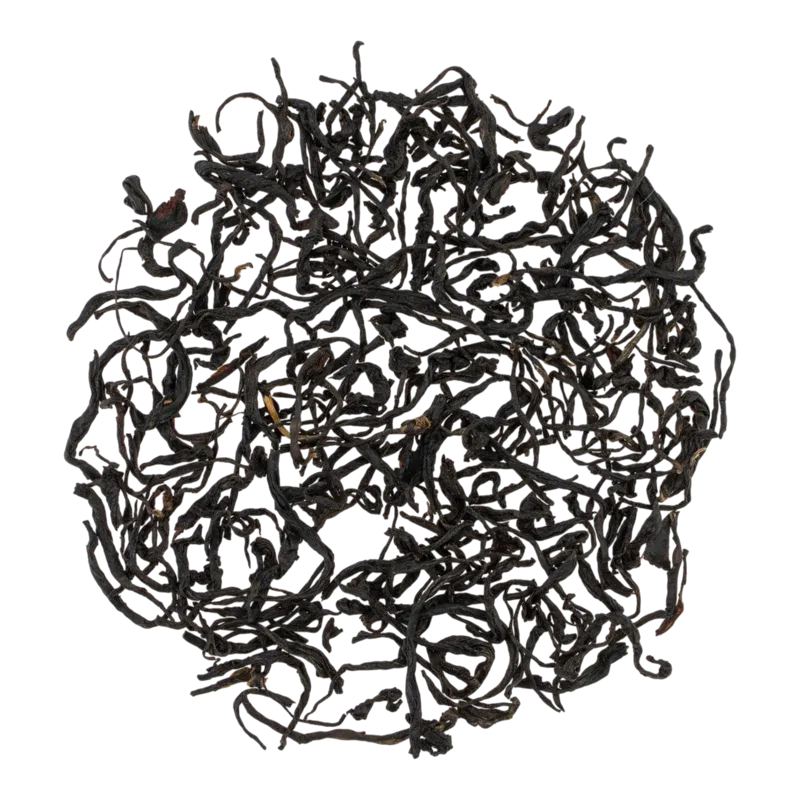
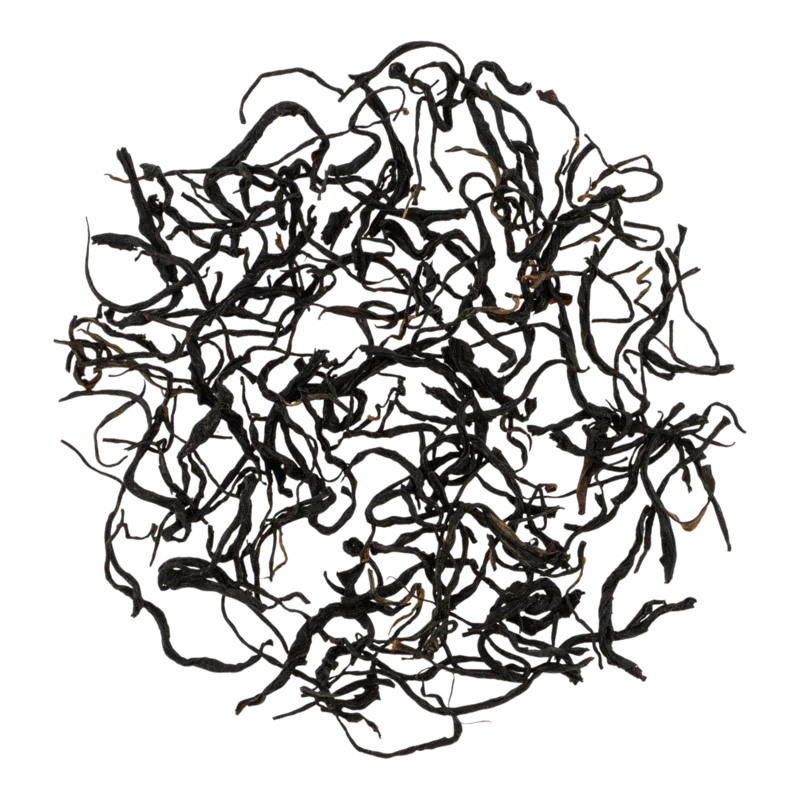
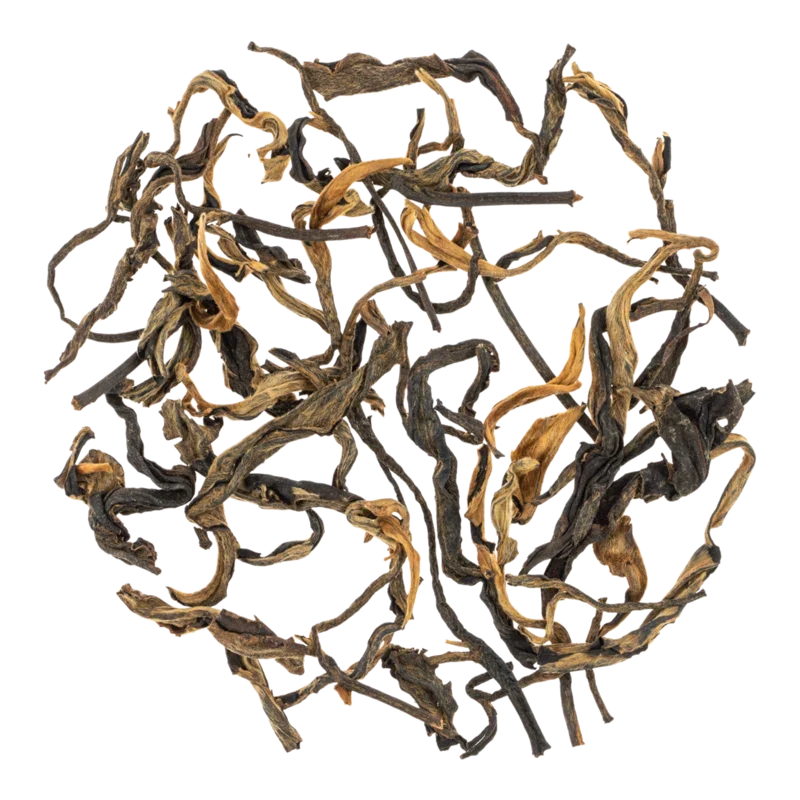
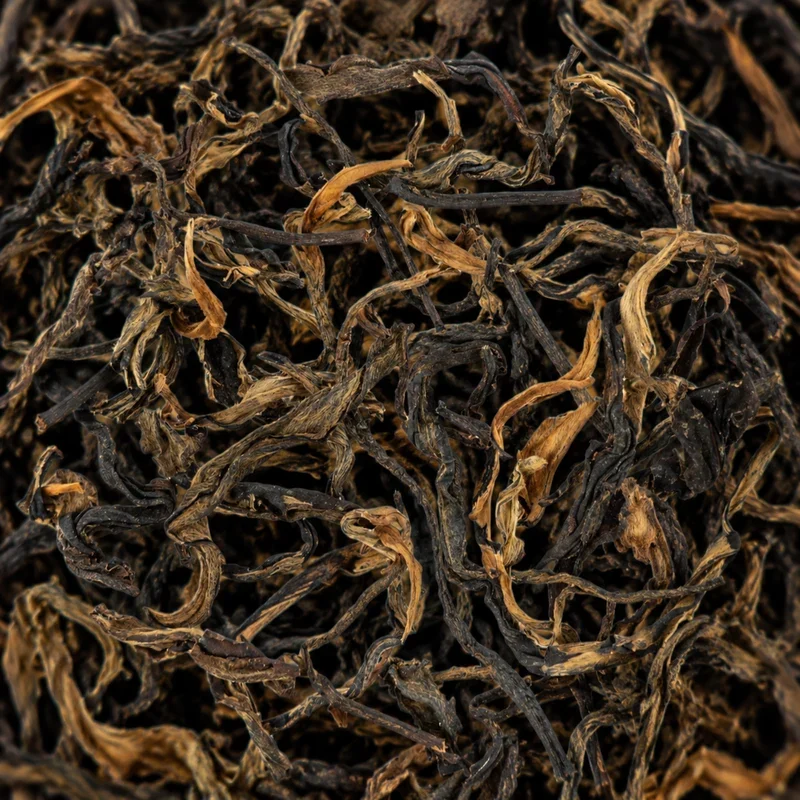
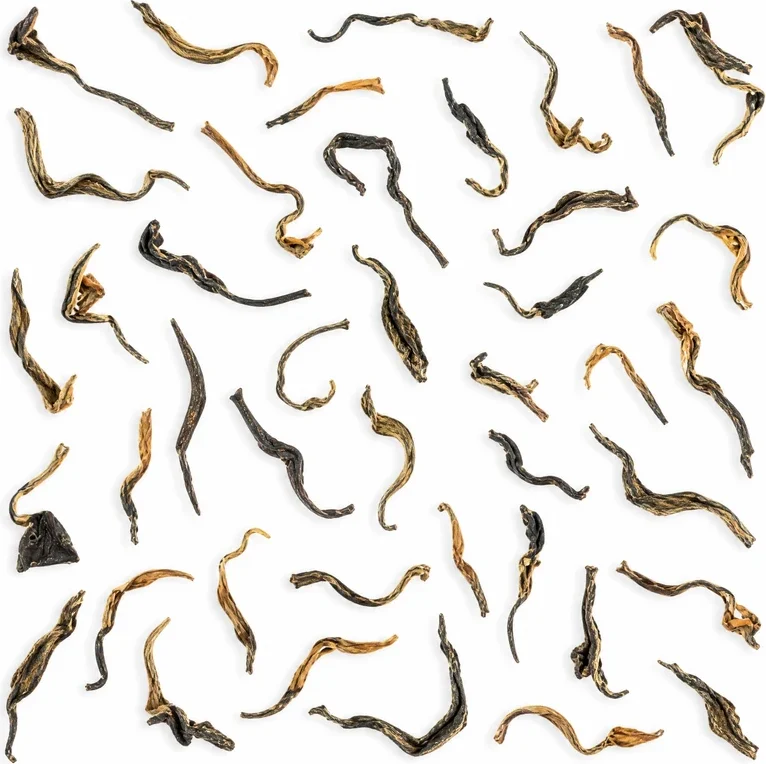
Dry Leaf Appearance: Large, dense, tightly twisted strips of dark brown color with abundant golden tips (金毫, jīn háo). Leaf noticeably larger than eastern Chinese red teas — heritage of the Assam type.
Dry Leaf Aroma: Rich and multi-layered. Dominated by notes of magnolia (玉兰花, yùlánhuā), roasted chestnut, and dark honey. In the background — light woody and nutty tones.
Liquor Aroma: In first infusions — bright floral and honey notes. As the liquor cools below 50°C, fruity tones intensify — grapefruit acidity, prunes, dried apricot. In cooled liquor — characteristic "sweet potato" shade (薯香, shǔ xiāng) typical of quality Dianhong, transitioning to caramel.
Liquor Color: Red-orange, bright and deep, with characteristic "golden ring" (金圈, jīn quān) on cup walls — indicator of high theaflavin content. In concentrated brews, possible "lenghohun" phenomenon (冷后浑, "clouding after cooling") — sign of high-quality red tea.
Spent Leaves: Large, elastic leaves of copper-red color. Whole buds unfold completely, demonstrating softness and tenderness of raw material.
Taste: Full, oily, with pronounced "body" (thickness). Natural sweetness — honey-caramel, without cloying. Moderate tannin structure that doesn't transition to rough astringency. Long, warming aftertaste with notes of dried fruits and light minerality. Texture becomes especially oily when using raw material from ancient trees.
Alkaloids: Caffeine — about 3.0–3.5% (elevated compared to small-leaf red teas). Theobromine and theophylline — in trace amounts.
Amino Acids: L-theanine — about 1.2–2.0 mg/g. Amino acid content lower than small-leaf "green" cultivars, but sufficient for forming sweet aftertaste and synergy with caffeine.
Linalool and its oxides (floral notes), geraniol (rose tones), methyl salicylate ("wintergreen" shade), furfurol (caramel notes). Characteristic "sweet potato" note (薯香) is linked to formation of maltol and cyclotene during drying of large-leaf raw material.
Extractive substances of large-leaf Yunnan teas reach 46–50%, significantly higher than small-leaf red teas (38–42%). This ensures multiple infusions and tea "endurance."
Minerals: Potassium, manganese, zinc, magnesium, iron, fluoride. Selenium-containing soils of Wuliang Mountains may determine presence of trace amounts of selenium in finished tea.
Polyphenols: Total content in fresh leaf — 28–38% (one of the highest among world tea regions thanks to large-leaf Assam type). In finished red tea, theaflavins (TF, ~0.8–1.5%) and thearubigins (TR, ~8–14%) dominate. High polyphenol level determines rich color and "body" of liquor.
Vitamins: B-group vitamins (B₁, B₂), vitamin K, vitamin P (rutin). Vitamin C content in red tea reduced due to oxidation.
Elevated caffeine content combined with L-theanine provides long-lasting, gentle stimulation without nervousness — "quiet alertness."
Theaflavins and thearubigins of Yunnan red teas demonstrate high antioxidant activity, exceeding that of many small-leaf red teas thanks to high initial polyphenol content.
Red tea gently affects gastric mucosa. Dianhong is traditionally recommended as after-dinner tea, promoting comfortable digestion of fatty foods.
According to several studies, regular consumption of red tea from large-leaf Yunnan raw material may contribute to normalization of intestinal microflora.
Red tea belongs to "warm" (温性) beverages in traditional Chinese medicine classification, making it especially suitable for cold seasons and people with "cold" constitution.
Red tea polyphenols may slow postprandial glycemic response, of interest for controlling blood sugar after meals.
Regular moderate red tea consumption is associated with maintaining vascular elasticity.
Tea Amount: 5–7 g per 100–150 ml (gongfu cha method); 3–4 g per 200–300 ml (European style).
Teaware: Gàiwǎn (盖碗, gàiwǎn) — for maximum revelation of aroma nuances. Porcelain teapot — for soft, "rounded" profile. Yíxīng teapot (宜兴紫砂壶) — for enhancing "body" and depth.
Water Temperature: 90–95°C. Boiling water (100°C) appropriate for dense autumn batches; for tender spring bud grades, 88–92°C preferable.
Container: Airtight, opaque — tin cans, foil vacuum bags, ceramic containers.
Shelf Life: Standard Dianhong (honggan) best consumed within 12–24 months. Quality batches "round out" after 2–3 years of proper storage, acquiring more pronounced caramel and chocolate tones. Shàihóng versions (晒红, sun-dried) possess potential for longer aging (3–5+ years), similar to sheng pu-erh.
Dry dark place, 15–25°C, humidity no more than 60%. Avoid proximity to strongly scented products.
Do not store in refrigerator. Freezing contraindicated.
Classic, "standard" Dianhong. Produced at lower altitudes (1,200–1,600 m), more often from plantation raw material. More "powerful," with pronounced "shuxiang" (薯香) and chocolate-peppery notes. Wuliang Hong Cha — more refined, with greater floral height and high-altitude terroir minerality.
Fújiàn bud red tea from Tóngmù (桐木关). Exceptionally tender, light, with floral-honey bouquet. Significantly "thinner" in body. Wuliang Hong Cha — more "voluminous" and oily thanks to large-leaf Assam raw material.
Anhui small-leaf gongfu hong cha with characteristic "orchid" aroma. Light, elegant, with finer tannin structure. Wuliang Hong Cha — opposite in "weight class": dense, rich, "southern" in character.
Sun-dried red tea from neighboring county, with aging potential. Less fully fermented (70–80%), with more "green," slightly acidic tones. Wuliang Hong Cha (honggan) — more "classic," stable and harmonious.
Guizhou gongfu hong cha from medium-leaf raw material. Lighter, elegant, with karst minerality. Wuliang Hong Cha — noticeably "heavier" and sweeter, with typically Yunnan "power" of Assam leaf.
Price Category: Wide range — from affordable plantation batches to premium lots from century-old trees, priced many times higher. Main price-forming factors: tree age (古树 vs. 台地茶), picking standard (单芽 vs. 一芽二叶), season (spring vs. autumn), growing altitude.
No reviews yet. Tell us what you think of this tea.
Rate this tea and share your impressions. We review each submission before publishing it.