Brewing
Gongfu brewing
- Water temperature
- 75 °C
- Tea amount
- 5 g
- Water volume
- 100 ml
- First steep
- 10 s
- Time added per infusion
- 5 s
- Infusions
- 3

Yǔnkēng lǜchá
Choose a brewing method. Start with the recommended quantities and time, then adjust to taste.
Brewing
Brewing
Taste
Tea encyclopedia
Alt Names: Báishā Lucha (白沙绿茶, Báishā Lǜchá) — main commercial name; "Tea from meteorite crater" — popular descriptive designation.
Alt Names: Báishā Lucha (白沙绿茶, Báishā Lǜchá) — main commercial name; "Tea from meteorite crater" — popular descriptive designation.
Category: Regional green teas of China. Product with protected geographical indication (国家地理标志保护产品, guójiā dìlǐ biāozhì bǎohù chǎnpǐn, 2004). The only green tea from Hainan Province to receive a special gold award at the "Zhonglü Bei" competition (中绿杯, 2020).
Coordinates: Approximately 19°13′ N, 109°27′ E (crater center — Yacha Town, 牙叉镇, Yáchā Zhèn, 9 km southeast).
Origin: China, Hǎinán Province (海南省, Hǎinán Shěng), Báishā Lì Autonomous County (白沙黎族自治县, Báishā Lízú Zìzhìxiàn), territory of Báishā State Farm (国营白沙农场, Guóyíng Báishā Nóngchǎng).
Type: Green tea (绿茶, lǜchá). Non-oxidized; degree of oxidation is minimal. Distinctive feature — steaming fixation (蒸青, zhēngqīng) instead of traditional pan-firing, which gives the tea a more "green," grassy-fresh profile.
Yunkeng Lu Cha is the only tea on the planet grown in meteorite crater soils. Baisha Crater is the only scientifically confirmed impact crater in China and one of the best preserved in Asia.
Thanks to Hainan's tropical climate, harvest begins as early as late December–early January, 1–3 months earlier than in any other tea region of China. Hainan tea is the "earliest" in the country.
In 2011, Baisha Lucha was chosen as the official tea of the Boao Forum for Asia — a key international economic summit of Asia held in Hainan.
Part of plantations (particularly "Wu Li Lu," 五里路有机茶园) passed organic certification from four jurisdictions simultaneously: China, European Union, USA and Japan — this is exceptionally rare for Chinese tea.
48 types of minerals have been discovered in Baisha Crater impact breccias; more than 50 in surrounding soils. This mineral wealth provides anomalously high water extract (43.2%) and water-soluble ash (71.4%) indicators.
Cultural Significance: Yunkeng Lu Cha is a symbol of Hainan Island in Chinese tea culture. It is the province's main tea brand, closely connected with Li people culture and the region's unique geological history. The tea is called "China's First Early Spring Tea" (华夏第一早春茶, Huáxià dì yī zǎo chūn chá), since the tropical climate allows harvesting to begin as early as late December — 1–3 months earlier than on the mainland.
Cultivar: Main cultivars — Hǎinán Dàyè Zhǒng (海南大叶种, Hǎinán Dàyèzhǒng, Camellia sinensis var. assamica) and Yúnnán Dàyè Zhǒng (云南大叶种, Yúnnán Dàyèzhǒng). Auxiliary: Fúdǐng Dàbáichá (福鼎大白茶, Fúdǐng Dàbái Chá), Qílán (奇兰, Qílán), Fuyun 6 Háo (福云6号). Large-leaf varieties are characterized by high polyphenol content (≥28.7%) and moderate amino acid content (≥3.2%), ensuring rich, concentrated flavor.
Picking: Year-round thanks to tropical climate, however spring harvest (January–April) is most valued. Pre-Qīngmíng tea (清明前, before early April) is of highest quality.
Pluck Standard: Special grade — one bud with beginning-to-unfurl leaf (一芽一叶初展); first grade — one bud with one unfolded leaf; second grade — one bud with two leaves.
Raw Material: Strict sorting by freshness and uniformity; adherence to "five control indicators" standard (五标管控, wǔ biāo guǎn kòng): plantation management, harvest standard, sorting by freshness and uniformity, processing control, packaging standard.
Altitude: Tea gardens are located on the inner slopes of the crater and adjacent hills; precise altitude varies, but plantations belong to the category of high-mountain cloud zones.
Climate: Tropical monsoon. Average annual temperature 23.4°C (average monthly fluctuations 16.4–26.9°C). Daily temperature range — more than 7°C. Annual precipitation — about 2,200 mm (main rainy season: May–October). Number of cloudy and foggy days exceeds 260 per year; proportion of diffused light — more than 75%.
Soil: Unique mixture of impact breccias and tropical lateritic soils enriched with meteoritic minerals. High content of organics and trace elements provides exceptional extractability to the tea leaf.
Báishā Crater (白沙陨石坑, Báishā Yǔnshí Kēng) was formed approximately 700,000 years ago as a result of an asteroid impact. Crater diameter — 3.5–3.7 km. This is the only scientifically confirmed meteorite crater in China and one of the few in the world where fragments of impact breccias have been discovered. Soils contain 48 minerals of cosmic and terrestrial origin, including elevated selenium concentrations (3 times higher than ordinary soils). Organic matter content — at least 15 g/kg, humus layer thickness — 40–60 cm.
Forest cover of Baisha County — 86%. Plantations are surrounded by 5,000 mu (about 333 hectares) of tropical rainforest, forming a natural protective barrier. Negative air ion concentration — 8,000 units/cm³. Water sources meet Category I National Standard. Chemical pesticides are prohibited; part of plantations have passed organic certification from four countries (China, EU, USA, Japan).
Harvested material is spread in a thin layer for 2–4 hours for partial moisture removal and beginning of aromatic profile formation.
Key technological feature. Leaves are processed with superheated steam at 120–140°C. Unlike wok or drum firing, steam provides instant and uniform enzyme deactivation without fire contact, completely eliminating "smoky" or "burnt" notes. The technology is called "steam-sealed freshness" (蒸汽锁鲜, zhēngqì suǒ xiān).
Light pressing and shaping of leaf into tight strips. Pressure is moderate to preserve cell structure and ensure controlled extraction during brewing.
Three-stage process with gradual temperature reduction: 80°C → 50°C → 40°C. This regime delicately fixes aroma and color without damaging delicate aromatic compounds.
Complete "garden to cup" cycle is standardized according to the "five controls" system. Vacuum packaging and storage in temperature-controlled warehouses extend shelf life by at least 8 months compared to traditional technology.
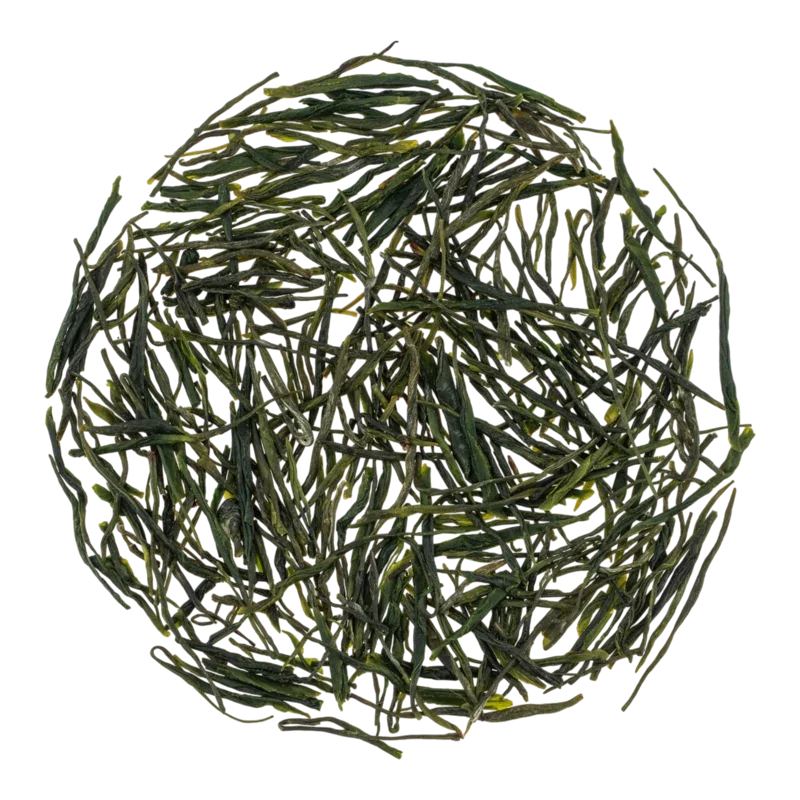
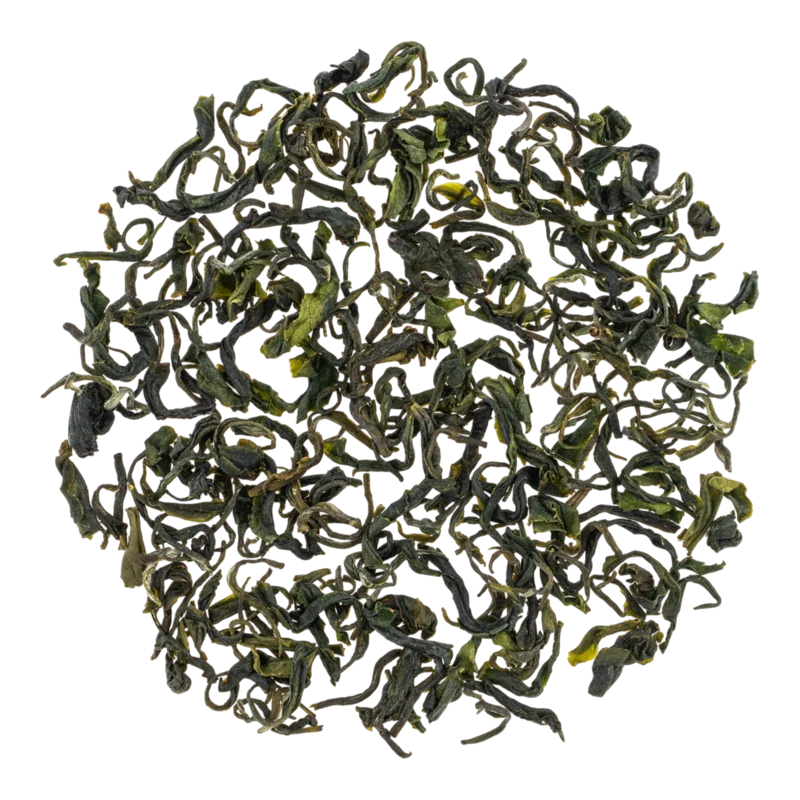
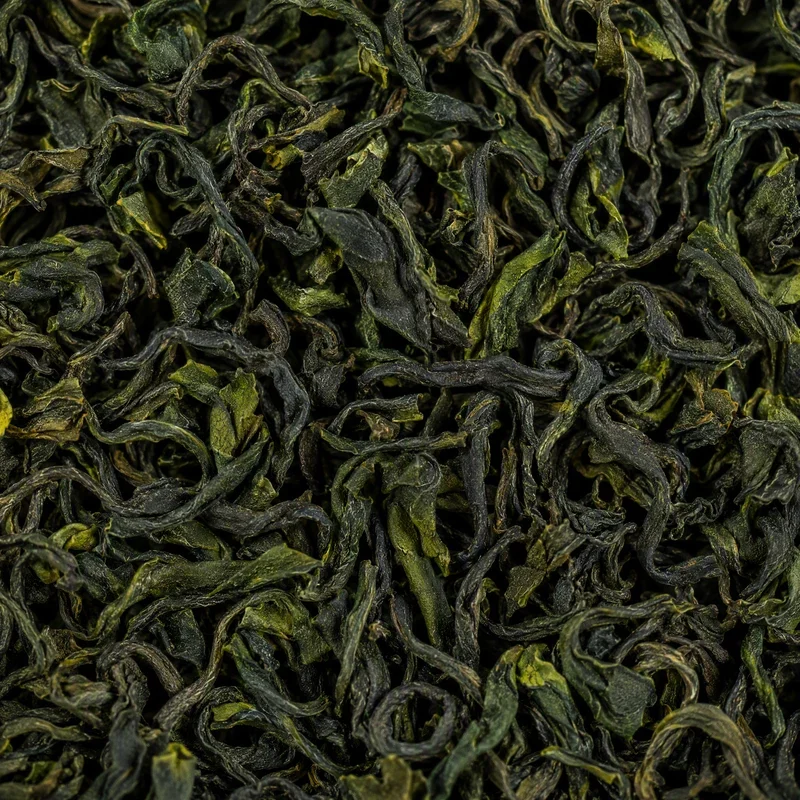
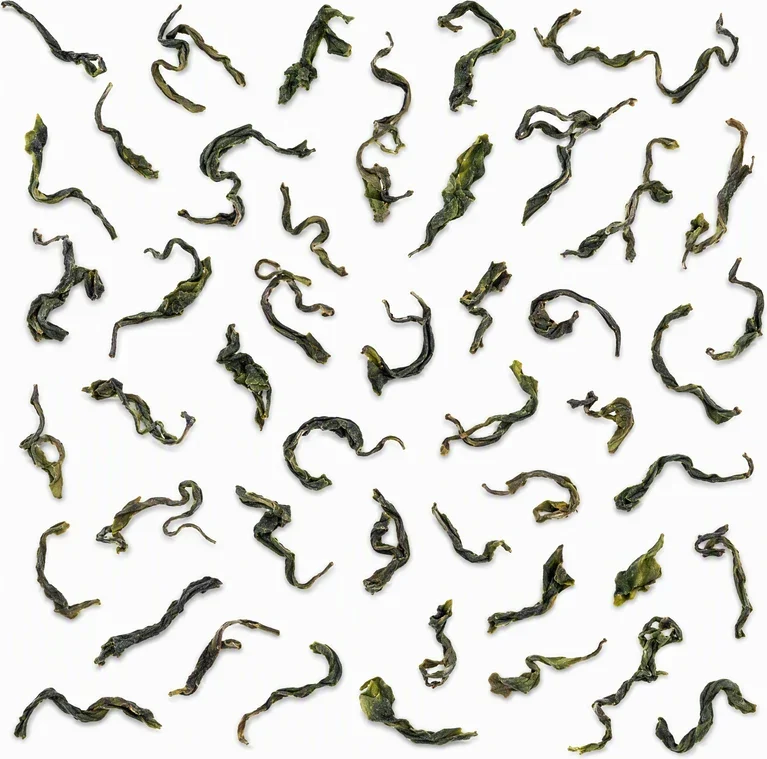
Dry Leaf Appearance: Tightly twisted strips (条索紧结, tiáosuǒ jǐnjié), slightly curved. Color — rich green with oily luster, noticeable white down (显毫, xiǎn háo). Leaf is uniform, dense.
Dry Leaf Aroma: Clean, high, with distinct roasted chestnut notes (栗香, lì xiāng) in spring varieties. Special grade reveals delicate zongzi leaf aroma (粽叶香, zòng yè xiāng — aroma of bamboo zongzi leaf). Cold cup retains aroma for more than 8 minutes.
Liquor Aroma: Main theme — pure freshness (清香, qīng xiāng) with chestnut undertone. Characteristic "mineral" overtone, which connoisseurs describe as "crater depth" (矿韵, kuàng yùn) — result of high soil mineralization.
Liquor Color: Yellow-green, bright and clear (黄绿明亮, huáng lǜ míng liàng). With each steeping, the shade shifts toward lighter green.
Spent Leaves: Tender, uniform, leaves unfold as "buds" (嫩匀成朵, nèn yún chéng duǒ). Color — bright, lively green; texture — soft and juicy.
Taste: Rich and mellow simultaneously (浓醇, nóng chún). Bright freshness (鲜爽, xiān shuǎng) due to balanced ratio of amino acids and polyphenols. Pronounced returning sweetness (回甘, huí gān). Astringency is minimal (涩感微弱). Body — medium to full, with sensation of "mineral density" uncharacteristic of most green teas.
Alkaloids: Caffeine — typical content for large-leaf tropical varieties (approximately 30–40 mg/g). Theobromine and theophylline — in trace amounts.
Amino Acids: At least 3.2%. L-theanine makes the main contribution to "umami" freshness and mild tonic effect.
43.2% — significantly exceeds national standard for green teas (34%). This explains the unusual "density" for green tea and high resistance to multiple steepings.
71.4% — more than one and a half times higher than the normative indicator (45%), reflecting high leaf mineralization inherited from meteoritic soils.
Content is 3.2 times higher than average for green teas.
Steam technology preserves a greater proportion of volatile "green" aldehydes (hexanal, cis-3-hexenol) compared to pan-firing, giving a more grassy-fresh profile.
Minerals: Selenium (content three times higher than ordinary soils), zinc, manganese, iron, phosphorus and others — in total more than 50 mineral components.
Polyphenols: Content — at least 28.7% (in large-leaf cultivars). High catechin level provides powerful antioxidant potential.
Vitamins: Vitamin C, B-group vitamins, vitamin E. Steam fixation preserves vitamin C better than pan-firing.
High polyphenol content provides effective neutralization of free radicals. According to producer data, the antioxidant effectiveness of this tea exceeds average green tea indicators by 37%.
L-theanine enhances α-wave brain activity, promoting a feeling of calm concentration. In Li people tradition, tea was used for "clearing heat and reducing fire" (清热降火, qīng rè jiàng huǒ) — relieving anxiety and spring drowsiness.
Increased flavonoid content stimulates immune cell activity.
Catechins contribute to blood lipid profile normalization.
In Li people traditional medicine, tea was used to support liver function.
High content of selenium, zinc and other trace elements compensates for their deficiency in diet.
Moderate tannin content stimulates digestive secretion without pronounced irritating action.
Antioxidants and vitamin C contribute to skin protection from photoaging.
Soft, neutral or slightly acidic. Alkaline water worsens color and clarity of liquor. Mountain spring water is ideal.
Tea Amount: 3 g per 150 ml (1:50 ratio).
Teaware: Glass tumbler (透明玻璃杯, tòumíng bōli bēi) — allows observing the "dance of leaves"; white porcelain gaiwan (白瓷盖碗, bái cí gàiwǎn) — better concentrates aroma.
Water Temperature: 80°C (let boiling water cool for about 90 seconds). For special grade — 75°C. Absolutely do not use boiling water: high temperature destroys L-theanine and intensifies bitterness.
Airtight packaging, protection from light and moisture. Optimal — refrigerator at 0–5°C. Vacuum packaging extends shelf life to 18 months; in ordinary airtight packaging — 12 months.
Fresh tea. Most expressive in the first 6 months after production. Not intended for aging.
Store opened package in refrigerator and consume within a month. Avoid proximity to products with strong odors. Remove serving portion 10–15 minutes before brewing so leaf "acclimates" to room temperature.
Famous "steam" (蒸青) green tea from Hubei Province — one of the few Chinese analogues by fixation method. Yulu is produced from small-leaf material at 800–1,200 m altitude, has more pronounced "needle" shape and delicate grassy aroma. Yunkeng Lu Cha is significantly denser in body and richer in taste thanks to large-leaf material and mineralized soils.
Steam fixation relates Yunkeng Lu Cha to Japanese tradition. However, Hainan tea uses large-leaf tropical varieties (var. assamica), while Japanese teas use small-leaf (var. sinensis). Result — Yunkeng Lu Cha is more "powerful," with pronounced minerality, while sencha is more delicate, with emphasis on umami.
Classic high-mountain green tea from Jiangxi. Pan-firing fixation, lighter body, floral-bean notes. Yunkeng Lu Cha is denser, with more pronounced chestnut aroma and unique "mineral" note.
Another Hainan green tea from Wuzhishan area, also from large-leaf wild material. Distinguished by more rough, "wild" character and strong returning sweetness. Yunkeng Lu Cha is more refined and standardized, with clearly expressed "steam" profile.
Price Category: Special grade — from 800 yuan per jin (500 g); first grade — 300–500 yuan; second grade — significantly cheaper, used for mass market and bagged tea. Organic tea (passed four-way certification) costs more than standard.
Raw material grade, harvest season (pre-Qingming — most expensive), plantation location (inside crater — premium), presence of organic certification.
No reviews yet. Tell us what you think of this tea.
Rate this tea and share your impressions. We review each submission before publishing it.