Brewing
Gongfu brewing
- Water temperature
- 93 °C
- Tea amount
- 5 g
- Water volume
- 100 ml
- First steep
- 10 s
- Time added per infusion
- 5 s
- Infusions
- 4

Yǔnkēng hóngchá
Choose a brewing method. Start with the recommended quantities and time, then adjust to taste.
Brewing
Brewing
Taste
Tea encyclopedia
Category: Hainan organic red tea (black tea); product of the "Yunkeng" brand (陨坑), belonging to Hainan Tianran Tea Co., Ltd. (海南天然茶叶有限公司, Hǎinán Tiānrán Cháyè). Part of the "Baisha Cha" product line (白沙茶, tea from Baisha County), alongside green and white tea.
Category: Hainan organic red tea (black tea); product of the "Yunkeng" brand (陨坑), belonging to Hainan Tianran Tea Co., Ltd. (海南天然茶叶有限公司, Hǎinán Tiānrán Cháyè). Part of the "Baisha Cha" product line (白沙茶, tea from Baisha County), alongside green and white tea.
Coordinates: approximately 19°05′ N, 109°26′ E.
Origin: China, Hǎinán Province (海南省, Hǎinán Shěng), Báishā Lì Autonomous County (白沙黎族自治县, Báishā Lízú Zìzhìxiàn), Yáchā Town (牙叉镇, Yáchā Zhèn). Tea plantations are located directly inside and on the adjacent slopes of the Báishā Meteorite Crater (白沙陨石坑, Báishā Yǔnshí Kēng) — an impact structure 3.7 km in diameter, formed approximately 700,000 years ago. This is the first and only confirmed meteorite crater on the territory of the PRC, as well as one of the best-preserved craters in the world.
Type: Chinese red tea (black tea) (红茶, hóngchá), fully oxidized.
Cultural Significance: Yunkeng Hong Cha is one of the most unusual teas in China by place of origin. It embodies the concept of "heavenly gift" (天赐, tiāncì): a cosmic event 700,000 years ago created soils that exist nowhere else on Earth — and it is precisely on these soils that tea grows. The Báishā crater is a source of pride for the Lì people (黎族, lízú), the indigenous population of Hainan Island, who for centuries have grown tea on the slopes of the basin, preserving traditions of "crater tea cultivation." Baisha bears the honorary titles "Birthplace of China's First Spring Tea" (中国早春茶之乡) and "Birthplace of China's Ecological Tea" (中国生态茶叶之乡). The tea season in Baisha begins 1–3 months earlier than in the main tea provinces of mainland China — already in December–January.
History: The Baisha Meteorite Crater was formed approximately 700,000 years ago as a result of a stony asteroid impact. The impact energy, according to scientists' estimates, was equivalent to 360 Hiroshima-type atomic bombs. The crater was scientifically identified in 1992 by a group of Chinese geologists; meteorite fragments were determined to be a rare type — "calcium-rich achondrite meteorite" (富钙无球粒陨石). Throughout Hainan Island, black glassy stones are found everywhere — "leigongmo" (雷公墨, "Thunder God's ink"), which are tektites ejected during the impact. Tea production in the crater area began in the 1960s, when a plantation was established here as part of a state program for developing tropical agriculture (later — Baisha State Tea Farm). Initially, local Hainan large-leaf varieties were grown; then additional cultivars were brought from Yunnan, Guangdong, Fujian, and Taiwan: Yunnan large-leaf (云南大叶种), Fènghuáng Shuǐxiān (凤凰水仙), Qílán (奇兰), Fúdǐng Dàbái (福鼎大白), Fuyun 6 (福云6号) and others. In 1990, Baisha Lü Chá (白沙绿茶) — green tea from the crater — was recognized as a "green product" (绿色食品) by the Ministry of Agriculture, and in 2004 received geographical indication status (国家地理标志保护产品). Hainan Tianran Tea Co., Ltd. (海南天然茶叶有限公司), founded in 2016 as a division of Hǎinán Agricultural State Concern (海南农垦), specializes in organic tea from the crater and produces products under the "Yunkeng" brand (陨坑). Yunkeng Hong Cha — the red line of the brand — quickly gained recognition: gold med
Name Breakdown: 陨坑 (yǔnkēng) — "meteorite crater"; 红茶 (hóngchá) — "red tea (black tea)." The name is maximally straightforward: "red tea (black tea) from a meteorite crater." This is simultaneously both a brand and an exact description of terroir — the tea grows literally inside an impact structure.
Cultivar: Main varietal composition of "Yunkeng" plantations: Yunkang 10 (云抗10号, Yúnkàng 10 hào — Yunnan large-leaf, cold-resistant), Yinghong 9 (英红9号, Yīnghóng 9 hào — Guangdong variety, adapted for red tea), Fúdǐng Dàbái (福鼎大白, Fúdǐng Dàbái), Qílán (奇兰, Qílán) and Shuǐxiān (水仙, Shuǐxiān). All varieties are Camellia sinensis, including large-leaf (var. assamica) and medium-leaf forms. Plantations are organized on the principle of agrobiodiversity: tea bushes grow among areca palms (槟榔), coconut palms, cinnamon trees and coffee bushes — such polyculture provides natural shading and ecological sustainability.
Picking: Thanks to Hainan's tropical climate, tea is harvested year-round. The most valuable batches are "first spring tea" (早春茶, zǎochūn chá), harvested as early as December–January, when the main tea provinces of China are still in winter dormancy. This is the earliest spring tea in the country — "华夏第一早春茶."
Pluck Standard: 1 bud + 1–2 young leaves for highest grade red tea (black tea).
Raw Material: Strict adherence to organic standards at all stages — from field to cup. Plantations are fertilized exclusively with organic manure from Inner Mongolia and fish-shrimp fertilizers of deep-sea origin. Organic matter content in soil — up to 4.76%, which significantly exceeds the International Federation of Organic Agriculture (IFOAM) standard for top tea gardens (≥ 3.5%).
Altitude: 100–400 m a.s.l. (crater topography — gentle inner slopes and basin floor). Despite the modest elevation, the crater's microclimate creates conditions analogous to higher mountain areas.
Climate: Tropical monsoon. Average annual temperature — 23.4°C; annual precipitation — 1,500–2,000 mm. The crater is constantly shrouded in clouds and mists; the southern Nándù River (南渡江, Nándù Jiāng) encircles it from east and west, increasing humidity. Characterized by mild winters, long growing season and early spring onset.
Soil: Unique impact-metamorphic soils of the crater. During the meteorite impact, cosmic material mixed with local rocks and deep layers of the Earth's crust, creating an anomalously mineralized substrate. According to X-ray phase analysis data, 48 minerals were found in impact breccia samples within several square centimeters; the total number of mineral species in tea zone soils is more than 50, including rare ones. Main type — red-yellow lateritic soils (红黄壤) with acidic reaction (pH 4.5–5.5). It is precisely this cosmic "cocktail" of minerals that, according to scientists, determines the unusual flavor and aromatic profile of crater tea.
Baisha is the "lungs of Hainan": three major rivers originate here, forest coverage — 84%. The crater is surrounded by dense tropical vegetation. The anomalously strong magnetic field inside the crater (so powerful that it magnetizes watch hands and disrupts electronic devices) is a subject of scientific discussion. Local residents notice that plants inside the crater grow noticeably faster and more luxuriantly than outside its boundaries; medicinal herbs possess enhanced effects; and sugar cane of the same variety turns out sweeter. "Yunkeng" plantations have passed organic certification of five systems: China, EU (27 countries), USA, Japan and Rainforest Alliance.
1 bud + 1–2 leaves, hand-picked.
Leaves are spread on racks in a clean, ventilated workshop. For red tea (black tea), withering duration is 12–16 hours (significantly longer than for green tea, which activates enzymatic processes and promotes aroma development).
Mechanical rolling, ensuring cell wall destruction and formation of tight twist (条索紧细).
Controlled fermentation at optimal temperature and humidity. Unique mineral components of the raw material influence the fermentation process, forming the specific "crater" taste — with increased sweetness and mineral aftertaste.
High-temperature drying to inactivate enzymes and fix aroma. Readiness determination: "tea sticks break with a crunch, and the leaf grinds to powder" (条一折就断,手捏成粉) — the classic master's test.
Classification by fraction and grade; packaging under clean production conditions.
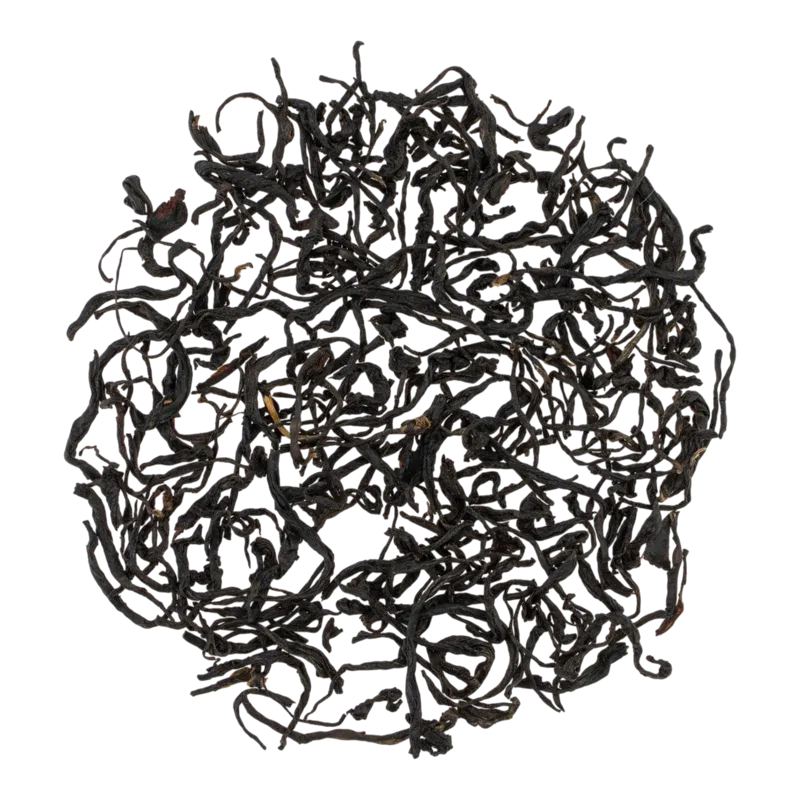
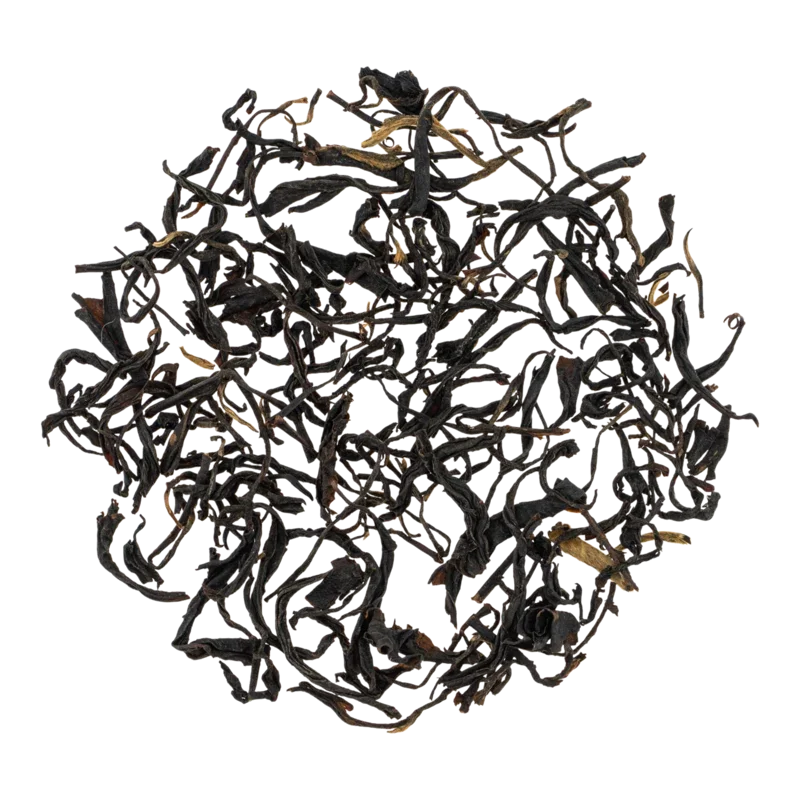
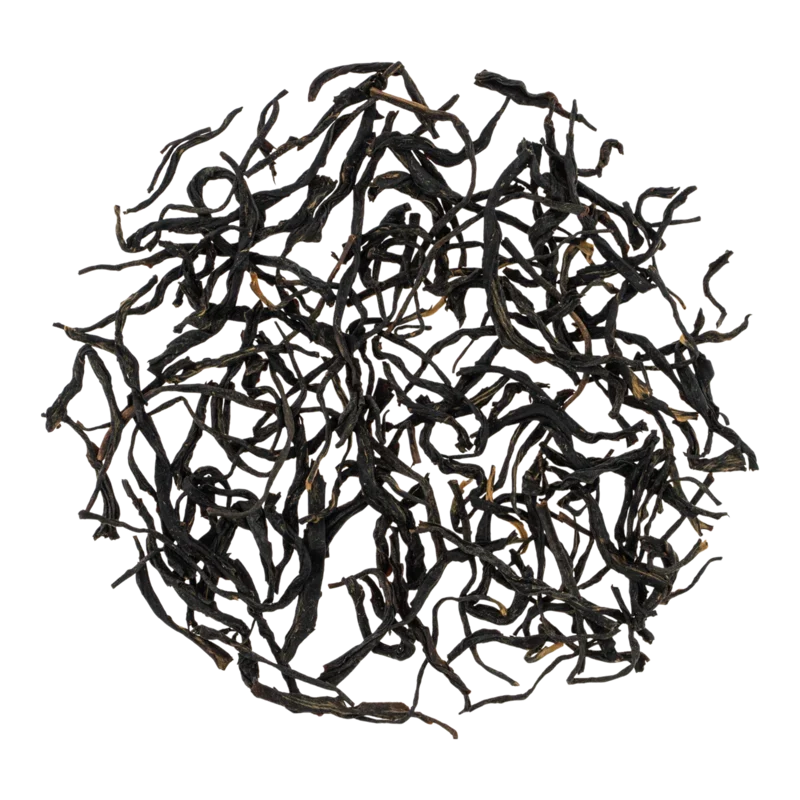
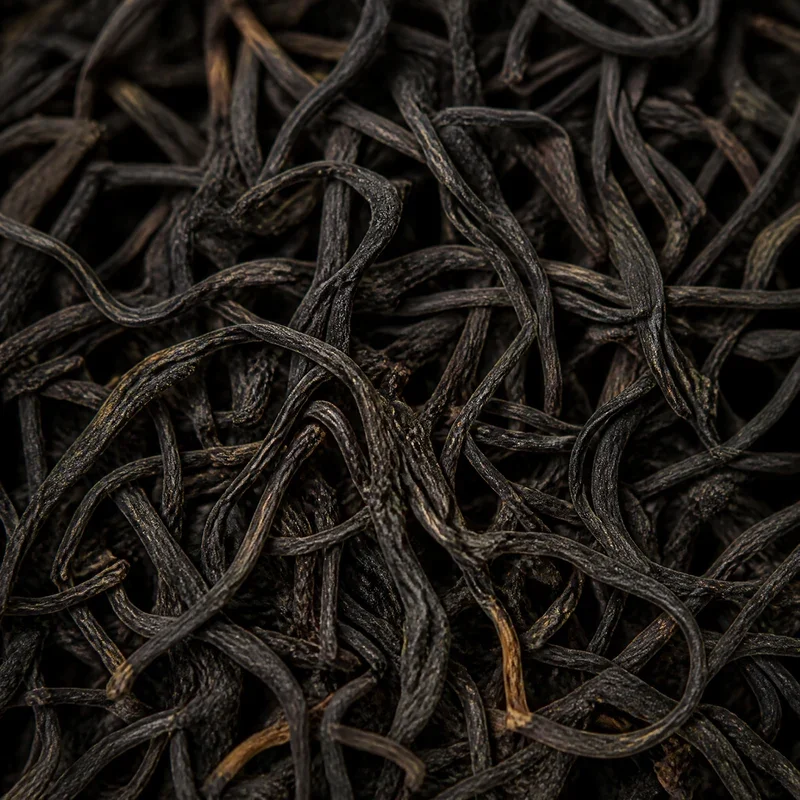
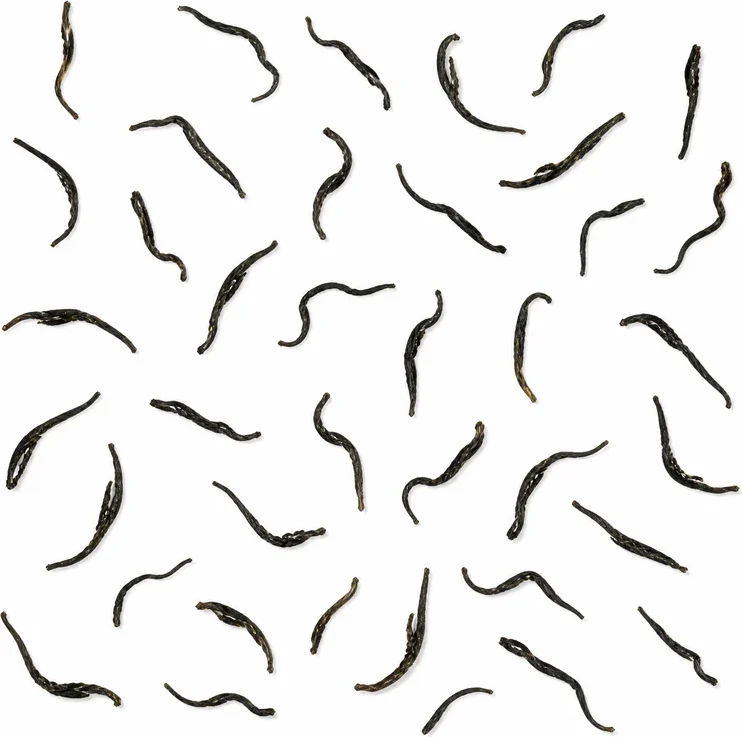
Dry Leaf Appearance: Tight, full twist (肥硕, féishuò — "robust, plump"); dark leaf with oily luster (色泽乌润油亮) and noticeable golden tips in highest grades.
Dry Leaf Aroma: Sweet, honey-floral, with warm fruity background and light mineral undertone. Aroma purity is a distinguishing feature: absence of foreign "chemical" or "burnt" notes — result of strict organic protocol.
Liquor Aroma: Bright, multi-layered: honey and floral notes with fruity undertone; aroma described by the formula "香、醇、韵、滑、甜" (aromatic, pure, with character, smooth, sweet).
Liquor Color: Red-amber to deep ruby, bright and clear (汤色红亮).
Spent Leaves: Red-copper, elastic, with well-opened whole leaves.
Taste: Full-bodied and sweet (甘甜, gāntián), with pronounced velvety texture, soft juiciness and minimal astringency. Aftertaste — long, enveloping, with honey "returning sweetness" (回甘, huí gān). Special feature — unusual "mineral touch" in the finish: light sensation of coolness and "stone," which connoisseurs associate with the unique mineral composition of crater soils.
Alkaloids: Caffeine (3–5% — somewhat higher than average for red teas, typical for large-leaf tropical varieties), theobromine, theophylline.
Amino Acids: Elevated content; studies show that tea from Baisha Crater exceeds analogs from other regions in amino acid levels, which is attributed to the mineral richness of soils.
In "Baisha" green tea, EGCG content is 0.86 mg/kg — 1–2 times higher than analogs from mainland China. In red tea (black tea), part of EGCG transforms during fermentation, but residual amounts remain significant.
Unique component discovered in crater tea — an anthocyanin with cardioprotective action; this component has not been detected in teas from other regions.
Essential Oils: Form the characteristic honey-floral aroma with "mineral touch."
Minerals: Zinc (elevated), manganese, selenium, iron, potassium and a number of trace elements determined by the unique composition of impact soils (50+ mineral species).
Polyphenols: Tea polyphenol content is elevated due to tropical climate and intense solar radiation; during fermentation, theaflavins and thearubigins form, determining the bright red color and "velvet" of the liquor.
Vitamins: Vitamin C (elevated level), B vitamins.
Tea Amount: 4–5 g per 100–120 ml (gongfu); 2–3 g per 200–250 ml (steeping).
Teaware: White porcelain gaiwan 100–120 ml; porcelain or glass teapot.
Water Temperature: 90–95°C; for delicate bud batches — 85–90°C.
Green "sibling" from the same crater — celebrated Hainan green tea with GI (2004). Both teas use the same raw material from "cosmic" soils, but green is crisp, chestnut-like, with mineral freshness, while red is warm, honey-like, velvety. Green Baisha Cha has been known since the 1960s and is the "elder brother"; the red "Yunkeng" line is young but rapidly gaining authority as the "younger brother."
Red tea (black tea) from Hainan's Wuzhishan Mountain, produced from Hainan large-leaf variety. Possesses "tropical" power — rich, astringent, bright, comparable to Ceylon highland tea. Yunkeng Hong Cha is softer and more delicate: "crater" soils with their mineral richness smooth tropical astringency and bring unique sweetness.
Famous Guangdong red tea (black tea) from Yingde. One of the cultivars used on "Yunkeng" plantations. Ying Hong 9 is a classic of Guangdong style: "oily" luster, dense body, honey-pepper notes. Yunkeng, using the same variety but in crater terroir, demonstrates more pronounced minerality and "cool" finish.
Yunnan red tea (black tea) from large-leaf varieties (some of which are the same Yunkang 10 that grow on "Yunkeng" plantations). Dian Hong is "fiery" and sunny; Yunkeng is "cosmic": same varieties, but in unique soils of meteorite origin, which brings additional mineral complexity.
No reviews yet. Tell us what you think of this tea.
Rate this tea and share your impressions. We review each submission before publishing it.