Brewing
Gongfu brewing
- Water temperature
- 93 °C
- Tea amount
- 5 g
- Water volume
- 100 ml
- First steep
- 10 s
- Time added per infusion
- 5 s
- Infusions
- 4

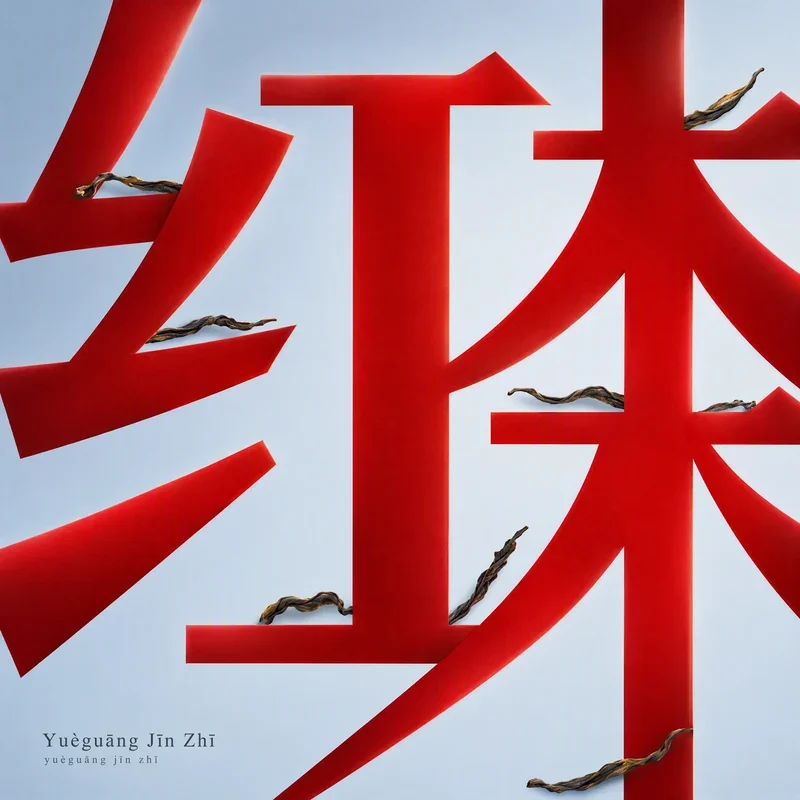
yuèguāng jīn zhī
Choose a brewing method. Start with the recommended quantities and time, then adjust to taste.
Brewing
Brewing
Taste
Tea encyclopedia
Category: Diānhóng (滇红, Diānhóng) — Yunnan red tea school based on large-leaf raw material. Belongs to the gōngfū black tea type (工夫红茶, gōngfū hóngchá). Diānhóng is among the four famous red teas of China alongside Qíhóng (祁红), Zhènghé Gōngfū (政和工夫), and Chuānhóng (川红).
Category: Diānhóng (滇红, Diānhóng) — Yunnan red tea school based on large-leaf raw material. Belongs to the gōngfū black tea type (工夫红茶, gōngfū hóngchá). Diānhóng is among the four famous red teas of China alongside Qíhóng (祁红), Zhènghé Gōngfū (政和工夫), and Chuānhóng (川红).
Coordinates: approximately 24°35′ N, 99°55′ E (center of Fengqing County).
Origin: China, Yúnnán Province (云南省, Yúnnán Shěng). Main production areas — Fèngqìng County (凤庆县, Fèngqìng Xiàn), Líncāng City (临沧市), as well as Jǐnggǔ County (景谷县, Jǐnggǔ Xiàn), Pu'er City (普洱市). Both areas are located in the Lancang River (Mekong) basin, in the zone of historical habitat of wild tea trees.
Type: Chinese red tea (black tea) (红茶, hóngchá), fully oxidized.
Cultural Significance: Yueguang Jin Zhi belongs to the new wave of Yunnan red teas oriented toward the domestic Chinese market, where Dianhong is experiencing a renaissance after decades of predominantly export focus. Fengqing, the key production area, holds the official title "Birthplace of Dianhong" (世界滇红之乡, Shìjiè Diānhóng zhī Xiāng) and actively develops tea tourism. The tea has been awarded at tea exhibitions and is positioned as a "red treasure" (红茶珍品) in the "Qicai Yunnan" assortment.
History: Yueguang Jin Zhi is a product of the modern stage of Yunnan red tea development. To understand its context, it is necessary to turn to the history of Dianhong as a whole.
Name Breakdown: "Yueguang" (月光) means "moonlight" — a poetic image referring to the silvery-white down of buds, reminiscent of lunar radiance. "Jin" (金) — "golden," denotes the abundance of golden tips in the finished tea. "Zhi" (枝) — "branch," a metaphor for thin, cord-like tea leaves. Together, the name creates an image of exquisite tea with a contrast of silver and gold — visually striking and memorable.
Cultivar: Yunnan large-leaf type (Camellia sinensis var. assamica). Main cultivar — Fèngqìng Large Leaf (凤庆大叶种, Fèngqìng Dàyè Zhǒng), recognized as a national variety in 1985. This is a seed (sexual) variety, tree-type, with large, fleshy leaves and abundant bud pubescence. Characterized by high polyphenol content (up to 30–33% dry matter) and caffeine, making it ideal for red tea production. The tree can reach several meters in height; terminal buds — up to 2.5 cm. Raw material from plantation plantings of Yúnkàng series clones (云抗, Yúnkàng) and Fèngqìng series (凤庆系) may also be used.
Picking: Spring (March–April) — main season for premium batches; summer and autumn raw material is used for mass batches. Spring buds contain maximum amino acids and give the sweetest, most delicate profile.
Pluck Standard: One bud with one leaf (一芽一叶, yī yá yī yè) — main standard for "Yueguang Jin Zhi." For more accessible batches, one bud with two leaves is acceptable.
Raw Material: Leaf must be whole, without mechanical damage, with preserved turgor. Tips — large, with dense silvery-white pubescence. Time between picking and start of withering — minimal.
Altitude: 1,000–2,200 m above sea level. Main Fengqing plantations are located at altitudes of 1,200–1,800 m.
Climate: Subtropical monsoon with mountain characteristics. Average annual temperature 18–22°C. Daily temperature fluctuations are significant — up to 15°C and more, which slows shoot growth and promotes concentration of aromatic substances. Annual precipitation — 1,200–1,700 mm. Characteristic feature — frequent morning and evening fogs: "In clear weather early morning and late evening — fogs everywhere, in cloudy weather — mountains all day in clouds" (晴时早晚遍地雾,阴雨成天满山云).
Soil: Red and yellow soils (红壤/黄壤), acidic, pH 4.5–6.0. Deep humus layer (up to 30 cm), formed by litter from tropical and subtropical vegetation. High content of organic matter and minerals.
Yunnan is the region of greatest concentration of wild tea trees on the planet. Forested mountain slopes create natural shade and biodiverse environment, which positively affects the tea's flavor profile. Fengqing has about 56,000 mu (≈3,700 ha) of ancient tea gardens, including 32,000 mu of plantations with trees planted before 1949.
Hand-picking of early spring buds with one leaf. Preferably morning after dew evaporation (9:00–11:00), when leaf moisture content is optimal.
Leaf is spread in thin layer on bamboo or wooden racks. Duration — 12–18 hours depending on air humidity. Goal — reducing turgor to elastic state, initial development of aromatic compounds, disappearance of grassy smell. Control: leaf easily crumples in hand and doesn't break.
Withered leaf is rolled to break cell walls and bring juice to surface. For delicate tippy raw material, light pressure is applied to preserve bud integrity. Rolling degree — until formation of characteristic thin cords.
Rolled leaf is laid in layer in room with controlled temperature (25–30°C) and high humidity (>90%). Time — 3–5 hours. By oxidation completion, leaf acquires reddish-copper shade, grassy smell completely disappears, fruity-honey aroma with characteristic Dianhong "malty" note forms.
Two-stage: primary (毛火) at higher temperature for rapid oxidation stoppage, then final (足火) at reduced temperature for aroma fixation and moisture reduction to safe level (≤6%). Possible final light warming (提香, tíxiāng) to enhance caramel-honey notes.
Separation by fraction size, tip content, leaf integrity. For "Yueguang Jin Zhi," fraction with maximum golden bud content is selected.
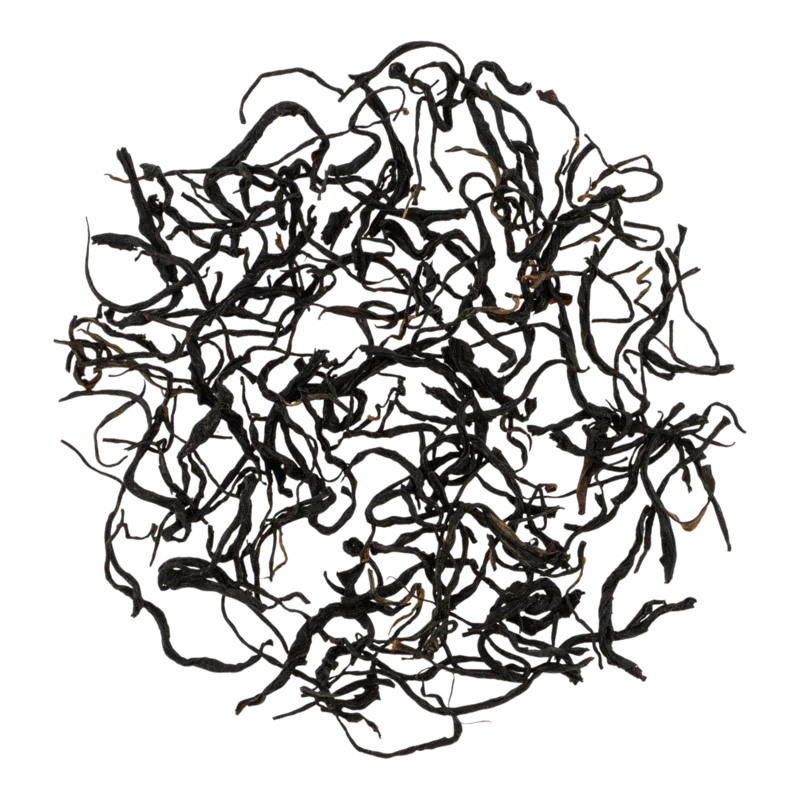
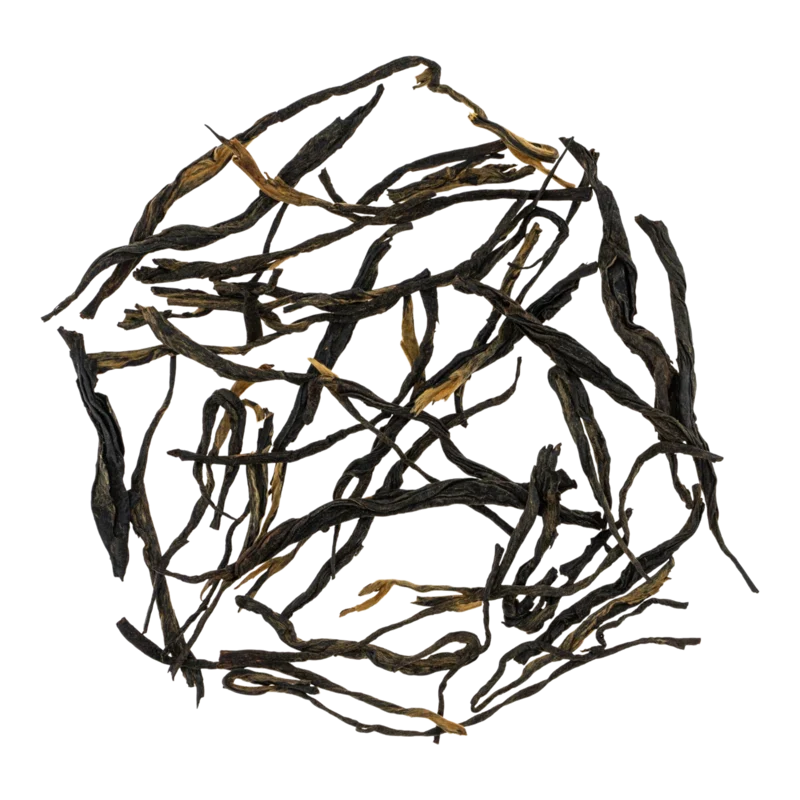
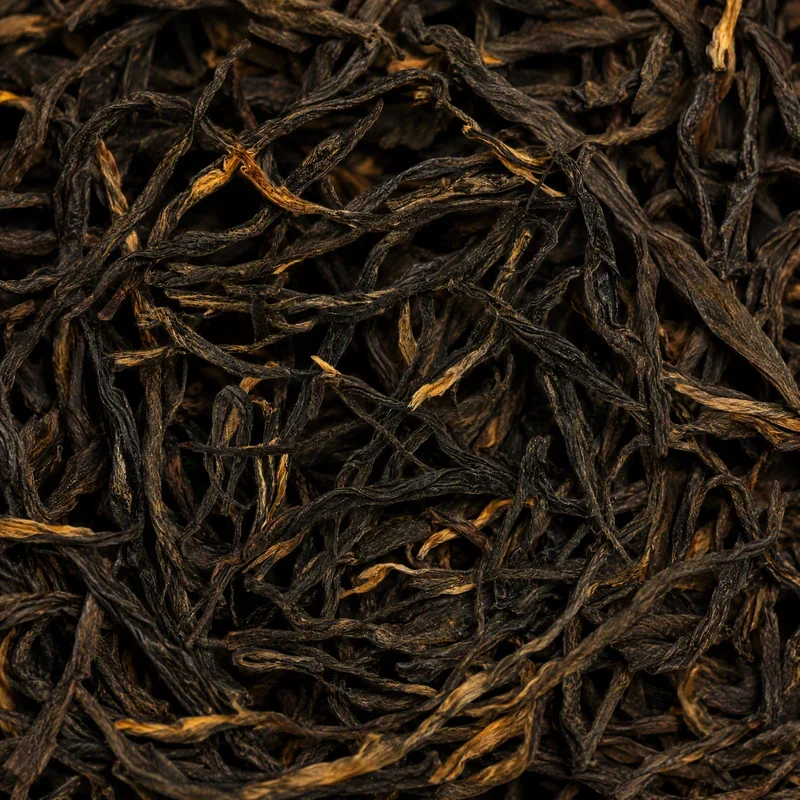
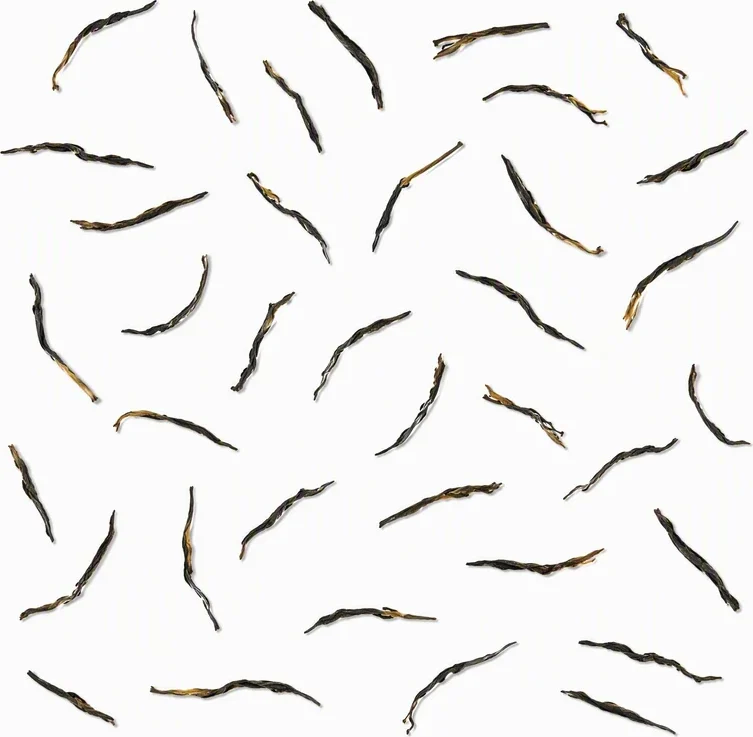
Dry Leaf Appearance: Thin, tightly twisted cords resembling pine needles (松针, sōngzhēn). Color — dark, with oily luster. Abundant golden tips are especially noticeable, evenly distributed in leaf mass. Overall impression — neat, uniform, elegant.
Dry Leaf Aroma: Sweet, honey-like, with distinct tones of caramel and dried fruits. Background floral note — light, unobtrusive.
Liquor Aroma: Multi-layered: floral-fruity notes dominate (garden roses, ripe apricot, dried plum), in middle plane — honey, caramel. When cooling, shades of baked sweet potato and milk chocolate emerge. Aroma is persistent, maintained throughout 6–8 infusions.
Liquor Color: Bright red, clear, with pronounced luster. In highest grades — with golden ring (金圈) around cup edge, indicating high theaflavin content.
Spent Leaves: Red-copper with orange shade, elastic, uniform. In highest grades — leaves whole, buds well distinguishable, texture soft and lively.
Taste: Full and rounded (醇厚, chúnhòu), with bright sweetness, freshness (甘爽, gānshuǎng) and mild astringency. Liquor body — full, velvety, with pronounced oily texture characteristic of large-leaf Yunnan raw material. Aftertaste — long, sweet (回甘, huígān), with honey and fruity overtones. Absence of bitterness — distinguishing feature of quality batches.
Alkaloids: Caffeine — content elevated compared to small-leaf cultivars (about 30–45 mg/g dry leaf). Theobromine and theophylline present in trace amounts.
Amino Acids: L-theanine and other free amino acids provide mildness and sweetness. Spring harvest contains higher amino acid concentration due to low growth temperatures and intensive root exchange.
High content of water-soluble extractive substances (水浸出物 ≥38–40%) — significantly higher than most small-leaf red teas, which determines taste richness and resistance to infusions.
Essential Oils: Linalool, geraniol, nerol, phenylethanol, cis-3-hexenol — key components of floral-fruity aroma. Volatile aromatic compound content in Dianhong — among highest among Chinese red teas.
Minerals: Potassium, magnesium, calcium, manganese, zinc, iron. Deep humus layer of Yunnan soils provides rich mineral profile.
Polyphenols: Yunnan large-leaf raw material is champion among Chinese cultivars in polyphenolic compound content (up to 30–33% in dry leaf). During full oxidation, significant portion of catechins transforms into theaflavins (茶黄素, 0.5–1.5%), responsible for brightness and "liveliness" of liquor, and thearubigins (茶红素, 8–15%), forming color depth and velvety texture. Theaflavin to thearubigin ratio — key quality indicator: higher theaflavin proportion means brighter and "fresher" liquor.
Vitamins: Vitamin C (partially preserved despite oxidation), B-group vitamins (B1, B2, B6), vitamin E.
Elevated caffeine content in large-leaf raw material provides pronounced but mild tone due to L-theanine buffering action.
Theaflavins and thearubigins — powerful antioxidants helping neutralize free radicals.
Red tea in traditional Chinese dietology — "warm" (温性) beverage, recommended for feeling cold, in autumn-winter period and for people with "cold" constitution.
Polyphenols stimulate gastric juice secretion and intestinal peristalsis; warm infusion after meals promotes comfortable digestion.
Theaflavins promote blood lipid profile normalization.
Polyphenols and their oxidized forms suppress growth of several pathogenic microorganisms.
Caffeine and theanine synergy improves concentration, reaction speed and reduces mental fatigue.
Warm, sweet honey-caramel aroma has relaxing effect, reducing anxiety levels.
Dianhong excellently suits milk or honey addition — tea's full body doesn't disappear when mixed, and caramel-honey profile harmoniously complements.
Tea Amount: 4–5 g per 100–120 ml (gongfu method); 3 g per 200–250 ml (European steeping, mug).
Teaware: Porcelain gàiwǎn (盖碗) 100–120 ml — best choice for aroma evaluation. Glass teapot allows admiring liquor color. Dianhong suits simple mug brewing well — liquor remains mild even with prolonged leaf contact.
Water Temperature: 90–95°C. For delicate tippy batches — 85–90°C; large-leaf Dianhong withstands 95°C without bitterness.
"Dianhong golden buds" — closest relative, made from single buds (单芽). Jinya is more delicate and sweet, with gentle aroma and light body. "Yueguang Jin Zhi," made from one bud with leaf, has fuller taste, pronounced fruitiness and better resistance to infusions.
"Golden needles" — finely twisted tippy cords. Visually similar to "Yueguang Jin Zhi," but may differ in specific cultivar blend and harvest region. Profile — slightly more "dry" and less fruity.
Anhui red tea from small-leaf raw material. "Qimen aroma" — more perfumed, refined, with rose-orchid tones. Compared to Qihong, "Yueguang Jin Zhi" is fuller, sweeter, more oily — characteristic feature of large-leaf Dianhong. Dianhong's resistance to infusions is significantly higher.
Fujian "Lapsang Souchong" — tea with smoky or "pine" aroma (in traditional version). Fundamentally different profile: if Xiaozhong is fire and smoke, then "Yueguang Jin Zhi" is honey and flowers. Raw material and terroir are completely different.
Guizhou red tea from medium- and small-leaf raw material. Compared to "Yueguang Jin Zhi," Zunyi Hong is lighter, fresher, with pronounced acidity and less body. "Yueguang Jin Zhi" as typical Dianhong — thicker, sweeter, more oily.
No reviews yet. Tell us what you think of this tea.
Rate this tea and share your impressions. We review each submission before publishing it.