Brewing
Gongfu brewing
- Water temperature
- 92 °C
- Tea amount
- 6 g
- Water volume
- 100 ml
- First steep
- 10 s
- Time added per infusion
- 5 s
- Infusions
- 8

yóuqiè hēi wūlóng
Choose a brewing method. Start with the recommended quantities and time, then adjust to taste.
Brewing
Brewing
Taste
Tea encyclopedia
Category: Fújiàn oolongs of Mǐnnán (闽南, Mǐnnán) style, reprocessed. Belongs to the commercial line of "beauty and health teas" (健美茶, jiànměi chá), developed specifically for the Japanese market.
Category: Fújiàn oolongs of Mǐnnán (闽南, Mǐnnán) style, reprocessed. Belongs to the commercial line of "beauty and health teas" (健美茶, jiànměi chá), developed specifically for the Japanese market.
Coordinates: Anxi — approximately 25°03′ North latitude, 117°59′ East longitude; Zhangping — approximately 25°17′ North latitude, 117°24′ East longitude; Wuyishan — approximately 27°43′ North latitude, 117°41′ East longitude.
Origin: China, Fújiàn Province (福建省, Fújiàn shěng). The core of production is concentrated in the southern part of the province — the classic area of Minnan oolongs. Key production districts: Ānxī County (安溪县, Ānxī xiàn), particularly Xīpíng Township (西坪镇, Xīpíng zhèn) — the historical birthplace of Tieguanyin; Zhāngpíng City (漳平市, Zhāngpíng shì), Yǒngfú Township (永福镇, Yǒngfú zhèn); as well as the scenic Wǔyíshān area (武夷山风景区, Wǔyíshān fēngjǐng qū). The geographical indication covers the Fujian oolong production zone — over 70,000 mu (≈4,700 hectares) of tea gardens.
Type: Reprocessed oolong (再加工乌龙茶, zài jiāgōng wūlóng chá) — semi-oxidized tea with high degree of oxidation (≈60–80%) and intensive double charcoal roasting (双重炭焙, shuāngchóng tàn bèi). According to Chinese six-color classification, it belongs to oolongs (青茶, qīngchá), however it stands out as a separate subcategory of reprocessed teas due to the specific technology of final roasting, where the leaf surface undergoes carbonization.
Uses the same base raw material (Tieguanyin cultivar), however oxidation degree is significantly lower (25–40%), and roasting is single and less intensive. Tieguanyin retains more floral notes and less pronounced charcoal character. Hei Wulong is darker, denser and more "straightforward" tea with minimum florality.
Yan cha (Da Hong Pao, Rou Gui, Shui Xian) also undergo deep charcoal roasting, but from different raw material (northern Fujian varieties), with different rolling form (longitudinal strip, not granule) and different flavor profile — minerality, "rock rhyme" (岩韵, yán yùn) and spicy notes dominate. Hei Wulong lacks mineral component of yan cha but exceeds them in caramel sweetness and body density.
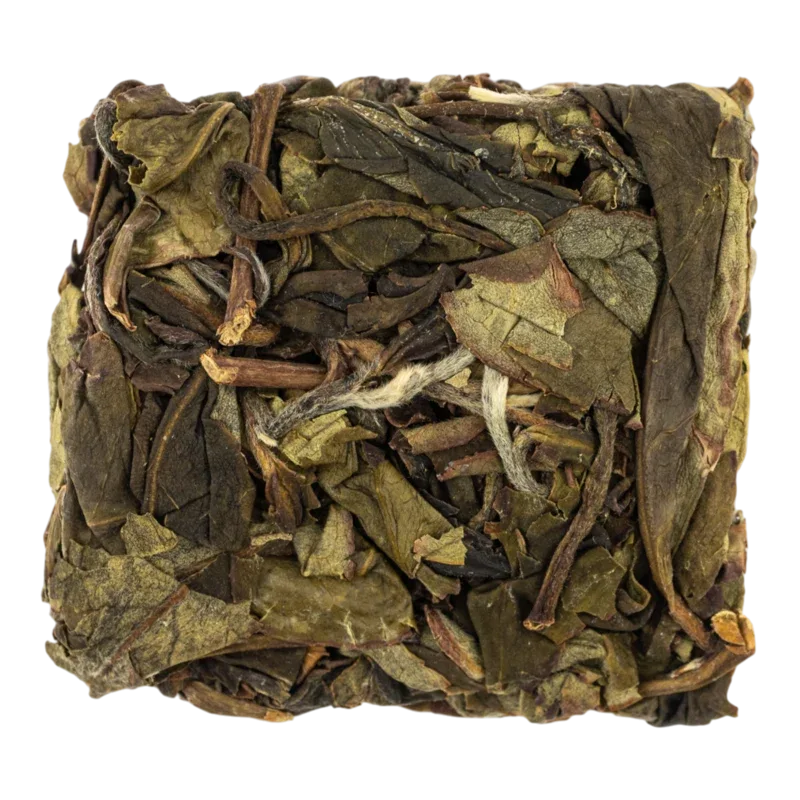
Pressed oolong from the same region (Zhangping), but with fundamentally different technology — moderate oxidation (30–50%), single roasting, pressing into square cakes. Taste is more floral and refreshing. Hei Wulong is its "dark antipode" in depth and intensity.
Taiwanese analog by style — charcoal roasting, granulated rolling, caramel-nutty profile. However, Dong Ding oxidation degree is significantly lower (25–40%), roasting is single, and overall character is more delicate. Hei Wulong is substantially more radical in processing intensity.
Industrial ready-to-drink beverage (RTD), made by low-temperature extraction method with addition of polymerized polyphenols (OTPP). Has little in common with whole-leaf artisanal Hei Wulong: different concentration, different flavor profile, absence of infusion dynamics. Actually these are two different products, united only by marketing name.
Cultural Significance: Youqie Hei Wulong occupies a unique niche in the tea world as a product in which three cultural layers are intertwined: traditional Fujian charcoal roasting mastery, Japanese cult of functional health products, and modern Chinese wave of conscious consumption. In Japan, this tea is known as "beauty tea" (美容茶, měiróng chá) and "slimness tea" (健美茶, jiànměi chá). In China, it embodies the return of interest to deeply roasted oolongs, which for a long time yielded positions to light floral styles.
History: The roots of Hei Wulong go back to the 19th century, when Fujian tea growers developed the technology of deep charcoal roasting of oolongs. Due to the characteristic coal-black color of the finished leaf, such tea received the straightforward name "black oolong" (黑乌龙茶, hēi wūlóng chá). However, for more than a century this product remained niche until it gained a second life in the Japanese market.
Name Breakdown: Let us examine each component. "Youqie" (油切, yóuqiè): 油 (yóu) — "fat, oil"; 切 (qiè) — borrowing from Japanese, where the verb 切る (きる, kiru) in this context means "to cut off, eliminate." Thus, "youqie" — "elimination of fat." The term first appeared in the Japanese functional food industry. "Hei" (黑, hēi) — "black," describes the coal-dark color of the leaf after double roasting. "Wulong" (乌龙, wūlóng) — "dark dragon," the classic name for oolongs. The full name, therefore, can be translated as "fat-breaking black oolong."
Cultivar: For the production of Youqie Hei Wulong, classic Minnan varieties of Camellia sinensis var. sinensis are used. Main cultivars: Tiěguānyīn (铁观音, Tiě Guānyīn) — basic cultivar with developed aromatics and dense liquor body; Jīn Xuān (金萱, Jīn Xuān, TTES №12) — Taiwanese breeding variety, widely cultivated in Fujian, imparting soft milky sweetness; Ruǎnzhī Wūlóng (软枝乌龙, Ruǎnzhī Wūlóng) — flexible cultivar with good adaptability to charcoal roasting. All these varieties belong to bush forms with compact crown, small and medium leaves, characteristic of the Minnan area.
Picking: Spring (April–May) and autumn (September–October) harvests. Spring harvest provides more saturated aroma and increased amino acid content, autumn — more pronounced sweetness and density of liquor body.
Pluck Standard: Open flush picking (开面采, kāimiàn cǎi) — bud with 3–4 unfolded leaves. For Hei Wulong, the maturity of raw material is fundamentally important: too tender leaves will not withstand intensive double roasting, while mature leaves ensure dense liquor body and deep flavor. Leaves damaged by cicadas (蝉叮咬叶, chán dīngyǎo yè) are particularly valued — insect bites trigger a protective biochemical reaction that forms pronounced honey aroma.
Raw Material: Whole flush without mechanical damage, uniform leaf maturity, absence of foreign odors. High-altitude plantations (above 800 m) are preferred, where the difference between day and night temperatures promotes accumulation of aromatic substances.
Altitude: From 800 m and higher. High-altitude raw material (above 1000 m) is especially valued, since lower temperature slows shoot growth, allowing leaves to accumulate more aromatic precursors and polyphenols.
Climate: Subtropical monsoon. Average annual temperature 16–20°C, annual precipitation about 1,400 mm, daily temperature difference over 10°C. Frequent fogs create natural shading, reducing catechin content and increasing amino acid levels, which forms the base for the soft and sweetish character of the future tea.
Soil: Red-yellow lateritic soils (红黄壤, hóng huáng rǎng), acidic (pH 4.5–5.5), well-drained. Distinguished by high organic matter content (≥1.5%) and increased selenium content — average value 0.76 mg/kg, which is an important factor: selenium participates in antioxidant protection of the organism and partially transfers into tea infusion. Rich humus horizon provides constant mineral nutrition for bushes.
The production zone covers mountainous areas of southern and northern Fujian. Ānxī is located in the Dàiyúnshān (戴云山, Dàiyúnshān) mountain system with rugged terrain and numerous microclimatic zones. Zhangping is situated in the western part of the province at the junction of mountain ranges, and Wuyishan — in the famous "Danxia" (丹霞, Dānxiá) landscape with characteristic red-brown cliffs.
Shoots are picked by hand or mechanized method in sunny weather, avoiding morning dew. Raw material is quickly delivered to the workshop, preventing overheating and spontaneous fermentation.
Leaves are spread in thin layers on bamboo screens and withered in open air under diffused sunlight (晒青, shàiqīng), then moved indoors for shade withering (凉青, liángqīng). At this stage, leaves lose 15–20% moisture, become pliable, cell membranes begin to partially break down.
Cycles of mechanical shaking in bamboo drums alternate with rest periods. Mechanical action destroys cells along the leaf edge, triggering oxidative processes. For Hei Wulong, more cycles and more intensive shaking are conducted than for standard oolongs — hence the high degree of oxidation (60–80%).
After shaking, leaves are left for deep oxidation under controlled conditions. At this stage, theaflavins and thearubigins characteristic of heavily oxidized oolongs are formed, creating the saturated red-brown color of the infusion and dense body.
High-temperature heating in a wok or drum stops enzymatic processes and fixes the achieved aroma profile.
Leaves are rolled, forming tight granules or hemispheres characteristic of Minnan oolongs. Rolling destroys cellular structure, ensuring high extractability during brewing.
Main roasting is conducted on lychee wood charcoal (荔枝木, lìzhī mù) or using electric ovens at temperature around 120°C for 5–12 hours. Lychee wood charcoal provides even heat and subtle fruity-smoky nuance.
After first roasting, tea is left for a short time, allowing moisture to redistribute inside the leaf. This prevents granule cracking during reprocessing.
Repeated roasting at similar or slightly reduced temperatures. This stage forms the "double effect": the leaf surface undergoes carbonization, becoming coal-black, while internal polyphenolic compounds are preserved thanks to the protective charcoal crust. The characteristic "golden rim" (金镶边, jīn xiāng biān) forms on the leaf edge — a sign of quality processing.
Moisture stabilization to storage level (≤5%).
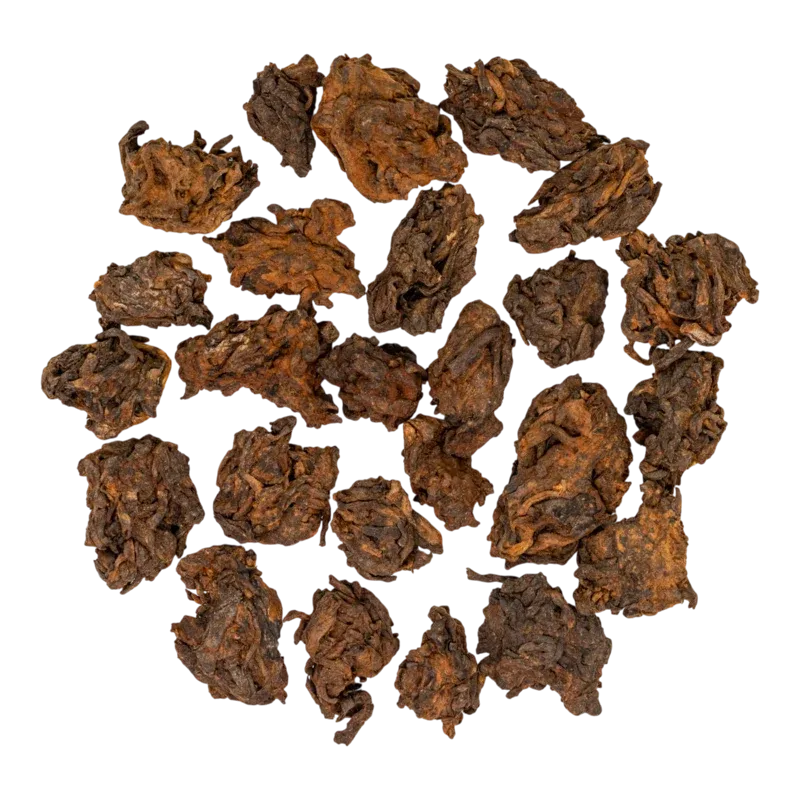
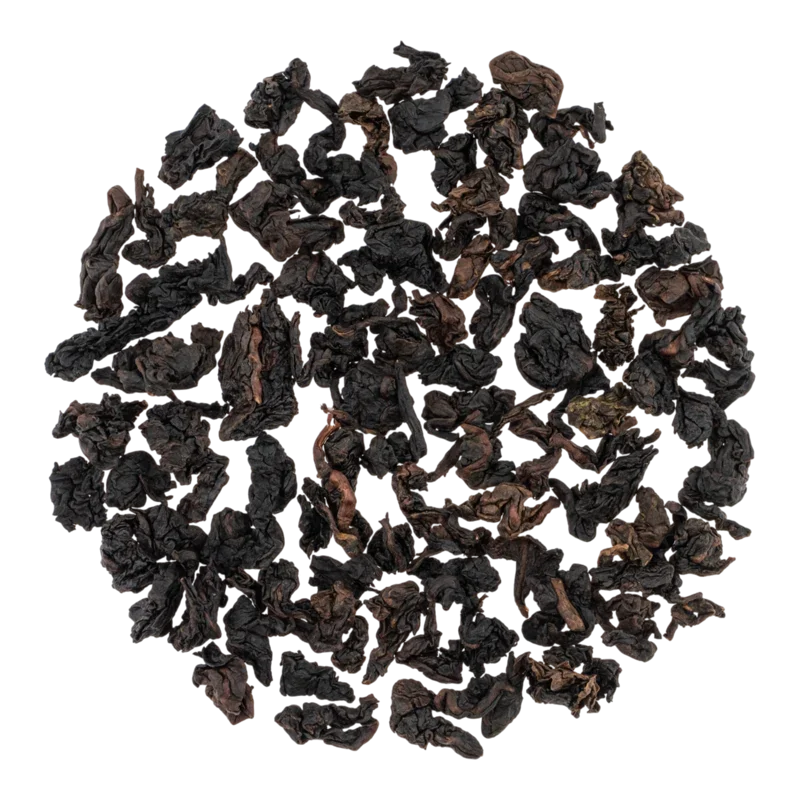
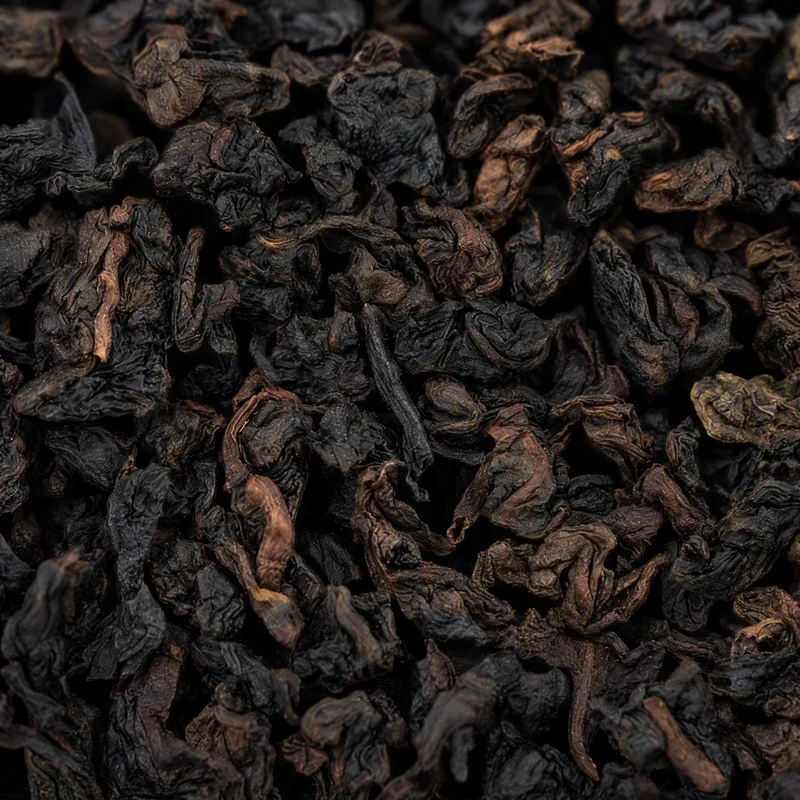
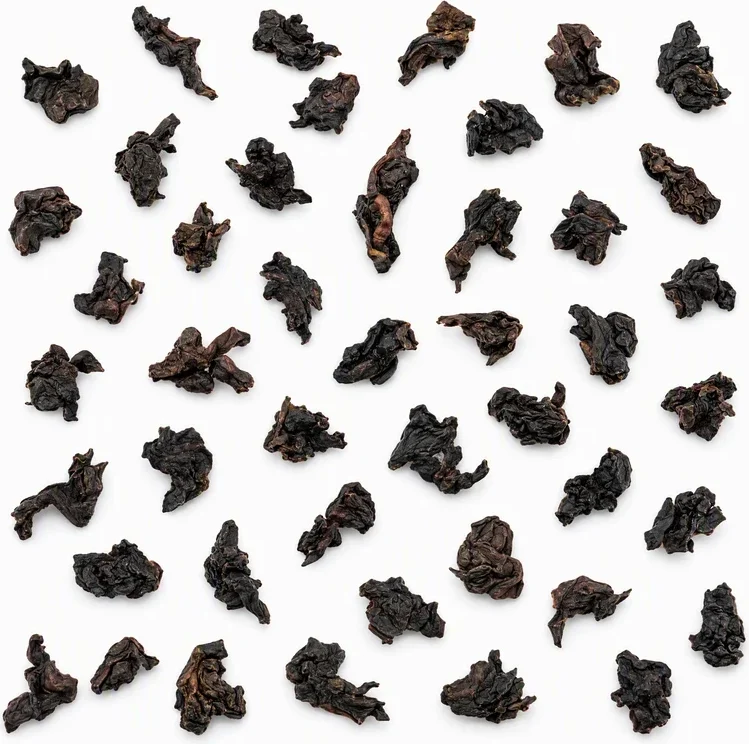
Dry Leaf Appearance: Dense, tight granules of irregular spherical or hemispherical form, characteristic of Minnan style rolling. Color — deep coal-black with oily luster. Calibration is even, granules uniform in size. In premium class tea, one can distinguish thin reddish-golden rim on granule breaks.
Dry Leaf Aroma: Intensive, multi-layered. Deep tone of burnt sugar and caramel dominates, behind which notes of roasted chestnuts, coffee, dark chocolate, smoked wood and light pine resin nuance (松烟香, sōng yān xiāng) unfold. Trail is warm, prolonged, with final accent of baked fruits.
Liquor Aroma: In first infusions — bright charcoal-caramel tone with notes of burnt sugar and coffee beans. As it opens, more subtle layers appear: dark honey, dried longan, dates, light floral sweetness and residual fruitiness from original raw material.
Liquor Color: Thick amber-chestnut, transitioning to deep reddish-brown (乌褐, wūhè). Clarity is high, liquor is clean. Color intensity significantly exceeds standard oolongs and approaches the color of strongly brewed red tea (black tea).
Spent Leaves: Whole unfolded leaves with characteristic "golden rim" along the edge — red-brown oxidized field with darker charcoal center. Leaves are resilient but noticeably stiffer than standard oolongs due to surface carbonization. Stems are strong, leaf color ranges from dark brown to almost black.
Taste: Full-bodied, oily-dense. First impression — thick caramel sweetness with nuances of burnt sugar and roasted nuts. Middle palate — mature, saturated, with shades of dark chocolate, coffee and baked fruits. Astringency is minimal, well-integrated. Aftertaste (回甘, huígān) is prolonged, with characteristic "burnt sugar sweetness" (冰糖甜, bīngtáng tián), reminiscent of rock candy. Liquor body is dense, with noticeable viscosity.
Alkaloids: Caffeine (咖啡因, kāfēi yīn) — content is moderately high, approximately 2.5–3.5% of dry mass. Double roasting slightly reduces caffeine content compared to unroasted oolong. Theobromine (可可碱, kěkě jiǎn) and theophylline (茶碱, chá jiǎn) — in trace amounts.
Amino Acids: L-theanine (L-茶氨酸, L-chá ānjī suān) — content is reduced compared to green teas and light oolongs due to high degree of heat treatment, however residual amount ensures taste softness and removes harshness of caffeine tone.
The carbonized leaf surface creates a "barrier effect" — during brewing, extraction proceeds slower but longer, ensuring flavor stability throughout multiple infusions. High content of polymerized polyphenols (OTPP) distinguishes Hei Wulong from most other oolongs.
Essential Oils: During double roasting, primary floral and green notes (linalool, geraniol) transform into more complex pyrolysis compounds: furfural, maltol, pyrazines — these form the characteristic aroma of roasted nuts, caramel and coffee.
Minerals: Potassium, magnesium, manganese, zinc, fluorine — in standard amounts for oolongs. Selenium (硒, xī) is of special interest: content in Anxi raw material reaches 0.76 mg/kg on average, and in Longzhongtang company products up to 3 mg/kg is claimed — significantly higher than in most teas. Selenium is a cofactor of glutathione peroxidase and an important element of the body's antioxidant system.
Polyphenols: The main claimed feature of Youqie Hei Wulong is increased content of tea polyphenols. Producers claim that double charcoal roasting allows preservation of twice as many polyphenols compared to ordinary oolong. Main components: polymerized oolong polyphenols (乌龙茶聚合多酚, wūlóng chá jùhé duōfēn, OTPP), theaflavins (TF), thearubigins (TR) — products of deep catechin oxidation. Total polyphenol content — approximately 15–25% of dry mass (exact values vary depending on batch and degree of roasting). OTPP is specifically attributed with the ability to suppress pancreatic lipase activity, reducing absorption of dietary fats.
Vitamins: B-group vitamins (B₁, B₂, B₆) — partially destroyed during high-temperature roasting but preserved in residual amounts. Vitamin C is practically absent due to thermal destruction.
Polymerized oolong polyphenols (OTPP) can inhibit pancreatic lipase activity, potentially reducing absorption of dietary fats by 20–40% (according to Japanese studies). The effect is most noticeable when consuming tea together with fatty food.
High polyphenol content provides pronounced ability to neutralize free radicals. Tea polyphenols increase activity of superoxide dismutase (SOD) — a key enzyme of antioxidant protection.
Regular consumption of oolongs is associated with reduction of total cholesterol and low-density lipoproteins (LDL) in blood, while simultaneously maintaining or increasing high-density lipoproteins (HDL) levels.
The combination of caffeine and residual L-theanine provides gentle, sustained alertness without sharp peaks and drops — characteristic "tea tone."
Deeply roasted oolongs are traditionally considered more "gentle" for the stomach than green teas. Roasting reduces free catechin content, which can irritate mucous membranes.
Clinical observations showed that regular consumption of black oolong can reduce neutral fat content in skin sebum film in people with oily skin type, promoting sebum production normalization.
Due to increased selenium content in Anxi raw material, tea can contribute to meeting daily requirements for this microelement.
Like other quality oolongs, Hei Wulong is excellent for meditative tea drinking — prolonged series of infusions allows observation of aroma and taste dynamics, reducing stress load.
Tea Amount: 5 g per 100–110 ml (gongfu); 3 g per 200–250 ml (European method).
Teaware: Gàiwǎn (盖碗, gàiwǎn) of white porcelain — allows precise control of infusion time and assessment of liquor color. Yíxīng teapot (宜兴紫砂壶, Yíxīng zǐshā hú) — clay absorbs aroma and "develops" character; especially good is a teapot from zhuni (朱泥, zhūní) or zisha (紫砂, zǐshā) clay with dense body. For first acquaintance, gaiwan is preferable.
Water Temperature: 90–100°C. For full opening of carbonized granules, boiling water (100°C) is recommended; for more delicate approach — 90–95°C.
Container: Airtight ceramic tea caddies, vacuum packaging from foil material or tin cans with tight lids.
Enemies: Moisture (main enemy of roasted oolongs — moisture return destroys carbonized crust), foreign odors (tea actively absorbs them), direct sunlight, sharp temperature fluctuations.
Shelf Life: Under proper conditions — 2–3 years and more without noticeable quality loss. Aging is acceptable: over time roasting notes soften, deeper sweetness and woody shades appear.
Dry, cool, dark place with constant temperature (15–25°C). Unlike green teas and light oolongs, refrigerator is not required and even undesirable — condensation when removing from cold is destructive for roasted tea.
Uses the same base material (Tie Guanyin cultivar), however the oxidation level is significantly lower (25–40%), and the roasting is single and less intensive. Tie Guanyin retains more floral notes and less pronounced charcoal character. Hei Wu Long is a darker, denser and more "straightforward" tea with minimal florality.
Yan cha (Da Hong Pao, Rou Gui, Shui Xian) also undergo deep charcoal roasting, but from different raw material (northern Fujian varieties), with different rolling form (longitudinal strip rather than pellet) and different flavor profile — minerality dominates, "rock charm" (岩韵, yán yùn) and spicy notes. Hei Wu Long lacks the mineral component of yan cha, but surpasses them in caramel sweetness and body density.
Pressed oolong from the same region (Zhangping), but with fundamentally different technology — moderate oxidation (30–50%), single roasting, pressing into square cakes. The taste is more floral and refreshing. Hei Wu Long is its "dark antithesis" in depth and intensity.
Taiwanese analogue in style — charcoal roasting, granulated rolling, caramel-nutty profile. However, Dong Ding's oxidation level is significantly lower (25–40%), roasting is single, and the overall character is more delicate. Hei Wu Long is substantially more radical in processing intensity.
Industrial ready-to-drink beverage (RTD), made by low-temperature extraction method with added polymerized polyphenols (OTPP). Has little in common with whole-leaf artisanal Hei Wu Long: different concentration, different flavor profile, absence of infusion dynamics. These are essentially two different products united only by a marketing name.
Price Category: Youqie Hei Wulong covers a wide price range. Mass production (bagged variants, supermarket brands) — budget segment. Artisanal Hei Wulong from small Fujian producers with charcoal roasting on lychee wood — medium and premium segments. Cost is influenced by: raw material growing altitude, harvest season (spring more expensive than autumn), roasting method (wood charcoal significantly more expensive than electric roasting), producer brand and certification presence (JAS, organic standards). Longzhongtang products with increased selenium content belong to upper price segment.
No reviews yet. Tell us what you think of this tea.
Rate this tea and share your impressions. We review each submission before publishing it.