Brewing
Gongfu brewing
- Water temperature
- 75 °C
- Tea amount
- 5 g
- Water volume
- 100 ml
- First steep
- 10 s
- Time added per infusion
- 5 s
- Infusions
- 3


Yǒngtài lǜchá
Choose a brewing method. Start with the recommended quantities and time, then adjust to taste.
Brewing
Brewing
Taste
Tea encyclopedia
Category: Chinese regional green teas, product with protected geographical indication of the PRC.
Category: Chinese regional green teas, product with protected geographical indication of the PRC.
Coordinates: approximately 118°23′–119°12′ E, 25°39′–26°05′ N.
Origin: China, Fújiàn Province (福建省, Fújiàn shěng), Yǒngtài County (永泰县, Yǒngtài xiàn), Fúzhōu Prefecture (福州市, Fúzhōu shì). Encompasses 21 townships and towns: Zhangcheng (樟城镇), Chengfeng (城峰镇), Geling (葛岭镇), Qīngliáng (清凉镇), Wútóng (梧桐镇), Songkou (嵩口镇), Dayang (大洋镇), Tong'an (同安镇), Chángqīng (长庆镇), Tangqian (塘前乡), Danyun (丹云乡), Báiyún (白云乡), Hongxing (红星乡), Pangu (盘谷乡), Xiaba (霞拔乡), Dongyang (东洋乡), Gaiyang (盖洋乡), Fukou (洑口乡), Fúquán (富泉乡), Chixi (赤锡乡) and Linglu (岭路乡).
Type: Green tea (绿茶, lǜchá) — unfermented; oxidation level minimal (less than 5%).
Cultivar: The foundation of plantations (about 70%) consists of cultivars from the Fúyún series (福云系列, Fúyún xìliè) — primarily Fuyun 6-hao (福云6号, Fúyún liù hào) and Fuyun 595 (福云595, Fúyún wǔjiǔwǔ). As supplementary varieties, Longjing 43 (龙井43, Lóngjǐng sìshísān), Tiě Guānyīn (铁观音, Tiěguānyīn) and Jīn Guānyīn (金观音, Jīn Guānyīn) are used. In recent years, new promising varieties have been introduced: Róngchūn Zǎo (榕春早, Róngchūn zǎo) and Ānjí Bái Chá (安吉白茶, Ānjí Báichá). Additionally, the local population Yǒngtài Càichá (永泰菜茶, Yǒngtài càichá) — an indigenous small-leaf tea bush — is preserved. All indicated cultivars belong to the species Camellia sinensis var. sinensis.
Picking: Main picking — spring (late March — April); summer and autumn picking are also possible. Spring tea (春茶, chūnchá) is most valued due to increased amino acid content.
Pluck Standard: Depends on grade: for special grade (特级, tèjí) — individual buds or bud with one leaf (单芽 or 一芽一叶, yī yá yī yè); for first grade (一级, yījí) — bud with two leaves (一芽二叶, yī yá èr yè); for second grade (二级, èrjí) — bud with three leaves (一芽三叶, yī yá sān yè).
Raw Material: Leaves must be fresh, whole, without mechanical damage and signs of disease. Picking is done by hand in morning hours during dry weather.
Altitude: The main part of tea plantations is located at 500 m and higher above sea level. Forest cover of the county — 76.8%.
Soil: Red soils (红壤, hóng rǎng) predominate with acidic reaction (pH 4.0–5.5), good sandy structure, deep fertile layer and high organic matter content. Notably, 78% of the county's soils are enriched with selenium (Se content 0.15–0.35 mg/kg), which is a distinctive feature of the local terroir. The water of the Dazhang River meets Class II purity standards. On plantations, an ecological cycle "pig farming — biogas — tea cultivation" (猪-沼-茶) is practiced, excluding the use of chemical fertilizers and pesticides.
Yǒngtài County is located on the northeastern slope of the Dàiyún Mountains (戴云山脉, Dàiyún shānmài), in the middle and upper reaches of the Dàzhāng River (大樟溪, Dàzhāng xī) — a tributary of the Min River. The terrain is mountainous, with the local formula "eight parts mountains, one part water, one part fields" (八山一水一分田) reflecting the landscape character: mountain ridges, deep gorges, numerous streams. The climate is subtropical monsoon: average annual temperature 14.6–20.7°C, annual precipitation 1400–2000 mm, number of foggy days over 200 per year. Significant diurnal temperature variation and predominance of diffused light stimulate amino acid accumulation in leaves (spring tea amino acid content ≥ 4.0%).
Hand picking according to standards corresponding to the target grade. For special grade — about 40,000 buds are required for 500 g of finished tea.
Freshly picked leaves are spread in a thin layer on bamboo screens for 4–6 hours for partial moisture removal and activation of enzymatic processes that form aroma.
Processing in a rotating drum at 200–240°C. High temperature inactivates polyphenol oxidase, preventing oxidation and preserving the green color of the leaf.
Light mechanical rolling for 10–15 minutes under moderate pressure. Breaks down cellular structure, ensuring uniform extraction during brewing.
Hand rolling into strips (搓条, cuōtiáo) — a stage that forms the characteristic "tight straight strip" shape (紧结匀整). Depending on the substyle, the leaf may take a form from straight to slightly curved.
Gentle drying at 60–80°C to residual moisture of about 5–6%. Fixes the shape and stabilizes the aromatic profile.
Sorting, removal of stems and off-grade material.
Key stage forming the signature chestnut aroma (栗香, lìxiāng) of Yongtai Lü Cha. Requires high-precision control of temperature and time.
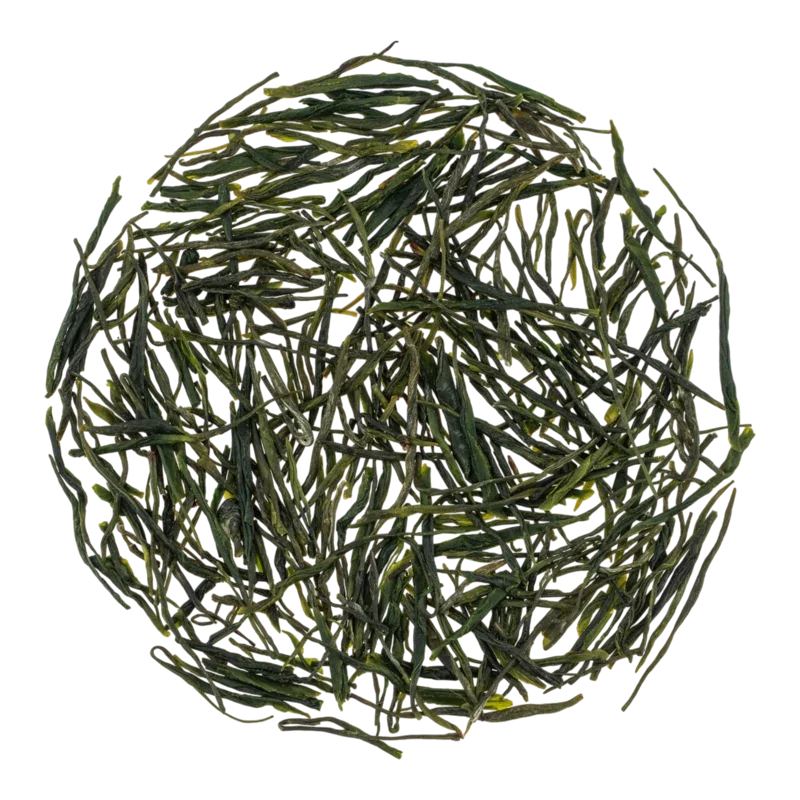
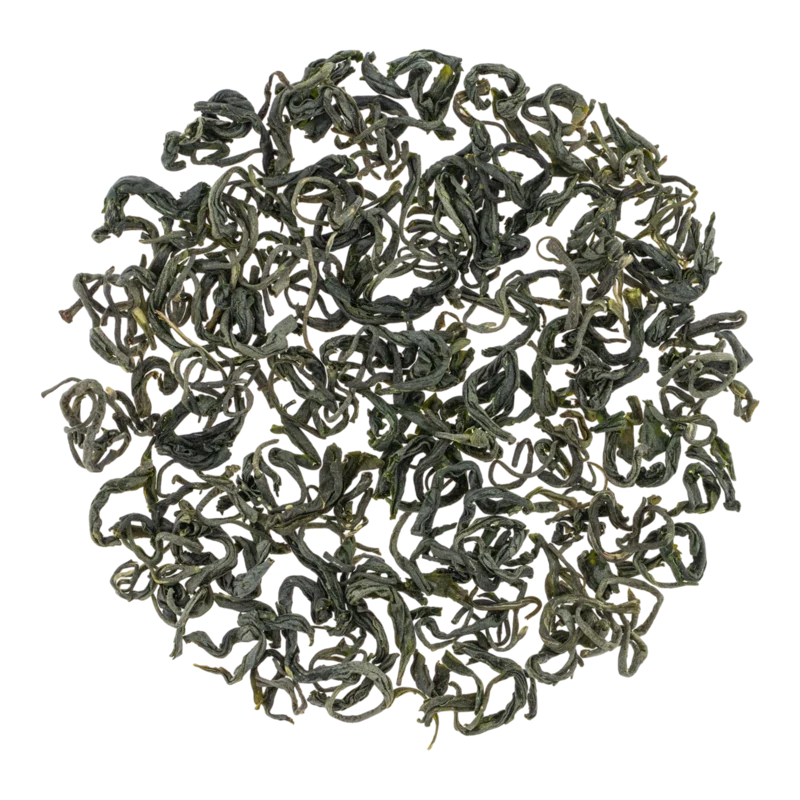
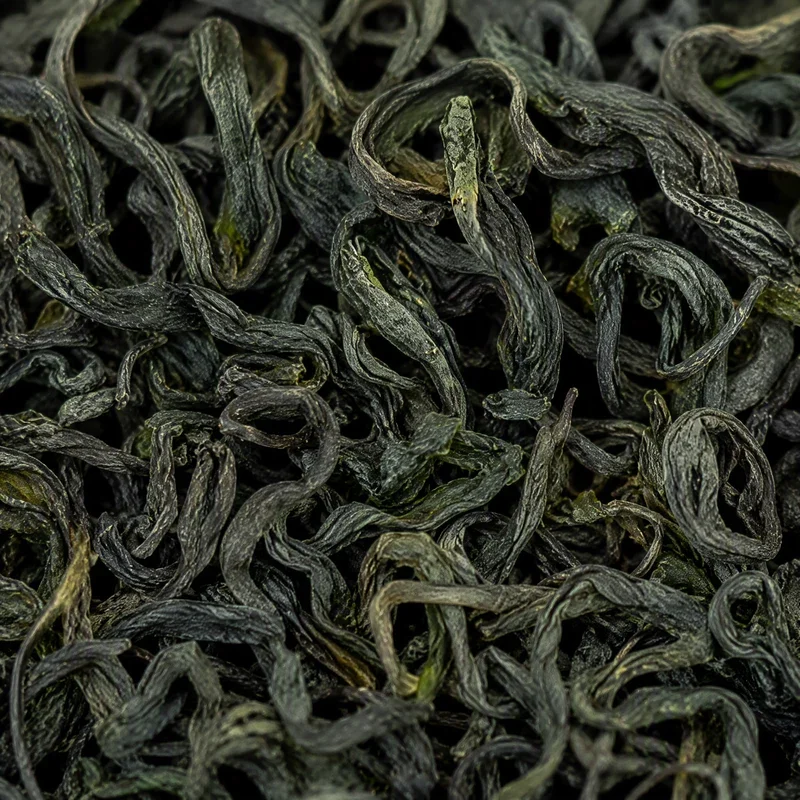
Dry Leaf Appearance: Tightly twisted, even, straight strips (条索紧结匀整, tiáosuǒ jǐnjié yúnzhěng); color — rich green with light luster and visible white down (色泽绿润毫显, sèzé lǜrùn háo xiǎn). The straight form of the leaf is the "calling card" of the style. Two subtypes are distinguished: straight strip form (直条形, zhítiáo xíng) — such as Songkou Lóngjǐng (嵩口龙井) — and curved strip form (曲条形, qūtiáo xíng) — the classic, most widespread variant.
Dry Leaf Aroma: Clean, distinct, with pronounced chestnut notes. Fresh harvest has bright floral overtones.
Liquor Aroma: Chestnut aroma (栗香, lìxiāng) dominates — the main marker of the style. Individual batches have floral and light grassy undertones. The aroma is high, persistent, multi-layered.
Liquor Color: Tender green, bright, clear (汤色嫩绿明亮, tāngsè nènlǜ míngliàng); in first infusions — with a light yellowish tint.
Spent Leaves: Green, bright, even (叶底绿亮匀齐, yèdǐ lǜ liàng yún qí). Leaves unfold completely, maintaining elasticity and uniform color.
Taste: Fresh, mellow-rich, with distinct sweetness and rounded aftertaste (鲜醇甘爽, xiān chún gān shuǎng). The umami component is perceptible due to high amino acid content. With correct brewing, bitterness and astringency are minimal. The aftertaste includes pronounced returning sweetness (huí gān) (回甘, huígān) and salivation-inducing (shēng jīn) (生津, shēngjīn).
Alkaloids: Caffeine (咖啡碱, kāfēijiǎn) — 2–4%; theobromine and theophylline in trace amounts. Caffeine content in the upper range for green tea provides pronounced tonic effect.
Amino Acids: Total content 100–220 g/kg (with water hydrolysis), which is significantly higher than the average indicator for green teas. L-theanine (L-茶氨酸, L-cháānjīsuān) is the dominant amino acid, providing characteristic freshness and umami. The high level of amino acids is due to mountain terroir: reduced temperatures and abundance of diffused light slow the conversion of amino acids to polyphenols.
Essential Oils: Responsible for forming the chestnut-floral aromatic profile; their content and composition are determined at the final heating stage (提香).
Minerals: Potassium, manganese, zinc, fluorine. A distinctive feature is increased selenium (Se) content in tea, due to the geochemistry of local soils. Fluorine contributes to strengthening tooth enamel and suppressing cariogenic microflora.
Polyphenols: 10–30% (calculated on dry matter), which is typical for green teas. Catechins (especially EGCG) provide antioxidant activity; according to sources, the effectiveness of free radical neutralization is 18 times higher than that of vitamin E. The catechin content in high-mountain tea is somewhat lower than in lowland tea, which reduces bitterness and increases sweetness of the liquor.
Vitamins: Vitamin C (ascorbic acid) is preserved in significant quantity thanks to gentle processing technology. Also present are B-group vitamins (B₁, B₂), vitamin E, β-carotene.
High content of polyphenols and catechins provides effective neutralization of free radicals, slowing cellular aging processes.
Caffeine combined with L-theanine gives a gentle but sustained surge of vigor without sharp excitement — a state of "calm concentration."
Catechins accelerate fat breakdown; according to some data, effectiveness is 30% higher than standard green teas, which may be related to the special ratio of polyphenols and amino acids.
Fluorine contained in leaves suppresses the growth of cariogenic bacteria and reduces dental plaque formation.
Polyphenols gently stimulate GI tract peristalsis, reduce bloating, promote food assimilation.
L-theanine improves concentration and reduces anxiety without causing drowsiness.
Due to natural selenium enrichment, regular consumption may contribute to immune support and antioxidant protection at the cellular level.
Tea Amount: 3 g per 150 ml (1:50 ratio) for glass method; 5–7 g per gaiwan (盖碗, gàiwǎn) 100–120 ml for gongfu.
Teaware: Glass tumbler (玻璃杯, bōlibēi) — optimal choice: allows observing bud unfolding in water ("dance of tea leaves"). White porcelain gaiwan and small porcelain teapot are also suitable.
Water Temperature: 80–85°C. Using boiling water (over 90°C) is strongly not recommended — L-theanine is destroyed, freshness is lost, bitterness increases.
Shelf Life: Tea maintains greatest expressiveness in the first 6–12 months after production. After opening packaging, recommended to consume within 7 days to avoid aroma loss.
Airtight, opaque container (vacuum foil bags, tin cans). Store away from light, moisture, heat sources and foreign odors.
Freshly made tea is recommended to be aged 7–15 days in a dark place to remove "fire energy" (褪火气, tuì huǒqì) before first tasting.
Temperature: Optimal — refrigerator, 0–5°C. At room temperature, storage life is significantly reduced.
Also from Fujian, but belongs to oolongs; similar cultivars (Tie Guanyin, Jin Guanyin), however fundamentally different technology — semi-oxidation. Yongtai Lü Cha, unlike oolongs, emphasizes freshness and chestnut note, not floral/creamy palette.
"Famous tea" of Zhejiang; flat, with pronounced bean aroma and higher amino acid content. Yongtai Lü Cha — in straight/curved strip form, with dominant chestnut note instead of bean; significantly more affordable in price.
Green tea from Henan; thin, down-covered needles, fresh and somewhat astringent taste. Yongtai Lü Cha is less astringent, with more pronounced chestnut note and gentle sweetness due to high amino acid content.
Sichuan green tea with curled leaves and bright "sweet dewy" profile. Yongtai Lü Cha has fuller body and chestnut accent, while Ganlu is more delicate and floral.
Tea from Hubei, one of the few Chinese "steamed" green teas (蒸青, zhēngqīng). Its profile is grassy-marine, with pronounced umami; Yongtai Lü Cha, produced by pan-firing method, gives more "dry," chestnut-floral aroma and less grassy taste.
Price Category: Cost depends significantly on grade and picking season:
No reviews yet. Tell us what you think of this tea.
Rate this tea and share your impressions. We review each submission before publishing it.