Brewing
Gongfu brewing
- Water temperature
- 92 °C
- Tea amount
- 6 g
- Water volume
- 100 ml
- First steep
- 10 s
- Time added per infusion
- 5 s
- Infusions
- 8

Yǒngfú gāo shān chá
Choose a brewing method. Start with the recommended quantities and time, then adjust to taste.
Brewing
Brewing
Taste
Tea encyclopedia
Category: Taiwanese high-mountain oolongs produced on the mainland (台式高山烏龍, táishì gāoshān wūlóng). Product with national geographical indication (国家农产品地理标志, guójiā nóngchǎnpǐn dìlǐ biāozhì).
Category: Taiwanese high-mountain oolongs produced on the mainland (台式高山烏龍, táishì gāoshān wūlóng). Product with national geographical indication (国家农产品地理标志, guójiā nóngchǎnpǐn dìlǐ biāozhì).
Coordinates: 117°12′28″–117°25′54″ E, 24°55′09″–25°10′55″ N.
Origin: China, Fújiàn Province (福建省, Fújiàn shěng), Lóngyán Prefecture (龙岩市, Lóngyán shì), Zhangping County-level City (漳平市, Zhāngpíng shì), Yǒngfú Township (永福镇, Yǒngfú zhèn). The protected zone includes 27 administrative villages — Guìyáng (桂洋村), Fuli (福里村), Jianzhu (箭竹村), Qiuyuan (秋苑村), Lingxia (岭下村) and others. Total area of the protected zone — 535.5 km².
Type: Oolong (semi-oxidized tea, 烏龍茶, wūlóngchá). Taiwanese-style processing (台式烏龍, táishì wūlóng). Oxidation degree varies: light-fragrance type (清香型, qīngxiāng xíng) — 15–30%, rich-fragrance type (浓香型, nóngxiāng xíng) — 30–50%, red oolong (紅烏龍, hóng wūlóng) — 50–60%.
Yongfu is the only region on mainland China officially recognized by Taiwanese tea growers as an analog of legendary Alishan. The coincidence of latitude, altitude and microclimate is so precise that blind tastings in the Taiwanese tea community have repeatedly recorded the indistinguishability of Yongfu and Alishan oolongs.
The technology of feeding trees with fermented soy milk (豆浆浇灌法) is a signature practice of Yongfu producers, with no analogs in other tea regions. It thickens the leaf and enhances aromatics without using chemical fertilizers.
Intercropping cherry (sakura) trees between tea rows is not a decorative whim, but an agronomic solution. Blooming trees attract natural predators of pests, and their root system improves soil structure. Pest incidence on plantations with cherry trees is reduced by 60%.
Yongfu Gao Shan Cha is one of the few teas to simultaneously enter the ranks of tribute teas of Beijing's Forbidden City (2011) and official beverages of the BRICS summit (2017). The product is certified according to standards of mainland China, Taiwan, Japan and the European Union — a four-way "quality passport" — a rarity for tea from one region.
The national standards "Taiwanese Oolong" (2021) were developed jointly with the Taiwan Tea Association and the Lugu Township Farmers' Association — this is the first case in history when both sides of the Taiwan Strait created a unified standard for the same product.
Cultural Significance: Yongfu Gao Shan Cha is a symbol of cross-strait agricultural cooperation between Taiwan and Fujian. The tea demonstrates how Taiwanese high-mountain oolong technology can be successfully reproduced in climatically similar mainland regions. Taiwanese tea masters brought not only cultivars and equipment, but also the philosophy of "high-precision agriculture" (高优精致农业, gāoyōu jīngzhì nóngyè) — with quality control, origin traceability, and organic certification. The Yongfu plantations, where blooming cherry trees are planted between tea rows as an ecological barrier, have become a tourist attraction and symbol of the "green" approach to tea farming.
History: Yongfu Gao Shan Cha is a relatively young tea whose history begins in the mid-1990s and is inseparably linked to Taiwanese-Fujian agricultural cooperation.
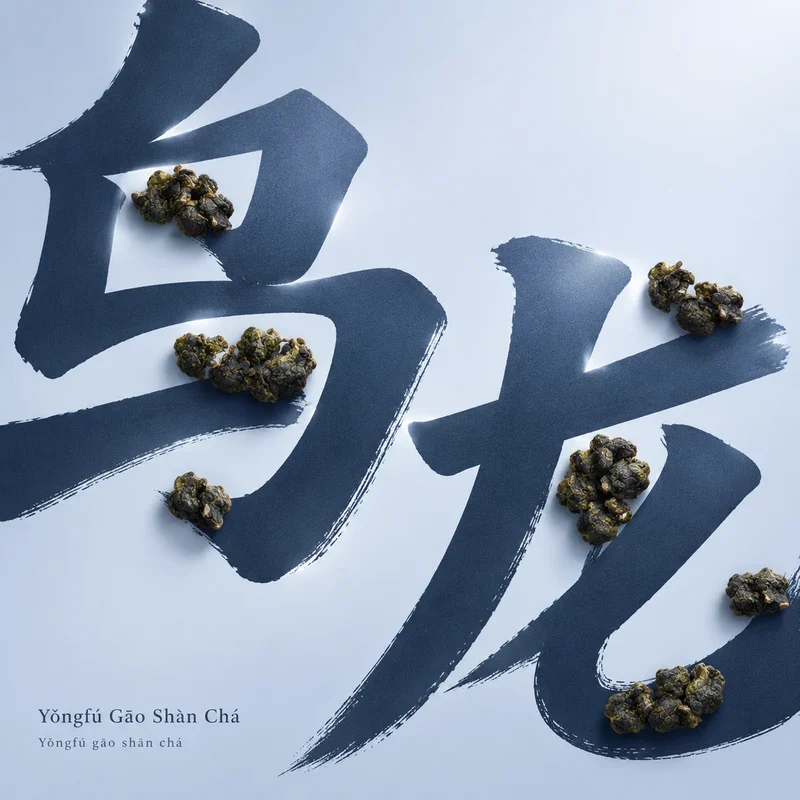
Name Breakdown: 永福 (Yǒngfú) — the township name, literally "eternal happiness" or "eternal prosperity." 高山 (gāoshān) — "high mountain," indicating mountain terroir and growing altitude above 700 m. 茶 (chá) — "tea." Thus, the full name means "high-mountain tea [from] Yongfu."
Cultivar: The main cultivar is Ruǎnzhī Oolong (软枝乌龙, ruǎnzhī wūlóng), also known as Qīngxīn Oolong (青心烏龍, Qīngxīn Wūlóng), one of Taiwan's four historical varieties. This is a bush form of Camellia sinensis var. sinensis, medium-leaf, late-maturing. Leaves are elliptical, thickened, rich green color with oily luster. Ruanzhi Oolong comprises about 70% of plantings. Additional cultivars: Jīnxuān (金萱, Jīnxuān, TTES No. 12) — with characteristic milky aroma notes; Cuì Yǔ (翠玉, Cuìyù, TTES No. 13) — with pronounced floral profile; Sì Jí Chūn (四季春, Sìjì Chūn) — early-budding high-yield variety. All cultivars are propagated vegetatively (cuttings).
Picking: Picking season — from mid-April to mid-October. Best quality comes from spring picking (April). Autumn picking is also highly valued. Summer tea is produced but considered less aromatic. Picking is manual, conducted during midday hours when morning dew has completely evaporated.
Pluck Standard: One bud and two leaves (一芽二叶, yī yá èr yè) for premium grades; one bud and three leaves for first grade. Shoots must be intact, uniform maturity, without mechanical damage.
Raw Material: Fresh top shoots with uniform turgor, absence of foreign odors, complete drying from dew before delivery to the workshop. Taiwanese technology requires special care: leaves must not overheat during transport, and the time interval between picking and beginning of withering is minimal.
Altitude: Average altitude — 755 m above sea level. Key similarity to Taiwan's Alishan: both regions are located practically at the same latitude (24°55′–25°10′ N).
Climate: Humid subtropical mountain climate. Average annual temperature — 17.3°C. Average annual precipitation — 1,839.4 mm. Daily temperature variation exceeds 10°C, which slows tea bush growth and promotes amino acid accumulation. Year-round cloudiness and fog provide predominant diffused light (up to 70% illumination), dominated by blue-violet spectrum — this extends the growing season and enhances aromatic properties of the leaf.
Soil: Acidic yellow soils (酸性黄壤, suānxìng huángrǎng) predominate, rich in organic matter with good drainage. A unique feature of Yongfu tea cultivation is the method of "watering tea bushes with soy milk" (豆浆浇灌法, dòujiāng jiāoguàn fǎ), developed by Lǐ Zhìhóng (李志鸿, Lǐ Zhìhóng), director of Hongding Farm (鸿鼎农场). Fresh soybeans are ground into milk, mixed with bioactive bacteria, brown sugar, rice husks, sugarcane bagasse and bird manure, fermented and diluted for root watering. This method thickens the leaf blade, increases disease resistance and improves taste-aroma characteristics of the tea. Chemical fertilizers and synthetic pesticides are not used — instead, a green plant protection system is employed, and intercropping with cherry trees forms an ecological barrier, reducing pest incidence by 60%.
Yongfu Township is located in the southwestern part of Zhangping County. This is a typical high-mountain basin (高山盆地, gāoshān péndì), surrounded by mountain ranges on four sides. Forest coverage of the territory — 78%.
"One bud — two leaves" shoots are picked manually during midday hours and immediately delivered to the workshop.
Fresh leaves are spread outdoors under the sun. The degree of withering is determined tactilely: the leaf should feel like "velvet" to the touch, a thin clean aroma appears, the second leaf loses gloss and acquires waviness. Mass loss — 8–12%. Duration is adjusted depending on season and air humidity — the "withering by sky" method (看天萎凋法, kàn tiān wěidiāo fǎ).
Alternating periods of rest and shaking (4–5 cycles). During shaking, leaf edges receive micro-damage, triggering partial oxidation — this forms the characteristic reddish rim along the serrated leaf edge. Final cycle: layer thickness 15–20 cm, leaves are laid "valley-style" to accelerate fermentation; holding 90–180 minutes until complete disappearance of "green" smell and appearance of clean floral aroma.
A cylindrical roasting machine (圆筒炒青机, yuántǒng chǎoqīng jī) is used at about 260°C. The process lasts 3–4 minutes; readiness indicator — weakening of crackling, disappearance of grassy smell and appearance of pleasant floral aroma. The leaf becomes soft, slightly sticky and curls in the hand without juice release. Principle: temperature should be maximally high provided there is no scorching.
The leaf is rolled until complete curling into tight strands, with moderate juice release to the surface.
Key stage of Taiwanese technology. The partially dried leaf is reheated to a plastic state, wrapped in cotton cloth and formed into a tight ball using a cloth rolling machine (布球揉捻机, bùqiú róuniǎn jī) or by hand. Multiple repetition of the "heating — cloth rolling" cycle gradually removes moisture and gives the leaf its characteristic spherical or hemispherical shape. This stage forms the visual "trademark" of Taiwanese oolong.
High-temperature air drying stops residual enzymatic activity and stabilizes quality.
Removal of coarse stems and foreign inclusions to even out commercial appearance.
Slow roasting at 60–80°C until moisture content ≤ 6.5% is achieved. At this stage, the final aromatic profile is formed: for light-fragrance style roasting is minimal, for rich-fragrance — deeper, with nutty-caramel notes.
Mechanical rolling is not applied at the cloth forming stage — the leaf is processed only in the cloth bag, which preserves leaf blade integrity. This is a fundamental difference from the Minnan style (e.g., Tie Guanyin), where machine pressing is permitted.
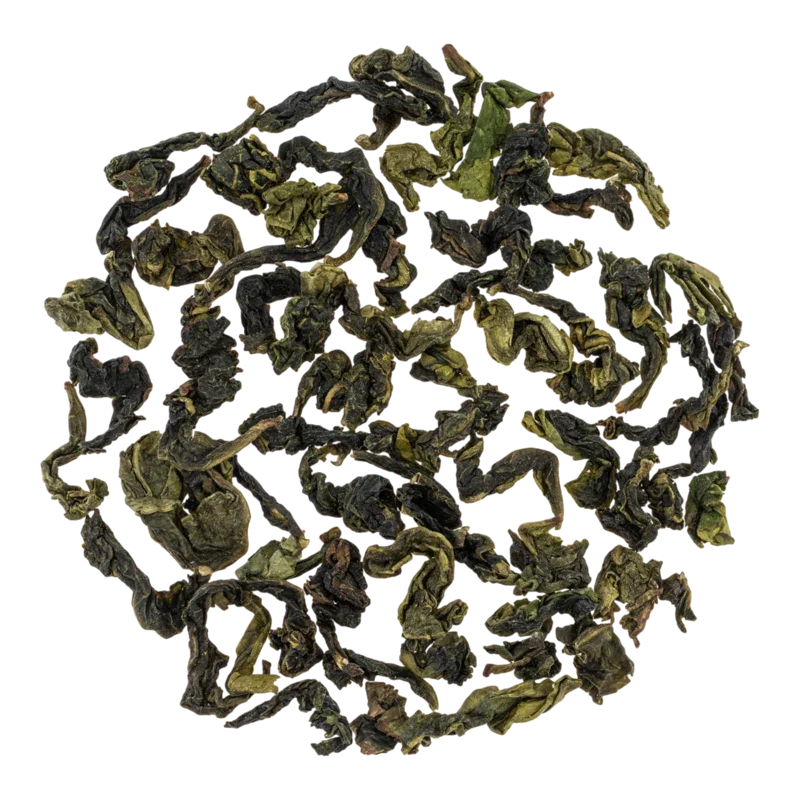
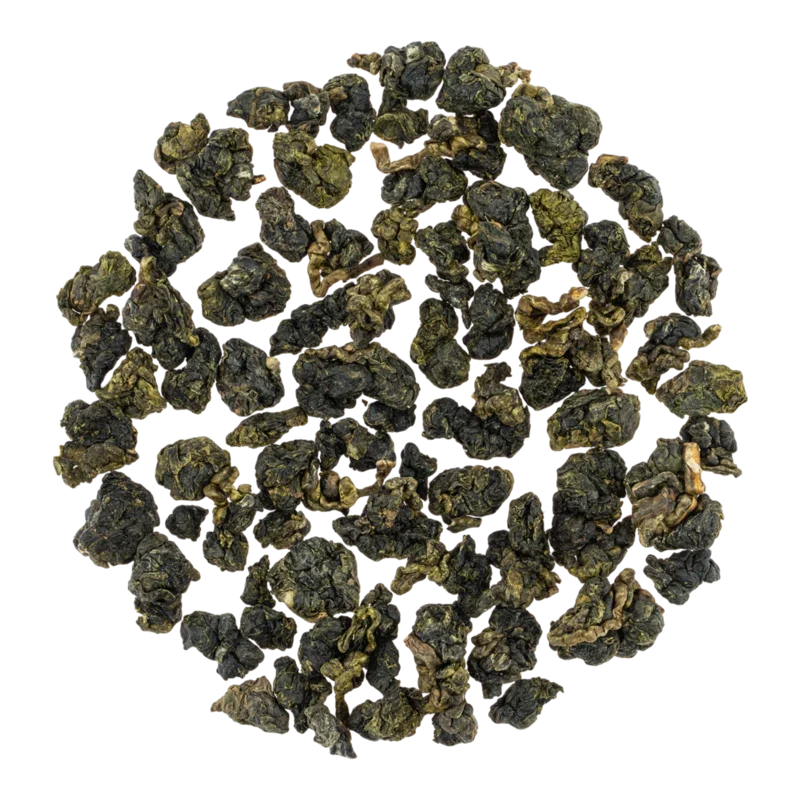
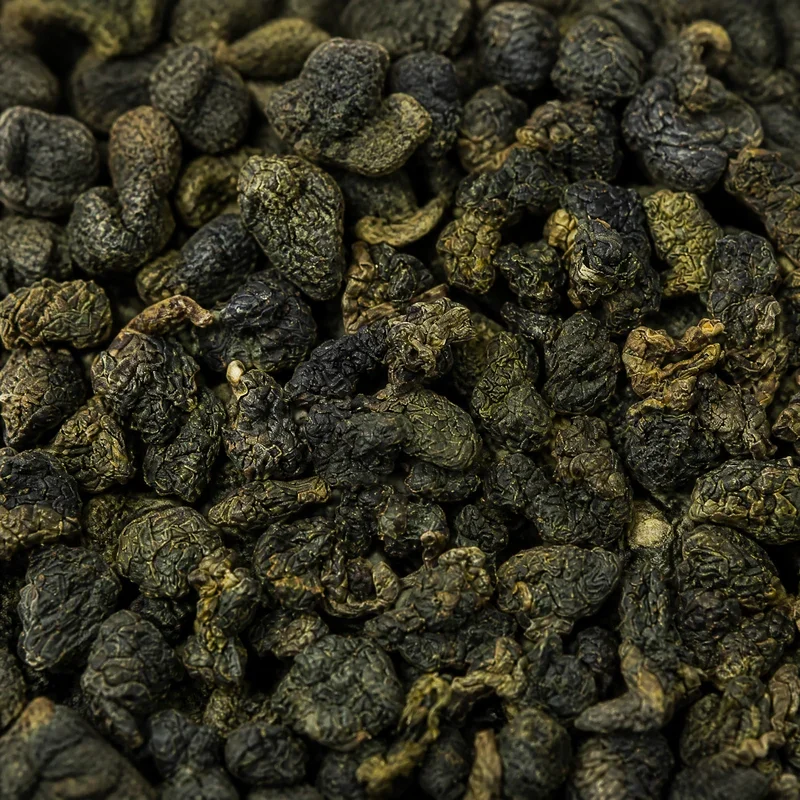
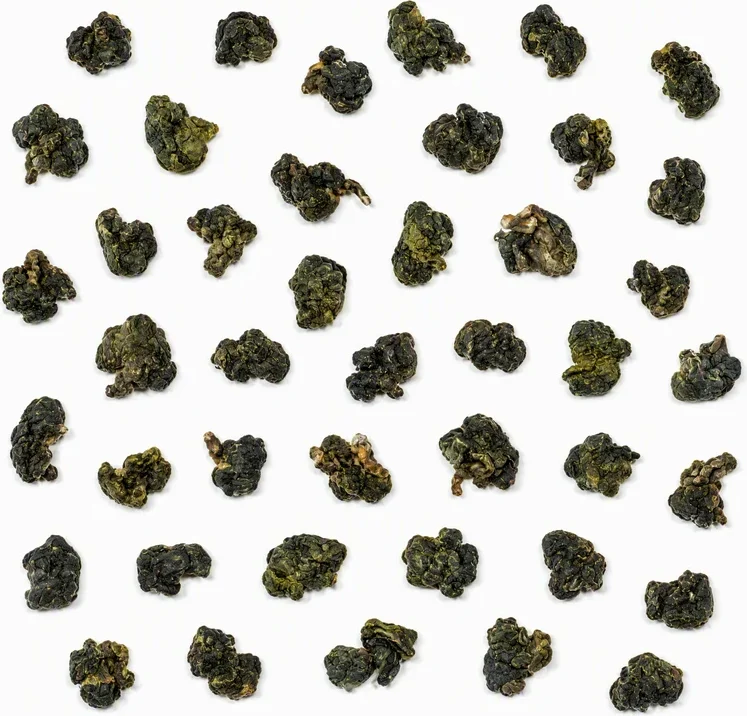
Dry Leaf Appearance: Dense granules of spherical or hemispherical shape (球型/半球型, qiú xíng / bàn qiú xíng), uniform calibration. Color — rich emerald-green with oily luster (翠绿鲜活、有油光).
Dry Leaf Aroma: Delicate, restrained, with notes of wildflowers, green fruits and light creamy sweetness. Jinxuan varieties have distinct milky notes. Rich-fragrance style has warm nutty nuances.
Liquor Aroma: Dominant floral-fruity spectrum: honey peach (水蜜桃, shuǐ mìtáo), osmanthus (桂花, guìhuā), orchid (兰花, lánhuā). With each subsequent infusion, the aroma builds and becomes more complex, revealing honey and fruit overtones. Aged batches develop honey aroma (蜜香, mìxiāng).
Liquor Color: Light-fragrance style — honey-green with yellow tint (蜜绿黄亮, mì lǜ huáng liàng), bright and clear. Rich-fragrance style — from warm golden to amber. Red oolong — rich red-orange (红亮, hóngliàng).
Spent Leaves: Intact opened leaves with preserved "bud + shoot" structure (芽叶连枝完整). The blade is soft, bright, elastic. Along the leaf edge — characteristic red dots on the serrations (叶缘锯齿呈红点状), indicating proper oxidation.
Taste: Full, rich (醇厚, chúnhòu), fresh (鲜爽, xiānshuǎng). Entry — soft sweetness with fruity notes; middle — harmonious astringency and body; aftertaste — prolonged sweetness in the throat (喉韵甘甜, hóuyùn gāntián) with characteristic "cooling" sensation. Pronounced returning sweetness (huígān) (回甘, huígān). The tea withstands more than 7 infusions while maintaining richness.
Alkaloids: Caffeine — moderate level (characteristic for semi-oxidized teas), theobromine and theophylline — in trace amounts. The synergy of caffeine and L-theanine provides mild, prolonged tonic action without sharp "caffeine peak."
Amino Acids: Total free amino acid content — ≥ 2.0% (according to standard), actual — up to 4.48%, which significantly exceeds the average for ordinary oolongs. High L-theanine content provides softness, sweetness and pronounced umami character.
41.9% — an exceptionally high indicator that determines the density and richness of the liquor.
10.37%, which gives the tea natural sweetness and long aftertaste.
Essential Oils: Complex of terpene and aromatic compounds (linalool, geraniol, nerol, indole, jasmone), forming the floral-fruity profile. High-mountain "diffused blue-violet light" regime promotes accumulation of aromatic precursors.
Minerals: Potassium, magnesium, manganese, zinc, fluorine — in trace amounts, contributing to the mineral character of the liquor.
Polyphenols: Tea polyphenol content — ≥ 12.8% (according to geographical indication standard), actual content in samples — up to 14.4%. Catechins comprise about 10.62% (including EGCG, ECG, EGC, EC). Partial oxidation products — theaflavins and thearubigins — form the color and body of the liquor.
Vitamins: Vitamins C, B₁, B₂, P (rutin) — characteristic for high-mountain oolongs.
Caffeine combined with L-theanine provides mild, sustained concentration without anxiety and rapid heartbeat. According to sources, the tonic effect of Yongfu oolong is 30% longer than green tea, with less likelihood of adverse stimulant reactions.
The polyphenol complex (EGCG, ECG) neutralizes free radicals and slows cellular oxidative stress. Antioxidant content in high-mountain oolong is, according to some data, 25% higher than in lowland analogs.
Catechins promote cholesterol synthesis regulation, LDL reduction and maintenance of healthy lipid profile.
Semi-oxidized teas have a gentler effect on gastric mucosa than green teas. Rich-fragrance (roasted) styles are especially comfortable for sensitive digestion.
Systematic consumption of tea polyphenols is associated with blood pressure normalization and improved vascular elasticity.
Polyphenols and caffeine accelerate metabolism and thermogenesis — individually, within a balanced diet.
Fluorine and catechins have antibacterial action in the oral cavity, preventing dental plaque formation.
Multiple-infusion serving (gongfu) turns tea drinking into a meditative process, promoting stress reduction.
Light oxidation (15–30%), minimal roasting. Dominant aroma — orchid and fresh fruits. Infusion honey-green. Taste fresh and sweet. Main cultivar — Ruanzhi Oolong. This is the "calling card" of the region and the most common style.
Medium oxidation (30–50%), pronounced roasting. Aroma — roasted nuts, caramel. Taste dense, with deep huigan. Main cultivar — Jinxuan (with milky undertone) and Ruanzhi Oolong. Infusion — golden-amber.
Heavy oxidation (50–60%). Combines the floral aromatics of oolong with the body and depth of red tea. Infusion rich, red-orange. This is a relatively new category gaining popularity.
For light-fragrance style, it's advisable to use temperature 5–10°C lower to avoid "burning" delicate notes. For rich-fragrance style — full boiling water and longer infusions to reveal caramel and nutty depths.
Tea Amount: 7 g per 140 ml (gongfu, 1:20 ratio) or 3–4 g per 200–250 ml for daily brewing.
Teaware: Porcelain gàiwǎn (白瓷盖碗, báicí gàiwǎn) — for observing liquor color and precise time control; ideal for light-fragrance style. Yíxīng purple clay teapot (紫砂壶, zǐshā hú) — for rich-fragrance and red oolong: clay accumulates heat and "gathers" aroma.
Water Temperature: 95–100°C (light-fragrance style — 90–95°C; rich-fragrance and red oolong — 100°C boiling water for full revelation of floral-fruity aroma).
Enemies: Moisture, heat, direct light, foreign odors. Do not store near spices, perfumes or household chemicals.
Airtight packaging, refrigerator (0–5°C), protection from foreign odors. After opening — consume within 6 months to avoid polyphenol oxidation and aroma loss. Moisture content of finished product — no more than 6.5%.
More storage-stable. Dry cool place (up to 25°C), opaque airtight container is sufficient. Storage period — up to 2 years. With proper storage, light "aging" is possible with development of honey notes.
Similar to rich-fragrance style; allows moderate aging.
The closest "relative" and standard of the style. Produced in Taiwan at altitudes of 1,000–1,600 m. More pronounced "high-mountain" sweetness, more delicate floral profile. Yongfu oolong is denser in body and slightly more intense in aroma — a consequence of lower altitude (755 m) and greater daily temperature fluctuations.
Classic Minnan oolong from Anxi, Fujian. Produced from the cultivar of the same name, not from Ruanzhi Oolong. The technology differs: Tie Guanyin uses machine rolling rather than cloth wrapping; the granules are larger and heavier. Light-fragrance Tie Guanyin is more mineral; Yongfu is more fruity and "creamy."
The Taiwanese "grandfather" of the style from which the entire genre of Taiwanese ball-rolled oolongs grew. Produced in Nantou at altitudes of 600–800 m from the same Qingxin Oolong. Stylistically closer to the rich-fragrance profile — with deeper roasting. Yongfu oolong in light-fragrance execution is lighter and fresher than Dongding, but in rich-fragrance style can approach it.
Another famous oolong from Zhangping, but fundamentally different: this is a pressed (in the form of square "cakes") Minnan oolong from the Shuixian cultivar. The technology and flavor profile (floral-woody, with narcissus notes) differ dramatically. Two teas — two faces of one county.
Taiwanese high-mountain oolong from altitudes of 1,800–2,600 m. Significantly more delicate, "ethereal," with cool floral sweetness. Yongfu tea, despite all its high-mountain character, is denser and "warmer" than Lishan — the difference in altitude and the continental nature of mainland climate shows.
Price Category: Cost varies significantly depending on variety, picking season, processing style and master level. Special grade (特级, tèjí): over 5,000 yuan/kg — from "bud + two leaves" shoots of impeccable quality, with high floral-fruity aroma and delicate taste. First grade (一级, yījí): 3,000–4,000 yuan/kg — "bud + three leaves" shoots, stable aroma, optimal price-quality ratio. Second grade (二级, èrjí): below 3,000 yuan/kg — from mature leaves, rich taste, excellent infusion endurance.
No reviews yet. Tell us what you think of this tea.
Rate this tea and share your impressions. We review each submission before publishing it.