Brewing
Gongfu brewing
- Water temperature
- 75 °C
- Tea amount
- 5 g
- Water volume
- 100 ml
- First steep
- 10 s
- Time added per infusion
- 5 s
- Infusions
- 3

yín sī lǜ chá
Choose a brewing method. Start with the recommended quantities and time, then adjust to taste.
Brewing
Brewing
Taste
Tea encyclopedia
Category: High-quality green teas of China; typological (rather than geographical) designation uniting elite bud green teas of thread-like form.
Category: High-quality green teas of China; typological (rather than geographical) designation uniting elite bud green teas of thread-like form.
Birthplace of Longjing and other famous green teas; characterized by use of small-leaf varieties of Camellia sinensis var. sinensis, producing tender buds with fine down.
Dongting Mountain area — birthplace of Biluochun, where elite bud teas are also produced.
Huangshan area and other high-mountain zones, known for green teas with pronounced down (Huangshan Mao Feng, Taiping Hou Kui).
Mengding area, where refined bud teas like Méngdǐng Gān Lù (蒙顶甘露) and Zhúyèqīng (竹叶青) are produced.
May also be a source of similar teas — for example, teas from Yueyang area.
Coordinates: Vary depending on specific production location. Main tea regions where Yin Si may be produced: Zhejiang (~30°N, 120°E), Anhui (~30°N, 118°E), Sichuan (~30°N, 103°E).
Origin: "Yin Si" (银丝, "silver threads") is primarily a description of form and raw material type, not a strictly geographically bound name. Teas of this type may be produced in several provinces of China with developed green tea traditions:
Type: Green tea (绿茶) (non-oxidized, 绿茶, lǜchá). By fixation method, belongs to hongqing lucha (烘青绿茶, hōngqīng lǜchá, "green tea dried with hot air") or to a transitional type — when kill-green (杀青) is conducted by pan-firing, while final drying uses hot air (炒烘结合, chǎo-hōng jiéhé). Minimal or zero rolling preserves the natural needle-like form of buds.
Specialized tea farms in Zhejiang, Anhui, Sichuan with established reputation for bud tea production.
Companies with long-term relationships with Chinese producers and quality control systems.
Physical and online stores focusing on Chinese green teas with knowledgeable staff and proper storage conditions.
Opportunities to purchase directly from producers during specialized events.
Famous flat green tea from Zhejiang. Longjing differs in characteristic flat leaf form (achieved by pressing in pan), more pronounced chestnut aroma and full-bodied taste. Yin Si — thread-like, more tender, with floral profile.
Spiral green tea from Jiangsu, famous for floral-fruity aroma. Biluochun is rolled into tight spirals — form opposite to thread-like Yin Si. Biluochun taste usually more saturated and fruity.
Anhui green tea from bud and one leaf, slightly curved, with characteristic "golden" fish-like leaf (鱼叶). Mao Feng more full-bodied and may have slightly orchid aroma, while Yin Si — more delicate, refined.
Close in concept tea — also from early bud raw material, but more often shaped as "sparrow tongues" (雀舌, quèshé), not "threads." Flavor profile close, but Yin Si visually more elegant.
Sichuan bud tea in form of flat "bamboo shoots." By raw material tenderness — closest competitor, but with completely different form and more pronounced chestnut notes.
Cultural Significance: Yin Si Lu Cha embodies the aesthetic ideal of Chinese green tea: beauty of form (thin threads), purity of color (silver and green), tenderness of taste and aroma. The tea is highly valued as a gift and as an object of contemplation during brewing — observing how silvery "threads" slowly unfold in a transparent glass is an independent aesthetic ritual.
History: The tradition of producing teas from tender, downy buds in China reaches deep antiquity. As early as the Tang (618–907) and Song (960–1279) dynasties, tea treatises mentioned teas from first spring buds as the most valuable raw material. Lù Yǔ (陆羽, Lù Yǔ) in "The Classic of Tea" (茶经, Chájīng, 760 CE) emphasized the superiority of early spring harvest. However, as an independent commercial designation, "Yin Si Lu Cha" was formalized in modern times — probably in the late 20th century, with the development of the elite green tea market and growing demand for visually expressive, gift-worthy varieties. Essentially, "Yin Si" is a marketing and descriptive term for an entire class of thread-like bud teas, not a historical designation with centuries-old lineage.
Cultivar: For Yin Si production, various varieties of Camellia sinensis var. sinensis may be used, selected by criteria of abundant down on buds and tenderness of young shoots. Among the most likely cultivars:
Picking: Early spring — period before Qīngmíng (清明, Qīngmíng, 清明前, qīngmíng qián, "before Pure Brightness Festival," usually before April 5) or very beginning of Gǔyǔ season (谷雨, Gǔyǔ, "Grain Rain"). Most valuable batches are harvested in late March — early April.
Pluck Standard: Exclusively tender, unopened buds (tips, 芽, yá) or bud with one barely unfolded upper leaf (一芽一叶初展, yī yá yī yè chūzhǎn). "Buds only" standard (单芽, dān yá) is characteristic of highest grades.
Raw Material: Extremely high. Only select, undamaged, juicy buds with dense silvery down are used. Harvest is conducted exclusively by hand, with maximum care — buds are taken with fingertips, not squeezing or twisting, to preserve down and cellular structure integrity. Harvested material is immediately delivered for processing, preventing overheating in containers.
Altitude: 500–1500 m above sea level. High-altitude plantations (above 800 m) produce raw material with most pronounced aroma and sweetness.
Soil: Typical red-yellow lateritic soils, rich in organic matter, with good drainage. In Anhui — characteristic mountain granitic soils; in Sichuan — yellow clay soils (黄壤, huáng rǎng).
Since Yin Si may be produced in different provinces, terroir varies, however unifying characteristics include:
Manual, described above.
Harvested buds are spread in thin layer (no more than 2–3 cm) on bamboo trays or clean cloth in shaded, well-ventilated room. Withering time — 4–6 hours. Goal — gentle moisture reduction by 10–15%, softening of cell walls and beginning of aromatic precursor formation. At this stage, tender buds cannot be stirred too frequently — this damages down.
Conducted especially delicately and quickly — at pan temperature 180–220°C for 2–3 minutes. Task: completely inactivate oxidation enzymes while preserving silvery color of down and bright green tone of leaf tissue. Excessive heating or delay leads to "burning" of tender buds and loss of characteristic fresh aroma. In some productions, steam or air fixation may be used instead of pan-firing.
After fixation, buds are immediately spread in thin layer for natural cooling, preventing "greenhouse" effect of residual heat.
For Yin Si, this stage is either completely absent or conducted in maximally light form — longitudinal, delicate shaping that only slightly elongates the bud without disrupting its integrity or damaging down. Unlike teas with spiral or flat rolling, Yin Si preserves natural, thread-like bud form — precisely this determines its visual identity.
Conducted in several stages at gradually decreasing temperature (initial — about 100–110°C, final — 70–80°C) until reaching residual moisture 5–6%. Multi-stage drying allows even moisture removal without overdrying surface down. Overdried buds become brittle, lose silvery luster and significant portion of aroma.
Careful final sorting — removal of broken buds, stems, tea dust and any defects. Highest grade represents uniform, whole, even "threads" with dense silvery down.
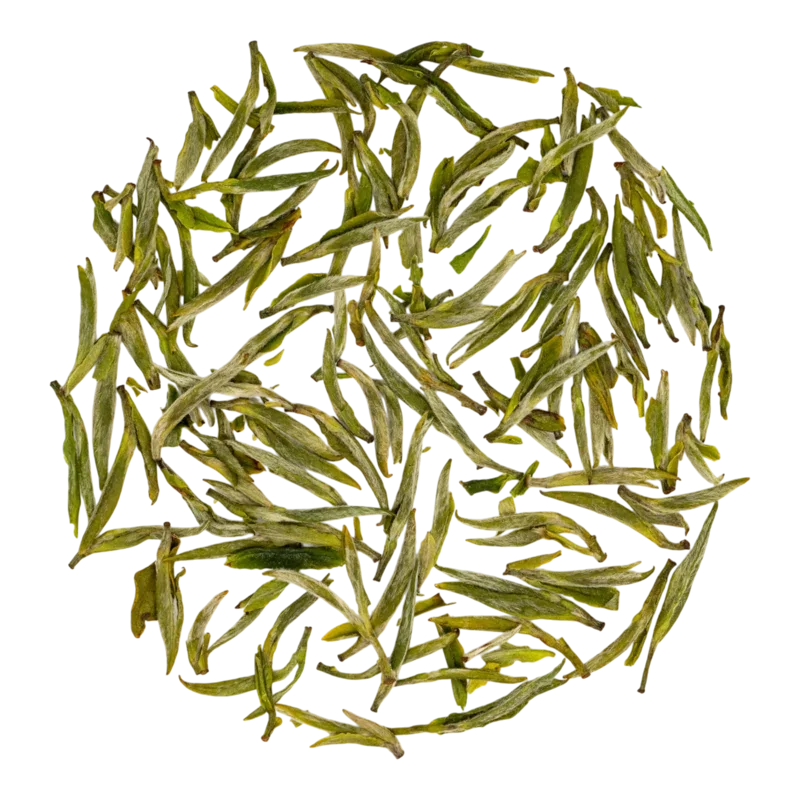
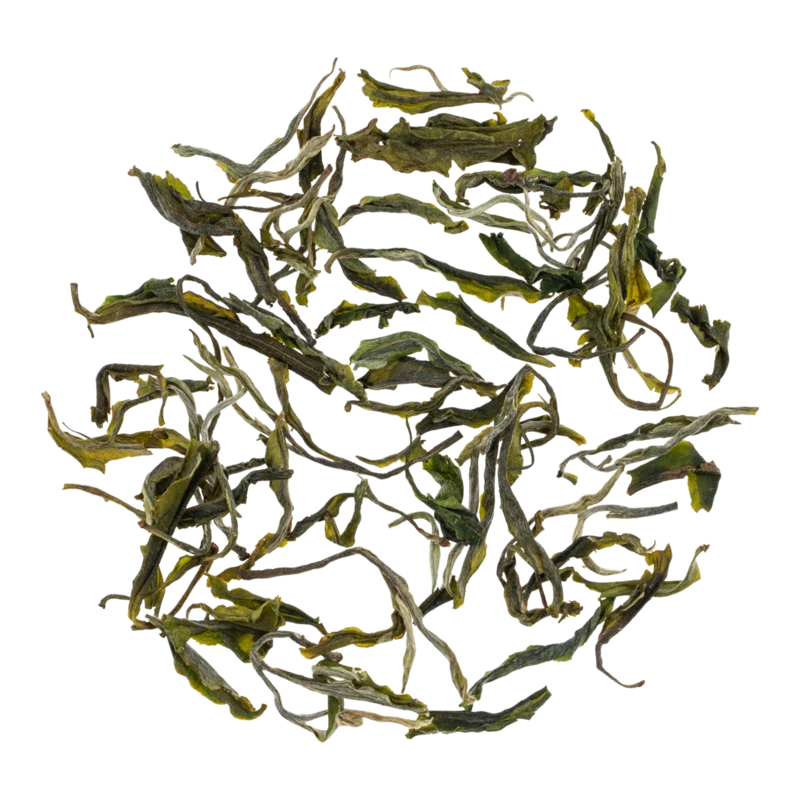
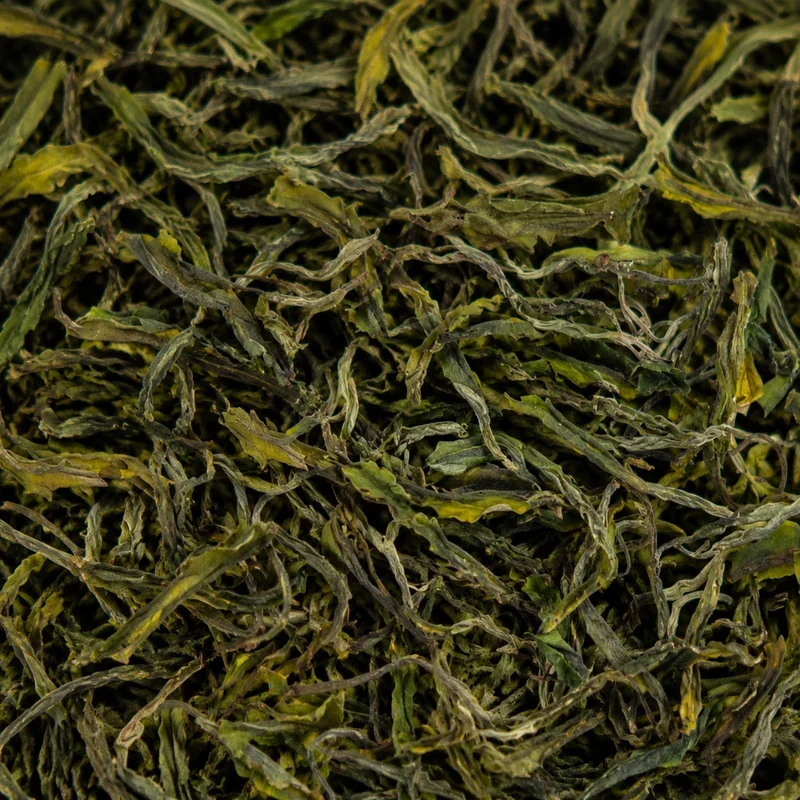
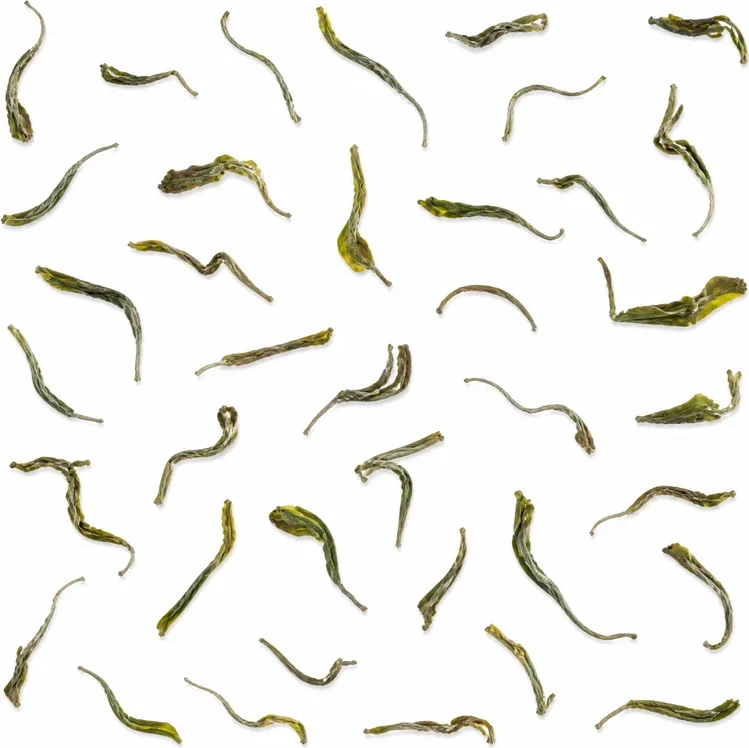
Dry Leaf Appearance: Thin, elongated, straight or slightly curved tea leaves, truly resembling silk threads. Buds tender, compact, densely covered with silvery-white down (baihao). Color — from light green to moderately green, with silvery sheen thanks to down. Tea leaves should be whole, even, without significant breakage; their length — 15–25 mm. Uniformity of form and size — important quality indicator.
Dry Leaf Aroma: Very fresh, tender, refined. Notes of young greenery and spring flowers (lily of the valley, acacia) dominate. Depending on region, light nutty (chestnut), citrus or delicate creamy nuances may be present. Aroma should not be intense — its strength lies precisely in delicacy.
Liquor Aroma: Bright, clean, with predominance of fresh grassy and floral notes. Top notes — young grass, cucumber freshness; middle — white flowers (jasmine, lily of the valley); base — light chestnut warmth.
Liquor Color: Pale green with light yellowish tint, crystal clear, with bright luster. Liquor turbidity is unacceptable and indicates low quality.
Spent Leaves: Tender, whole, resilient buds, completely preserving form and silvery down, bright green color. Uniformity and integrity of spent leaves — key indicator of quality and authenticity.
Taste: Soft, tender, exceptionally clean, refreshing. Pronounced natural sweetness (回甘, huígān) with minimal astringency. Bitterness is completely absent with proper brewing. Aftertaste prolonged, floral-sweet, with light "umami" shade thanks to high L-theanine content. Liquor body light, with silky, almost oily texture.
Alkaloids: Caffeine — 2.0–3.0% of dry mass (about 15–25 mg per 150 ml cup). Caffeine content in bud tea is usually moderate; combined with high L-theanine level provides gentle tonic effect without nervousness.
Amino Acids: Elevated content — 3.5–5.5% of dry mass. L-theanine — dominant amino acid, may reach 1.5–2.5% of dry mass in best early spring harvest samples. Precisely high amino acid to polyphenol ratio (低酚氨比, dī fēn ān bǐ) determines tender, sweetish flavor profile of Yin Si.
Main biochemical distinctive feature of Yin Si — high amino acid to catechin ratio. This provides taste that Chinese tasters describe as 鲜甜 (xiān tián, "fresh-sweet") — reference profile of elite bud green tea.
Essential Oils: Aromatic profile includes cis-3-hexenol (fresh "green" note), linalool, geraniol, nerolidol and series of aldehydes forming floral-grassy bouquet.
Minerals: Potassium (K) — main mineral, up to 1.5–2.0% of dry mass. Fluorine (F), magnesium (Mg), zinc (Zn), manganese (Mn), phosphorus (P).
Polyphenols: Total content — 16–22% of dry mass, somewhat lower than in green teas from mature leaves. Main components: EGCG, EGC, ECG, EC. Precisely moderate catechin content ensures absence of pronounced bitterness and astringency.
Vitamins: Vitamin C — up to 150–280 mg/100 g dry leaf (one of highest indicators among teas, since buds are richest in ascorbic acid). Vitamins B₁, B₂, B₆, vitamin E, β-carotene.
Catechins (EGCG) and vitamin C jointly provide powerful cell protection from free radicals, contributing to oxidative stress deceleration.
Unique combination of moderate caffeine and high L-theanine creates state of "calm alertness" — concentration and cognitive performance improve while maintaining emotional balance.
High vitamin C content (up to 280 mg/100 g) combined with polyphenols strengthens body's protective functions.
Catechins possess moderate antibacterial and anti-inflammatory action in gastrointestinal tract, while light astringency stimulates digestion.
Regular green tea consumption is linked to reduced oxidized low-density lipoprotein (LDL) levels and maintenance of vascular elasticity.
Antioxidants (EGCG, vitamin C, vitamin E) contribute to skin protection from ultraviolet damage and collagen synthesis support.
Light, clean taste and minimal bitterness make Yin Si ideal summer beverage.
Tea Amount: 3–5 grams per 150–200 ml water.
Teaware: Best choice — glass tumbler (玻璃杯, bōli bēi) or glass teapot: transparent walls allow observing aesthetic picture of unfolding silvery "threads," which is independent aesthetic pleasure. Porcelain gaiwan from thin white porcelain also suitable.
Water Temperature: 70–80°C. Tender Yin Si buds require reduced temperature — too hot water (above 85°C) instantly extracts excess catechins, generating bitterness and "burning" delicate down.
Container: Vacuum packages with aluminum layer (best option), tin cans with tight lid, porcelain containers with silicone seal. Avoid transparent glass jars — light destroys chlorophyll and accelerates degradation.
Enemies: Oxygen, light, moisture, foreign odors, high temperature. Each of these factors accelerates polyphenol oxidation, vitamin C breakdown and loss of volatile aromatic substances.
Shelf Life: When stored in refrigerator — up to 12–18 months. At room temperature — no more than 6–8 months. Best consumption time — first 3–4 months after production.
Temperature: Ideal option — refrigerator (0–5°C) in hermetic packaging, isolated from foreign odors. This is most reliable way to preserve aroma and taste.
Famous flat green tea from Zhejiang. Long Jing is distinguished by its characteristic flat leaf shape (achieved by pressing in a wok), more pronounced chestnut aroma and full-bodied taste. Yin Si is thread-like, more delicate, with a floral profile.
Spiral-shaped green tea from Jiangsu, famous for its floral-fruity aroma. Biluochun is rolled into tight spirals — a form opposite to the thread-like Yin Si. The taste of Biluochun is usually more intense and fruity.
Anhui green tea made from bud and one leaf, slightly curved, with characteristic "golden" fish-shaped leaf (鱼叶). Mao Feng is more full-bodied and may have a slightly orchid aroma, while Yin Si is more subtle, delicate.
A tea close in concept — also made from early bud material, but more often shaped like "sparrow tongues" (雀舌, quèshé), rather than "threads." The flavor profile is similar, but Yin Si is visually more elegant.
Sichuan bud tea in the form of flat "bamboo shoots." In terms of raw material tenderness — the closest competitor, but with a completely different shape and more pronounced chestnut notes.
Specialized tea shops working directly with farmers, or authoritative online platforms with review and return systems.
Tea leaves should be whole, thin, even, uniformly covered with silvery down. Abundance of breakage, uneven color, presence of stems and fragments — signs of low quality or substitution.
Quality Yin Si possesses clean, fresh, grassy-floral scent. Musty, sour, "fishy" or excessively smoky aroma — alarming signs.
Color should be pale green or pale yellow, crystal clear. Turbid, dark or brownish liquor indicates old or spoiled tea.
High-quality bud tea requires large labor costs during harvest (to produce 1 kg dry tea requires up to 60,000–80,000 buds), determining its cost.
No reviews yet. Tell us what you think of this tea.
Rate this tea and share your impressions. We review each submission before publishing it.