Brewing
Gongfu brewing
- Water temperature
- 75 °C
- Tea amount
- 5 g
- Water volume
- 100 ml
- First steep
- 10 s
- Time added per infusion
- 5 s
- Infusions
- 3

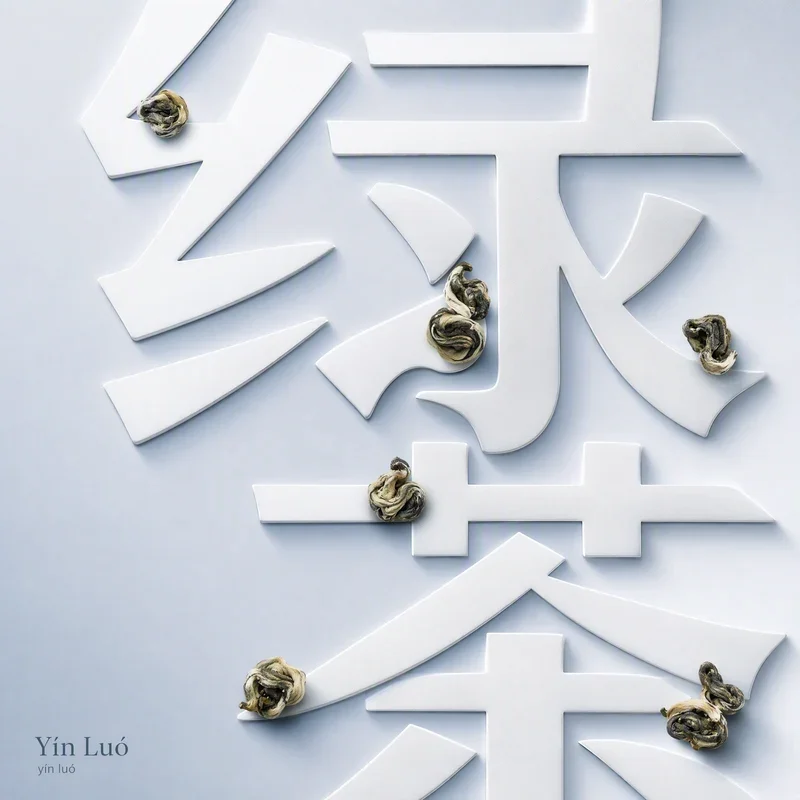
yín luó
Choose a brewing method. Start with the recommended quantities and time, then adjust to taste.
Brewing
Brewing
Taste
Tea encyclopedia
Category: Quality Chinese green teas of spiral-rolled form. Not included among the "Famous Teas" (十大名茶) and does not possess protected geographical indication — this is rather a stylistic name uniting spiral-rolled green teas with pronounced downy appearance from several provinces.
Category: Quality Chinese green teas of spiral-rolled form. Not included among the "Famous Teas" (十大名茶) and does not possess protected geographical indication — this is rather a stylistic name uniting spiral-rolled green teas with pronounced downy appearance from several provinces.
Considered one of the main regions. Small-leaf and medium-leaf cultivars are used; the tea is distinguished by floral-sweet aroma and light "maritime" minerality.
Produced from large-leaf cultivars (Camellia sinensis var. assamica); the leaf is larger, the liquor more full-bodied, with honey notes.
Medium-leaf varieties; delicate, soft profile with light chestnut notes.
Encountered less frequently; close in style to Fujian versions.
Coordinates: Vary depending on production province (from ~24° to ~31° N latitude, from ~100° to ~120° E longitude).
Origin: The name "Yin Luo" is not strictly geographically bound. The tea is produced in a number of Chinese provinces, each contributing its own terroir imprint:
Type: Green tea (non-oxidized, 绿茶, lǜchá). Oxidation level — less than 5%.
Cultural Significance: Yin Luo occupies the niche of "everyday quality tea" — it is valued for its beautiful spiral form, delicate taste, and accessibility. For tea lovers who appreciate the aesthetics of Biluochun but are not ready to pay for Dongting terroir, Yin Luo is a logical and honest alternative. In the tea enthusiast community, Yin Luo sometimes serves as an "entry point" into the world of spiral-rolled green teas. Notably, the very fact of Yin Luo's existence as a separate name is a consequence of protecting the geographical indication of Dongting Biluochun: after introducing standard GB/T 18957, producers outside Dongting could no longer market their product as "Biluochun," and some began using the name "Yin Luo" or "Cui Luo" — honest alternatives not claiming foreign terroir. In this sense, Yin Luo is not so much a "fake" Biluochun as an independent product with transparent identity.
History: Yin Luo is a relatively young tea, not possessing the centuries-old history of great Chinese teas. It appeared on the tea market in the second half of the 20th century, when tea factories in several provinces began producing spiral-rolled green teas using technology close to Biluochun, but from local raw material and without connection to Dongting terroir. The name "Yin Luo" is essentially a commercial designation of form and appearance, rather than a historically established name of a specific tea. This allowed offering consumers an aesthetically attractive spiral-form product at a more accessible price than authentic Dongting Biluochun. In the 1990s-2000s, as the Chinese tea market grew and control over geographical indications tightened, names like "Yin Luo" and "Cui Luo" became increasingly in demand — they gave producers a legitimate opportunity to sell spiral-rolled green tea without misleading consumers about origin. Today Yin Luo firmly occupies its niche as an accessible but quality representative of the "螺"-tea family.
Cultivar: Various tea bush varieties are used for Yin Luo production depending on the production region. In Fujian and Zhejiang — small-leaf and medium-leaf cultivars Camellia sinensis var. sinensis. In Yunnan — large-leaf forms C. sinensis var. assamica or hybrid cultivars. In Sichuan — medium-leaf local varieties. The absence of connection to one cultivar is a fundamental difference of Yin Luo from teas like Dongting Biluochun (strictly "Dongtingshan quntichong").
Picking: Spring — preferable; young buds and leaves are collected from late March through April. Summer and autumn batches also exist but are inferior in aroma and delicacy.
Pluck Standard: Usually one bud + one-two upper leaves (一芽一叶 or 一芽二叶). For Yunnan versions, larger leaf is acceptable.
Raw Material: Healthy, undamaged buds and leaves with pronounced silvery down. Fraction uniformity is important for forming aesthetically attractive spiral form.
Since Yin Luo is produced in several provinces with fundamentally different climate and terrain, no unified terroir description exists. This is a tea defined by technology, not place.
Fujian Yin Luo is more "maritime" and floral; Yunnan — more full-bodied, sweet, with honey notes; Sichuan — soft, chestnut-like. This is precisely why indicating the province when purchasing is critically important. By analogy with the wine world, where the same "pinot noir" from Burgundy, Oregon, and New Zealand are three completely different wines, Yin Luo from different provinces represents three different tea experiences. Yunnan versions are also characterized by more pronounced "body" in the liquor: large-leaf Assam-type raw material provides noticeable density that cannot be obtained from small-leaf Fujian cultivars. Fujian Yin Luo, conversely, is distinguished by elegant lightness, close to the mood of coastal tea gardens.
Described above.
Collected raw material is spread in a thin layer in shade for 2–4 hours to remove surface moisture and lightly soften the leaf. Goal — make the leaf pliable for subsequent rolling.
Pan-firing in an inclined wok or rotary cylinder at 180–200°C. Goal — enzyme inactivation, stopping oxidation, removing "grassy" smell. For small-leaf raw material (Fujian, Zhejiang) temperature is lower (~170–180°C), for large-leaf Yunnan — higher (~190–210°C).
Key form-shaping stage. Leaves are rolled by hand or with mechanical rollers, giving them the form of tight spirals resembling snail shells. With hand rolling the process lasts 15–25 minutes; the master controls pressure to preserve down integrity and avoid excessive dust. With mechanical rolling, special rollers with adjustable pressure are used.
Staged — primary stabilization at ~100°C followed by final drying at ~60–70°C to 6–7% moisture. Fixes spiral form and sets aroma.
Finished tea is sorted by size, rolling density, and amount of down. Highest grades are distinguished by spiral uniformity and abundant silvery covering.
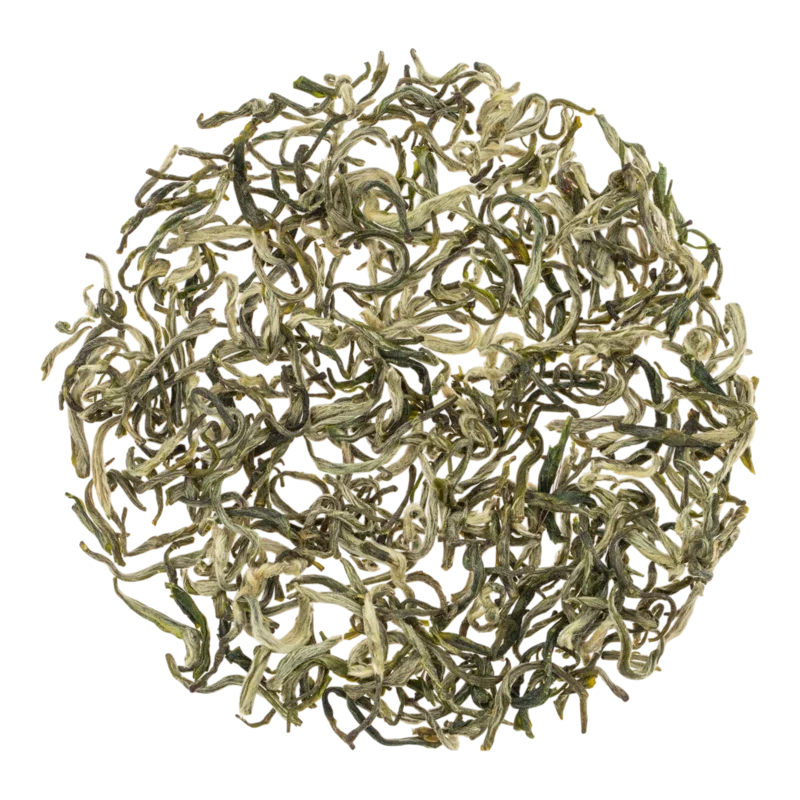
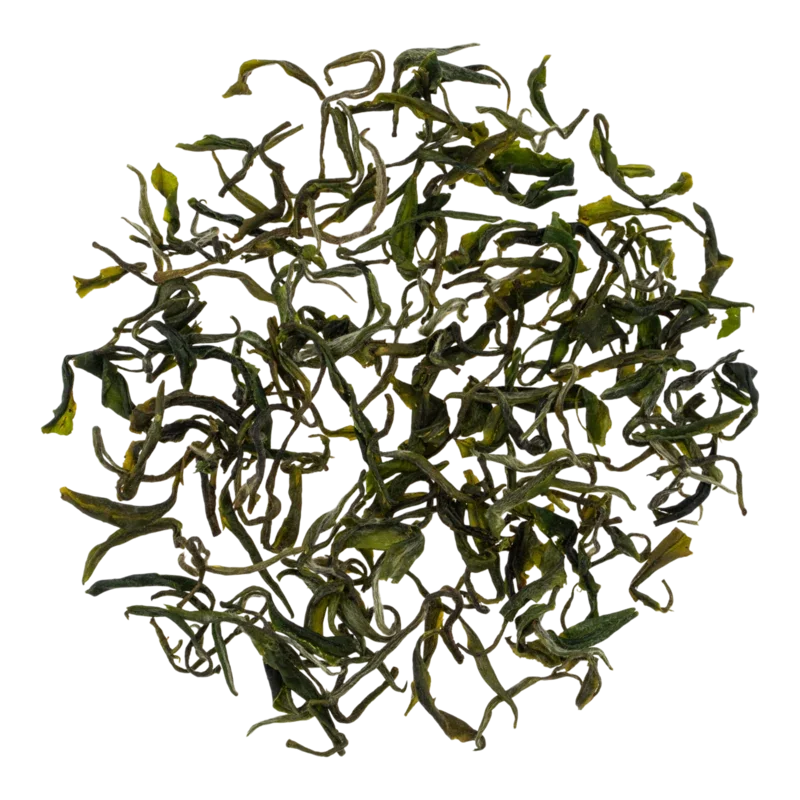
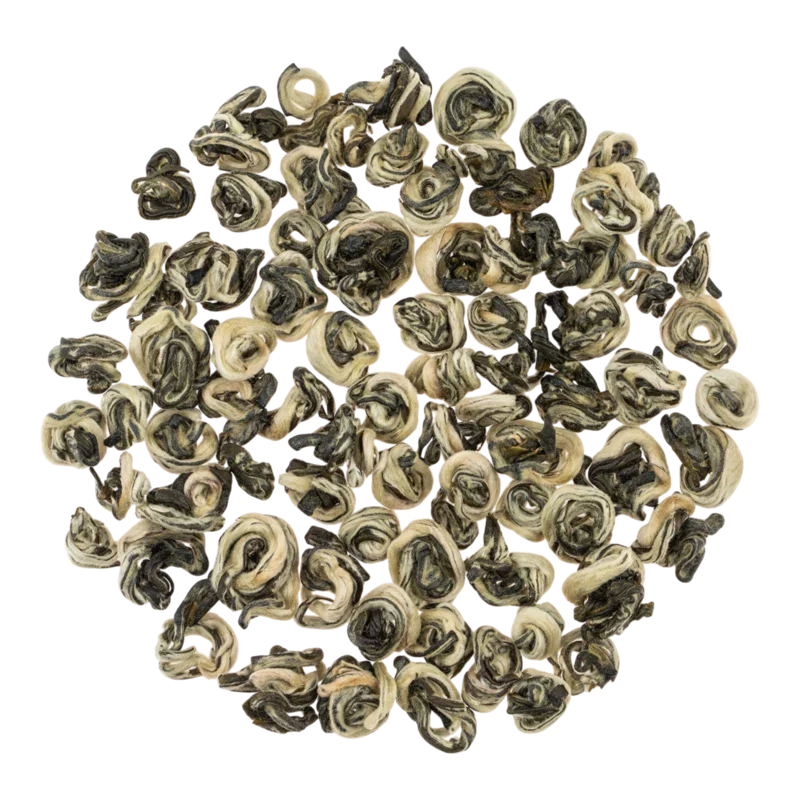
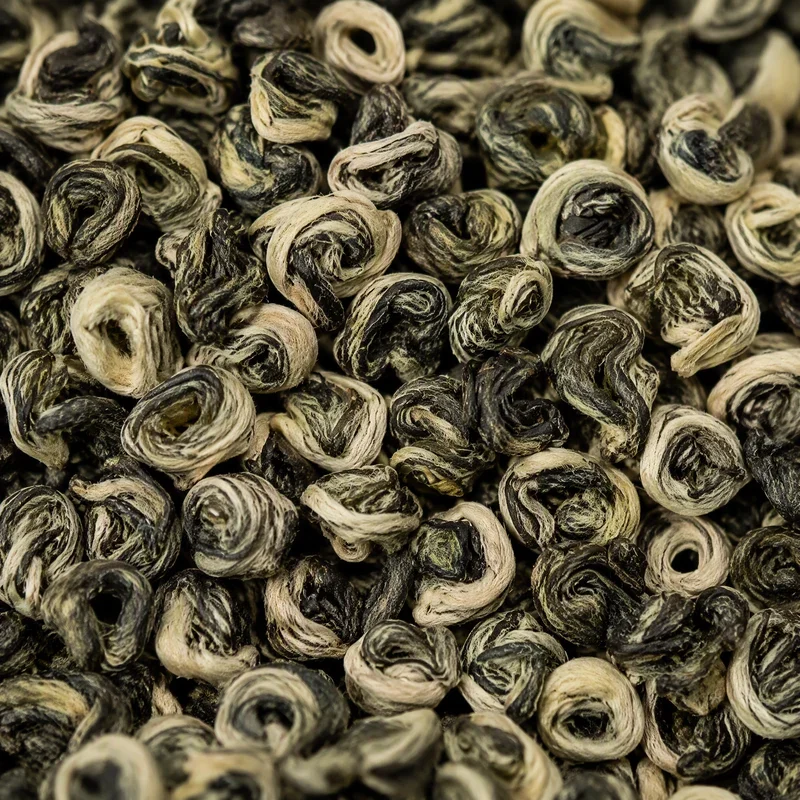
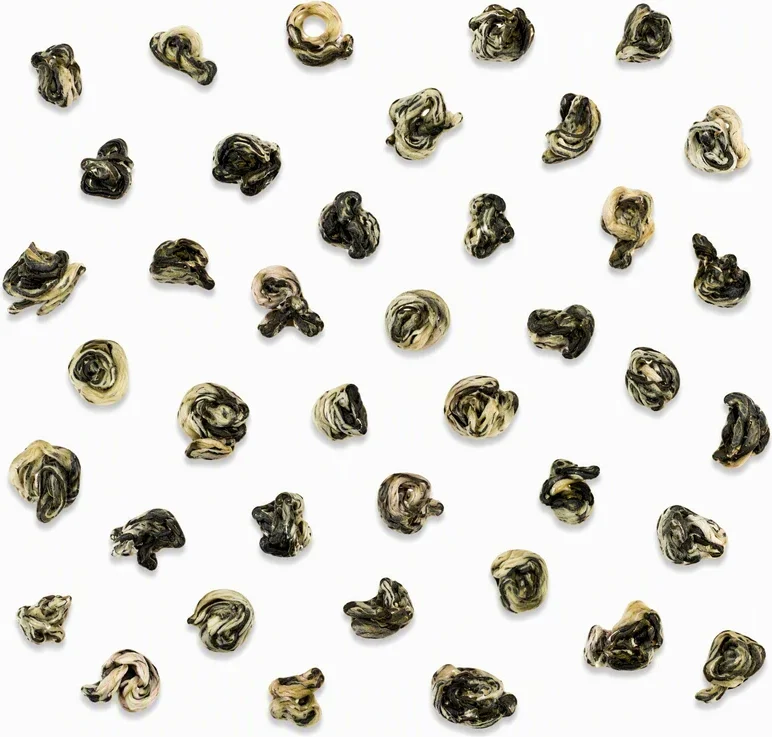
Dry Leaf Appearance: Tightly rolled tea particles of spiral form resembling small snail shells. Color — from dark green to emerald green, with noticeable silvery shade thanks to downy tips (银绿, yínlǜ). Tea particles are generally somewhat larger than Dongting Biluochun.
Dry Leaf Aroma: Fresh, delicate, clean. Notes of greenery and spring grass, light floral shade (jasmine, meadow flowers), subtle nutty or creamy nuances. Lacks the characteristic "floral-fruity" note of Dongting Biluochun (result of proximity to fruit trees).
Liquor Aroma: Bright, fresh, with predominance of floral and grassy notes. Yunnan versions — more honeyed and deep.
Liquor Color: Light green, clear, transparent, with light yellowish shade (嫩绿微黄). Yunnan versions — slightly more saturated, golden-green.
Spent Leaves: Whole, elastic leaves and buds of green color, fully opened after brewing. Good quality indicator — fraction uniformity and absence of broken leaf.
Taste: Soft, delicate, sweetish (鲜爽, xiānshuǎng), refreshing, with light, pleasant astringency. Aftertaste — long, with gentle returning sweetness (回甘, huígān). The bouquet may contain notes of greenery, white flowers, nuts; Yunnan versions — honey and fruit notes. Taste is less "complex" and "voluminous" than Dongting Biluochun, but clean and honest.
Alkaloids: Caffeine (咖啡碱) — 2–4% dry mass; theobromine and theophylline — in trace amounts. Caffeine and L-theanine synergy provides gentle tonic effect.
Amino Acids: About 2–4% dry mass. L-theanine (L-茶氨酸) — main component providing sweetness and taste softness. Early spring batches generally contain more amino acids (polyphenol/amino acid ratio lower), making taste more "delicate."
Essential Oils: Aromatic profile simpler than Dongting Biluochun; aldehydes (hexanal, trans-2-hexenal), terpenoids (linalool), and grassy-green components dominate.
Minerals: Potassium (K), fluorine (F), magnesium (Mg), zinc (Zn), manganese (Mn).
Polyphenols: Approximately 18–25% dry mass for small-leaf versions (Fujian, Zhejiang) and 22–30% for large-leaf (Yunnan). Dominant catechins: EGCG, ECG, EC. Higher polyphenol content in Yunnan versions explains their more astringent and full-bodied taste.
Vitamins: Ascorbic acid (vitamin C), B-group vitamins (B₁, B₂, B₆), folic acid, vitamin A (carotenoids).
Catechins (especially EGCG) effectively neutralize free radicals; regular green tea consumption is associated with reduced oxidative stress.
Gentle increase in concentration and alertness thanks to caffeine and L-theanine synergy — without sharp excitement "peaks."
Polyphenols and caffeine stimulate gastric juice secretion, accelerate fat metabolism. Yin Luo — good choice after lunch.
Catechins help reduce LDL cholesterol levels, improve vascular elasticity.
Vitamin C and polyphenols jointly support body immune function.
Pronounced thirst-quenching and refreshing property — makes Yin Luo excellent tea for hot season.
Fluorine content strengthens tooth enamel; polyphenols suppress cariogenic bacteria growth.
L-theanine in synergy with caffeine promotes increased attentiveness and mental clarity while reducing anxiety — an effect researchers describe as "relaxed concentration."
Antioxidant properties of green tea polyphenols slow photoaging processes and reduce oxidative stress in skin cells; traditionally in China green tea infusion is used as facial tonic.
Tea Amount: 3–5 g per 150–200 ml water.
Teaware: Porcelain gàiwǎn (盖碗, gàiwǎn), glass teapot, or glass cup. Glass allows observing spiral unfolding.
Water Temperature: 80–85°C. Yin Luo is somewhat less delicate than Dongting Biluochun and tolerates slightly higher temperature.
Enemies: Moisture, light, high temperature, foreign odors, oxygen.
Shelf Life: 6–12 months. Like other green teas, Yin Luo is best consumed fresh — current harvest tea (新茶) possesses greatest aromatic expressiveness.
Dry, dark, cool place, isolated from foreign odors. Airtight container — tin can, vacuum packaging, or porcelain vessel with tight lid.
Temperature: Optimally — in refrigerator at 0–5°C, especially for small-leaf spring batches from Fujian and Zhejiang. Yunnan versions from large-leaf raw material are slightly more resistant to room temperature, but refrigerator is preferable for them too.
Closest "elder brother" — both teas of spiral form with down. Key differences: Biluochun is strictly tied to Dongting (Jiangsu), produced from small-leaf Dongting cultivar, possesses unique "floral-fruity" aroma from proximity to fruit trees, and costs several times more. Yin Luo — larger leaf, more "simple" aroma, absence of fruitiness, more accessible price. If Biluochun is a chamber quartet, then Yin Luo is a pleasant acoustic guitar: simpler, but good in its own way.
Both are downy spring teas, but Maofeng has "flower bud" form, not spiral. Maofeng is "mountainous," with orchid notes, without spiral rolling. Yin Luo is "rounded," more "neutral" in character.
Another "螺"-type tea, "Jade Spirals." Close to Yin Luo but usually less downy (emphasis on green color rather than silvery down). Taste — slightly more "grassy" and less "sweet."
Taiwanese version of Biluochun from Sanxia area. More pronounced "greenness" and light astringency. Formally — Biluochun, but without Dongting terroir; by position in price and flavor niche closer to Yin Luo than to original.
Downy green tea but with straight, "needle-like" leaf form. More astringent and "chestnut-like" in character, without spiral rolling.
Price Category: Suspiciously low cost (less than 100 yuan per 500 g for "spring bud tea") — reason for concern.
Clarify where the tea is from — Fujian, Yunnan, Sichuan, or Zhejiang. This determines flavor profile.
Tea particles should be uniform, tightly rolled, with clean silvery down. Loose rolling, broken leaf, excess dust — signs of low quality.
Fresh, clean, without "mustiness," "raw earth," or foreign smells. Absence of aroma — sign of old or improperly stored tea.
Light green, clear. Murky, dark yellow, or brownish liquor indicates old raw material or technology violation.
No reviews yet. Tell us what you think of this tea.
Rate this tea and share your impressions. We review each submission before publishing it.