Brewing
Gongfu brewing
- Water temperature
- 75 °C
- Tea amount
- 5 g
- Water volume
- 100 ml
- First steep
- 10 s
- Time added per infusion
- 5 s
- Infusions
- 3

Yǎngtiān xuě lǜ
Choose a brewing method. Start with the recommended quantities and time, then adjust to taste.
Brewing
Brewing
Taste
Tea encyclopedia
Category: Modern named green tea of Henan Province; included in the "Ten Famous Teas of Henan" (河南省十大名茶). Belongs to the group of special flat-form green teas (扁形绿茶, biǎnxíng lǜchá).
Category: Modern named green tea of Henan Province; included in the "Ten Famous Teas of Henan" (河南省十大名茶). Belongs to the group of special flat-form green teas (扁形绿茶, biǎnxíng lǜchá).
National-level geographical indication product (国家地理标志产品, certified 2004). Included in the registry of ecological products with origin protection (生态原产地保护产品, 2015). Trademark registered in 2003, brand value exceeded 29 billion yuan (2024).
Coordinates: approximately 115°33′–115°34′ E, 31°36′–31°37′ N (core territory).
Origin: China, Hénán Province (河南省), Xìnyáng Prefecture (信阳市), Gushi County (固始县). Core territory — Yǎngtiān Wa Tea Farm (仰天洼茶场) on the northern slope of Mount Nǎinai Diān (奶奶殿) in Zushimiao Township (祖师庙镇), at the junction with Wumiao Township (武庙乡) and Chenlinzi Township (陈淋子镇). Continuous tea gardens — 4,500 mu (approximately 300 hectares), having national ecological demonstration zone status.
Type: Green tea (绿茶, lǜchá) — unfermented, minimal oxidation degree (less than 5%). By drying technology, belongs to the hongqing (烘青, hōngqīng) category — green tea with heat-drying (beiho, 焙烘).
Yangtian Xue Lü is one of the few Chinese teas whose name directly traces to a poetic line. The verse author — Wǔ Qījūn (吴其濬), the only jinshi (状元, "first in state examination") in all history of Henan Province in the Qing era, and also author of the monumental botanical work "Zhiwu mingshi tukao" (《植物名实图考》) — one of the most important botanical atlases of 19th-century China.
When creating the tea in 1982–1984, agronomist Zhu Xueyi consciously borrowed elements of Japanese sencha technology (gentle processing, emphasis on amino acid preservation) and combined them with classical Chinese pan-firing. This makes Yangtian Xue Lü a rare example of intercultural synthesis in tea production.
Gushi County is located precisely on the zero January isotherm — climatological boundary between subtropics and temperate zone of China. This transitional character gives local teas unique ambivalence: mildness of southern teas with density and persistence of northern ones.
In 2015, Yangtian Xue Lü entered the registry of 11 Gushi products receiving national-level ecological origin protection — first such precedent in China at county level.
Gushi tea gardens are located exactly between two famous tea regions: Xìnyáng (信阳) to the west with its Máo Jiān and Luán (六安) to the east with its Gua Pian. Yangtian Xue Lü thus grows "in the shadow of the great," but offers a completely different flavor profile.
Cultivar: Base — local small-leaf population variety (本地群体小叶种, běndì qúntǐ xiǎoyè zhǒng) Camellia sinensis var. sinensis. Auxiliary cultivars: Fúdǐng Dàbái Chá (福鼎大白茶, Fúdǐng Dàbái Chá) and Longjing 43 (龙井43, Lóngjǐng 43). Age of main plantations — over 30 years. Leaves elliptical, thick and fleshy; weight of 100 shoots of "one bud — one leaf" standard is about 45 g. Tenderness period (持嫩期) in the local variety is extended by 7–10 days compared to standard cultivars.
Picking: Spring picking — primary. Optimal window — from Qīngmíng (清明) to Gǔyǔ (谷雨), i.e., approximately from early to late April. Early spring picking (before Qingming) — most valuable.
Pluck Standard: Supreme grade (特级) — single buds or bud with one barely opened leaf (单芽或一芽一叶初展); First grade (一级) — bud with one leaf (一芽一叶); Second grade (二级) — bud with two leaves and opened leaves (一芽二叶及开展叶).
Raw Material: Shoots must be full, tender, uniform, with abundant down. Hand picking is mandatory for highest grades.
Altitude: About 653 m above sea level (main plantations); Nainai Dian peak — higher.
Climate: Transitional from subtropical to temperate monsoon. Average annual temperature 12.5–15.5 °C; daily temperature range — more than 10 °C. Number of foggy days — over 102 per year. Diffused light (散射光) predominates, stimulating accumulation of L-theanine and amino acids.
Soil: Micro-acidic yellow sandy soils (微酸性黄沙土), pH 4.5–5.6. Rich in humus, as well as zinc and selenium. Soils developed on ancient shales and known by the local name "gray-ash earth" (香灰土, xiānghuī tǔ) — ideal substrate for tea bushes.
Forest cover — 87.6%. Use of chemical fertilizers and pesticides is prohibited; the farm has European organic certification. Territory recognized as national ecological demonstration zone.
Freshly picked leaves are spread in a thin layer for 4 hours for partial moisture loss and initial aroma formation.
Performed in a cast iron pān (铁锅) at about 120 °C. Temperature lower than most classical chao-qing teas — this allows preserving leaf tenderness and delicate aroma.
Key stage, giving the tea its characteristic flat form. Combines two techniques: "rolling into strips" (搓条, cuō tiáo) — drawing leaf between palms to form straight strips; and "casting strips" (甩条, shuǎi tiáo) — light shaking for straightening and leveling. Precisely at this stage the tea acquires its flat, slender, slightly glossy form with protruding down.
Heating at 80 °C; reducing moisture content to intermediate level.
Prolonged low-temperature drying at 60 °C to moisture content ≤7%. Ensures aroma fixation and storage stability.
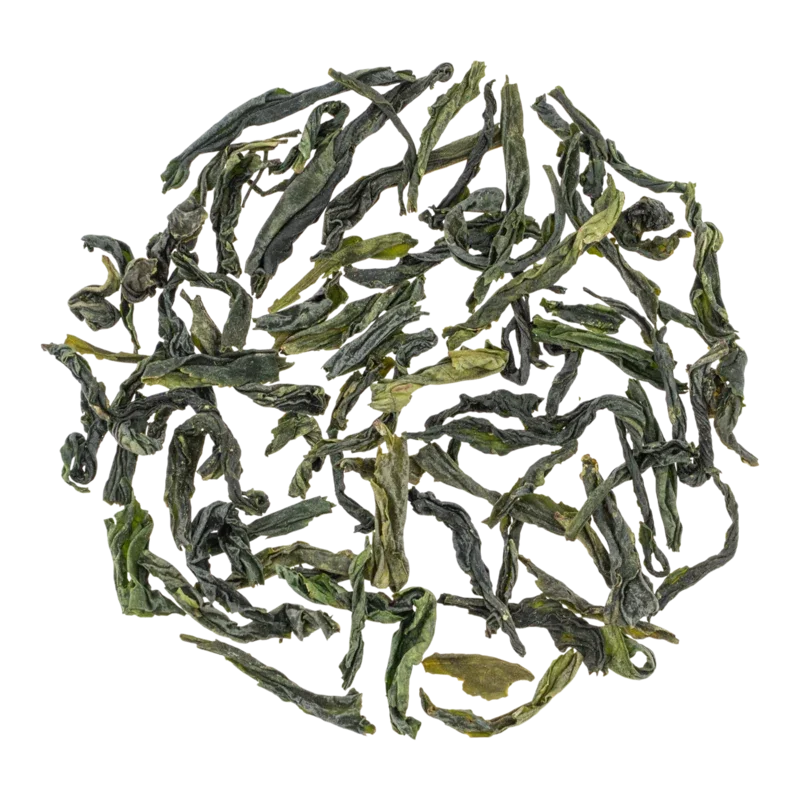
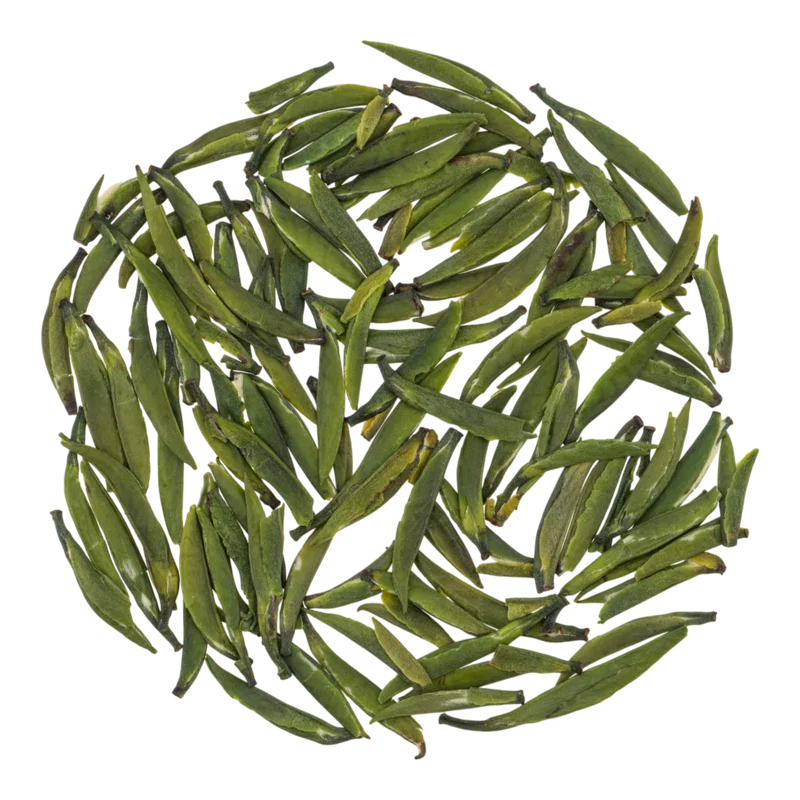
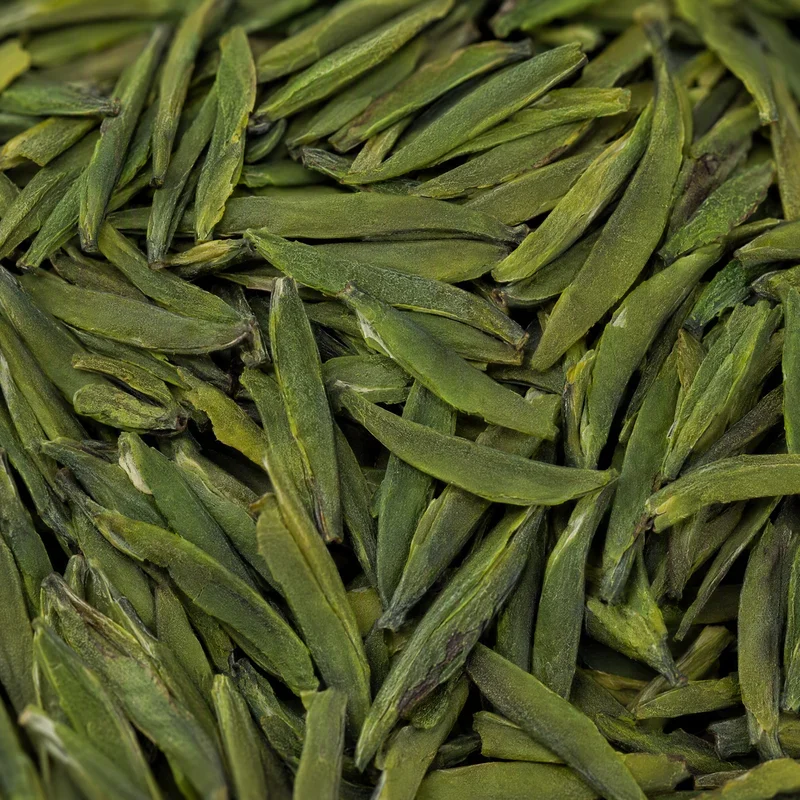
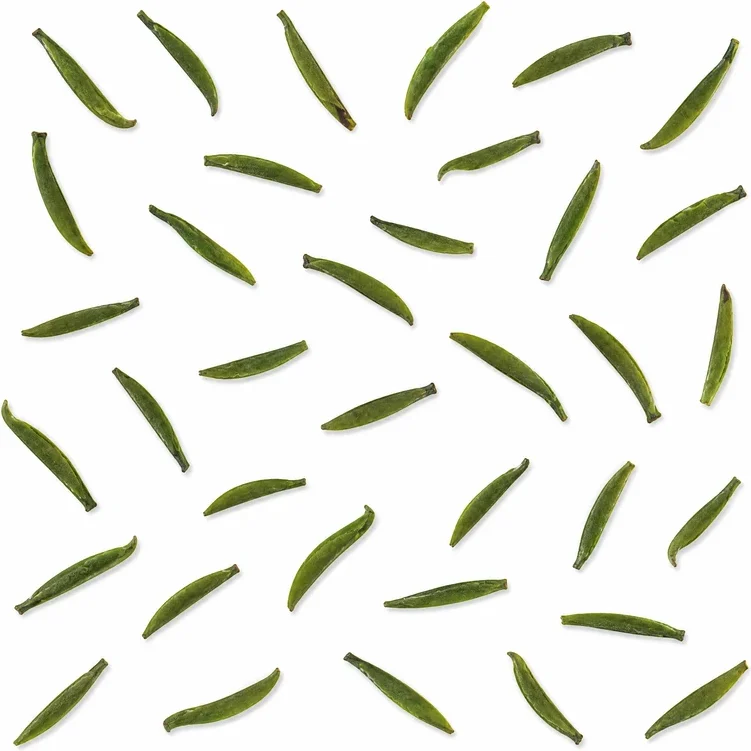
Dry Leaf Appearance: Flat, slender, straight (扁平挺秀), with abundant silvery down (显毫). Color — oily green, fresh (翠绿油润). Leaf even, uniform in size. Visually resembles Longjing, but with more pronounced down.
Dry Leaf Aroma: Clean, high, with distinct orchid note (兰花香, lánhuā xiāng). Spring picking has additional chestnut note (栗香).
Liquor Aroma: Persistent, long-lasting, with predominant orchid note. Aroma height is one of the main distinguishing features: according to geographical indication standard, aroma is characterized as "qing gao chijiu" (清高持久) — "clean, elevated, long."
Liquor Color: Tender green with light yellowish undertone (嫩绿微黄), clean and clear (清澈明净).
Spent Leaves: Tender green, bright (嫩绿明亮), even, lively (匀齐鲜活). Leaves open completely, demonstrating integrity and tenderness.
Taste: Fresh and mellow-rich (鲜醇, xiān chún), with pronounced sweet-rich fullness (甘厚, gān hòu). Aftertaste — long returning sweetness (回甘持久). Bitterness and astringency are absent with proper brewing. Liquor body — medium, with velvety texture.
Alkaloids: Caffeine — within typical limits for green tea (2.5–4%); theobromine, theophylline — in trace amounts.
Amino Acids: ≥4.6%. High L-theanine content is due to diffused light and daily temperature range over 10 °C.
≥44% — one of the highest indicators among famous green teas of China, which ensures extraordinary "density" and richness of liquor.
High ratio of amino acids to polyphenols (amino acids/polyphenols ≈ 0.2) — one of the markers of "mild," "sweet" green teas.
Essential Oils: Orchid aromatic profile is formed by linalool, geraniol and nerolidol.
Minerals: Zinc and selenium — in elevated concentrations, due to soil mineralization of Dabie Mountains.
Polyphenols: ≥23% (for first grade and above). Moderate level compared to southern green teas — precisely this explains mildness and absence of bitterness.
Vitamins: Vitamin C — 100–500 mg/100 g (significant variation depending on season and grade). B vitamins, vitamin E.
High vitamin C content (up to 500 mg/100 g) provides effective neutralization of free radicals and cellular membrane support.
Vitamin C promotes elimination of heavy metals (lead, cadmium) and reduction of radiation exposure consequences.
Combination of caffeine and L-theanine provides mild, steady alertness without anxiety — state of calm concentration.
Catechins stimulate fat oxidation; moderate regular consumption may contribute to cholesterol reduction and gallstone disease prevention (through stimulation of cholesterol conversion to bile acids).
Tea polyphenols are linked to blood pressure reduction and improved vascular elasticity.
L-theanine improves brain alpha rhythms, promoting mental clarity and concentration.
Antioxidant complex (vitamin C + catechins) supports collagen synthesis and protection from photoaging.
Moderate tannin content gently stimulates peristalsis without mucosal irritation.
When brewing in glass, you can add water when about 1/3 volume is consumed — this maintains stable concentration.
Tea Amount: 3 g per 150 ml (1:50 ratio).
Teaware: Glass tumbler (玻璃杯) — optimal for observing leaf form and liquor color; white porcelain gaiwan (盖碗) — for fuller aroma development and layered taste evaluation.
Water Temperature: 85–90 °C. Boiling water above 90 °C is categorically not recommended — high temperature destroys theanine and intensifies bitterness.
Enemies: Light, moisture, heat, foreign odors, oxygen. Do not store near strongly scented products.
Airtight light-proof packaging (aluminum foil + tin or pewter container). Store in refrigerator at 0–5 °C.
Most expressive in first 6–12 months. Fresh tea is recommended to "awaken" (醒茶) 7 days after opening — keep in air in light-protected place to dissipate residual "fire" taste. After opening — consume within 10 days.
For short-term storage (up to 2 months) cool dark place at room temperature is acceptable.
Closest geographical neighbor, one of the "Ten Famous Teas of China." Both are from Henan, both with abundant down. However, Mao Jian has rounded, finely twisted form (细圆光直), while Xue Lü has flat and slender. Mao Jian aromatics are more chestnut-beany; Xue Lü has pronounced orchid note. Xinyang terroir is somewhat higher (800–1000 m), but without such bright northern exposure effect.
Reference flat green tea. Yangtian Xue Lü leaf form visually resembles Longjing, but Xue Lü has more pronounced down (毫), while best Longjings are smooth. Longjing aromatics are chestnut-beany, more "roasted"; Xue Lü is more floral (orchid). Longjing is chao-qing (wok firing); Xue Lü is hongqing (heat drying), giving softer, more "airy" aroma.
Anhui flat green tea, also from Dabie Mountain zone, but significantly large-leaf. Hou Kui is the "biggest" of flat green teas; Xue Lü is conversely miniature. Hóu Kuí aromatics are orchid (兰花香), which relates it to Xue Lü, but Hou Kui taste is more oily and "voluminous."
Eastern neighbor in Dabie Mountains. Unique in being produced from leaf blade without bud. Form — rolled "melon seed slice." Aromatics — more "heated," chestnut. Absence of bud gives less tender but more saturated taste.
Second famous tea of Gushi. Produced at same latitudes but by technology closer to classical Xinyang Mao Jian. Form — rounded, twisted; aroma — chestnut. If Jiuhuashan Mao Jian is "traditional" representative of Gushi teas, then Yangtian Xue Lü is "authorial innovator."
Authentic Yangtian Xue Lü is flat, slender, with pronounced gloss and abundant silvery down. Imitations often have looser or irregular structure.
Real tea has persistent orchid aroma without "hay," grassy or sour smell.
Tender green with yellowish undertone, clean and clear. Cloudy or dark green liquor is sign of substitution or improper storage.
Suspiciously low price for "supreme grade" is sign of substitution with cheaper raw material.
Prefer products with geographical indication marking (国家地理标志产品) from Gushi County. Brands tied to specific Yangtian Wa tea farms are reliable.
No reviews yet. Tell us what you think of this tea.
Rate this tea and share your impressions. We review each submission before publishing it.