Brewing
Gongfu brewing
- Water temperature
- 75 °C
- Tea amount
- 5 g
- Water volume
- 100 ml
- First steep
- 10 s
- Time added per infusion
- 5 s
- Infusions
- 3

Xīshān chá
Choose a brewing method. Start with the recommended quantities and time, then adjust to taste.
Brewing
Brewing
Taste
Tea encyclopedia
Category: Geographical indication product (国家地理标志保护产品, since 2010); included in China-EU mutual recognition registry of geographical indications (中欧地理标志互认名录, 2021). Intangible cultural heritage of Guigang city (2019). Twice "National Famous Tea of China" (全国名茶, 1986, 1990). One of 21 historical famous teas of China and one of the "24 Great Teas" of the Qing empire.
Category: Geographical indication product (国家地理标志保护产品, since 2010); included in China-EU mutual recognition registry of geographical indications (中欧地理标志互认名录, 2021). Intangible cultural heritage of Guigang city (2019). Twice "National Famous Tea of China" (全国名茶, 1986, 1990). One of 21 historical famous teas of China and one of the "24 Great Teas" of the Qing empire.
Coordinates: ~23°10′–24°10′ N, 109°30′–110°30′ E (Guiping territory).
Origin: China; Guǎngxī Zhuāng Autonomous Region (广西壮族自治区, Guǎngxī); Guiping county-level city (桂平市, Guìpíng Shì), part of Guigang prefecture-level city (贵港市, Guìgǎng Shì). Protection zone — entire territory of Guiping (26 townships and towns, 4074 km²). Quality core — Xīshān mountain (西山, ancient name 思灵山, Sīlíng Shān), area of Chess Stone (棋盘石, Qípán Shí), Milk Spring (乳泉井, Rǔquán Jǐng) and Xǐshí hermitage (洗石庵, Xǐshí Ān) — at altitude up to 700 m, in the primeval forest zone.
Type: Green tea (non-oxidized, 绿茶, lǜchá). Kill-green fixation — pan-firing in iron wok (铁锅, tiěguō) at 180°C, method of "shake + smother" (抖闷结合, dǒu mèn jiéhé). Shape — twisted threads (条索形, tiáosuǒ xíng).
This phrase was spoken twice — Qing county gazetteer (19th century) and Mao Zedong (1950s). Two centuries between them, but the assessment is the same: Xishan Cha is on the level of China's best green tea.
Unique characteristic: spring — qingxiang (pure green), summer — pear, autumn — deep creamy, winter — lotus. This is a consequence of Xishan's unusual inverted temperature regime.
According to legend, a woodcutter met two immortals playing chess on the mountain, tasted their tea and spent one day beside them — and returning, discovered that a hundred years had passed. Tea trees grew where he had forgotten his axe. Hence the tea's second name — "Chess Tea" (棋盘茶).
Rǔquán (乳泉) — a spring with white, "milky" water, flowing from granite rocks of Xishan. Considered ideal water for brewing Xishan Cha; by mineral composition — close to the best mountain springs of Europe.
In the 1950s Xishan Cha was gifted to the King of Morocco — one of the early episodes of China's "tea diplomacy." In 2021 inclusion in the China-EU registry opened the European market.
The revival of Xishan Cha is the merit of two Buddhist nuns: Kuanneng and Changhui. In post-war years they restored destroyed gardens and developed the technique of "light rolling to reveal down" (轻揉显毫), which became the calling card of modern Xishan Cha.
Cultural Significance: Xishan Cha is one of the few Chinese teas inseparably connected with Buddhist culture. The tradition of "禅茶一味" (chán chá yī wèi, "Chan and tea are of one taste") has been alive here since Tang times: monks and nuns not only grew and processed tea, but also used it as an instrument of meditation. The Milk Spring Ruquan is a famous natural attraction of Guangxi: its water, white as milk, is considered ideal for brewing Xishan Cha. A local saying states: "The mountain has good scenery, tea has good taste" (山有好景,茶有佳味). In the 1950s the tea was sent as a gift to the King of Morocco — one of the early examples of China's "tea diplomacy."
Name Breakdown: 西山 (Xīshān) — "Western Mountain" — famous Buddhist mountain in Guiping, one of four "Great Southern Buddhist Places" (南方四大佛教名山). Ancient name — Silingshan (思灵山, "Mountain of Thoughtful Spirit"); 茶 (Chá) — "tea". Alternative names: Qípán Chá (棋盘茶, "Chess Tea") and Qípán Xiānmíng (棋盘仙茗, "Immortal Tea from the Chess Board") — after the legend of the immortals.
Cultivar: Guìpíng Xīshān group variety (桂平西山茶群体种, Guìpíng Xīshān Chá Qúntǐzhǒng) — local bush small-leaf variety Camellia sinensis var. sinensis. Leaves elliptical, dark green, with abundant down. Weight of 100 shoots "bud + 3 leaves" — ~46 g. Biochemical profile: amino acids ≥3.2%, polyphenols ≥27.5% (spring raw material). Water-extractable substances ~50% — exceptionally high indicator.
Picking: Practically year-round — from late February to November, 20–30 batches per season. Four seasons give four different aromatic profiles: spring — qingxiang (清香, pure green), summer — lixiang (梨香, pear), autumn — chunxiang (醇香, deep/creamy), winter — hexiang (荷香/莲香, lotus).
Pluck Standard: Highest grade — single buds or bud with one half-opened leaflet. Length — ≤4 cm. Uniformity in size, length and color required.
Raw Material: Tender, whole, fresh shoots. Hand picking — exclusively by hand, without scissors. Careful transport in bamboo baskets without damage or crushing.
Altitude: Up to 700 m (core zone — Chess Stone, Milk Spring, Guanyin Rock). Main plantations — 200–700 m.
Climate: Southern subtropical. Average annual temperature 21.4°C; precipitation 1700–2400 mm/year (one of the wettest tea regions of China); foggy days >200 per year; frost-free period 354 days. Peculiarity — "夏不热而秋热,冬不寒而春寒" ("summer not hot but autumn hot; winter not cold but spring cold") — inverted temperature regime, stimulating unusual accumulation of aromatic substances.
Soil: Yellow-red sandy loams (黄红砂壤), formed by granite weathering. pH 4.5–6.5, organic matter 2–3%. Good drainage, enriched with minerals from granite substrate. Core zone — water protection area (水源保护区), where chemical fertilizers and pesticides are prohibited.
Core gardens are located among primeval forest on Xishan slopes, near Ruquan spring. High humidity, diffused light (>70% of light flow) and constant fogs create ideal conditions for synthesis of amino acids and aromatic compounds. Irrigation water — from Milk Spring, mineralized with calcium and magnesium. Xishan mountain is one of the most important Buddhist sanctuaries of Southern China, which ensures strict ecological control: the territory is a national protected zone with restrictions on economic activity. This is a natural guarantee of environmental purity, additional to geographical indication standards.
Hand picking, standard "bud + one-two leaves", ≤4 cm.
4–6 hours on bamboo trays.
In iron wok at 180°C, by method of "shake + smother" (抖闷结合) — alternating tossing of leaf in air and pressing it to hot surface. Combination of techniques "lift, throw, shake, cast off" (扬、抛、抖、甩).
Light hand rolling — formation of thread-like structure.
Shape fixation.
At 80°C on traditional bamboo basket-braziers (竹焙笼, zhú bèi lóng).
Last "finishing" firing to form chestnut and floral-fruity aroma. Moisture content ≤5%.
The entire process is conducted without metal tools (except iron wok for fixation) — bamboo and wooden implements exclude contact with oxidizing metals. This principle echoes the "Three NOTs" (三不原则) of Xinyi He Luo Green Tea: both traditions independently arrived at the same conclusion — contact of tea with metal deteriorates polyphenol quality.
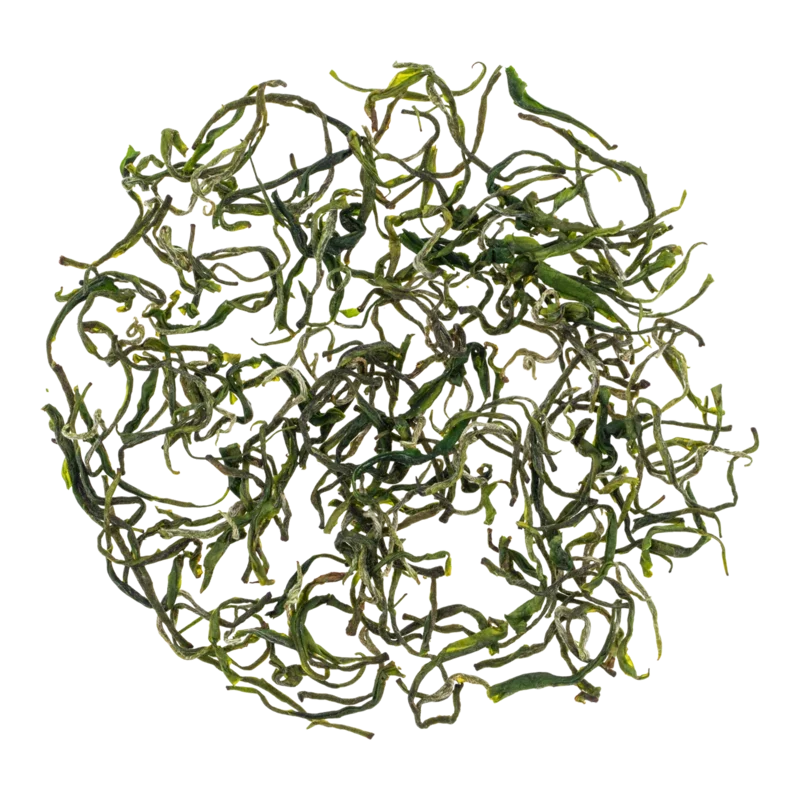
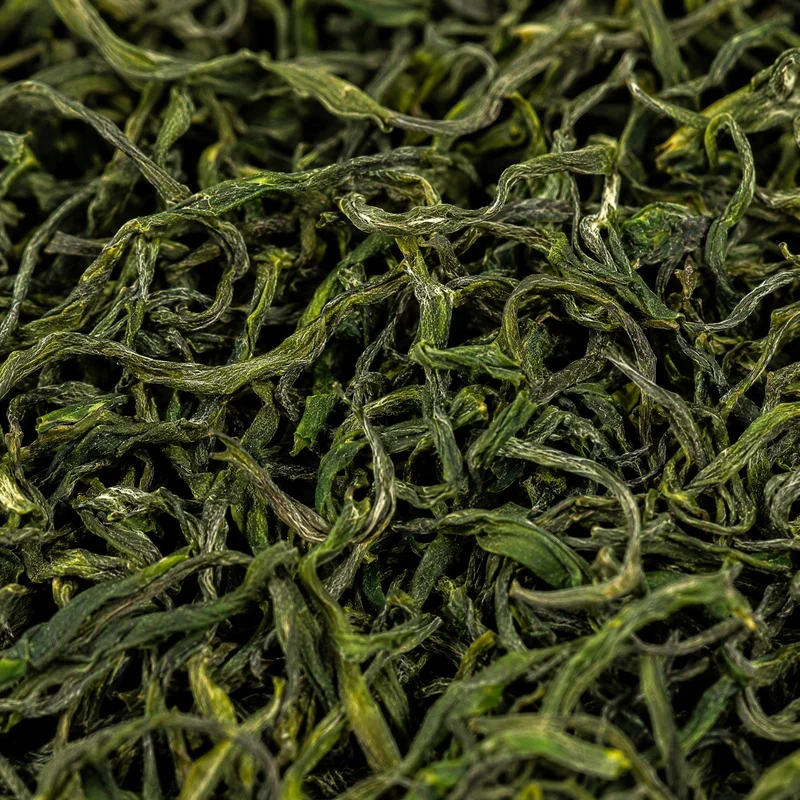
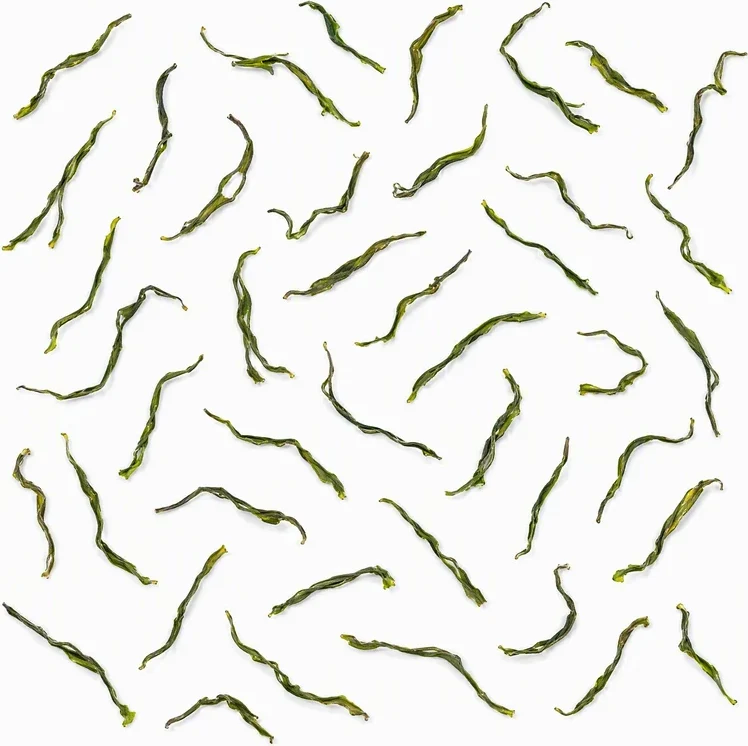
Dry Leaf Appearance: Thin, tight, slightly curved threads (紧细微曲), dark green with silvery down (黛绿显毫). "Dragon spiral" (龙卷状, lóng juǎn zhuàng) — characteristic shape with pointed tips. Silver tips cover the tops.
Dry Leaf Aroma: Depends on season. Spring — pure green (清香); summer — pear (梨香); autumn — deep creamy (醇香); winter — lotus (莲香/荷香). Persistent and multi-layered.
Liquor Aroma: Floral-fruity (花果香) — unique "four-season" characteristic, atypical for most green teas. With cooling, chestnut background emerges.
Liquor Color: Emerald green, clear and bright (碧绿清澈).
Spent Leaves: Tender green, even, fresh and lively (嫩绿匀整鲜活).
Taste: Pure and harmonious (醇和, chún hé), with pronounced freshness (鲜爽) and long returning aftertaste (回甘持久). Full-bodied, but without coarse astringency. Endurance — 3–6 infusions.
Amino Acids: ≥3.2% (spring tea). L-theanine dominates.
~50% — one of the highest indicators among green teas, testifying to exceptional richness and "density" of liquor.
≥3.9% — above average, providing pronounced tonic effect.
Minerals: Potassium, manganese, fluorine; traces of calcium and magnesium from granite soils and mineral water of Ruquan.
Polyphenols: ≥27.5%; according to some data, up to 35.6% in core batches. Good balance with amino acids, ensuring softness without excessive astringency. High EGCG content.
Vitamins: Vitamin C, B-group vitamins, vitamin E. Flavonoids.
Polyphenols (≥27.5%) + flavonoids + vitamin C — comprehensive protection from oxidative stress.
Caffeine (≥3.9%) in synergy with L-theanine — gentle, prolonged alertness.
Catechins promote cholesterol regulation and vascular elasticity.
Flavonoids and vitamin C jointly inhibit oxidation and reduce UV damage — especially relevant for southern latitudes of Guangxi with intense solar radiation.
L-theanine stimulates alpha-wave brain activity.
Listed properties are based on general data and are not medical recommendations. Not recommended to drink on empty stomach. Fresh tea should be aged 7 days to "discharge fire." After opening — consume within 10 days.
Process: Rinse 5 seconds → first steeping 20 seconds → each subsequent +10 seconds. 3–6 infusions.
Tea Amount: 3 g per 150 ml (ratio 1:50).
Teaware: Glass tumbler — for observing "standing shoots" (芽叶竖立); white porcelain gaiwan.
Water Temperature: 80–85°C. Ideally — mineral water, close in composition to Ruquan (soft, slightly alkaline). Do not use boiling water (>85°C destroys active substances and causes bitterness).
Container: Airtight, without foreign odors.
Light: Complete isolation.
Recommended to consume in first 6 months for maximum brightness of "four-season" aroma. Fresh tea — age 7 days "醒茶" (tea awakening) to discharge "fire." Winter batches (lotus aroma) keep longer than spring ones due to lower moisture content.
Temperature: 0–5°C (refrigerator).
Guangxi, Liuzhou. More "northern" by location. Chestnut-orchid profile, endurance 5–7 infusions. Xishan — more "floral-fruity," with unique lotus winter aroma. Sanjiang — mass production (215,000 mu); Xishan — boutique (20,500 mu), with higher status.
Guangxi, Baise. High-altitude (800–1500 m), from Lingyun White Down cultivar. More delicate, "silvery" tea with abundant down. Xishan — "warmer" in profile, with more complex aromatics and Buddhist cultural significance.
Zhejiang. Comparison is inevitable: two gazetteers — Qing and Republican — assert that Xishan "is not inferior to Longjing," and Mao Zedong confirmed this in the 20th century. Longjing — flat, chestnut-nutty; Xishan — twisted, floral-fruity. Longjing — significantly more expensive and famous; Xishan — less promoted, but with unique "four-season" aroma and Buddhist history, which Longjing lacks.
No reviews yet. Tell us what you think of this tea.
Rate this tea and share your impressions. We review each submission before publishing it.