Brewing
Gongfu brewing
- Water temperature
- 75 °C
- Tea amount
- 5 g
- Water volume
- 100 ml
- First steep
- 10 s
- Time added per infusion
- 5 s
- Infusions
- 3

Wùyuán xiān zhī
Choose a brewing method. Start with the recommended quantities and time, then adjust to taste.
Brewing
Brewing
Taste
Tea encyclopedia
Category: Regional famous tea (地方名茶, dìfāng míngchá) within the "Wuyuan Lu Cha" (婺源绿茶, Wùyuán Lǜchá) system — tea with protected geographical indication (地理标志产品).
Category: Regional famous tea (地方名茶, dìfāng míngchá) within the "Wuyuan Lu Cha" (婺源绿茶, Wùyuán Lǜchá) system — tea with protected geographical indication (地理标志产品).
Coordinates: Approximately 29°01′–29°35′ N, 117°22′–118°11′ E (according to the boundaries of the "Wuyuan Lu Cha" geographical indication zone).
Origin: China, Jiāngxī Province (江西省, Jiāngxī Shěng), Shàngráo City (上饶市, Shàngráo Shì), Wùyuán County (婺源县, Wùyuán Xiàn). Main production area — the Dà Zhāng Shān (大鄣山, Dà Zhāng Shān) mountain range and adjacent townships: Duanshen (段莘), Xīkǒu (溪口), Qinghua (清华), Tuochuan (沱川), Zheyuan (浙源) and others among 16 townships within the protected zone.
Type: Green tea (non-oxidized), 炒青 (chaoqing, 炒青 — tea fixed by pan-firing in a wok).
Cultural Significance: Wùyuán is the birthplace of Zhú Xī (朱熹, Zhū Xī, 1130–1200), the great Neo-Confucian philosopher, who was a passionate tea lover and called himself a "tea immortal" (茶仙, cháxiān). The county was part of Huīzhōu (徽州, Huīzhōu) — one of China's key cultural regions — from the 8th century until 1934. Tea culture here is inextricably intertwined with the traditions of Huizhou merchants: it was precisely Huizhou traders who brought Wuyuan green tea to the international market as early as the 19th century under the brand "婺绿" (Wùlǜ — "Wuyuan green"). Part of the famous "Tunxi Lu Cha" (屯溪绿茶, Túnxī Lǜchá — "屯绿") was historically produced from Wuyuan raw material. Today the county positions itself as "China's most beautiful village" (中国最美的乡村), and tea is its calling card: tea garden area exceeds 168,000 mu (ca. 11,200 hectares), annual spring tea production — more than 7,400 tons.
History: Wuyuan County has a documented tea cultivation history spanning more than 1,200 years. In the "Classic of Tea" (茶经, Chájīng) by Lù Yǔ (陆羽, Lù Yǔ) of the Tang era, it is mentioned that in Shezhou (歙州, Shēzhōu, — the administrative unit of that time, which included Wuyuan) "tea grows in the mountain valleys of Wuyuan" (茶生婺源山谷). In the "Memoirs of the Court Cook" (膳夫经手录, Shànfū Jīngshǒu Lù) by Yáng Huā (杨华) of the Tang period (Dazhong era, 大中, ca. 856 CE), it is directly stated that "Wùyuán compressed tea (婺源方茶) is excellently made, without admixture of tree leaves; from Liang to Song, from Yan to Bing, people highly value it." The name "Xian Zhi" (仙枝) itself first appears in the "Hongzhi Huizhou Fu Zhi" (弘治徽州府志, ca. 1488–1505) of the Ming era: among local tea varieties are listed "Shengjin, Nensang, Xian Zhi, Laiquan, Zhuchun, Yunhe, Huaying" (胜金、嫩桑、仙枝、来泉、朱春、运合、华英). During the Ming era, Wùyuán tea was presented to the court as tribute tea (贡茶, gòngchá). In the early 20th century, American researcher William Ukers in "All About Tea" called Wuyuan green tea "not only the best of the lu-cha category, but also the highest in quality among all Chinese green teas." In 2008, "Wuyuan Lu Cha" received protected geographical indication status (原国家质检总局2008年第122号公告). In 2010 — agricultural geographical indication status from China's Ministry of Agriculture. In 2020, Wuyuan green tea was included in the first list of mutually recognized geographical indications between China and the EU. In
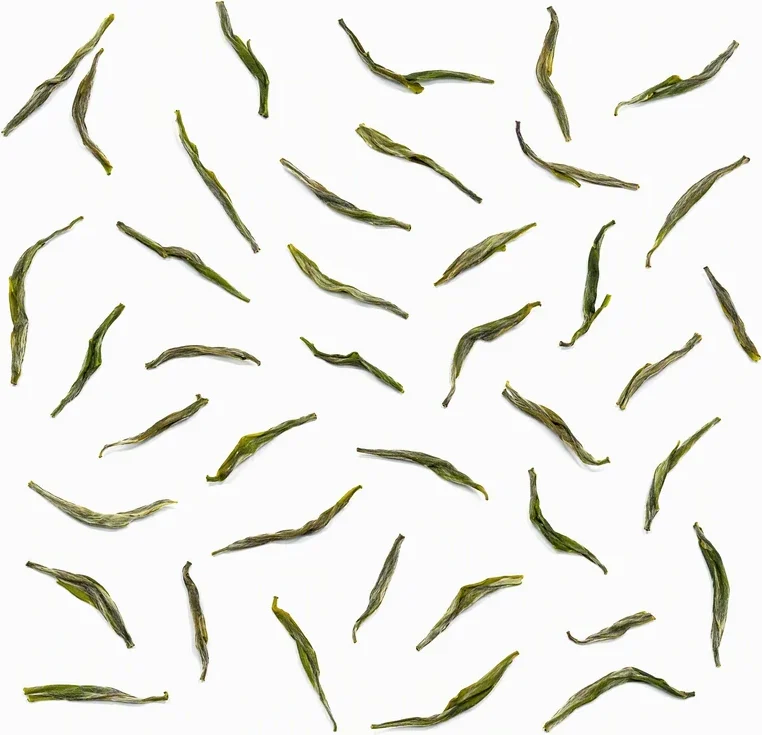
Name Breakdown: 婺源 (Wùyuán) — county name, literally "source of the Wu River" (婺江); 仙 (xiān) — "celestial," "immortal"; 枝 (zhī) — "branch," "shoot." The name "Xian Zhi" is explained by the form of the finished tea: dry tea leaves resemble straight thin pine twigs reaching upward, as if "branches of celestials." The variant writing "仙芝" (xiānzhī — "celestial lingzhi mushroom") is also encountered, however 仙枝 ("celestial branch") is canonical.
Cultivar: The foundation of plantations consists of local population varieties (群体种, qúntǐ zhǒng), adapted to mountain terroir over centuries. Among them stands out the Shàng Méi Zhōu (上梅洲, Shàng Méizhōu) variety — a non-clonal variety developed in Shang Mei Zhou village, Meilin township, Wuyuan County. This is a large-leaf type shrub plant, early-maturing, with densely pubescent buds; it is the reference raw material for the famous "Wuyuan Mingmei" (婺源茗眉). For Xian Zhi, seedlings of this and similar local varieties are also used.
Picking: Main harvest — spring, from late March to mid-April (before and after Qingming). For premium batches — early spring (ming qian, 明前, míng qián). High-mountain plantations (above 800 m) often harvest slightly later due to late vegetation.
Pluck Standard: One bud and two upper leaves (一芽二叶, yī yá èr yè), just beginning to unfold (初展, chūzhǎn). For Xian Zhi, the integrity of the shoot, its freshness and absence of mechanical damage are important.
Raw Material: Shoots must be uniform in length and color, without purple leaves, without pest damage, without foreign plant impurities.
Altitude: From 200 to 1,630 m a.s.l. (highest point — Zhanggongshan peak, 鄣公山, 1,629.8 m). Premium batches of Xian Zhi are collected predominantly at altitudes from 800 to 1,000 m and higher.
Climate: Subtropical monsoon, average annual temperature 16.7°C. Characterized by the formula "on clear days morning and evening — fog everywhere, on cloudy days — clouds on all mountains" (晴时早晚遍地雾,阴雨成天满山云). Abundant diffused light favors amino acid accumulation.
Soil: Red-yellow soils (红黄壤, hóng huáng rǎng) predominate with pH 4.5–6.5, deep humus horizon, high organic content and good drainage capacity. About 90% of tea garden soils belong to this type.
About 1,800 mm/year, with maximum in spring and early summer.
Forest coverage of the county — about 86%. Many plantations are located in natural surroundings of broad-leaved forests, creating conditions of "natural shading" and biodiversity that reduces the need for pesticides.
Topography: The county is located at the junction of three provinces (Jiangxi, Anhui, Zhejiang), surrounded by the Huaiyushan (怀玉山) and Huángshān (黄山) ranges. Mountains occupy more than 85% of the area; a local saying states: "eight and a half parts mountains, one part fields, half part waterways and gardens" (八分半山一分田,半分水路和庄园).
Hand picking according to the "four selections" standard (四选, sì xuǎn) — selection of garden, bush, branch and bud. The rule of "eight prohibitions" applies (八不采, bā bù cǎi): do not pick non-standard, do not pick too thin or too large shoots, do not pick diseased and damaged leaves, do not pick shoots without buds, do not pick shoots with elongated internodes, do not pick scaly and "hoof-shaped" leaves, do not pick in rain, do not pick at the height of midday heat.
Freshly picked shoots are spread in a thin layer on bamboo trays in a cool, ventilated room. The process lasts 4–8 hours (no more than 10). The leaf loses surface gloss, becomes soft, moisture decreases to 70–72%, a light fresh aroma appears.
Key stage — high-temperature pan-firing in a wok (flat pan). Wall temperature 110–200°C according to the principle "first high, then lower" (先高后低). Batch size — about 220–250 g for hand firing. In the first 1–2 minutes — slow stirring for rapid heating; then — vigorous tossing to remove moisture and grassy smell. After ~5 minutes the leaf darkens from bright green to dark green, becomes soft, primary tea aroma appears. Moisture content decreases to ~60%.
Forms cellular structure, releasing juices and setting the shape of tea leaves. Requires high skill — the degree of pressure determines the richness of the future liquor.
Giving the characteristic Xian Zhi form — thin straight "twigs" with tight rolling.
Preliminary drying at moderate temperature.
Redistribution of residual moisture within the leaf.
Drying to stable moisture (~6–7%) and "lifting aroma" — stage that forms characteristic chestnut notes (栗香, lìxiāng).
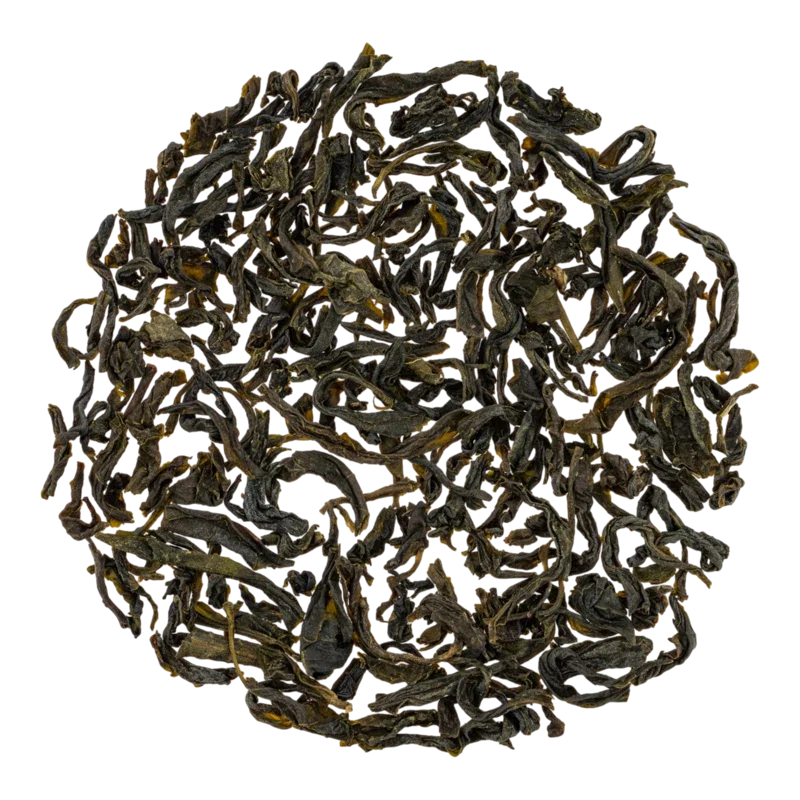
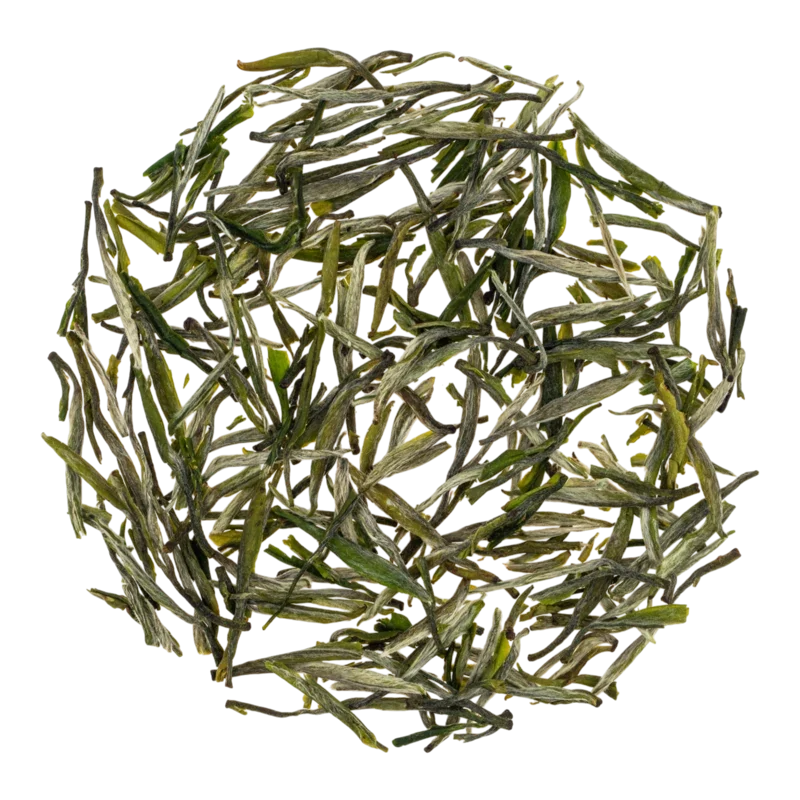
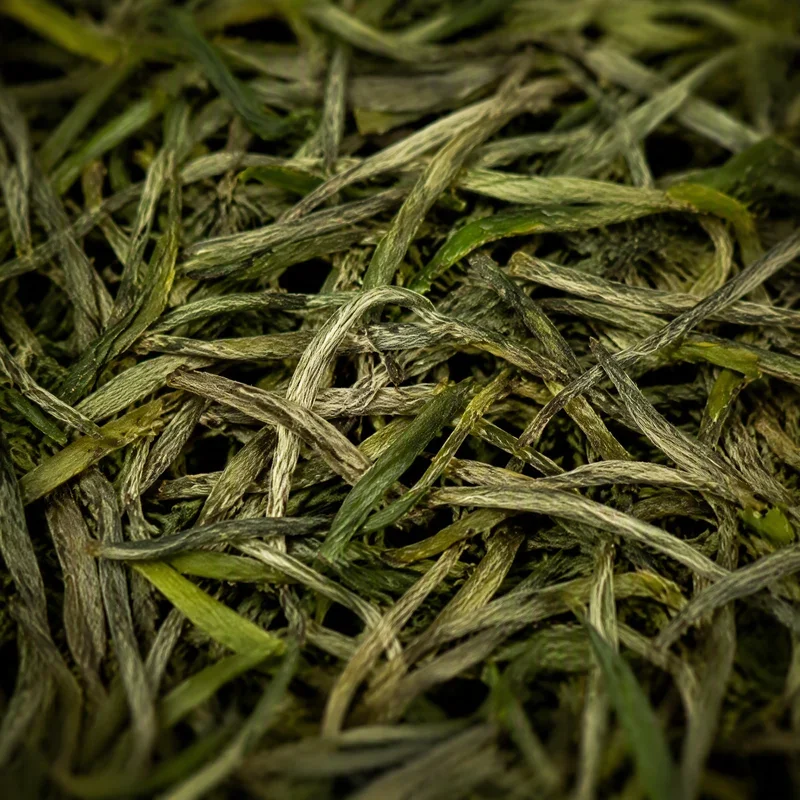
Dry Leaf Appearance: Thin, straight, tightly rolled tea leaves resembling pine needles or twigs. Color — rich dark green (翠绿, cuìlǜ) with oily luster. White down (white pekoe, 白毫, báiháo) is visible on the surface, especially at the base of buds.
Dry Leaf Aroma: Clean, high, with distinct chestnut tone (栗香) and light overtone of field flowers.
Liquor Aroma: Persistent and clean. Roasted chestnut dominates (板栗香, bǎnlì xiāng), complemented by a subtle orchid overtone (兰花香, lánhuā xiāng). Aroma persists through several infusions.
Liquor Color: Clean, bright, from light green to yellow-green (碧绿清澈明亮). High transparency.
Spent Leaves: Tender green, even, with well-preserved structure of bud and two leaves. Leaves are soft and elastic.
Taste: Fresh (鲜爽, xiānshuǎng), soft, with pronounced sweetness and full body. Lǒng aftertaste with growing sweetness (回甘, huígān) and sensation of purity.
Alkaloids: Caffeine (咖啡碱) — ~2–4% of dry mass. Theobromine and theophylline — in trace amounts.
Amino Acids: Elevated content — data from the Tea Research Institute of CAAS (中国农业科学院茶叶研究所, 2005) showed that Wuyuan green teas have one of the highest catechin indices in the country, and the content of water-soluble extractive substances significantly exceeds the national standard (水浸出物 ≥ 36.0%). L-theanine (L-茶氨酸) — key amino acid responsible for taste sweetness and calming effect — accumulates more intensively thanks to mountain mists and diffused light.
Linalool, geraniol, nerolidol, methyl salicylate — responsible for chestnut and floral tones in aroma.
According to inspection data, Wuyuan green teas are distinguished by exceptionally high content of water-soluble extractive substances with moderate polyphenol content, creating a "rich but mild" flavor profile.
Minerals: Potassium, manganese, fluorine, zinc, selenium (in trace amounts, depends on soil).
Polyphenols: Content — on average about 20–27% of dry mass (characteristic of high-mountain green teas of Jiangxi). Main fraction — catechins (EGCG, EGC, ECG), providing astringent tone and antioxidant potential.
Vitamins: C (ascorbic acid), B₁, B₂, E, K. High vitamin C content — characteristic feature of green teas that preserve it thanks to gentle heat treatment.
High catechin content (especially EGCG) provides powerful protection of cells from oxidative stress.
Combination of caffeine and L-theanine gives calm, steady surge of attention without sharp excitement — classic "tea focus."
Regular green tea consumption is associated with lowering "bad" cholesterol (LDL) levels and improving vascular elasticity.
Polyphenols stimulate peristalsis and support healthy intestinal microflora. Tea goes well with light food.
Fluorine and catechins have mild antibacterial effect and help maintain gum health.
L-theanine promotes generation of brain alpha waves, improving the state of relaxed concentration.
Green tea antioxidants slow skin photoaging.
People with increased caffeine sensitivity should observe moderation; strong green tea is not recommended on an empty stomach.
Tea Amount: 3 g per 150 ml (glass cup) or 5 g per 150 ml gaiwan.
Teaware: Transparent glass cup with straight walls (ideal for observing the unfolding of "twig" tea leaves), porcelain gaiwan or thin-walled porcelain teapot.
Water Temperature: 75–85°C. For delicate early spring batches — 75–80°C; for more mature raw material — up to 85°C.
Container: Airtight, opaque — tin cans with tight lids or vacuum bags made of foil material are preferable. Contact with foreign odors is inadmissible.
Shelf Life: For best taste — consume within 6–12 months after production. Xian Zhi is not a tea that benefits from aging; freshness here is the main virtue.
Enemies of green tea. Store away from direct light and moisture sources.
Temperature: Optimally — refrigerator, 0–5°C, in airtight packaging. Without refrigerator — cool dry place (no higher than 10°C).
Flagship of the Wuyuan tea line. Harvested from more tender raw material (one bud and one leaf or bud with first unfolding leaf), has curved form resembling an eyebrow (眉). Taste is more refined and delicate, price higher. Xian Zhi is a more "popular" version: stronger, richer, with pronounced chestnut character.
Famous Anhui green tea from neighboring region. Form — slightly curved, resembling sparrow tongue. Aroma — gently floral and sweetish, without chestnut tones. Maofeng is hong-qing (烘青, hōngqīng — heat drying), while Xian Zhi is chao-qing (炒青 — pan-firing).
Henan green tea with powerful white down and dense astringent taste. Compared to Xian Zhi — more astringent and "northern" in character; Xian Zhi has softer and sweeter body.
Another Jiangxi competitor. Conditionally "thicker" leaf, powerful and rich taste. Xian Zhi is more elegant and drier in style.
Price Category: Medium and medium-high segment among Chinese green teas. Early spring batches (明前) from high-mountain Da Zhang Shan plantations cost significantly more than summer harvests. Xian Zhi is one of the most affordable teas in the "Wuyuan Lu Cha" line, inferior in cost to premium "Wuyuan Mingmei" (婺源茗眉).
No reviews yet. Tell us what you think of this tea.
Rate this tea and share your impressions. We review each submission before publishing it.