Brewing
Gongfu brewing
- Water temperature
- 95 °C
- Tea amount
- 6 g
- Water volume
- 100 ml
- First steep
- 10 s
- Time added per infusion
- 5 s
- Infusions
- 4

Táiwān Yúchí āsàmǔ hóngchá
Choose a brewing method. Start with the recommended quantities and time, then adjust to taste.
Brewing
Brewing
Taste
Tea encyclopedia
Category: Taiwanese red tea from Sūn Moon Lake (日月潭紅茶, Rìyuètán Hóngchá). Product with protected geographical indication.
Category: Taiwanese red tea from Sūn Moon Lake (日月潭紅茶, Rìyuètán Hóngchá). Product with protected geographical indication.
Coordinates: Approximately 23°52′ N, 120°54′ E.
Origin: Taiwan (臺灣), Nántóu County (南投縣, Nántóu Xiàn), Yúchí Township (魚池鄉, Yúchí Xiāng), vicinity of Sun Moon Lake.
Type: Red tea (紅茶, hóngchá) — fully oxidized (oxidation degree 90–100%). In Western classification — black tea.
Cultural Significance: Yuchi Assam and other red teas from Sun Moon Lake are the pride of Taiwanese tea production and a symbol of the successful combination of borrowed traditions with unique local terroir. Tea from Yuchi has repeatedly been used as a diplomatic gift when receiving high-ranking guests. The Sun Moon Lake region has protected geographical indication status, and tea plantations have become an important element of local tourism infrastructure.
History: The history of Taiwanese Assam red tea is inextricably linked to the Japanese colonial period. In 1925 (Taishō period), the Agricultural Bureau of the Taiwan Governor-General purchased seeds of large-leaf tea varieties — Jaipuri, Manipuri and Kyang — from the Indian state of Assam and sent them for trials to several experimental stations. Plantings in Pingzhen, Linkou and Kyushu (Japan) failed, but in the Liánhuāchí (蓮華池, Liánhuāchí) basin near Yuchi, the varieties took root and showed excellent growth. In 1936, the Yúchí Red Tea Experimental Station (魚池紅茶試驗支所, Yúchí Hóngchá Shìyàn Zhīsuǒ) was established on Mount Māolán (貓囒山, Māolán Shān) on the shores of Sun Moon Lake. A key role in its creation was played by Japanese agronomist Arai Kokichiro (新井耕吉郎, 1904–1946), later dubbed the "father of Taiwanese red tea." Arai built a Ceylon-type tea factory and established serial production. The first batches of tea were sent to the London auction and received high ratings. Taiwanese Assam tea was even presented to the Japanese emperor as a gift. After Japan's defeat in World War II, Arai refused to leave Taiwan and continued to pass on the technology to local masters. In the post-war decades, production declined amid competition from Indian and Ceylon teas, but was revived through the efforts of the Taiwan Tea Research and Extension Station (茶業改良場, Cháyè Gǎiliáng Chǎng, TRES). In 1973, cultivar Taicha No. 8 (台茶8號, Táichá Bā Hào, TTES No. 8) was officially selected and registered from
Cultivar: Taicha No. 8 (台茶8號, Táichá Bā Hào, TTES No. 8) — large-leaf variety of Camellia sinensis var. assamica, developed by individual selection from the Indian Jaipuri line. Bush is upright, tree-type, belongs to large-leaf, early-ripening varieties. Leaf blade is elongated-elliptical, large (12–15 cm), dark green, with high polyphenol content. Plants reach 4–6 m in height. Has no official trivial name (unlike TTES No. 12 "Jin Xuan" or TTES No. 18 "Hong Yu"), so it is colloquially called simply "Assam" or "Yuchi Hong Cha."
Picking: Traditional hand-picking is applied. Standard — one bud and two upper young leaves (一心二葉, yī xīn èr yè). Summer picking (June–July) is considered optimal, when the best ratio of tannins, caffeine and aromatic substances is achieved. Nevertheless, picking is conducted throughout a long season — from spring to autumn.
Raw Material: Only healthy, undamaged flushes picked in the optimal vegetation phase are used. Presence of golden tips (buds with down) is a sign of high quality.
Altitude: 600–800 m above sea level.
Climate: Subtropical monsoon. High humidity, abundant precipitation (about 2000 mm annually), evenly distributed due to lake influence. Average annual temperature about 20°C. Characterized by significant diurnal temperature variations (from +25°C during day to +15°C at night), stimulating accumulation of aromatic substances in tea leaves. Short duration of sunshine due to frequent clouds and fogs.
Soil: Fertile red soils with acidic reaction (pH 4.5–5.5), rich in organic matter (over 3%). Soil composition provides good aeration and drainage.
Plantations are located on hilly slopes around Sun Moon Lake in Yuchi Township, Nantou County, central Taiwan.
The unique microclimate of the Sun Moon Lake region — combination of warmth, humidity, temperature variations and fertile soils — is considered a key factor in forming the special flavor-aromatic profile of local red tea. The lake with an area of about 8 km² acts as a natural thermoregulator, moderating extreme temperatures and providing stable air humidification. Morning fogs rising from the lake surface create a natural shading effect, slowing photosynthesis and promoting accumulation of amino acids and aromatic precursors in leaves. Many farms practice organic (natural) farming without pesticides and synthetic fertilizers — SGS laboratory test results regularly show absence of detectable pesticide residues in finished products.
Picked leaves are spread on bamboo trays and kept at controlled humidity (about 85%) for approximately 18–24 hours. Moisture content decreases to about 68%. Leaves become soft and pliable.
Withered leaves are rolled on mechanical rollers. Cell wall destruction releases cell sap and enzymes (polyphenol oxidase), initiating the oxidation process.
Rolled leaves are left to oxidize at temperature around 28–30°C and high humidity. Duration — about 90 minutes. Oxidation degree reaches 90% and higher, characteristic of fully oxidized red teas. In the process, catechins transform into theaflavins and thearubigins, forming characteristic color and taste.
Oxidation is stopped by high-temperature drying. Cascade mode with gradual temperature reduction (110°C → 95°C → 80°C) is often applied. Moisture of finished product decreases to 3–5%.
Finished tea is sorted by leaf size, integrity and tip content.
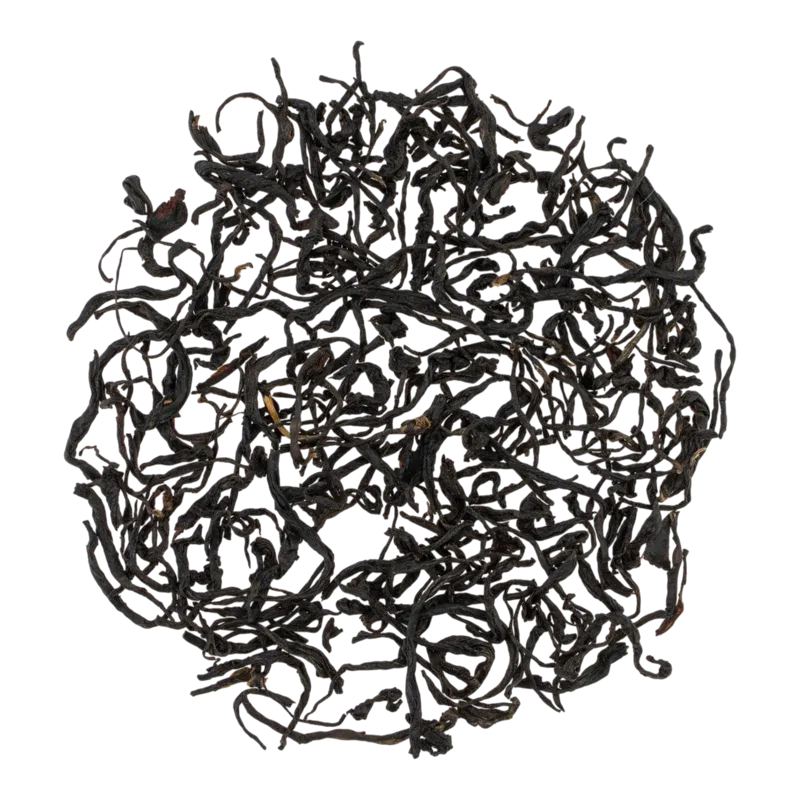
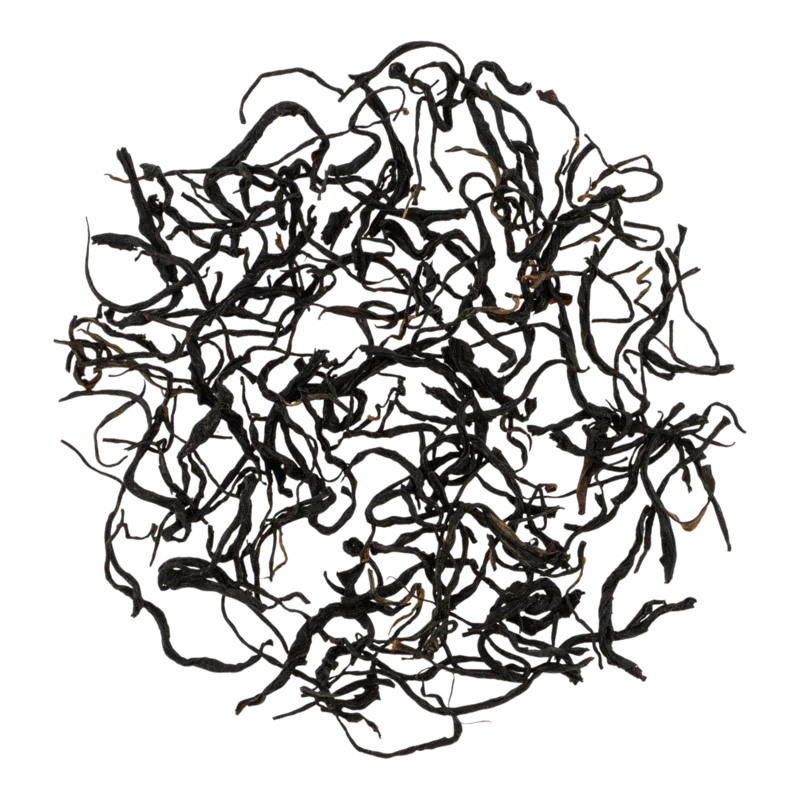
Dry Leaf Appearance: Large, longitudinally twisted leaves of corkscrew shape. Color — dark brown, chocolate, with inclusions of golden and copper tips.
Dry Leaf Aroma: Intense, sweet, with pronounced notes of malt, caramel, dried fruits (dried apricots, raisins) and light floral undertones.
Liquor Aroma: Rich and warm. Malty-honey and caramel tones dominate, complemented by fruity nuances — sometimes grapefruit or citrus — and delicate floral accents.
Liquor Color: Bright, clear, from reddish-amber to rich ruby-burgundy with silky shine. When cooled, high-quality tea demonstrates characteristic "tea cream" (cream down) — cloudiness associated with high theaflavin content.
Spent Leaves: Soft, elastic leaves of reddish-brown color, well-preserving shape. Whole buds and unfolded leaf plates are visible.
Taste: Full, rich, but soft, without excessive astringency. Distinct natural sweetness. Notes of malt, rye bread, caramel and honey. Possible light fruity acidity. Aftertaste is long, sweetish, warming, with almond and honey undertones.
Alkaloids: Caffeine — about 3.5% of dry mass, providing pronounced tonic effect. Theobromine and theophylline are also present in trace amounts.
Amino Acids: L-theanine is present, though its content is lower than in green teas due to oxidation during fermentation. Nevertheless, L-theanine contributes to taste softness and sweetness.
In some batches of Taiwanese Assam tea, trace amounts of methyl salicylate are found, imparting light minty-camphor notes, which is attributed to local ecosystem influence.
Essential Oils: Rich complex of volatile aromatic compounds — linalool, geraniol, nerol, β-ionone — forms characteristic caramel-malty aroma with fruity and floral nuances.
Minerals: Potassium, manganese, zinc, magnesium, fluorine.
Polyphenols: Total polyphenol content is high, characteristic of large-leaf Assam variety. During full oxidation, significant portion of catechins transforms into theaflavins (TF, responsible for brightness and liveliness of liquor) and thearubigins (TR, forming color depth and taste body).
Vitamins: B-group vitamins (B₁, B₂), vitamin C (in small amounts, partially destroyed during fermentation), vitamin P (rutin).
High caffeine content provides gentle but sustained increase in alertness and concentration, acting more smoothly than coffee due to L-theanine presence.
Theaflavins and thearubigins are powerful antioxidants, contributing to free radical neutralization and cell protection from oxidative stress.
Regular moderate consumption of red tea is associated with improved vascular endothelial function and potential reduction of "bad" cholesterol (LDL) levels.
Red tea stimulates digestive enzyme secretion and may promote comfortable digestion after meals.
In traditional Chinese dietology, red tea belongs to "warm" beverages recommended in cold seasons.
Synergy of caffeine and L-theanine promotes improvement of attention, memory and reaction speed without coffee-characteristic overexcitation.
Polyphenolic compounds and vitamins have general strengthening effect on immune system.
Fluorine and polyphenols contained in tea have antibacterial properties, promoting caries prevention and gum health maintenance.
Tea Amount: 3–5 g per 150–200 ml for steeping; 5–7 g per 100–150 ml gaiwan or teapot for flash steeping method.
Teaware: Porcelain gàiwǎn (蓋碗, gàiwǎn) — emphasizes aroma purity; Yíxīng clay teapot (紫砂, zǐshā) — smooths taste and retains heat longer; glass teapot — for observing leaf opening and liquor color.
Water Temperature: 90–95°C (not recommended to use rolling boiling water to avoid increasing astringency).
Most famous red tea of Taiwan. Hybrid of Burmese large-leaf camellia and Taiwanese wild camellia (Camellia formosensis). Unlike soft malty-caramel profile of Assam, Hong Yu possesses bright, exotic aroma with pronounced cinnamon and mint notes, earning nickname "Taiwan Red" (台灣紅, Táiwān Hóng). Taste is more spicy and complex.
Genetically related tea, but Yuchi conditions (lower altitude than Indian Assam, but greater diurnal temperature variations and lake influence) form softer, less astringent profile with greater natural sweetness. Indian Assam is usually denser, stronger and more astringent.
Great Chinese red tea from Anhui Province, produced from small-leaf Camellia sinensis var. sinensis. Distinguished by elegant, delicate aroma with orchid and smoke notes, lighter body and less sweetness. Yuchi Assam — conversely, is denser, maltier and sweeter.
Yunnan red tea from same large-leaf assamica. Dian Hong usually possesses deeper, oilier body, chocolate and dried fruit notes, while Yuchi Assam differs in greater purity and brightness of taste, caramel sweetness and light citrus nuances. Dian Hong is produced at significantly higher altitude (1600–2200 m), giving it additional minerality, while Yuchi Assam (600–800 m) takes its softness from lake basin microclimate.
No reviews yet. Tell us what you think of this tea.
Rate this tea and share your impressions. We review each submission before publishing it.