Brewing
Gongfu brewing
- Water temperature
- 93 °C
- Tea amount
- 5 g
- Water volume
- 100 ml
- First steep
- 10 s
- Time added per infusion
- 5 s
- Infusions
- 4

Táiwān yān xiǎozhǒng hóngchá
Choose a brewing method. Start with the recommended quantities and time, then adjust to taste.
Brewing
Brewing
Taste
Tea encyclopedia
Alt Names: Tarry Lapsang Souchong (English), Formosa Lapsang (English), Taiwanese Lapsang Souchong (Russian), Lapsang Souchong Crocodile (trade name in some markets).
Alt Names: Tarry Lapsang Souchong (English), Formosa Lapsang (English), Taiwanese Lapsang Souchong (Russian), Lapsang Souchong Crocodile (trade name in some markets).
Category: Premium Taiwanese smoked red tea (black tea). A regional adaptation of Fújiàn Zhěng Shān Xiǎo Zhǒng (正山小種, Zhèngshān Xiǎozhǒng) technology.
Coordinates: Approximately 23°54' N, 120°41' E.
Origin: Míngjiān Township (名間鄉, Míngjiān Xiāng), Nántóu County (南投縣, Nántóu Xiàn), central Taiwan. The modern "tarry" form (with resinous smoking) developed in the 1980s.
Type: Red tea (black tea) (紅茶, Hóngchá) — fully oxidized, subjected to hot smoking (煙燻, Yānxūn) over pine wood with added pine resin. Belongs to the category of smoked teas (煙茶, Yānchá).
Tall bushes (up to 2 m) with large, dense obovate leaves 10–15 cm long, light green in color. Young shoots may have light pubescence along the central vein.
Cultivar: Hybrids based on the Assam variety (Camellia sinensis var. assamica) are used, particularly Taiwanese selections from the Tea Research and Extension Station. The Assam subspecies produces large, dense leaves optimally suited for intensive smoking.
Picking: Conducted primarily in summer, when polyphenol content in leaves is maximum, ensuring sufficient flavor density to withstand intensive smoking. Mechanized harvesting is permitted.
Raw Material: For the "tarry" version, mature, large leaves are selected — the third and fourth pair from the shoot tip (so-called "old souchong"). Coarser and thicker leaves better tolerate prolonged smoking and more actively absorb aromatic compounds from smoke.
Altitude: Plantations are located at moderate elevations — 200–500 m above sea level.
Climate: Subtropical, humid. Average annual temperature 22–25 °C. Annual precipitation — 1500–2000 mm. Significant diurnal temperature variations between daytime heating and nighttime cooling from the mountains promote accumulation of aromatic substances in tea leaves.
Soil: Alluvial soils along the Zhuóshuǐ River (濁水溪, Zhuóshuǐ Xī), enriched with minerals, including quartz particles carried from the Yùshān Mountain Range (玉山). Soil acidity — pH 4.8–5.2.
Míngjiān Township (名間鄉), Nantou County, central Taiwan. Mingjian is located on the western foothills of the Central Mountain Range.
Two species of endemic Taiwanese pines are used for smoking: Pinus morrisonicola (Taiwanese white pine, 台灣五葉松) and Pinus taiwanensis (Taiwanese red pine, 台灣二葉松). Their wood and resin possess a specific aromatic profile different from Fujian Masson pine (Pinus massoniana), which determines the unique character of Taiwanese Lapsang.
Harvested leaves are spread for initial moisture loss. Distinctive feature: withering is conducted over cold smoke from freshly cut Taiwanese white pine (Pinus morrisonicola) at approximately 60 °C, which already begins forming the smoky profile at this stage.
Withered leaves are rolled by hand or with rollers to break cell walls and release cell sap.
Complete oxidation of tea leaves under controlled conditions. At this stage, theaflavins and thearubigins form, constituting the foundation of black tea flavor and color.
Quick pan-firing in a wok (traditional method) to stop oxidative processes.
Leaves may be given various shapes, including small granules.
The main and defining stage. Tea is subjected to smoking at high temperature (approximately 110 °C) over smoldering pine wood. Duration of this stage for the "tarry" version is about 9 hours — substantially longer than the Fujian analog (~6 hours).
During the hot smoking stage, pine resin (rosin) is added, which when burned releases intense aromatic compounds, giving the tea its characteristic "tarry" — resinous-tar-like — profile. This is the key technological difference from classic Fujian Zheng Shan Xiao Zhong, where resin is not added.
Moisture content is reduced to minimum — less than 3%, ensuring stability during long-term storage.
Finished tea is aged for at least three months to stabilize and harmonize the aroma. During this time, the most aggressive smoky notes soften, and the profile becomes more rounded.
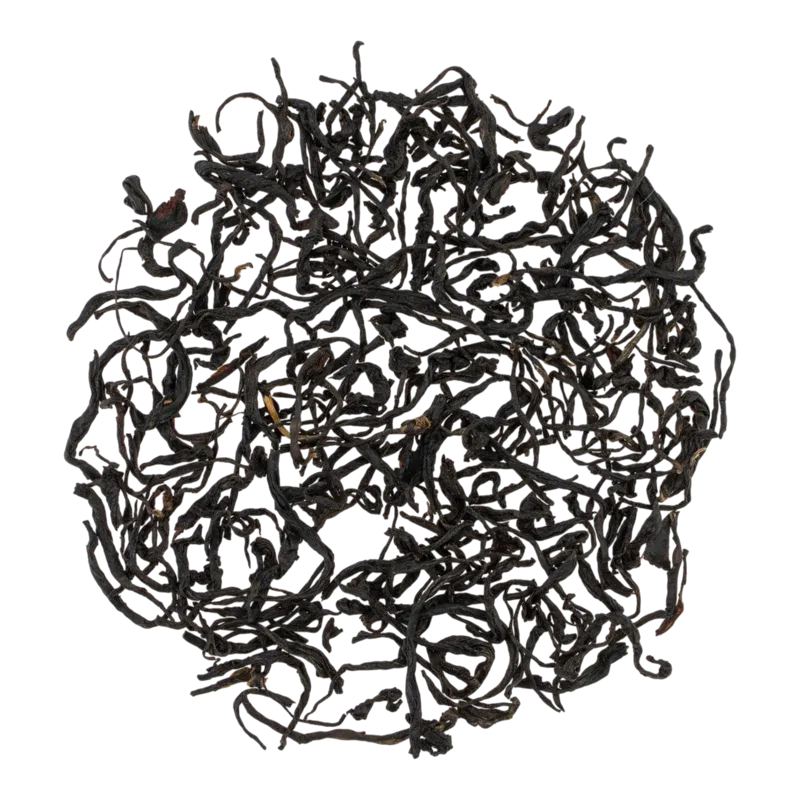
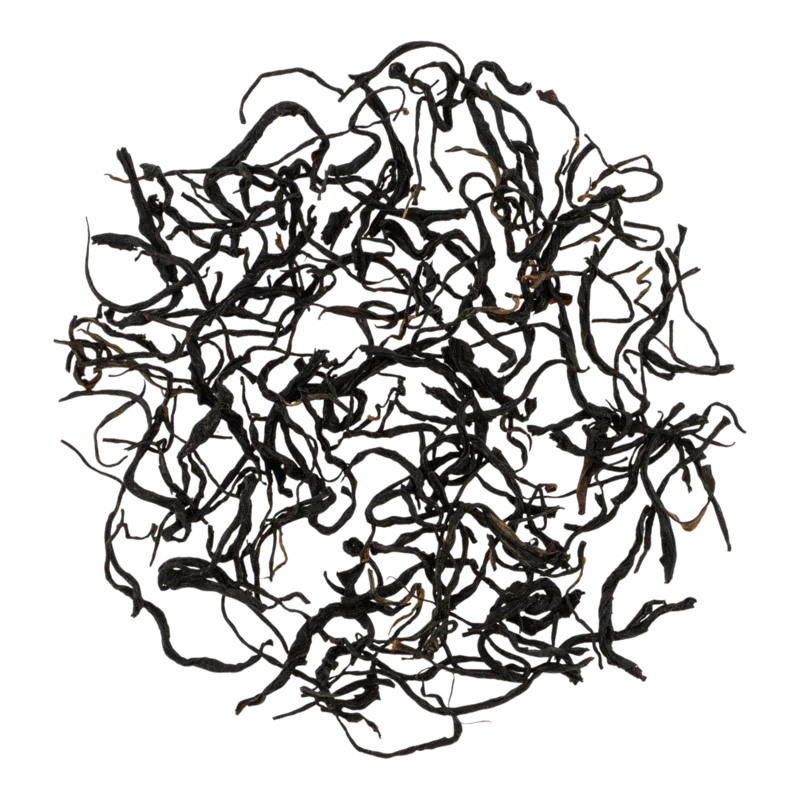
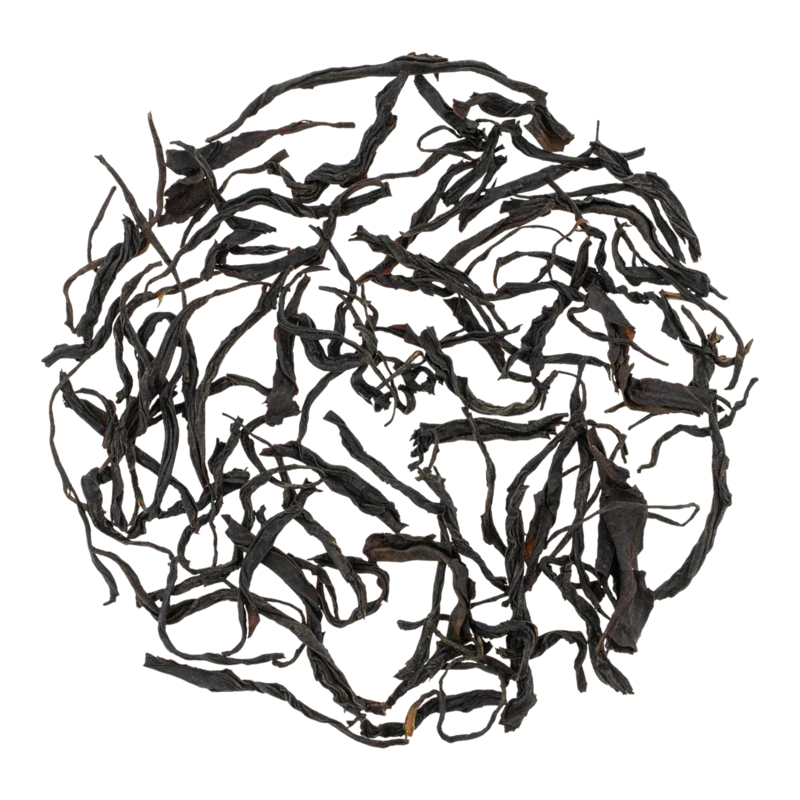
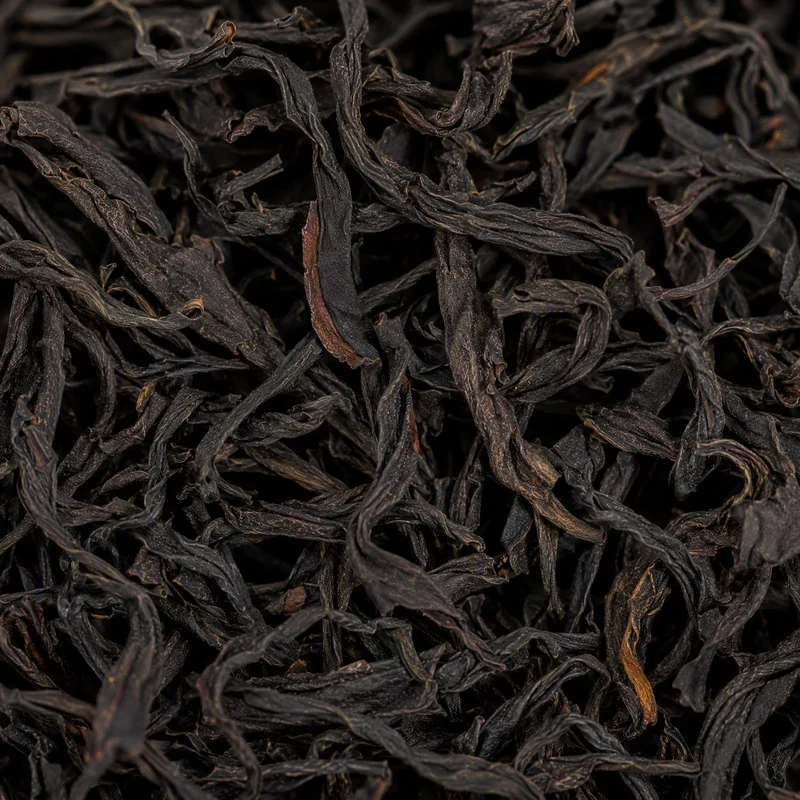
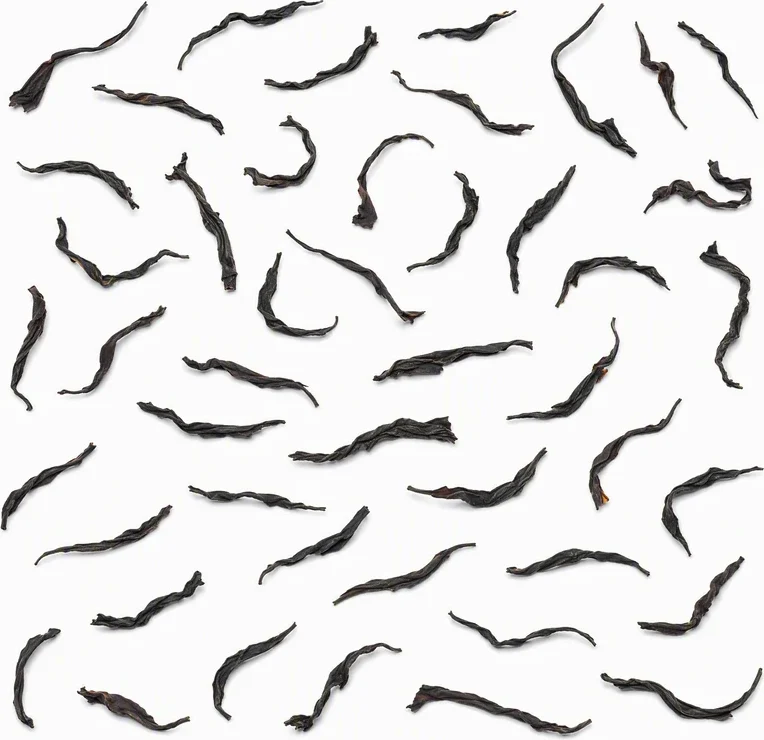
Dry Leaf Appearance: Large, twisted leaves of dark brown or black color, sometimes in granule form. May have a slight oily sheen due to deposition of resin combustion products.
Dry Leaf Aroma: Powerful, dominating aroma of smoke, pine resin, tar, and smokiness. Associated with coniferous bonfire, smoked ham, smoking fireplace.
Liquor Aroma: Intense, multi-layered: based on smoky-resinous notes with hints of guaiacol (smoky-woody) and creosote. Upon development, unexpected sweet tones of dried longan, vanilla, and dark caramel may appear.
Liquor Color: Rich dark red, ruby, or cognac-colored, with deep warmth.
Spent Leaves: Large, dense leaves of dark brown color. Unfold incompletely due to intensive processing.
Taste: Dense, rich, oily. Smoky note dominates, supported by light natural sweetness and deep, warm aftertaste. Moderate astringency. Full, dense body with velvety texture. Tasters note hints of brown sugar, caramel, cedar, cinnamon, and roasted barley.
Key markers: guaiacol (2-methoxyphenol) — main smoky-woody note; creosol — deep resinous tone; longifolene — sesquiterpene from pine wood, characteristic specifically of the Taiwanese variant. Unlike Fujian analogs, methylchavicol (estragole) may be absent.
Content typical for red teas (black teas) of Assam subspecies — approximately 3.5–4.5%, providing pronounced tonic effect.
Form the body and deep color of the liquor. Their high concentration is due to complete oxidation of large Assam leaves.
Minerals: Potassium, magnesium, calcium, phosphorus, iron. Mineral profile enriched by alluvial soils of the Mingjian region.
Polyphenols: High total content. Catechin oxidation products — theaflavins — are present in elevated concentration compared to classic Fujian Lapsang, ensuring brightness and liveliness of the liquor.
Vitamins: B₁, B₂, PP — in moderate amounts.
High content of polyphenols and theaflavins provides protection of cells from free radical damage.
Pronounced caffeine content stimulates the central nervous system, increases concentration and alertness. This tea is traditionally considered a good morning beverage.
Due to complete oxidation, dense body, and smoky character, the tea is traditionally recommended in cold weather. In Taiwanese folk medicine, smoked teas are considered "warming" (溫性, Wēnxìng).
Some studies indicate anti-inflammatory properties of red tea (black tea) polyphenols, capable of inhibiting certain pro-inflammatory enzymes.
Red tea (black tea) is traditionally used to improve digestion, especially after heavy, fatty food. The dense, oily texture of smoked tea pairs well with meat dishes.
Theaflavins contribute to cholesterol reduction and maintenance of vascular elasticity.
3–4 g per 250–300 ml boiling water, steeping 3–5 minutes. This method is recommended by most tasters as optimal for this tea type — large broken leaf quickly releases flavor and does not require multiple steepings.
Tea pairs well with milk — its intense smoky character is not lost even in milk preparation. Also used in cooking: as base for broths, sauces, and marinades.
Tea Amount: 5–7 g per 150–200 ml water (flash steeping method) or 3–4 g per 250–300 ml (European method).
Teaware: Yíxīng clay teapot (宜興紫砂壺) is an excellent choice, since porous clay absorbs and over time returns smoking aromas, enhancing flavor depth. Porcelain gaiwan or teapot also suitable. Recommended to dedicate a separate Yixing teapot for smoked teas to avoid "contaminating" other varieties with smoky aroma.
Water Temperature: 95–100 °C. Boiling water is necessary for complete development of the dense smoky flavor and aroma of smoked tea.
Container: Airtight, opaque container — mandatory condition. Tightly closing metal tin, ceramic tea jar, or vacuum packaging. Important to prevent both dissipation of smoky aroma and its transfer to neighboring products.
Light: Protection from direct sunlight.
Shelf Life: With proper storage, tea maintains quality for extended periods — from 3 to 5 years and more. Aged samples (10+ years) may acquire additional complexity and softness, and are valued by collectors.
Dry, cool place at temperature not exceeding 15 °C and relative humidity less than 35%. Avoid sharp temperature fluctuations.
For long-term storage, vacuum packaging or use of oxygen absorbers is optimal.
Original Fújiàn Lapsang Souchong from the Tóngmù region (桐木關) in the Wuyi Mountains. Uses raw material from local varieties (var. sinensis, so-called "bohea"). More delicate smoking — over smoldering pine wood without resin addition. Higher oxidation degree (~92%), shorter smoking time (~6 hours). More elegant profile: longan, dried fruits, light smokiness. Classic Zheng Shan Xiao Zhong is elegance; Taiwanese Tarry is power.
General name for Taiwanese smoked teas with less intensive smoking, without resin addition. Oxidation degree may be lower (~78%), smoking time shorter (~4 hours). Softer profile with more pronounced floral and fruity notes.
Famous red tea (black tea) from Anhui. Not subjected to smoking. Profile — delicate, orchid-like, with notes of dried fruits and light smokiness. Comparison emphasizes how much the smoking process transforms the base character of red tea (black tea).
Modern unsmoked variant from Tongmuguan village, known as "Jin Jun Mei" (金駿眉, Jīn Jùn Méi) and related varieties. Complete opposite of "tarry" variant — delicate, floral-honey, without smoky notes. Demonstrates two poles of one tradition.
Price Category: Authentic Taiwanese Yan Xiao Zhong is a premium tea due to complex manual work in smoking, use of specific raw material, limited supplies of endemic Taiwanese pine, and small production volumes. Approximate retail price — 28–45 USD per 100 g for quality product.
Teas produced in other regions (including mainland Fujian) imitating Taiwanese style, or red teas (black teas) processed with "liquid smoke" (artificial flavoring) instead of natural smoking, cost significantly less — 12–18 USD per 100 g.
No reviews yet. Tell us what you think of this tea.
Rate this tea and share your impressions. We review each submission before publishing it.