Brewing
Gongfu brewing
- Water temperature
- 75 °C
- Tea amount
- 5 g
- Water volume
- 100 ml
- First steep
- 10 s
- Time added per infusion
- 5 s
- Infusions
- 3

Táiwān 'jiǎ chūn' qīngxīn lǜchá
Choose a brewing method. Start with the recommended quantities and time, then adjust to taste.
Brewing
Brewing
Taste
Tea encyclopedia
Category: Single micro-lot (single batch). Artisanal Taiwanese green tea from hand-picked oolong cultivar. Commercial name — 'Faux Spring' Qing Xin Green Tea.
Category: Single micro-lot (single batch). Artisanal Taiwanese green tea from hand-picked oolong cultivar. Commercial name — 'Faux Spring' Qing Xin Green Tea.
Coordinates: 23°50′ N, 120°40′ E (central part of Mingjian Township).
Origin: Táiwān (臺灣, Táiwān), Nántóu County (南投縣, Nántóu Xiàn), Míngjiān Township (名間鄉, Míngjiān Xiāng).
Type: Green tea (绿茶) (non-oxidized, oxidation level less than 8%). Kill-green fixation by steaming (蒸青, zhēngqīng), which brings the technology closer to Japanese rather than classical Chinese approach.
Cultural Significance: "False Spring" is a tea-witness to climate change, a tea-document of the anomalous warmth of winter 2018/2019 in Central Taiwan. For agronomists and climatologists, it is interesting as a marker of atypical vegetation captured in a cup. For connoisseurs—as an example of Taiwanese farmer mastery, able to transform weather's caprice into a work of taste. For collectors—as an irreproducible single lot: the exact combination of temperature, harvest timing, and bush condition is unique and cannot be copied.
History: Taiwanese tea cultivation traces its origins to Fujian settlers of the 18th–19th centuries, who brought seeds and saplings to the island from Ānxī County (安溪, Ānxī), the birthplace of Tie Guanyin and many oolong cultivars. Among the imported varieties was Qīng Xīn (青心, Qīngxīn, "Green Heart")—one of the oldest and most revered Taiwanese cultivars. The island historically specialized in oolong production: Dōng Dǐng (凍頂, Dòngdǐng), Bǎo Zhǒng (包種, Bāozhǒng), Gāoshān Chá (高山茶, Gāoshān Chá). Green teas appeared later—mass production began in the 1970s, largely oriented toward export to Japan. The Sānxiá (三峽, Sānxiá) district in New Taipei became the main center of Taiwanese green tea cultivation, specializing in Biluochun and Longjing from the same Qing Xin Gan Zhi cultivar.
Due to the off-season nature of harvest and immaturity of shoots, finished tea yield was only about 18% of fresh leaf weight—significantly below normal (22–25% for typical spring harvests). This indicates exceptional tenderness and high water content of the raw material used: small, just-emerged shoots contained more water and fewer coarse fibers than usual spring material.
Cultivar: Qīng Xīn Gǎn Zhì (青心柑仔, Qīngxīn Gānzǎi) — subvariety of the famous Taiwanese cultivar Qīng Xīn (青心). It is believed this line naturally evolved from Fujian ancestral plants brought to Taiwan during the Qing era. Qing Xin Gan Zhi differs from the main Qing Xin (Qing Xin Oolong, 青心烏龍 / Ruan Zhi, 軟枝) in several features: increased bud formation (abundant tips), small tender leaf blades (2–3 cm), slightly curled edges, noticeable white trichomes (hairs) along the central vein of young shoots. Thanks to abundant buds, this subvariety is particularly sought after for producing Dòng Fāng Méi Rén (東方美人, Dōngfāng Měirén, "Oriental Beauty"), as well as Sanxia green teas—Biluochun and Longjing.
Picking: January 2019. Exclusively hand-picked to the standard "one bud and one upper leaf" (一芽一葉, yī yá yī yè). Harvest was conducted in early morning hours to minimize temperature stress.
Altitude: 350–400 meters above sea level. This is mid-mountain by Taiwanese standards—below the Gāoshān Chá (高山茶, high-mountain teas, from 1000 m) zone, but high enough to form quality terroir with mists and cool nights.
Climate: Subtropical maritime, modified by mountain topography. Average annual temperature — 22–25°C. Annual precipitation — 1,500–2,000 mm, concentrated from May to August (monsoons and typhoons). Frequent mists on hilly areas. Winter temperatures — usually around +12°C (January). January 2019 anomaly: average daily temperature rose to +16°C — 4°C above normal. This shift was sufficient to trigger vegetation in Qing Xin Gan Zhi tea bushes, which have a relatively low awakening threshold.
Soil: Bagua Mountain Range terraces are covered with characteristic red soils (紅土, hóngtǔ / 紅壤, hóng rǎng) — acidic (pH 5.2–5.8), well-drained, containing quartz inclusions. These red soils are considered among Taiwan's best tea soils: iron oxide richness provides mineral profile to the liquor, acidic reaction stimulates microelement absorption, and porous structure guarantees drainage even during typhoon season.
Míngjiān Township (名間鄉) — Taiwan's largest tea-producing district. Located in the western part of Nantou County, north of the Zhuóshuǐ River (濁水溪, Zhuóshuǐ Xī), between the Bagua Mountain Range to the west and the foothills of Jiji-dashan (集集大山) to the east. Territory — 86.2 km², from hilly terraces (elevation 200–432 m) to valley plains. Over 90% of terrace area is occupied by tea gardens—this is the highest concentration of tea plantations in Taiwan.
The garden is managed organically: lupine fertilization (green manure), hand weeding without herbicides. One week before harvest, shade covering was applied (analogous to Japanese kabuse technique, 被せ) — covering bushes with nets to increase amino acid and chlorophyll content in shoots, enhancing "sweetness" and "body" of future liquor while simultaneously reducing polyphenols and bitterness.
Fresh-picked leaves undergo brief steam treatment at approximately 105°C for about 45 seconds. Steam instantly inactivates oxidases, stopping enzymatic oxidation and fixing bright green color, delicate aroma, and maximally fresh flavor profile. Unlike wok firing, steam does not introduce "roasted" notes, preserving purity of floral and fruity tones.
Steamed leaves are directed to infrared heating chambers for rapid moisture reduction to approximately 60%. Infrared radiation provides even heating without surface overheating, critical for such tender winter material with high moisture content.
Partially dried leaves are given characteristic spiral shape through double rolling in rollers under low pressure. Gentle rolling partially breaks cell walls, releasing cell sap and intensifying future liquor richness, while not damaging integrity of small tender leaves.
Bringing moisture to standard level ≤3% in convection ovens at approximately 80°C. Low final moisture ensures storage stability and concentrates aromatic components.
No flavoring applied — all taste and aromatic characteristics are natural. Absence of withering stage (萎凋, wěidiāo), characteristic of oolong processing, emphasizes that tea was produced entirely by green, not semi-oxidized technology.
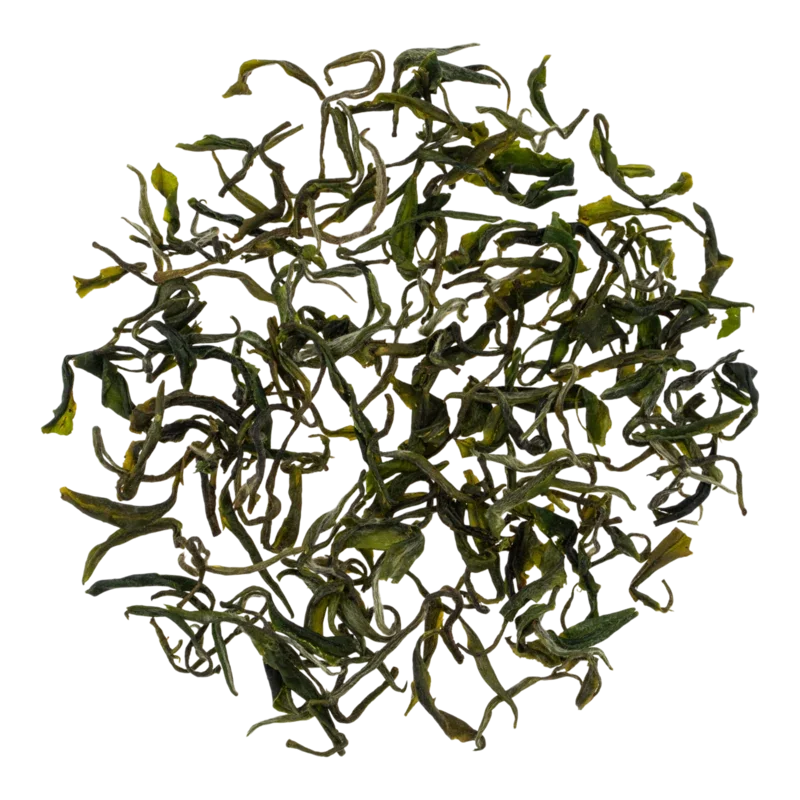
Dry Leaf Appearance: Small, tightly twisted spirals about 4 mm in diameter, rich emerald-green color. Leaves compact, uniform in size, with noticeable matte luster. Individual white hairs visible on unopened buds — evidence of raw material tenderness.
Dry Leaf Aroma: Delicate, clean, with distinct floral notes — hyacinth, violet, light hint of fresh-cut grass.
Liquor Aroma: Complex, multi-layered, developing over time. Initial note — hyacinth (bright, clear floral tone), transitioning to lotus shade (deeper, sweetish), and concluding with nuances of almond essence (subtle, almost imperceptible marzipan trail). Aroma is persistent and remains in empty cup for several minutes.
Liquor Color: Very light, pale yellow with slightest pearlescent sheen. Transparency perfect — liquor "glows" in cup. With repeated steepings, shade shifts toward tender green.
According to ISO system tasting, tea received 93 points — exceptionally high result for green tea.
Spent Leaves: Small, whole, tender leaves of light green color, fully expanded. Shoots — "one bud, one leaf" — perfectly preserved shape and demonstrate harvest uniformity.
Taste: Exceptionally soft (柔和, róuhé), sweetish (甘甜, gāntián), without slightest bitterness or astringency. Flavor profile unfolds with nectarine notes — juicy, fruity, slightly honeyed — transitioning to violet floral tones (cool, delicate). Aftertaste long, refreshing, with distinct minerality — consequence of Mingjian's red soils rich in iron oxides. Liquor body silky, enveloping, with light viscosity.
Alkaloids: Caffeine (咖啡碱, kāfēi jiǎn) — reduced content compared to typical spring harvests. Early winter harvest means leaves spent less time under intense sun, and caffeine is synthesized, in part, as protective reaction to UV radiation. Also present are theobromine and theophylline in trace amounts.
Amino Acids: Elevated content — presumably 5–7% of dry weight (exact data for this lot not published, estimate based on cultivar characteristics, shading technology, and early harvest). L-theanine (L-茶氨酸) — dominant amino acid, responsible for pronounced sweetness, "body," and relaxing effect. Winter shoots accumulate more amino acids and fewer polyphenols than spring ones — similar to how early spring harvests (before Qingming) are valued for tenderness.
Cis-3-hexenol (green freshness), linalool (floral note), benzaldehyde (almond nuance), indole (lotus shade in small concentrations). This set forms the characteristic "hyacinth → lotus → almond" aroma development.
Minerals: Potassium (K), magnesium (Mg), manganese (Mn), zinc (Zn), fluorine (F), iron (Fe). Elevated iron content due to red ferrallitic soils of Mingjian and manifests in mineral character of aftertaste.
Polyphenols: Catechin content — about 18% of dry weight. Main components — EGCG (epigallocatechin gallate), EGC (epigallocatechin), ECG (epicatechin gallate). Content somewhat lower than typical spring green teas (20–25%), explained by combination of winter harvest (less ultraviolet → fewer polyphenols) and pre-harvest shading. This ensures taste softness and complete absence of bitterness.
Vitamins: Vitamin C (ascorbic acid) — preserved in significant quantity thanks to steam fixation (steam less destructive to ascorbic acid than high-temperature firing); B-group vitamins (B₁, B₂); β-carotene (provitamin A).
Reduced caffeine content combined with high L-theanine creates optimal balance of "calm alertness" — improved cognitive functions (memory, concentration, reaction speed) without typical caffeine "spike." Ideal evening tea for those sensitive to caffeine.
Catechins (especially EGCG) neutralize free radicals, protecting cells from oxidative stress.
Reduced polyphenol content makes this tea gentle on stomach — less aggressive than typical green teas with high tannin levels. Suitable for people with sensitive digestion.
L-theanine stimulates alpha-wave generation in brain — state of relaxed attention, favorable for meditation, creative work, reading.
Regular consumption of green tea catechins is associated with improved vascular elasticity and blood pressure normalization.
Vitamin C, preserved by steam fixation, combined with catechins and L-theanine supports immune function.
Green tea catechins promote thermogenesis and fat oxidation, beneficial within balanced diet.
Ideal choice. White porcelain doesn't absorb aromas and allows admiring pearlescent liquor shade.
Perfect for visual enjoyment — can observe how tiny spirals unfold in water, releasing pale yellow liquor.
Logical choice, considering steam fixation — technological kinship with Japanese teas.
Tea Amount: 3–5 g per 150–200 ml water (gongfu method). For European brewing — 2–3 g per 200 ml.
Water Temperature: 70–80°C. This is critically important parameter: tender winter material is extremely sensitive to overheating. Temperature above 80°C destroys L-theanine and releases catechins, provoking bitterness uncharacteristic of this tea. Optimum — 75°C.
Container: Vacuum packaging (in which tea typically comes), aluminum bags with zipper, tin cans with tight lid.
Enemies: Light (destroys chlorophyll, causing leaf yellowing), moisture (provokes oxidation and mold), high temperature (accelerates amino acid and vitamin C degradation), foreign odors (green tea is powerful absorbent).
Shelf Life: For maximum freshness — within 6 months after production. Considering single lot nature (January 2019), by 2025 the tea, if still preserved, has already lost part of its original brightness, though mineral and sweet profile could have evolved interestingly.
Temperature: Optimally — 0–5°C (refrigerator) in airtight packaging. Before opening, package must warm to room temperature to avoid moisture condensation on cold leaves.
Green tea from same Qing Xin Gan Zhi cultivar, but produced in Sanxia district (New Taipei). Fixation — by firing, not steam. Taste more saturated, with noticeable bean and nutty notes. Leaf — small twisted "snails." Difference from "False Spring": different region (Sanxia vs. Mingjian), different fixation technology (firing vs. steam), different season (spring vs. winter), flavor profile less floral and more "beany."
Taiwanese version of Longjing, also from Qing Xin Gan Zhi. Flat leaf (pressing in wok). Taste — fruity, sweet, with denser body than "False Spring." Technology close to Chinese Longjing, but with Taiwanese specifics (oolong processing elements).
Rarely encountered Taiwan product, produced by Japanese technology with steam fixation. Most similar to "False Spring" in processing method, but usually made from other cultivars (Jin Xuan, Si Ji Chun). Taste more grassy and "green," with pronounced umami, while "False Spring" — more floral and fruity.
High-mountain green tea from Chiayi County. Fixation by firing. More oily, with nutty note dominance. Elevation (1,000–1,500 m) gives it bright "mountain freshness," different from gentle minerality of low-mountain Mingjian.
Price Category: Above average for Taiwanese green teas. Price determined by several factors: single lot (irreproducible harvest), hand picking to "bud + leaf" standard, low finished product yield (18% vs. 22–25%), organic farming, Qing Xin Gan Zhi cultivar (low-yielding), pre-harvest shading (additional labor costs), high professional evaluation (93 ISO points).
Ensure specific year (2019), region (Mingjian, Nantou), cultivar (Qing Xin Gan Zhi), and technology (steam fixation) are indicated. Absence of any element — reason for doubt.
Authentic tea — small, compact spirals of emerald-green color. Large, coarse leaf or dull color indicate substitution.
Hyacinth-lotus profile — characteristic marker. Coarse grassy or "fishy" smell indicates poor quality material.
Pale yellow, pearlescent, clear. Cloudy or intensely green liquor — atypical.
"False Spring" tea — single 2019 lot. Offers of "fresh harvest" of same name after 2019 should raise authenticity questions.
No reviews yet. Tell us what you think of this tea.
Rate this tea and share your impressions. We review each submission before publishing it.