Brewing
Gongfu brewing
- Water temperature
- 92 °C
- Tea amount
- 6 g
- Water volume
- 100 ml
- First steep
- 10 s
- Time added per infusion
- 5 s
- Infusions
- 8

sìjìchūn
Choose a brewing method. Start with the recommended quantities and time, then adjust to taste.
Brewing
Brewing
Taste
Tea encyclopedia
Category: Taiwanese oolongs from low- and mid-altitude zones. Does not belong to high-mountain teas (高山茶, gāoshān chá); main plantations are located significantly below 1000 m elevation. Commercially often positioned as "Songbai Changqing Cha" (松柏長青茶, Sōngbǎi Chángqīng Chá) — "Evergreen Tea of Songbai."
Category: Taiwanese oolongs from low- and mid-altitude zones. Does not belong to high-mountain teas (高山茶, gāoshān chá); main plantations are located significantly below 1000 m elevation. Commercially often positioned as "Songbai Changqing Cha" (松柏長青茶, Sōngbǎi Chángqīng Chá) — "Evergreen Tea of Songbai."
Coordinates: Approximately 23°50' N, 120°40' E (core tea zone of Mingjian, Bailing Plateau on the southern tip of the Bagua Mountain range).
Origin: Táiwān (台灣, Táiwān), Nántóu County (南投縣, Nántóu Xiàn), Míngjiān Township (名間鄉, Míngjiān Xiāng) — the main production center. Also cultivated in Chiayi County (嘉義縣, Jiāyì Xiàn) and Hualien County (花蓮縣, Huālián Xiàn). The cultivar was first discovered in the Mùzhà area (木柵, Mùzhà, modern Taipei).
Type: Oolong (semi-oxidized tea). Oxidation level — 15–30%, most commonly light oxidation (清香型, qīngxiāng xíng — around 20%) or moderate oxidation (浓香型, nóngxiāng xíng — around 30%). Roasting is typically minimal; the style focuses on preserving fresh floral aroma.
Cultural Significance: Sijichun occupies a unique niche in Taiwanese tea culture. On one hand, it is the "workhorse" of the tea industry — a mass, democratic product, the foundation for milk tea cocktails and flavored oolongs. On the other hand, quality spring and winter batches from artisanal farms are valued by connoisseurs for their pure floral profile and harmonious taste. Sijichun became the "gateway" to the world of Taiwanese oolongs for millions who first tried it as a cold tea beverage. The tea is deeply connected to the Sōngbǎi (松柏, Sōngbǎi) tea region and Mingjian Township — Taiwan's largest wholesale tea center, where tea shops stretch along streets for hundreds of meters.
History: Sijichun is a relatively young cultivar, discovered in the early 1980s. Tea farmer Zhāng Wénhuī (張文輝, Zhāng Wénhuī) from the Mùzhà area noticed a tea tree in his garden that arose from natural hybridization (自然有性繁殖, zìrán yǒuxìng fánzhí) and demonstrated exceptionally vigorous growth and year-round budding. Initially, the plant was called "Hui Zai Cha" (輝仔茶, Huī Zǎi Cha — "Hui's tea") after its discoverer, and also "Liu Ji Xiang" (六季香, Liù Jì Xiāng — "aroma of six seasons"). When seedlings were brought to Mingjian Township in Nantou County, local farmers appreciated the high yield of the new cultivar and gave it the name "Sijichun" — "Spring of Four Seasons." In 1988, planting material was introduced to Fujian Province (PRC). After 2000, Sijichun made an "industrial breakthrough": thanks to its suitability for machine harvesting and high yield, it became the main tea raw material for Taiwan's rapidly developing tea beverage industry (手搖茶飲, shǒuyáo cháyǐn), occupying up to 30% of areas in mid- and low-altitude tea zones of the island according to some estimates.
Cultivar: Sìjìchūn (四季春, sìjìchūn) — a local Taiwanese cultivar (地方性品種, dìfāngxìng pǐnzhǒng) arising from natural hybridization. Not an officially registered cultivar of the "Tai Cha" (台茶, Táichá) series by the Taiwan Tea Research and Extension Station (TTES). Belongs to Camellia sinensis var. sinensis. Botanical characteristics: shrub form (灌木型, guànmù xíng), small-leaf type (小葉種, xiǎoyè zhǒng), early budding (早生種, zǎoshēng zhǒng). Leaf shape — spindle-shaped (纺锤形, fǎngchuí xíng), with pointed tips at both ends. Leaf blade color — light green with yellowish tinge. Leaf edges covered with fine sharp serrations. Young shoots have pale reddish-purple coloration. The plant is distinguished by spreading habit (樹型披張, shùxíng pīzhāng), dense arrangement of buds and leaves, strong growth energy, high resistance to diseases and cold. Practically no dormancy period, ensuring multiple harvests throughout the year.
Picking: The main advantage of the cultivar — possibility of harvesting up to 6–8 times per year (some sources indicate 4–5 full harvests with additional summer ones). Most valuable — spring harvest (春茶, chūnchá, March–April): one bud with one leaf, pronounced gardenia aroma, fresh and clean taste. Winter harvest (冬茶, dōngchá, November–December) is valued for liquor density, cane sugar sweetness and characteristic "cold" aromatics. Summer and autumn harvests are used primarily for commercial blends and tea beverages.
Pluck Standard: Predominantly one bud and two-three leaves (一芽二三叶, yī yá èr-sān yè). For premium batches — one bud and two leaves with a proportion of at least 95%. Mass production is conducted by machine harvesting.
Raw Material: Compared to high-mountain oolongs, raw material requirements are less strict, which is part of the cultivar's commercial appeal. Use of more mature leaves is permitted, however the best batches are selected from young shoots with uniform degree of maturity.
Climate: Subtropical, warm and humid. Average annual temperature 18–22 °C. Annual precipitation — over 2000 mm. Air humidity — 80% and higher. Number of foggy days — more than 200 per year. Abundant sunlight on the open plateaus of Mingjian ensures vigorous tea bush growth and frequent harvests, but reduces amino acid accumulation compared to high-altitude shaded zones.
Soil: Red and red-yellow lateritic soils (紅黃壤, hóng huáng rǎng), characteristic of the Bagua Mountain plateau. Acidity pH 4.5–6.5. Soils enriched with iron and magnesium, well-drained, promoting deep rooting of tea bushes. Forest cover in the vicinity of tea gardens comprises about 85%.
The production core — Bǎilǐng Plateau (柏嶺台地, Bǎilǐng Táidì) in Mingjian Township, located on the southern tip of the Bāguà Mountain chain (八卦山脈, Bāguà Shānmài). This is hilly terrain with gentle slopes and extensive terraced plantations. Additional cultivation zones — Songbaikeng (松柏坑, Sōngbǎi Kēng) and Chìshuǐ (赤水, Chìshuǐ) areas, where century-old tea gardens are preserved. Also cultivated in Chiayi and Hualien counties.
200–500 m above sea level — typical low- and mid-altitude zone. Some farms grow Sijichun at elevations up to 800 m, however the bulk of production comes from plantations below 500 m.
Young shoots are collected by hand (for premium batches) or machine method (mass production). Harvested raw material is immediately delivered to the processing facility.
Leaves are spread under the sun for approximately 30 minutes for initial moisture loss and activation of enzymatic processes.
Continues for about 4 hours in a ventilated room. The leaf becomes pliable, aroma base is formed.
Three cycles of gentle shaking on bamboo trays initiate partial oxidation along leaf edges, forming the characteristic pattern "green leaf with red border" (綠葉紅鑲邊, lǜyè hóng xiāngbiān). Shaking intensity for Sijichun is usually lower than for Dong Ding or dancongs.
Pan-firing at approximately 280 °C stops enzymatic processes and fixes aroma direction.
Leaves are rolled to form appearance and increase extractability.
Drying at 80 °C for stabilization.
Manual wrapping in cloth with subsequent pressing gives leaves the classic semi-spherical shape (半球狀, bànqiú zhuàng), typical of Taiwanese oolongs.
Final drying at 60 °C to stable moisture level suitable for storage. "Low-temperature slow drying" regime is applied for maximum preservation of floral aroma.
Finished tea is sorted by granule size, uniformity and quality.
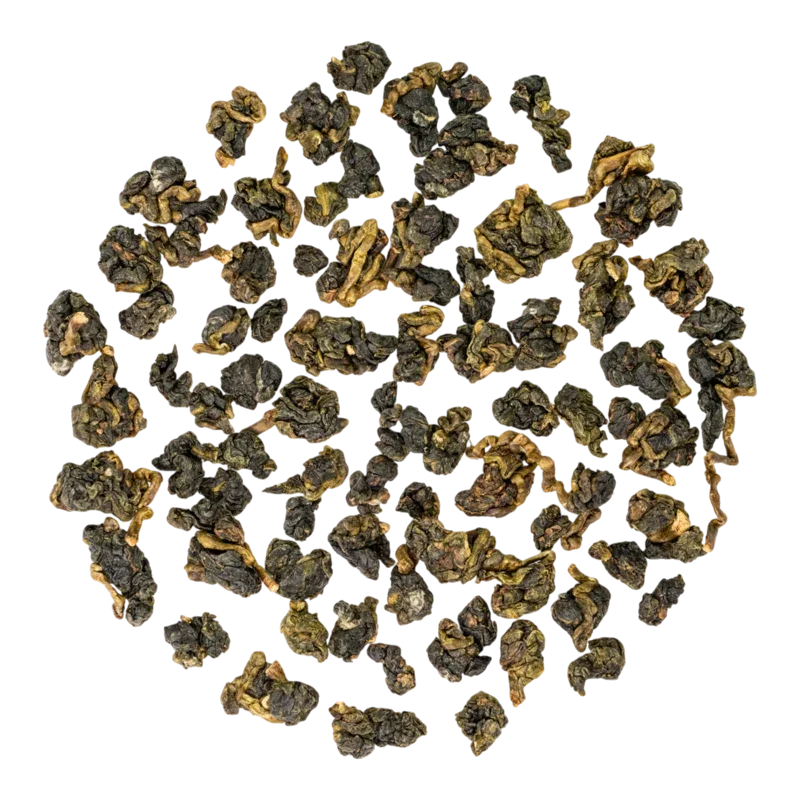
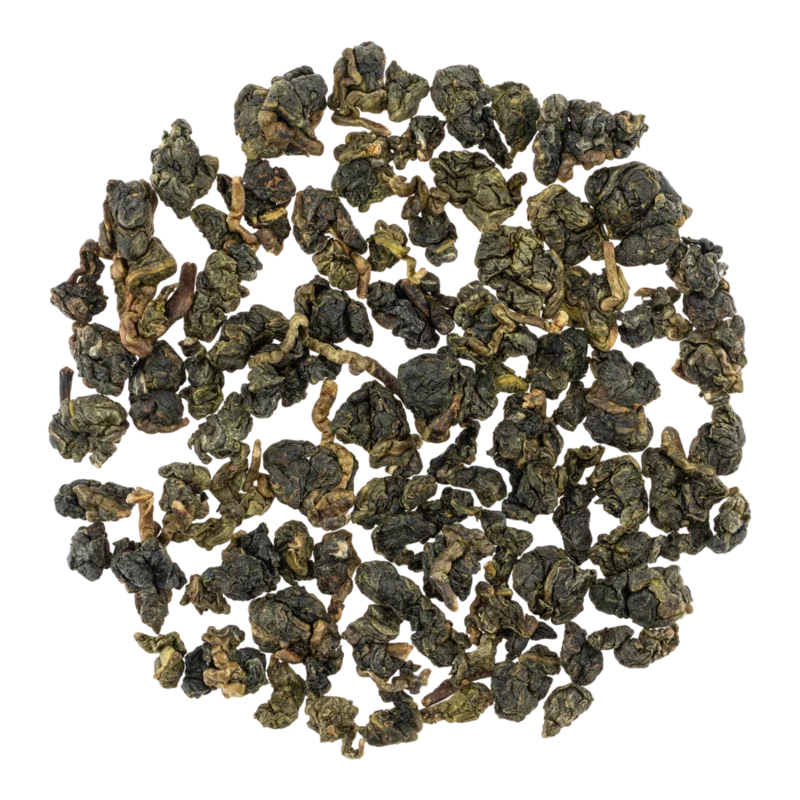
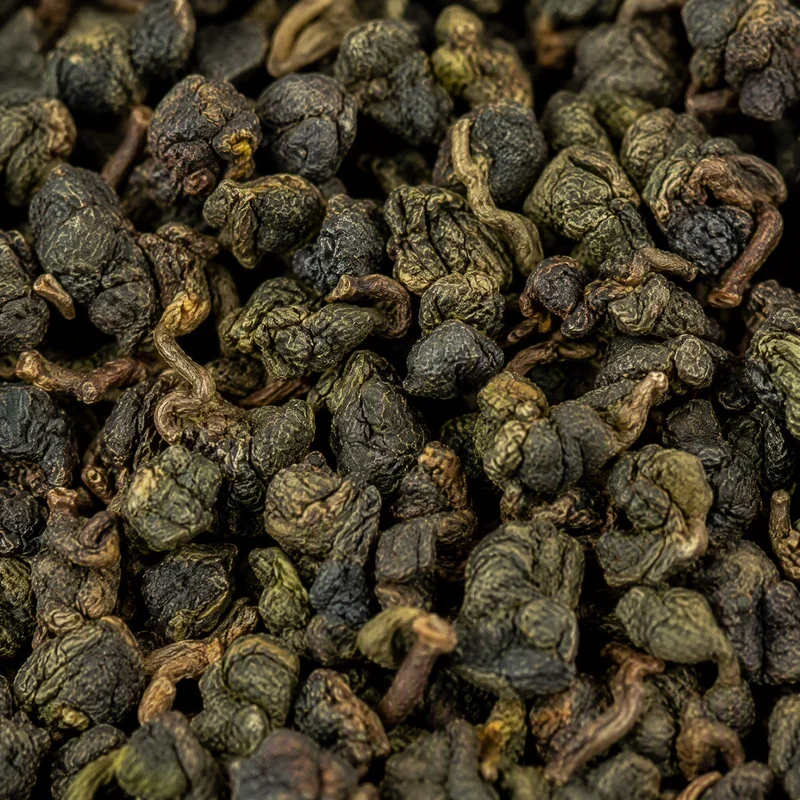
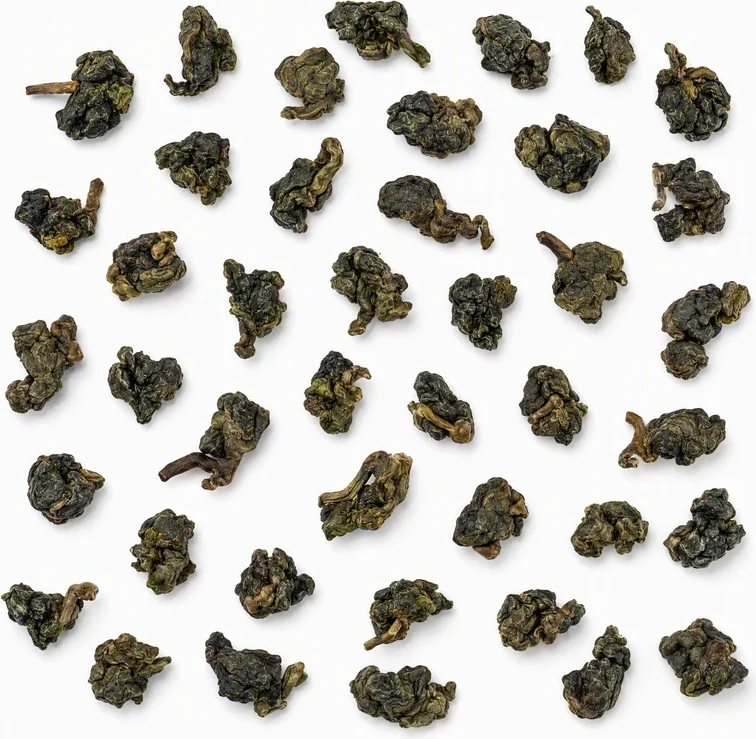
Dry Leaf Appearance: Tightly rolled semi-spherical granules (半球狀, bànqiú zhuàng), tight and compact. Color — dark green with oily luster (墨綠油潤, mòlǜ yóurùn), with light yellowish tinge characteristic of this cultivar. Granule calibration is uniform.
Dry Leaf Aroma: Intense, clean floral aroma with distinct gardenia dominance (梔子花香, zhīzihuā xiāng) — Sijichun's calling card. Secondary notes: magnolia (玉蘭香, yùlán xiāng), wild ginger flower (野薑花香, yě jiānghuā xiāng), grassy-fruity nuances. The aroma is active, "reaching out" — felt at a distance even before brewing.
Liquor Aroma: Rich floral spectrum with increasing sweetness. In hot liquor — full, oily floral-fruity bouquet. When cold — cleaner, more transparent floral tone with gardenia accent. In moderately oxidized versions, honey and caramel notes appear.
Liquor Color: With light oxidation — honey-green with golden cast (蜜綠透金黃, mìlǜ tòu jīnhuáng), transparent and clear. With moderate oxidation — orange-yellow, bright and rich (橙黃明亮, chénghuáng míngliàng).
Spent Leaves: Whole, elastic, fleshy leaves with characteristic "green leaf with red border" pattern — green-olive center and reddish-brown oxidized edges. Leaves are thick and soft (肥厚軟亮, féihòu ruǎnliàng), opening well after several steeps.
Taste: Fresh and brisk (鮮爽, xiānshuǎng), with pronounced smooth sweetness (甘滑, gānhuá) and full-bodied aftertaste. Returning sweetness (回甘, huígān) — prolonged, with cool "throat melody" (喉韻, hóuyùn). Liquor body — light to medium, less oily and complex than high-mountain oolongs, but with brighter and more "resonant" floral component. Amino acid content ≥ 4.2% provides pronounced freshness and umami. With over-extraction, slight bitterness is possible, due to relatively high catechin content and lower theanine levels compared to Qing Xin Oolong.
Alkaloids: Caffeine (咖啡鹼, kāfēi jiǎn) — 2–4% of dry mass. In brewed liquor — approximately 25–55 mg per 100 ml (depending on concentration and brewing method), constituting about a quarter of caffeine content in equivalent coffee volume. Theobromine and theophylline are also present in trace amounts.
Amino Acids: Total free amino acid content — ≥ 4.2% (for spring harvest). Main component — L-theanine (L-茶氨酸, L-chá ānjīsuān), providing freshness sensation and umami in taste. Theanine content in Sìjìchūn is noticeably lower than in Qīng Xīn Oolong (青心烏龍), explained by more abundant sunlight exposure of low-altitude plantations and, consequently, accelerated theanine breakdown to catechins during photosynthesis.
A characteristic feature of Sijichun's chemical profile — relatively high catechin content with moderate amino acid levels. This gives a more "resonant," invigorating taste, but with prolonged steeping, bitterness and astringency may appear.
Essential Oils: Determine the characteristic gardenia aroma of Sijichun. Main volatile fraction components: linalool, geraniol, nerol, benzyl acetate, methyl salicylate. The unique balance of volatile substances makes Sijichun easily recognizable even in blind tasting.
Minerals: Potassium, magnesium, manganese, fluorine, iron, zinc — in physiologically significant trace amounts. High iron and magnesium content in Mingjian soils is reflected in the tea's mineral profile.
Polyphenols: Total content — 15–25% of dry mass. Total catechin content — about 101–121 mg/g (according to Taiwan Tea Research Institute data), comparable to Jīn Xuān (台茶12号) and somewhat lower than Qing Xin Oolong (about 124 mg/g). Main catechins: epigallocatechin gallate (EGCG), epicatechin gallate (ECG), epicatechin (EC). Sijichun polyphenols demonstrate high antioxidant activity.
Vitamins: Vitamin C (ascorbic acid), B-group vitamins (B₁, B₂, folic acid). Vitamin C content is higher in lightly oxidized batches.
High tea polyphenol content provides free radical neutralization. Some Taiwanese sources indicate that the antioxidant effectiveness of Sijichun polyphenols exceeds that of vitamin E many times over.
The combination of caffeine and L-theanine provides mild but sustained invigorating action — increased concentration and performance without sharp "caffeine peak" and subsequent crash.
Polyphenols promote fat breakdown and acceleration of metabolic processes. Sijichun is traditionally considered in Taiwan a "light" tea, suitable for daily consumption within a balanced diet.
Organic acids and polyphenols stimulate digestive enzyme secretion, helping food digestion. Recommended for consumption after meals; strong liquor on empty stomach may irritate gastric mucosa.
Antioxidant components help reduce oxidized cholesterol levels and maintain vascular elasticity.
Moderate caffeine content promotes excess fluid elimination and edema reduction.
Tea polyphenols possess antimicrobial activity and support immune function.
L-theanine promotes relaxation without drowsiness, reducing stress hormone levels. Cold brewing of Sijichun — a popular method for obtaining a mild, calming beverage with minimal tannin extraction.
One bud and one leaf, pronounced gardenia aroma, fresh and bright taste. Considered the best season.
Thicker leaf, increased polysaccharide content, "cold" aromatics and cane sugar sweetness. Second most valuable season.
Used primarily for commercial batches and tea beverages. Taste simpler, astringency higher.
One bud + two leaves proportion ≥ 95%. Dense granules, color — dark green with sandy tinge. Gardenia aroma — powerful, long, piercing. Price from 600 yuan per jin.
Predominantly one bud + two leaves. Clean aroma, honey-yellow liquor, transparent.
Mixed harvest including summer and autumn leaves. Clean taste but less complex, lower steeping endurance.
Pour 1000 ml cold water over 5 g tea, place in refrigerator for 4–5 hours. This method reduces tannin and caffeine extraction, giving an especially clean, sweet and refreshing beverage with bright floral aroma — one of the best ways to reveal Sijichun's character in hot weather.
Tea Amount: Gongfu method: 8 g per 200 ml (tea ratio 1:25). Everyday method: 3–5 g per 250–300 ml. Cold brewing: 5 g per 1000 ml.
Teaware: Porcelain gàiwǎn (蓋碗, gàiwǎn) — optimal choice for revealing floral profile. Yíxīng clay teapot (宜興紫砂壺, Yíxīng zǐshā hú) also suitable, though porcelain is preferable for light oolongs as it doesn't absorb aroma. Glass teaware — good choice for observing leaf opening.
Water Temperature: 90–95 °C for hot brewing. For cold brewing (cold-brew) — cold water (~5 °C), steeping 4–5 hours in refrigerator.
Container: Airtight, light-proof packaging — vacuum bags from multi-layer foil material or tin cans with tight lids.
Enemies: Moisture, heat, foreign odors and direct light — main factors of aroma and taste degradation.
Shelf Life: Fresh Sijichun is best consumed within 6–12 months. Taiwanese sources recommend aging new tea in a dark place for about 15 days to "dissipate fire" (褪火, tuìhuǒ) after final drying, and after opening packaging, use within 72 hours to preserve maximum aromatics.
Unlike dark oolongs or pu-erhs, Sijichun does not improve with age. Its value lies in freshness.
Temperature: For long-term storage, refrigerator is recommended (5–10 °C), especially for qingxiang style batches. Roasted versions (nongxiang) are less demanding and can be stored at room temperature.
High-mountain oolong (1000–1500 m), made predominantly from Qing Xin Oolong cultivar. More complex, oily and deep taste with creamy and fruity notes. Liquor is denser and "heavier." Sijichun — lighter, brighter, more floral, significantly more accessible in price.
Mid-mountain oolong (500–800 m) with medium-strong roasting. Flavor profile — nutty-caramel with honey sweetness and pronounced returning sweetness. Dong Ding is significantly deeper and "warmer" in character, while Sijichun — fresh and "cool."
Taiwanese breeding cultivar known for natural creamy-milky aroma. Taste — soft, creamy, without pronounced florality. Sijichun and Jin Xuan are often grown on the same plantations in Mingjian, but give completely different aromatic profiles: gardenia and field flowers in Sijichun versus milky softness of Jin Xuan.
Lightly oxidized Taiwanese oolong with longitudinal twist (not semi-spherical). Baozhong — more elegant and refined, with nuanced lily-of-the-valley and narcissus aromatics. Sijichun — more "loud" and straightforward in its florality, while simpler in perception.
Breeding cultivar with characteristic jasmine-magnolia aroma. Profile more delicate and "tender" than Sijichun. Both teas belong to mid- and low-altitude zones and often compete in the same price segment, but differ in aromatics: jasmine in Cui Yu versus gardenia in Sijichun.
Price Category: Sijichun belongs to the most accessible Taiwanese oolongs. Price range is significantly lower than high-mountain teas (Alishan, Li Shan, Da Yu Ling). Cost depends on harvest season (spring and winter — more expensive, summer/autumn — cheaper), harvest method (hand-picked — more expensive, machine — cheaper), specific farm and year. Approximate price in Taiwan for quality special grade batches — from 600 yuan (≈ 2,700 rubles) per jin (500 g) and higher; mass batches significantly cheaper.
Authentic Sijichun possesses clean, bright gardenia aroma — without chemical perfumery and foreign notes. Absence of pronounced floral aroma or its "artificiality" — warning signal.
Granules should be uniformly rolled, dense, without excess stems and dust.
Color — clean, transparent, without cloudiness. Taste — fresh, smooth, with returning sweetness, without rancid or musty tones.
Excessively cheap "Sijichun" may be produced from low-quality raw material or represent mainland Chinese production (where the cultivar has also been grown since 1988) passed off as Taiwanese.
No reviews yet. Tell us what you think of this tea.
Rate this tea and share your impressions. We review each submission before publishing it.