Brewing
Gongfu brewing
- Water temperature
- 92 °C
- Tea amount
- 6 g
- Water volume
- 100 ml
- First steep
- 10 s
- Time added per infusion
- 5 s
- Infusions
- 8

sìjì chūn hóng zhū
Choose a brewing method. Start with the recommended quantities and time, then adjust to taste.
Brewing
Brewing
Tea encyclopedia
Alt Names: Taiwan Four Seasons 'Red Pearl' Oolong Tea (English), Four Seasons Black Pearl (English), 四季春紅烏龍 (Sìjì Chūn Hóng Wūlóng — 'Red Four Seasons Oolong').
Alt Names: Taiwan Four Seasons 'Red Pearl' Oolong Tea (English), Four Seasons Black Pearl (English), 四季春紅烏龍 (Sìjì Chūn Hóng Wūlóng — 'Red Four Seasons Oolong').
Category: Taiwanese heavily oxidized oolong. It belongs to the 'red oolong' trend that gained wide popularity in Taiwan after 2008, when the Taitung Branch of the Tea and Beverage Research Station (茶業改良場臺東分場, Cháyè Gǎiliáng Chǎng Táidōng Fēnchǎng) developed and popularised the production technology for red oolong.
Coordinates: Approximately 23°51′ N, 120°41′ E.
Origin: Taiwan (臺灣, Táiwān), Nantou County (南投縣, Nántóu Xiàn), Mingjian Township (名間鄉, Míngjiān Xiāng). Mingjian is one of the island's largest tea-producing regions, located in the western part of Nantou County on foothill terraces north of the Zhuoshui River (濁水溪, Zhuóshuǐ Xī). More than 90% of the township's terrace area is occupied by tea plantations, making it the densest tea-growing district in Taiwan. Besides Mingjian, the Si Ji Chun cultivar is also grown in Chiayi (嘉義, Jiāyì), Yunlin (雲林, Yúnlín) and Taoyuan (桃園, Táoyuán) counties, but 'Red Pearl' is most characteristic of Mingjian.
Type: Oolong (烏龍茶, Wūlóng Chá) — semi-fermented tea with a high degree of oxidation (80–90%). By oxidation level, this tea falls into the category of 'red oolongs' (紅烏龍, Hóng Wūlóng), occupying a borderline position between oolongs and red (black) teas. The fermentation process is halted before complete oxidation, which is precisely what allows it to be classified as an oolong rather than a red tea.
Cultural Significance: 'Red Pearl' symbolises the democratisation of quality Taiwanese tea. While high-mountain oolongs — Alishan (阿里山, Ālǐshān), Lishan (梨山, Líshān), Shanlinxi (杉林溪, Shānlínxī) — require specific conditions and manual labour, 'Red Pearl' yields a rich, multi-faceted infusion from accessible low-altitude raw material. The tea is valued for its consistent quality, smoothness, and versatility — it is equally good both hot and cold-brewed, making it popular in domestic and international markets.
History: The Si Ji Chun cultivar (四季春, Sìjì Chūn) was discovered in 1985 by a tea farmer in the Muzha area (木柵, Mùzhà) in northern Taiwan. Among his Tieguanyin (鐵觀音, Tiě Guānyīn) bushes he noticed several plants with unusually rapid growth. Upon closer examination it turned out to be a natural semi-wild hybrid — presumably a cross between the Hong Xin Wai Wei Tao (紅心歪尾桃) and Qingxin (青心, Qīngxīn) cultivars. Initially the cultivar was named Liu Ji Xiang (六季香, Liùjì Xiāng — 'Fragrance of Six Seasons'), reflecting its ability to yield up to six harvests a year. Later the more poetic name Si Ji Chun — 'Four Seasons Spring' — took hold, emphasising the springtime freshness of its aroma at any time of year.
Name Breakdown: Each component of the name carries meaning:
A flush — a bud with 2–4 developed leaves. Leaves should be young but sufficiently mature to ensure fullness of taste under strong oxidation.
Cultivar: Si Ji Chun (四季春, Sìjì Chūn). A natural semi-wild hybrid, a likely cross between Hong Xin Wai Wei Tao and Qingxin cultivars. Bushes are medium to tall, with a dense, well-branched canopy. Young buds have a characteristic lavender tint at early growth stages. Leaves are spindle-shaped (lanceolate), medium length (4–6 cm), light green with small pointed serrations along the edge. Mesophyll is thick, slightly glossy. Venation is distinct, lateral veins depart from the midrib at an angle of 30–60°. Tea buds have moderate pubescence. The cultivar features an early budbreak period and abundant flowering. It has high disease resistance and moderate drought tolerance.
Picking: The crop is harvested up to 6 times a year thanks to the cultivar's exceptional productivity. Main harvesting periods: early spring (March–April), late spring (May), summer (June–July), late summer (August), autumn (October), and early winter (November–December). Spring harvest is traditionally considered the most aromatic and most valuable. For 'Red Pearl', summer and autumn harvests are often used, as the leaves accumulate more polyphenols, which is favourable for deep oxidation.
Raw Material: For 'Red Pearl', leaves with a denser structure and pronounced veins are preferred, able to withstand the intense mechanical stress of rolling into pearls. Machine harvesting is common, which is typical of the Mingjian area and contributes to the product's affordability.
Altitude: 200–500 metres above sea level. The maximum elevation in the Jiji mountain area reaches 404 m. Low elevations and a warm climate promote rapid bush growth and high yield, but lower the concentration of amino acids compared to high-mountain teas. For 'Red Pearl' this is not a drawback: with high oxidation, polyphenols play the predominant role rather than amino acids.
Climate: Subtropical monsoon. Average annual temperature — 22–25°C. Precipitation — 1500–2000 mm per year, concentrated from May to August. Sufficient sunlight and moisture ensure intensive growth of tea bushes virtually year-round.
Soil: Predominantly red clay and loam soils (紅壤, hóng rǎng), characteristic of the foothills of Nantou. Red soils are rich in iron and minerals, which positively affects the mineral profile of the tea and lends the infusion its characteristic depth.
Mingjian (名間鄉, Míngjiān Xiāng), Nantou County, central-western Taiwan. The township is located north of the Zhuoshui River, at the foot of the Jiji Mountains (集集, Jíjí). The territory extends 13.7 km from west to east and 9.1 km from north to south, with a total area of 86.2 km². Nantou is the only landlocked county in Taiwan and the largest tea-producing region on the island, with a total tea plantation area of about 8,100 hectares.
The Si Ji Chun cultivar is exceptionally adaptive to various growing conditions. Its high disease resistance allows some farmers to practise organic farming without pesticides. Thanks to the flat and gently sloping terrain of Mingjian, mechanised harvesting is widely employed, significantly reducing production costs.
Mechanised or hand plucking of young flushes (bud + 2–4 leaves). For 'Red Pearl', hand plucking is preferred as it ensures more homogeneous raw material.
Freshly plucked leaves are spread in a thin layer outdoors under the sun. The master periodically turns and flips the leaves for even dehydration. Duration — from 30 minutes to several hours depending on weather and humidity. The goal is initial moisture loss (up to 20–30%) and initiation of oxidative processes.
Leaves are moved indoors and spread on bamboo or steel trays. The dehydration process continues, with redistribution of moisture within the leaf.
Leaves are placed in bamboo or mechanical drums and periodically shaken. Mechanical action damages the leaf edges, breaks cell walls, and activates fermentation. This step is repeated several times with increasing intensity, alternating with rest periods. For 'Red Pearl', turning is more intense and repeated more times than for lightly oxidized oolongs.
The key stage that defines the 'red' character of the tea. Oxidation proceeds to 80–90% — significantly higher than in traditional Taiwanese oolongs (8–40%). Leaves are left under controlled temperature and humidity conditions, allowing polyphenols (catechins) to transform into theaflavins and thearubigins. It is these compounds that give the infusion its amber-red colour and characteristic sweetness. The process lasts several hours but is stopped before full oxidation, preserving the multilayered quality of oolong.
Brief high-temperature treatment in heated rotating drums to deactivate enzymes and halt oxidation. Temperature — about 200–300°C, duration — a few minutes. In Taiwan, heated drums (hot air) are traditionally used for this; manual pan-firing in a wok is rarer.
The leaves are shaped into tight 'pearl' spheres. Taiwanese production uses a multi-step process: leaves are placed in cloth bags and rolled by a mechanical press, then opened, loosened, and the cycle repeated many times. For 'Red Pearl', rolling is intense, resulting in dense, tight knots.
Final hot-air drying to remove residual moisture (to 3–5%) and fix the shape and aroma. Temperature — about 80–110°C.
Unlike classic Dong Ding oolong (凍頂烏龍, Dòng Dǐng Wūlóng), this tea often does not undergo a final roast (焙火 — bèihuǒ), preserving its fresh fruity and floral notes. However, some producers carry out a light or medium roast that enhances caramel tones. Red oolongs that have been roasted are also suitable for ageing (陳放, chénfàng) as aged tea.
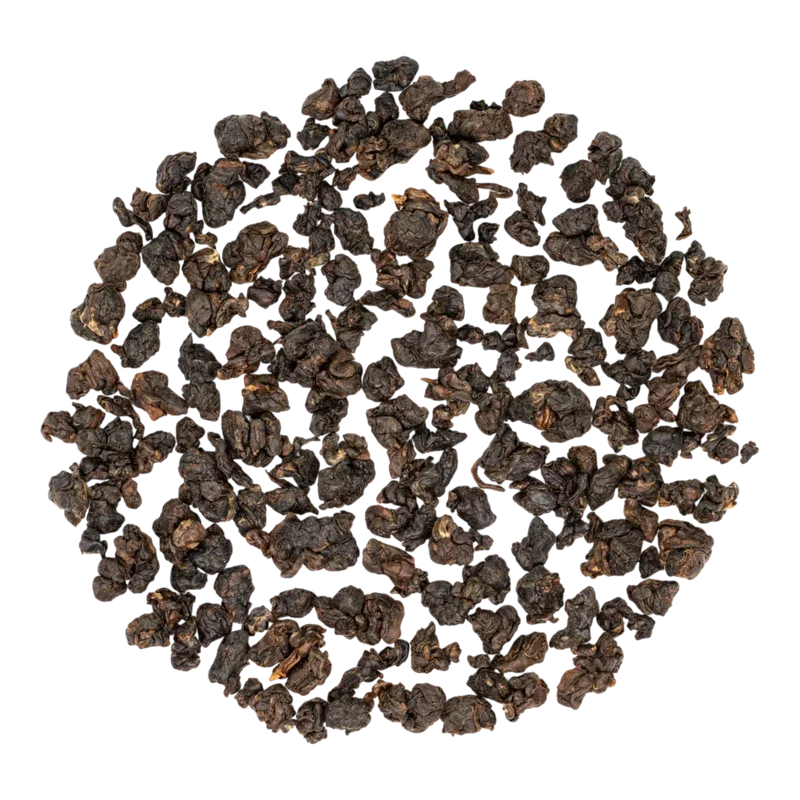
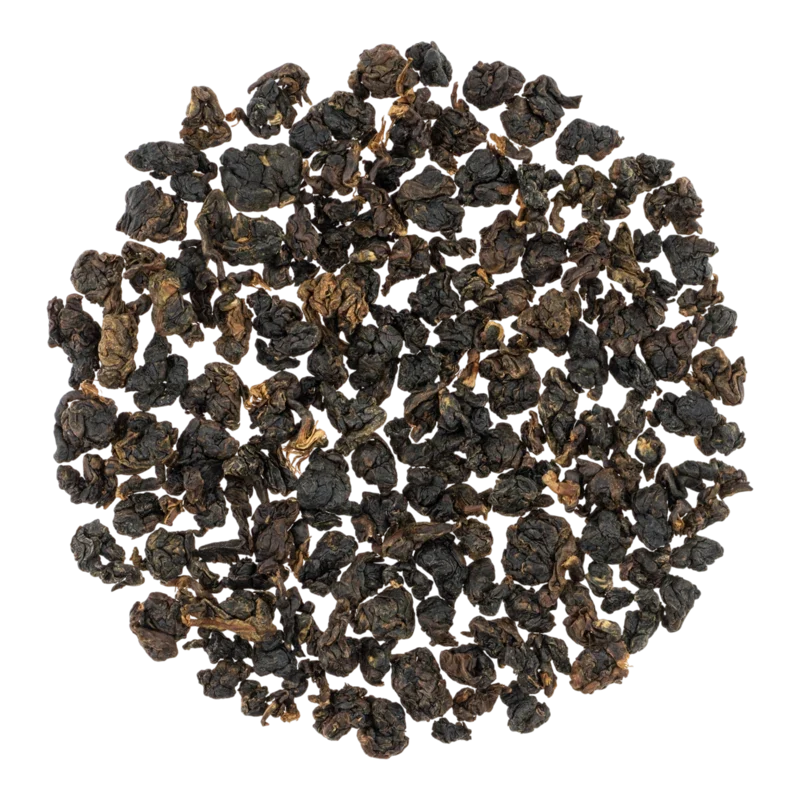
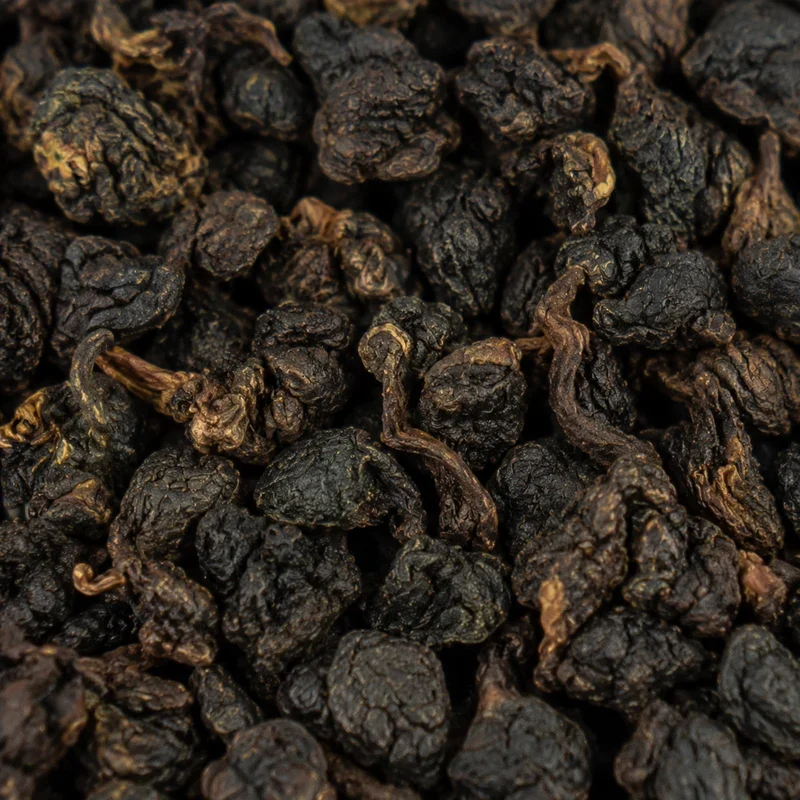
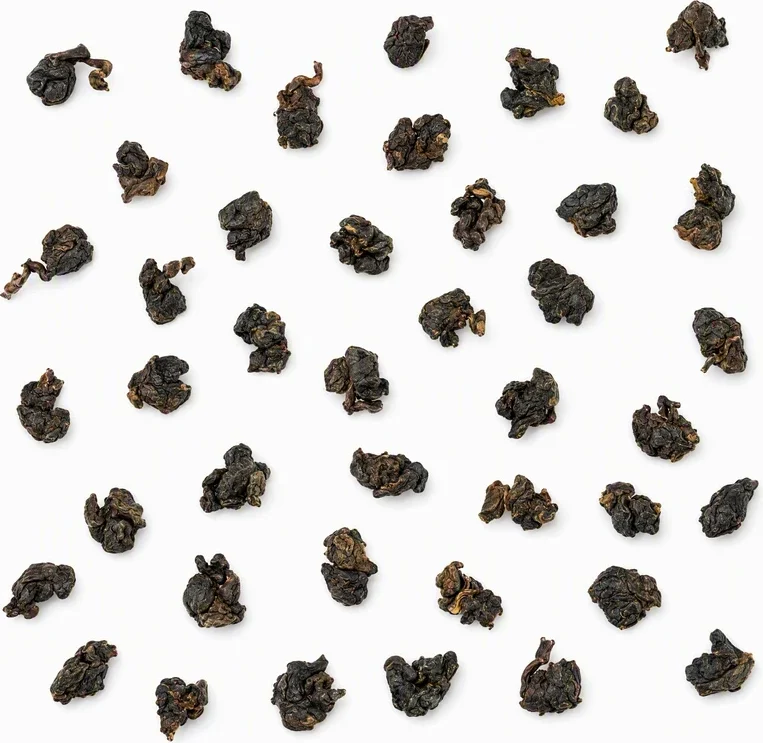
Dense, tightly rolled 'pearl' knots of irregular spherical shape. Colour — dark brown, almost black, with a reddish or bronze sheen. Pellet size — 5–8 mm in diameter. Surface slightly glossy.
Intense, sweet, multi-layered. Notes of honey and baked fruits dominate — plum, apricot, peach. Berry nuances (raspberry, rosehip) and light floral tones of gardenia and honeysuckle, inherited from the Si Ji Chun cultivar, are also present. When the leaf is warmed in a gaiwan, the aroma unfolds more fully, adding notes of burnt sugar and caramel.
Rich, warm, enveloping. The honey-fruit profile is complemented by nuances of caramel, dark molasses, and light mineral notes. As the infusion cools, floral tones characteristic of the original cultivar emerge.
Bright, clear, from golden-amber to reddish-cognac. Early infusions are lighter, honey-golden; with longer exposure — saturated amber-red. High transparency.
Leaves fully unfurl, showing integrity and size. Colour — dark brown with distinct coppery-red edges (red rim — 紅邊, hóng biān), evidence of deep oxidation. The central part of the leaf may retain a darker, olive-brown tone. Leaves are soft, elastic, with noticeable veins.
Taste: Smooth, velvety, enveloping, with a full, 'rounded' body. Virtually no astringency or bitterness even with prolonged steeping. Sweet notes of honey and ripe stone fruits (plum, apricot) dominate. The middle ground features a light tartness reminiscent of red berries (raspberry) and a mineral flavour. The aftertaste is long, honey-sweet, with a berry and slightly dry finish. The tea has a pronounced hui gan (回甘, huí gān) — returning sweetness.
Alkaloids: Caffeine (caffeine — about 1.0–1.5% of dry weight, corresponding to ~20–35 mg per 150 ml cup with standard brewing). Theobromine and theophylline are also present in minor amounts.
Amino Acids: Moderate L-theanine content (lower than in shaded or high-mountain teas, but sufficient to soften caffeine's action). L-theanine promotes relaxation without drowsiness and improves concentration. Total free amino acids — about 1.5–3%.
Because of the high oxidation degree, 'Red Pearl' contains significantly more theaflavins and thearubigins than regular Si Ji Chun oolong (10–20% oxidation). This provides a more pronounced antioxidant effect typical of red teas, combined with an oolong aromatic profile.
Essential Oils: Contain linalool, geraniol, nerol, α-farnesene and other terpenoid compounds that determine the complex fruity-floral aroma. The Si Ji Chun cultivar is noted for a higher content of floral aromatic compounds, which are partly preserved even after deep oxidation.
Minerals: Potassium, calcium, magnesium, manganese, zinc, fluorine, iron. The red clay soils of Mingjian enrich the tea's mineral profile.
Polyphenols: Total polyphenol content — about 8–12% in dry matter. Thanks to deep oxidation, a significant proportion of catechins (EGCG, EGC, ECG) has been transformed into theaflavins (which give the infusion brightness and 'liveliness') and thearubigins (responsible for depth of colour, fullness of body, and sweetness). It is precisely the ratio of theaflavins to thearubigins that determines the quality of red oolongs — a high level of theaflavins is considered a marker of good raw material and the producer's skill.
Vitamins: B-group vitamins (B₁, B₂, B₃), vitamin E, vitamin K. Vitamin C content is reduced compared to green teas due to oxidation.
Theaflavins and thearubigins are powerful antioxidants that protect cells from free radical damage. Studies show that the antioxidant activity of heavily oxidized teas is comparable to that of green teas, although the mechanisms of action differ.
Theaflavins help lower 'bad' cholesterol (LDL) and strengthen blood vessel walls. Regular oolong consumption is associated with a reduced risk of cardiovascular diseases.
Polyphenols and thearubigins stimulate the production of digestive enzymes and improve intestinal motility. Thanks to its smoothness, 'Red Pearl' does not irritate the stomach lining, unlike more aggressive green teas.
Moderate caffeine content combined with L-theanine provides balanced alertness — increased concentration and productivity without nervousness or sharp energy spikes.
Heavily oxidized oolongs stimulate thermogenesis and lipid metabolism, which may support normal weight maintenance.
Polyphenols have antibacterial and antiviral properties, strengthening the body's natural defence mechanisms.
The combination of L-theanine and caffeine improves attention, memory, and information processing speed. L-theanine promotes the generation of alpha brain waves, associated with a state of calm alertness.
Antioxidants (theaflavins, vitamin E) help slow skin ageing processes by protecting against UV damage.
One bud and one leaf, pronounced gardenia aroma, fresh and bright taste. Considered the best season.
Denser leaf, higher polysaccharide content, 'cold' aromatic profile and sugarcane sweetness. The second most valued season.
Used mainly for commercial lots and tea beverages. Simpler taste, higher astringency.
Share of one bud + two leaves ≥ 95%. Dense pellets, colour — dark green with a sandy tint. Gardenia aroma — powerful, long-lasting, penetrating. Price from 600 yuan per jin.
Predominantly one bud + two leaves. Clean aroma, honey-yellow, transparent infusion.
Mixed harvest, including summer and autumn leaves. Clean taste but less complex, lower infusion stamina.
3–4 g per 250 ml, temperature 90°C, steeping time — 3–4 minutes. Possible 2–3 re-steepings with increased time.
The tea opens up superbly with cold brewing: 5–10 g per 1 L cold water, steep in the refrigerator for 6–10 hours. The cold infusion highlights honey-fruit notes and is almost completely devoid of bitterness and astringency.
Tea Amount: 5–7 g per 100–150 ml of water for the gongfu method (功夫茶, gōngfū chá); 3–4 g per 250 ml for steeping in a cup or teapot.
Teaware: Porcelain gaiwan (蓋碗, gàiwǎn) — a universal option that reveals the pure aroma. Yixing clay teapot (宜興紫砂壺, Yíxīng zǐshā hú) — well-suited for oolongs; the porous clay 'remembers' the tea and enriches the infusion over time. Glass teapot — convenient for observing the 'pearls' unfold. A European-style porcelain teapot for steeping is also suitable.
Water Temperature: 90–95°C. High temperature is necessary to unfurl the dense 'pearls' and fully extract the rich taste of the heavily oxidized oolong. Boiling water (100°C) is not recommended, to avoid introducing unnecessary astringency.
Container: Airtight, opaque vessel — a tin canister with a tight lid, a vacuum foil pouch, or a ceramic tea caddy.
Shelf Life: Under proper conditions — 1.5–2 years without significant loss of quality. Heavily oxidized oolongs are more stable in storage than lightly oxidized ones. No refrigeration required (unlike green teas).
Dry, cool place with a temperature of 15–25°C, away from direct sunlight. Relative humidity — no more than 60%.
Moisture, foreign odours (tea actively absorbs aromas), direct sunlight, sharp temperature fluctuations.
Specimens that have undergone a final roast (焙火, bèihuǒ) can be aged and over time acquire deeper, 'autumnal' tones — dried fruit, old wood, honey. For ageing, porous ceramic containers and a stable microclimate are necessary.
The classic version of tea from the same cultivar. Infusion colour — pale yellow with a greenish tint. Aroma — bright, floral (gardenia, honeysuckle). Taste — fresh, 'green', with light sweetness and a creamy finish. The fundamental difference from 'Red Pearl' lies in the oxidation degree: 10–20% vs. 80–90%, yielding an entirely different flavour profile.
From Lugu (鹿谷, Lùgǔ) in Nantou County. More traditional, with pronounced roasting, caramel-nut profile, and greater 'warm' depth. Differs from 'Red Pearl' in having a lower oxidation degree but a more pronounced roast. Predominantly uses the Qingxin cultivar.
The 'progenitor' of the genre, produced in Luye (鹿野, Lùyě). Oxidation — ~80%, heavy roasting mandatory. Aroma — tropical fruits, honey, cocoa. Differs from 'Red Pearl' in a heavier roast and a somewhat different terroir (eastern coast of Taiwan). Price is generally higher.
Heavily oxidized oolong (60–80%) from Hsinchu (新竹, Xīnzhú). The key difference is the use of leaves bitten by leafhoppers (小綠葉蟬, xiǎo lǜ yè chán), which gives the tea a unique muscatel-honey character. More expensive and labour-intensive to produce.
Red oolong from the Jinxuan cultivar (TRES No. 12). Distinguished by milky-creamy nuances typical of this cultivar, combined with the honey sweetness of red oolong. Less pronounced florality compared to 'Red Pearl'.
Price Category: Affordable to mid-range. Thanks to the high yield of the Si Ji Chun cultivar, the possibility of machine harvesting, and low-altitude plantation locations, 'Red Pearl' costs considerably less than high-mountain hand-made Taiwanese oolongs (Alishan, Lishan, Da Yu Ling). It represents one of the best price/quality ratios among Taiwanese oolongs. The price varies depending on the specific producer, harvest season, and whether hand plucking was used.
Genuine 'pearls' are tightly rolled, of a uniform dark brown colour with a reddish sheen, with no admixture of green or black fragments.
Natural tea has a clean, multilayered honey-fruit aroma. A sharp, 'chemical' or unnaturally bright odour may indicate the use of artificial flavourings.
The colour should be clean and transparent, from golden-amber to reddish-cognac. An opaque or unnaturally dark infusion is a sign of low quality.
If the price is significantly below market — the raw material may be substituted with cheaper varieties or Vietnamese/Thai tea from the Si Ji Chun cultivar (the cultivar is actively grown in Thailand and Vietnam) passed off as Taiwanese.
No reviews yet. Tell us what you think of this tea.
Rate this tea and share your impressions. We review each submission before publishing it.