Brewing
Gongfu brewing
- Water temperature
- 95 °C
- Tea amount
- 7 g
- Water volume
- 100 ml
- First steep
- 10 s
- Time added per infusion
- 5 s
- Infusions
- 10

Shénnóngjià hóngchá
Choose a brewing method. Start with the recommended quantities and time, then adjust to taste.
Brewing
Brewing
Taste
Tea encyclopedia
Category: Regional high-altitude red tea of Hubei Province. Belongs to the gōngfū hóngchá (工夫红茶, gōngfū hóngchá) category. A product of Shennongjia Forest District — a specific feature of Shennongjia Hong Cha is its production within the territory of a national nature reserve and UNESCO World Heritage site.
Category: Regional high-altitude red tea of Hubei Province. Belongs to the gōngfū hóngchá (工夫红茶, gōngfū hóngchá) category. A product of Shennongjia Forest District — a specific feature of Shennongjia Hong Cha is its production within the territory of a national nature reserve and UNESCO World Heritage site.
Coordinates: approximately 31°25′ N, 110°20′ E (Muyu area, southern slope of Shennongjia highland).
Origin: China, Húběi Province (湖北省, Húběi shěng), Shénnóngjià Forest District (神农架林区, Shénnóngjià línqū). Main production area — Mùyú Town (木鱼镇, Mùyú zhèn), located at the southern foothills of Shennongding Peak (神农顶, 3106 m — the highest point in Central China). Tea gardens are also concentrated in Qīngtián Village (青天村), along the Xiāngxī River (香溪河), and on adjacent mountain slopes.
Type: Chinese red tea (black tea) (红茶, hóngchá), fully oxidized (fermented).
Cultural Significance: Shennongjia is a UNESCO World Heritage site (since 2016) and biosphere reserve (since 1990). Tea produced on territory of such status acquires an additional dimension — it embodies the idea of harmony between agriculture and wild nature. Local tea growers actively develop the concept of "ecological tea gardens" (生态茶园): instead of sterile plantations — tea bushes growing among trees, grasses, and wildflowers, in conditions maximally approximating forest ecosystems. This is a kind of manifesto of "wild" tea — a new trend in Chinese tea cultivation.
History: Shennongjia occupies a special place in Chinese tea mythology: according to legend, it was here that the legendary Emperor Shénnóng (神农, "Divine Farmer") tasted hundreds of herbs and discovered the healing properties of tea leaves. The classical treatise "Shennong Bencao Jing" (《神农本草经》) states: "Shennong tasted hundreds of herbs, encountered seventy-two poisons daily, and was cured by tea." Lù Yǔ (陆羽, Lù Yǔ) in "The Classic of Tea" (《茶经》, Chájīng) confirmed: "Tea as a beverage originates from Shennong." These texts established Shennongjia's status as one of the cradles of Chinese tea culture.
Name Breakdown: "Shennongjia" (神农架) is a toponym literally meaning "Shennong's scaffold/shelter": according to legend, Shénnóng constructed wooden platforms (架, jià) for collecting and drying medicinal herbs on the slopes of these mountains. "Hong cha" (红茶) means "red tea." Thus, the full name means "Red tea from Shennongjia" — a direct connection to the mythological founder of Chinese phytotherapy and tea culture.
Cultivar: Primarily uses regionally adapted vegetatively propagated (无性系, wúxìngxì) varieties: Fúdǐng Dàbái (福鼎大白, Fúdǐng Dàbái) — a small-leaf high-productivity cultivar well-proven in high-altitude conditions; Jīn Guānyīn (金观音, Jīn Guānyīn) — a hybrid with high aromatic potential; E Cha 10-hao (鄂茶10号, È chá 10 hào) — a variety specially bred for Hubei conditions. Besides cultivated varieties, groups of wild tea trees Camellia sinensis documented in the region in 2007 are used for limited batches of "Shennongjia wild tea" (神农架野茶).
Picking: Due to high-altitude location and cold climate, vegetation begins later than in lowland regions. Spring harvest falls in late April to May. Shennongjia cannot compete in the "pre-Qingming tea" (明前茶) segment, but late harvest ensures longer accumulation of amino acids and sugars.
Pluck Standard: One bud and one-two leaves (一芽一二叶, yī yá yī-èr yè). For red tea, slightly more mature leaves are acceptable than for green tea, which increases body of the liquor.
Raw Material: Whole, undamaged leaves, free from coarse stems. Minimal delay between harvest and withering. For the best batches, leaves from high-altitude plots (above 1200 m) are selected, where accumulation of aromatic substances is maximal.
Altitude: Tea gardens — from 550 to 1465 m (Muyu data); best plantations — from 1000 to 1400 m. Individual tea plots are located near Qingtianbao Pass at approximately 1400 m elevation.
Soil: Mountain yellow-brown (黄棕壤) and brown forest soils (棕壤), pH 5.5–6.9. Organic horizon thickness — 20–40 cm, which is exceptional for tea regions. Soils are rich in minerals, well-drained due to mountain topography.
Shénnóngjià is a mountain massif at the junction of the Dabashan (大巴山) and Jìngshān (荆山) ranges, with elevations from 398 to 3106 m. Tea gardens are located on mountain slopes in the Xiāngxī River (香溪河, tributary of the Yangtze) basin, among mixed broadleaf and coniferous forests. Forest cover in Muyu exceeds 88.6%, ensuring exceptional air quality (negative ion concentration reaches 30,000 per cubic centimeter) and diffused lighting.
In Muyu area — about 11.6°C, significantly lower than most Chinese tea regions. Summer average — about 20–22°C. Day/night temperature differential is pronounced, promoting accumulation of aromatic compounds and amino acids.
1200–2500 mm annually depending on altitude. Humidity is constantly high; mountain mists are common, especially during morning and evening hours.
Territory has no industrial enterprises, free from pollution. Tea farms practice organic farming principles; two farms have organic tea certification. In new-type tea gardens, local trees are planted between bush rows — dove tree (珙桐), cinnamon tree, red tree — creating mini-ecosystems.
Freshly picked leaves are spread in thin layers on bamboo trays or in rooms with controlled ventilation. Under mountain climate conditions with their coolness, withering may take longer than in lowland regions. Leaves lose 55–65% of original moisture, becoming soft and elastic. Extended withering promotes fuller aroma development.
Withered leaves undergo mechanical rolling to break cell walls and bring cell sap to the surface. Rolling forms the characteristic dense, resilient shape of tea particles and ensures uniform oxidation.
Rolled leaves are placed under controlled temperature conditions (25–28°C) and high humidity. Catechins oxidize to theaflavins and thearubigins, forming the red color of the liquor and honey flavor profile. Due to high amino acid content in the original raw material, fermentation proceeds gently, without excessive bitterness.
Two-stage: initial drying at elevated temperature to stop oxidation, then "sufficient fire" (足火) at low temperature to fix aroma and completely remove moisture to 4–6%.
Finished tea is sieved, separating fractions. Batches are sorted by leaf size, tip content, and quality characteristics.
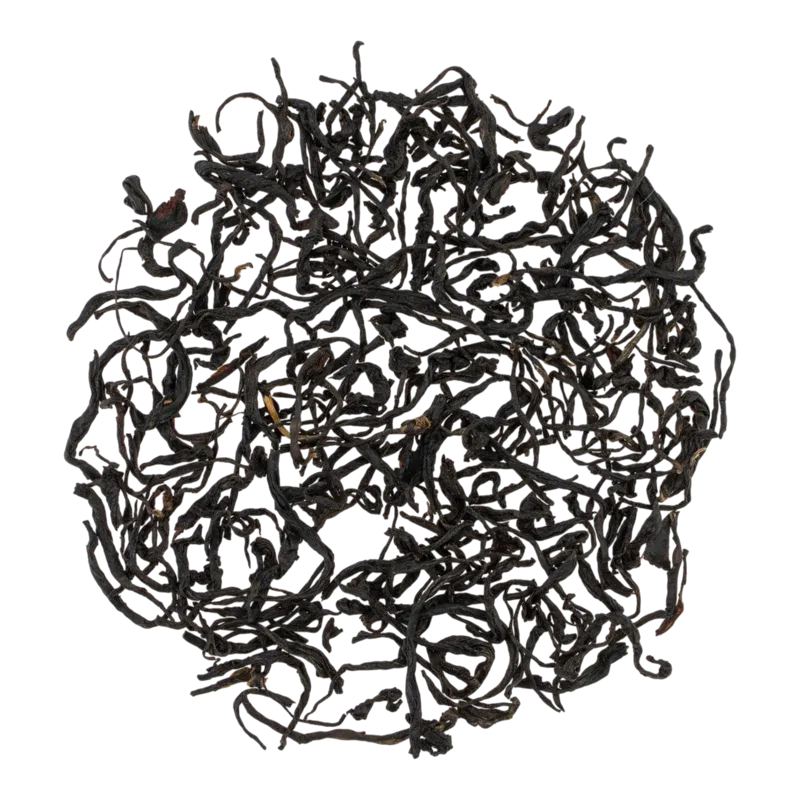
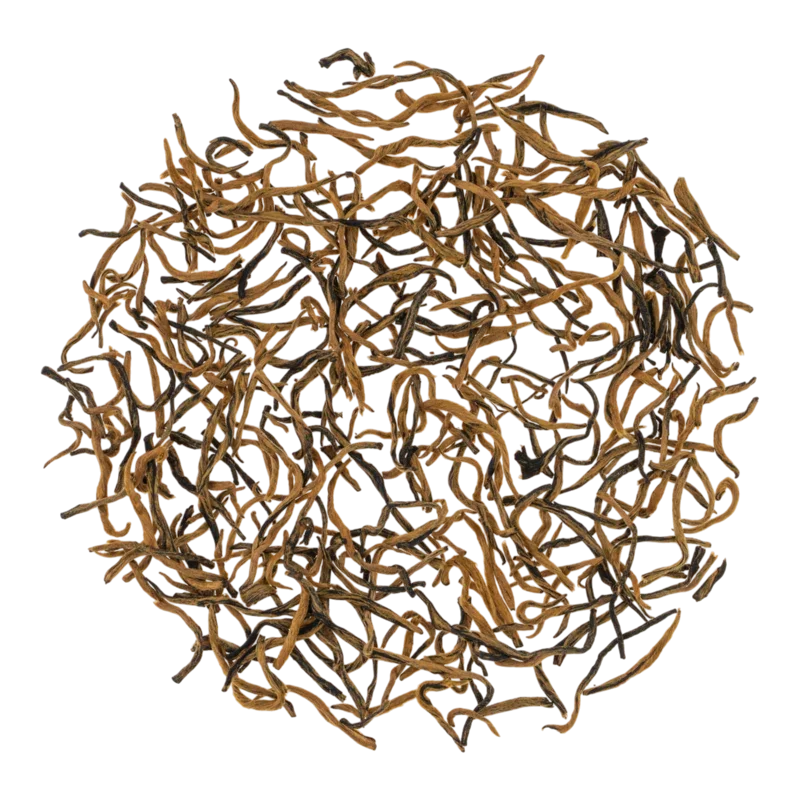
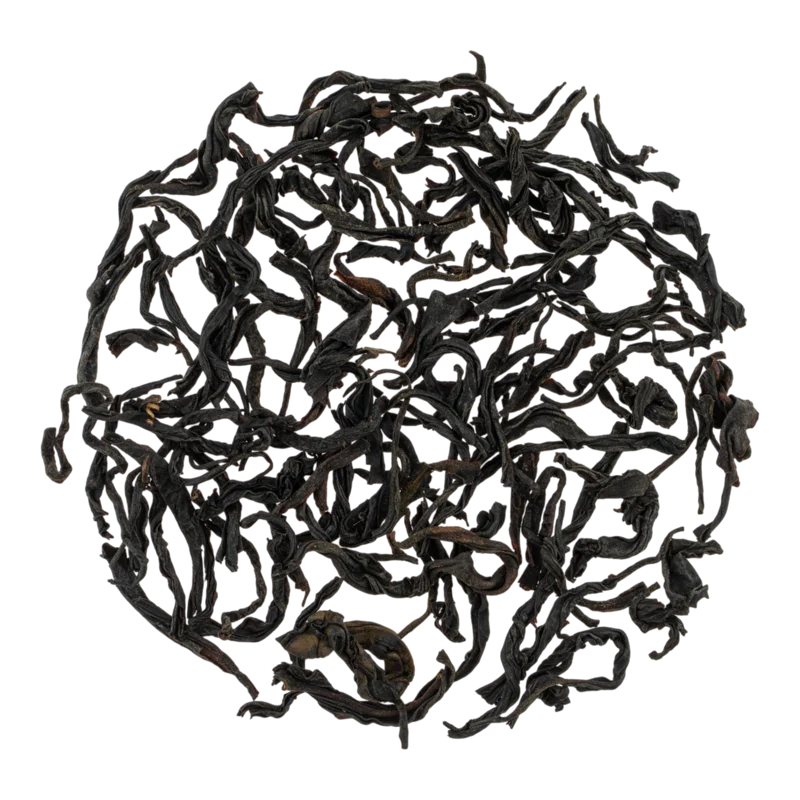
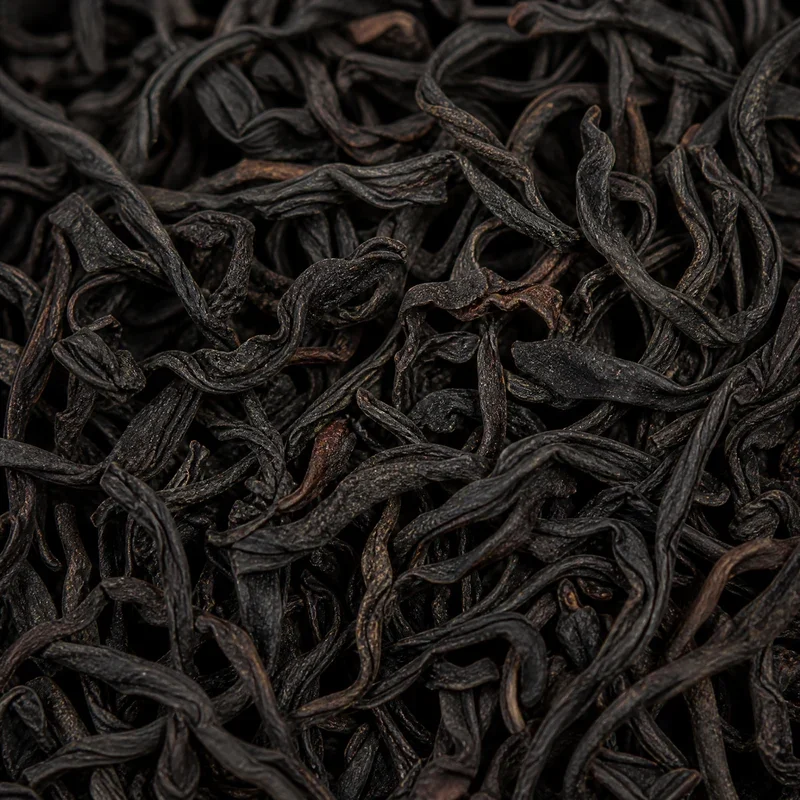
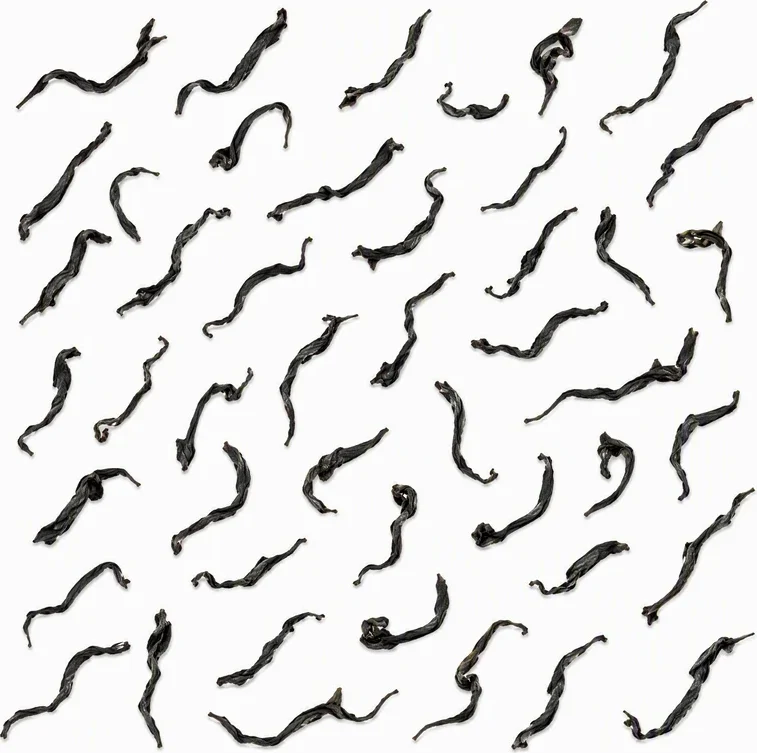
Dry Leaf Appearance: Tea particles are tightly rolled, resilient, dark-colored with characteristic "oily" luster (乌润). Abundant golden tips are noticeable, giving batches an elegant appearance. Leaves are even, well-sorted.
Dry Leaf Aroma: Pronounced honey (蜜香, mì xiāng) with nuances of caramel, dried fruits, and light floral undertones. Characteristic "purity" of aroma — absence of foreign notes, related to the ecologically pristine growing environment.
Liquor Aroma: Deep, warm, with dominant honey sweetness. Unfolds gradually: initial notes — honey and ripe fruits; middle steeps — caramel, warm wood; final — gentle sweetness with roasted nut undertones.
Liquor Color: Red-amber to ruby, transparent and clear, with good luster. Best batches have a thin golden rim.
Spent Leaves: Red-copper, evenly colored. Leaves are whole, elastic, tender. High grades are soft and glossy, opening into full plates.
Taste: Dense, round, with rich natural sweetness (甘爽, gān shuǎng). Tea body — medium, "velvety." Astringency minimal, quickly transitioning to prolonged sweet aftertaste (回甘). Aftertaste is long, with honey-fruit trail. Characteristic "juiciness" (鲜活) — sensation of living freshness that distinguishes high-altitude teas with high amino acid content.
Alkaloids: Caffeine — 2.5–4% of dry mass. Theobromine and theophylline — in standard amounts for red tea. Cold mountain climate may somewhat reduce caffeine content.
Amino Acids: Elevated content (approximately 3.5–5%) — consequence of cool climate and slow shoot growth. L-theanine provides natural sweetness, "freshness" and taste softness, as well as relaxing effect.
High-altitude conditions and significant day/night temperature differential promote accumulation of linalool, geraniol, and their oxides — key components of honey-floral aroma of red tea.
Minerals: Potassium, magnesium, calcium, zinc, manganese, selenium. Rich organic mountain soils ensure high microelement content.
Polyphenols: Total content in red tea after fermentation — approximately 12–18% of dry mass. Significant portion of catechins transforms into theaflavins (茶黄素) and thearubigins (茶红素), providing color, "velvet," and characteristic "honey" tone of liquor. High-altitude origin of raw material typically reduces initial polyphenol content compared to lowland leaf, making red tea from Shennongjia less astringent and more "sweet."
Vitamins: C (partially preserved after fermentation), B₁, B₂, P, PP.
Combination of caffeine and high L-theanine levels provides sustained, calm alertness, improved concentration and memory without anxiety.
Theaflavins and thearubigins, as well as residual catechins neutralize free radicals, protecting cells from oxidative damage.
Warm red tea with gentle tannin profile is comfortable for the stomach, aids digestion of fatty foods without causing mucosal irritation.
Regular moderate consumption of red tea is associated with reduced LDL cholesterol levels and improved vascular tone.
Red tea is traditionally classified as "warm" (性温) beverage. Shennongjia Hong Cha, with its honey sweetness and full body, is especially appropriate in autumn-winter period.
High L-theanine level provides gentle anxiolytic action. Warm honey aroma complements the relaxing effect on sensory level.
Red tea polyphenols possess antibacterial and antiviral properties, supporting the body's natural defense mechanisms.
Tea Amount: 4–5 g per 100–120 ml (gongfu method); 2–3 g per 200–250 ml (Western steeping).
Teaware: Porcelain gàiwǎn (盖碗) of 100–120 ml volume — optimal choice, allowing control of extraction and full appreciation of aroma. Porcelain teapot also suitable. For more "warm," enveloping character — Yixing clay teapot.
Water Temperature: 90–95°C. For particularly delicate batches with high tip content — 85–90°C.
"Neighbor" in Hubei Province. Yihongcha is a classic Hubei gongfu hongcha from lower altitudes (200–800 m), possessing dense, rich taste with pronounced astringency. Shennongjia Hong Cha is significantly softer, sweeter, and "cleaner" in taste due to high-altitude terroir and elevated amino acid content.
Another Húběi red tea from the mountainous Ēnshī (恩施) area. Lishan Hongcha is also produced at altitude, but lower (600–1000 m). It is known for bright floral aroma and honey taste. Shennongjia Hong Cha surpasses it in "purity" of ecological environment and degree of terroir "wildness."
Famous Fujian red tea from pure tips. Jin Junmei is "perfumed," intense, with notes of honey, flowers, and dried fruits. Shennongjia Hong Cha is less "perfumed" but more "landscape-oriented": it conveys mountain freshness and "forest" purity absent in Fujian tea.
Yunnan red tea from large-leaf variety. Dianhong is powerful, full-bodied, with cocoa and chocolate notes. Shennongjia Hong Cha is from small-leaf variety, significantly more delicate, with light body and emphasis on natural sweetness and "mountain" freshness.
No reviews yet. Tell us what you think of this tea.
Rate this tea and share your impressions. We review each submission before publishing it.