Brewing
Gongfu brewing
- Water temperature
- 92 °C
- Tea amount
- 6 g
- Water volume
- 100 ml
- First steep
- 10 s
- Time added per infusion
- 5 s
- Infusions
- 8



Shānlínxī wūlóng
Choose a brewing method. Start with the recommended quantities and time, then adjust to taste.
Brewing
Brewing
Taste
Tea encyclopedia
Category: Taiwanese high-mountain oolongs (高山烏龍, gāoshān wūlóng). According to Taiwanese classification — tea grown at altitudes above 1,000 m above sea level.
Category: Taiwanese high-mountain oolongs (高山烏龍, gāoshān wūlóng). According to Taiwanese classification — tea grown at altitudes above 1,000 m above sea level.
Coordinates: Approximately 23°38′ N, 120°46′ E.
Origin: Táiwān (臺灣, Táiwān), Nántóu County (南投縣, Nántóu Xiàn), Zhúshān Township (竹山鎮, Zhúshān Zhèn), Shānlínxī mountain area (杉林溪, Shānlínxī). The tea region is located on the spurs of the Ālǐshān Range (阿里山支脈), at the junction of three counties — Nantou, Chiayi (嘉義, Jiāyì), and Yúnlín (雲林, Yúnlín). Partially, plantations extend into Lùgǔ Township (鹿谷鄉, Lùgǔ Xiāng).
Type: Oolong (烏龍茶, wūlóng chá) — semi-oxidized tea. Oxidation level — light, from 15 to 30%. Roasting is typically light or moderate; the traditional competition style (竹山鎮農會) permits more pronounced roasting (4–5 points on the Taiwanese scale).
Cultural Significance: Shanlinxi Oolong is considered one of the exemplary Taiwanese gaoshan teas and enjoys high status both among Taiwanese connoisseurs and in the international market. The Shanlinxi area is simultaneously a popular tourist zone — here are located nature parks, observation platforms, mountain trails among cryptomerias and bamboo groves. The possibility of traveling along the "Twelve Zodiac Turns," tasting tea from each section of the route, has made Shanlinxi one of the most attractive tea tourism destinations in Taiwan.
History: Shanlinxi is a relatively young tea region. During the Japanese colonial period and in the first post-war decades, the mountain area was a zone of industrial logging: the slopes were covered with plantations of Japanese cryptomeria (杉木, shānmù — Cryptomeria japonica), for which the locality received its name. By the 1970s, forest protection policies and government encouragement of alternative activities led to the decline of the forest industry. Entrepreneur Liú Āndìng (劉安定) founded the recreational company "Shanlinxi" and achieved the construction of Taiwan's first private mountain road, passing through the famous "Twelve Zodiac Turns" (十二生肖彎道) from Xītóu (溪頭) to Shanlinxi. It was on the cleared forest areas that farmers began planting tea bushes in the late 1970s — early 1980s, primarily the Qing Xin Oolong cultivar. The very first harvest showed that the tea acquired a unique "cold" pine note, apparently related to the terroir of former cryptomeria forests and the preserved acidic coniferous litter. By the 1990s, the "cold mineral aroma" of Shanlinxi became a market sensation, and the tea firmly entered the ranks of the most sought-after gaoshan teas. Since the 2000s, the Zhushan Township Farmers' Association (竹山鎮農會) has conducted annual quality competitions (spring and winter seasons), where samples are evaluated by experts from the Taiwan Tea Research and Extension Station (茶業改良場). Competition standards — aroma and taste 70%, leaf appearance 20%, liquor color 10%. Spec
Name Breakdown: "Shanlinxi" (杉林溪) literally translates as "Cedar Forest Creek." The character 杉 (shān) denotes cryptomeria (in Russian tradition often translated as "Chinese cedar" — Cunninghamia, or "Japanese cedar" — Cryptomeria), 林 (lín) — forest, 溪 (xī) — mountain stream. "Oolong" (烏龍, wūlóng) — "black dragon," the general name for the group of semi-oxidized teas. The area is also known by local names of individual tea zones: Lóngfèngxiá (龍鳳峽, Lóngfèngxiá — "Dragon and Phoenix Gorge"), Yángzǎiwān (羊仔彎, Yángzǎiwān), Ruan'an (軟鞍, Ruǎnān), Fanzitian (番仔田, Fānzǎitián), Sǎn Céng Píng (三層坪, Sāncéngpíng), Caodazi (草沓仔, Cǎotàzǎi).
Cultivar: The main cultivar is Qīng Xīn Oolong (青心烏龍, Qīngxīn Wūlóng), also known as Ruǎnzhī Oolong (軟枝烏龍, Ruǎnzhī Wūlóng) — "Oolong with soft branches." This is a late-ripening Taiwanese local variety, genetically tracing back to Fújiàn varieties Ruǎnzhī Oolong and Ǎi Jiào Oolong (矮腳烏龍). Qing Xin Oolong comprises about 90% of plantings in the Shanlinxi area. The variety is distinguished by high content of alcoholic aromatic compounds (55–70% in the volatile substances profile), which easily transform into various floral notes depending on the degree of oxidation. In small quantities, there are also Jīn Xuān (金萱, Jīn Xuān) — TTES No. 12, known for its light creamy shade, and Cuì Yù (翠玉, Cuì Yù) — TTES No. 13, giving a refreshing aroma. Camellia sinensis var. sinensis.
Picking: Main seasons — spring (春茶, chūnchá; May) and winter (冬茶, dōngchá; November). There is also late-winter "winter leaf" (冬片, dōngpiàn) — harvest around the winter solstice, valued for its especially cold, pure aroma. Summer and autumn harvests are less prestigious. The average vegetation period of spring and winter buds in Shanlinxi exceeds 55 days — significantly longer than in lowland tea zones, which contributes to the accumulation of amino acids and aromatic substances.
Pluck Standard: For highest grades — "one bud and two leaves" (一心二葉, yī xīn èr yè), the proportion of such standard in competition tea ≥ 95%. Leaves must be covered on the reverse side with fine white down.
Raw Material: Whole young shoots, uniform maturity, juiciness, absence of mechanical damage, foreign odors, and coarse leaves. Amino acid content in fresh leaf of "Special" class — not less than 5.2%.
Altitude: Tea plantations are located at altitudes from 1,000 to 1,950 m. The core of the best gardens — at elevations of 1,500–1,800 m; the highest areas (up to ~2,600 m according to some sources) belong to border zones with Fushoushan and Cuifeng.
Climate: Subtropical high-mountain. Average annual temperature below 15°C. Daily temperature fluctuations ≥ 15°C. Number of foggy days per year ≥ 200, relative humidity ≥ 85%. Fogs begin already in midday hours and envelop tea plantations, diffusing sunlight and slowing photosynthesis. Slowed leaf growth leads to reduced bitterness and astringency (lower catechin content) and increased sweetness and aroma (higher amino acid and essential oil content). Winters are cool, sometimes with frosts.
Soil: Red-yellow soils (紅黃壤) on volcanic rock, pH 4.5–5.5, rich in iron and magnesium. Organic matter content ≥ 3%. Good natural drainage on steep mountain slopes. Acidic coniferous litter from cryptomerias contributes to the formation of the characteristic "cold" mineral aroma of tea.
Shanlinxi is an extensive mountain zone on the spurs of the Alishan Range with steep slopes, deep gorges, and numerous streams. Forest cover reaches 93%, mountains are covered with primary and secondary cryptomeria and bamboo forests, isolating tea gardens from external pollution. Main tea zones: Lóngfèngxiá (海拔 ~1,800 m) — considered the highest and most prestigious; Yangzaiwan (~1,500 m) — areas with mature trees (age ≥ 30 years); Ruan'an, Fanzitian, San Ceng Ping, Caodazi — zones with medium altitudes.
Hand picking of upper shoots of "bud + 2 leaves" standard. Fresh leaf is immediately delivered to the processing facility to prevent overheating and uncontrolled oxidation.
Picked leaves are spread outdoors for 20–30 minutes under gentle sunlight to begin moisture loss and activate enzymatic processes.
Leaf is transferred to a ventilated room and spread on bamboo trays for approximately 4 hours. At this stage, cell membranes are partially damaged, triggering slow oxidation and forming the aroma base.
Three cycles of gentle shaking (浪青, làngqīng) with intervals for leaf "rest." For Shanlinxi, shaking is especially delicate — the goal is to form a floral profile without excessive oxidation. Oxidation proceeds predominantly along the leaf edge, forming the characteristic border "green leaf with red edge" (綠葉紅鑲邊, lǜyè hóng xiāngbiān).
Heating at about 280°C stops enzymatic processes and fixes the aroma direction.
Mechanical processing of leaf to break down cellular structure and increase extractability.
Drying at 80°C to stabilize shape.
Leaf is wrapped in cloth and repeatedly hand-rolled, giving the characteristic semi-spherical shape (半球狀, bànqiú zhuàng). This stage is one of the most labor-intensive and requires skill and physical strength.
Low-temperature finish drying at ~60°C following the principle "low temperature — slow roasting" (低溫慢焙, dīwēn mànbèi) to fix the "cold aroma" and stabilize moisture to storage level.
Removal of old leaves, stems, and foreign inclusions. For competition tea, selection is especially strict.
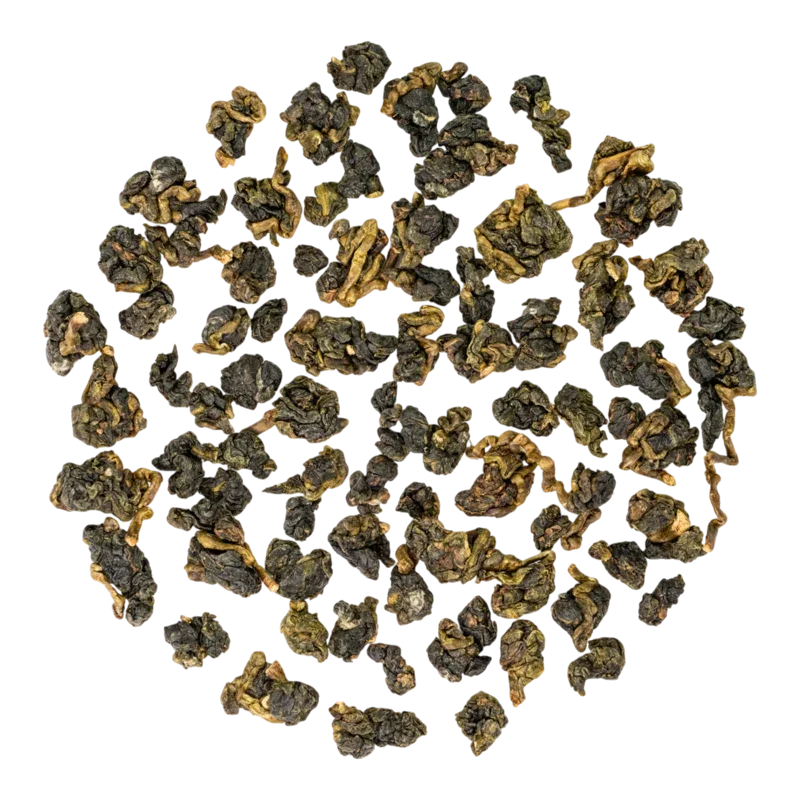
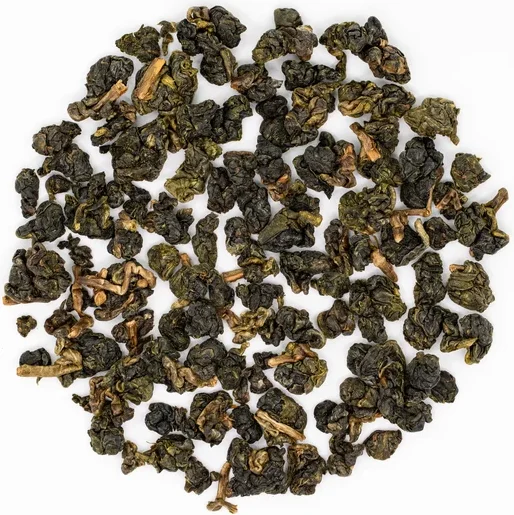
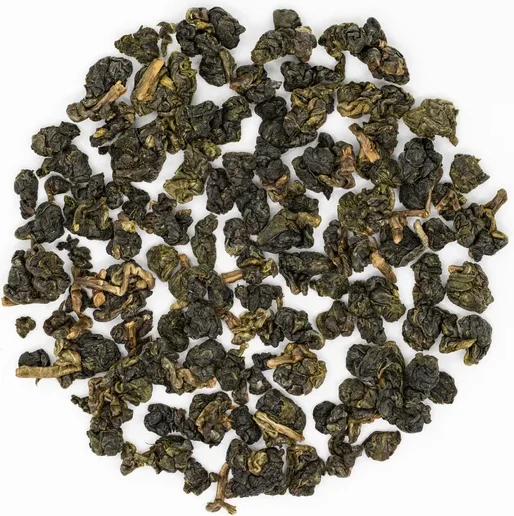
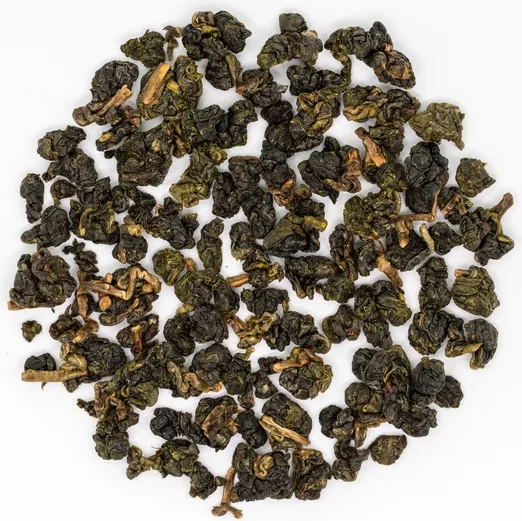
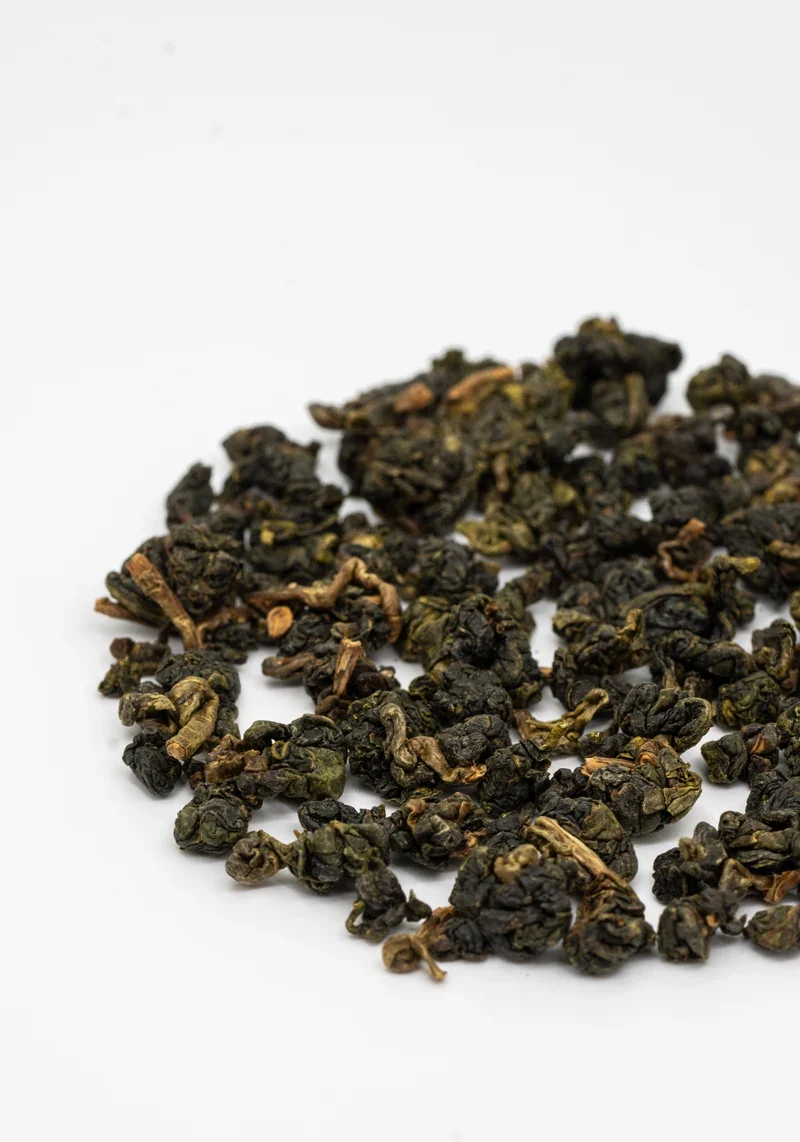
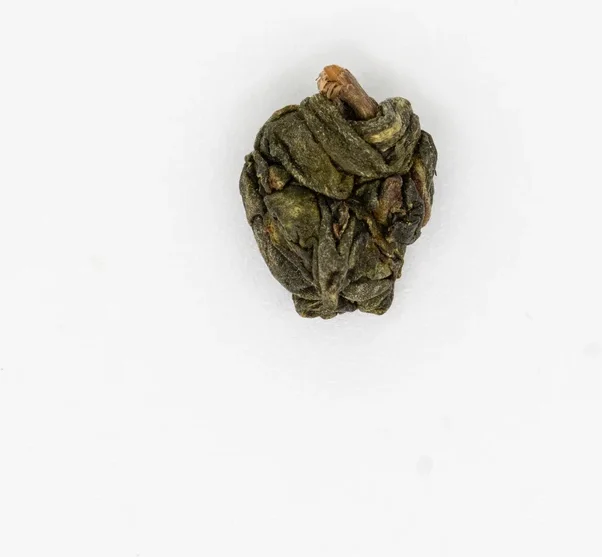
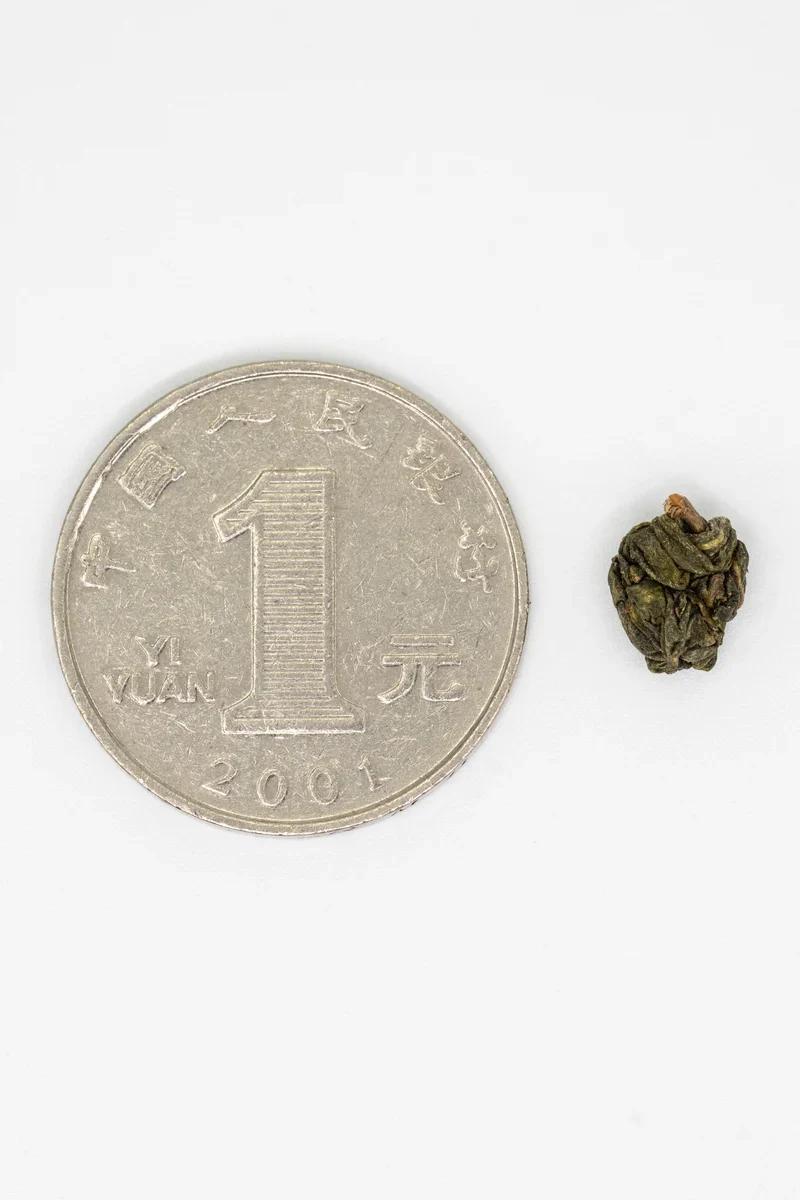
Dry Leaf Appearance: Tightly rolled semi-spherical granules (半球狀), size from medium to large. Color — dark green with oily luster (墨綠油潤). In highest grades, granules are heavy and dense. Light down is noticeable on tips.
Dry Leaf Aroma: Dominant "cold" note (冷香) — clean, cool, with distinct pine shade of cryptomeria. In the background — orchid, lily of the valley, and light creamy sweetness. Spring tea more brightly expresses floral-bean aroma (蘭香與嫩豆香), winter — sugar sweetness and minerality.
Liquor Aroma: Rich floral-pine spectrum with growing honey sweetness. Orchid note interweaves with the woody "base" of cryptomeria — this is the signature feature distinguishing Shanlinxi from other gaoshan teas. At the bottom of the cup after cooling, a persistent creamy-caramel aroma unfolds. In roasted competition styles, nutty-caramel nuances appear.
Liquor Color: Honey-green with golden shade (蜜綠透金黃), high transparency, noticeable colloidal shine on surface (光暈).
Spent Leaves: Fleshy, elastic, whole leaves, opened to full size. Color — from bright green to olive, with reddish border along the edge. Stems and petioles — elastic and juicy.
Taste: Full, oily, smooth (甘滑醇厚). Pronounced freshness (鮮), due to high amino acid content. Sweetness — "sugar cane" in winter tea, more floral and light in spring. Light and pleasant bitterness quickly transitions to lǒng returning sweet aftertaste (回甘, huígān) with characteristic minty-menthol coolness in the throat (喉韻, hóuyùn). Liquor body is dense, with noticeable "gel" texture (膠質顯). Notes: orchid, cryptomeria, ripe peach, honey.
Alkaloids: Caffeine — moderate level (approximately 2–3% dry weight). Tannin content ~20% higher than lowland oolongs, therefore not recommended to drink on empty stomach. Also present are theobromine and theophylline.
Amino Acids: Elevated content — not less than 5.2% in fresh leaf of highest grades (above average for Taiwanese oolongs). L-theanine dominates, responsible for sweetness, umami shade, and relaxing effect. High amino acid concentration is a direct consequence of slowed growth at low temperatures, diffused lighting, and large temperature differences.
High content of alcoholic aromatic compounds (linalool, geraniol, nerol, cis-3-hexenol), comprising 55–70% of the aroma profile for Qing Xin Oolong cultivar. These compounds transform into orchid and cryptomeria aromas during light oxidation.
Minerals: Potassium, magnesium, manganese, iron, fluorine (~15 mg/100 g — high indicator, providing pronounced anti-caries activity), zinc, selenium in trace amounts. Mineral profile is enriched with iron and magnesium from volcanic soils.
Polyphenols: Total polyphenol content — moderate for oolongs, lower than lowland varieties, due to slowed growth at altitude and light oxidation. Main components — catechins: epigallocatechin gallate (EGCG), epicatechin gallate (ECG), epigallocatechin (EGC), epicatechin (EC). Partial oxidation converts part of catechins into theaflavin-like compounds, softening astringency.
Vitamins: C, E, K, B group. Vitamin C is preserved better than in heavily oxidized teas, thanks to light oxidation.
Polyphenols and catechins neutralize free radicals, helping slow cellular aging processes. According to some sources, the effectiveness of free radical neutralization in high-mountain oolongs is comparable to 18-fold vitamin E activity.
Tea polyphenols promote fat breakdown; according to some data, lipolysis rate in high-mountain oolongs is ~30% higher compared to lowland analogs. Regular consumption may contribute to lowering "bad" cholesterol (LDL) levels and raising "good" (HDL).
The combination of caffeine and L-theanine provides gentle, focused alertness without anxiety. L-theanine stimulates alpha-wave generation in the brain, promoting a state of calm concentration.
Polyphenols and tannins gently stimulate secretion of digestive enzymes, improving food absorption. Roasted styles are especially beneficial for the stomach.
High fluorine content (~15 mg/100 g) combined with antibacterial activity of polyphenols suppresses cariogenic bacteria activity (up to 90% according to some estimates), strengthens tooth enamel.
Polyphenols contribute to strengthening vessel walls and reducing atherosclerosis risk by inhibiting LDL-cholesterol oxidation.
Antioxidants, vitamins C and E contribute to evening skin tone and maintaining its elasticity.
Cryptomeria aroma and high L-theanine content together create a relaxing effect, making the tea an excellent complement to mindful tea practice.
Don't over-steep first infusions — excess extraction will lead to unwanted astringency that will "close" the delicate pine aroma. Short steeps better reveal the layered taste structure.
Tea Amount: 6–8 g per 150–200 ml (gongfu); 3–4 g per 250 ml (European style).
Teaware: White porcelain gàiwǎn (蓋碗, gàiwǎn) — ideal for revealing "cold aroma" and evaluating liquor color. Yíxīng teapot from zǐshā clay (紫砂, zǐshā) — suitable for roasted styles, adding softness. Porcelain teapot — universal option.
Water Temperature: 90–95°C for standard batches; 85–90°C for the most delicate spring harvests of "Special" class. Competition style (roasted) tolerates 95–100°C.
Enemies: Moisture, heat, direct sunlight, foreign odors.
Airtight packaging (vacuum or foil bag with clip), cool (< 20°C), dark place, without foreign odors.
Ideally — refrigerator storage at 0–5°C, in separate compartment, without proximity to food products. Such tea is especially sensitive to moisture and odors. After opening packaging, recommended to consume within 72 hours to preserve aroma freshness.
Less demanding, room temperature storage in airtight container is acceptable. Over time, roasted oolongs may slightly "settle," softening in aroma.
Recommended to let new tea "rest" in a dark place for about a month to dissipate residual "fire qi" (火氣, huǒqì) from production heating.
Grows at altitudes 1,000–1,600 m in neighboring Chiayi County. Aroma — more uniform, with clean orchid note without pronounced woodiness. Taste — soft and elegant, with less mineral density. Considered "entry-level" high-mountain oolong, while Shanlinxi is more complex and multi-layered.
Cultivated at altitudes 1,800–2,600 m, making it one of the world's highest-altitude oolongs. Aroma — refined, fruity-floral, with "frosty" shade. Compared to it, Shanlinxi possesses denser body and pronounced pine-woody character. Lishan is even more expensive and rare.
Classic oolong from Lugu Township (neighboring Zhushan area), growing at modest altitudes 600–800 m. Traditionally subjected to stronger roasting and oxidation. Taste — warm, caramel-nutty, with less freshness and "cold" note compared to Shanlinxi. Dong Ding is the historical "teacher" of Taiwanese oolongs, while Shanlinxi is its high-mountain "heir."
The highest-altitude Taiwanese oolong (2,400–2,600 m). Extremely limited production, finest, ethereal aroma with mineral transparency. Compared to it, Shanlinxi is more accessible, has more pronounced body and pine character, but yields in "airiness" and mineral purity.
Price Category: Shanlinxi Oolong belongs to the premium segment of Taiwanese high-mountain oolongs. Price depends on growing altitude (higher — more expensive), harvest season (winter tea from high-mountain zones — most valuable, comprising ~70% of market), cultivar (Qing Xin Oolong more expensive than Jin Xuan), degree of handwork, competition rating, and reputation of specific producer. Approximately: "Special" class tea from 1,800 m altitude — from 6,000 yuan (~$180) per jin (500 g). Competition lots "Special Award" (特等獎) reach 30,000 Taiwan dollars (~$950) per jin.
No reviews yet. Tell us what you think of this tea.
Rate this tea and share your impressions. We review each submission before publishing it.