Brewing
Gongfu brewing
- Water temperature
- 92 °C
- Tea amount
- 6 g
- Water volume
- 100 ml
- First steep
- 10 s
- Time added per infusion
- 5 s
- Infusions
- 8

Shānlínxī hóng wūlóng
Choose a brewing method. Start with the recommended quantities and time, then adjust to taste.
Brewing
Brewing
Taste
Tea encyclopedia
Category: Taiwanese high-mountain oolongs (臺灣高山烏龍, Táiwān gāoshān wūlóng); subcategory — red oolong (紅烏龍, Hóng Wūlóng).
Category: Taiwanese high-mountain oolongs (臺灣高山烏龍, Táiwān gāoshān wūlóng); subcategory — red oolong (紅烏龍, Hóng Wūlóng).
Coordinates: ≈ 23.65° N, 120.68° E (center of Longfengxia tea district).
Origin: Taiwan, Nántóu County (南投縣, Nántóu xiàn), Zhúshān Township (竹山鎮, Zhúshān zhèn), Shānlínxī tea district (杉林溪, Shānlínxī). Main subregions: Lóngfèngxiá (龍鳳峽, Lóngfèngxiá), Yangziwan (羊仔灣, Yángzǎiwān), Ruan'an (軟鞍, Ruǎn'ān), Dàlúnshān (大崙山, Dàlúnshān), Fanzitian (番仔田, Fānzǎitián), Sāncéngpíng (三層坪, Sāncéngpíng).
Type: Oolong (semi-oxidized tea) with high degree of oxidation — 70–90%, which brings it close to red tea in fermentation depth, but preserves oolong structure thanks to final fixation (殺青, shāqīng) and semi-spherical rolling. Found both in zero roasting (清香, qīngxiāng — emphasis on honey fruitiness) and with light or medium roasting (烘焙, hōngbèi — enhancement of malty and caramel tones).
Cultural Significance: Shanlinxi Hong Oolong represents one of the most vivid illustrations of Taiwanese tea innovation: masters take classic high-mountain terroir and reinterpret it through the prism of non-traditional technology. If standard Shanlinxi gaoshan oolong is coolness and orchids, then its red version reveals the same terroir from an unexpected side: honey, ripe fruits and velvety depth, while the coniferous «mountain freshness» doesn't disappear but becomes an elegant background. Red oolong from Shanlinxi remains a rare and collectible tea, since most farmers still prioritize classic qingxiang oolong, and for hong oolong they use predominantly summer harvest — raw material that doesn't reveal itself in the «light» style. Participation and victories of local masters in tea competitions organized by the Nántóu Tea Industry Association (南投縣茶商業同業公會) additionally raise the status and recognition of this tea.
History: The history of the Shanlinxi tea district is closely connected with Taiwan's forestry industry. Until the 1970s, this high-mountain district was a center of logging: the slopes were covered with coniferous forests — cryptomerias (杉木, shānmù), cypresses and Taiwanese red cypresses (紅檜, hóngguì). After the government course toward forest conservation and tourism development, logging was curtailed, and the freed lands began to be planted with tea. The first tea gardens in the Longfengxia area appeared in the 1970s, however, before the construction of the motor road (initiative of entrepreneur Liu Anding / 劉安定), tea had to be carried out of the mountains by hand. The decisive turning point occurred around 2000, when the Taiwanese market reoriented toward light high-mountain oolongs of qingxiang style — and Shānlínxī rapidly entered the trio of most prestigious gāoshān regions alongside Ālǐshān (阿里山) and Líshān (梨山). The tradition of making red oolongs (紅烏龍) originated in 2008 in eastern Taiwan — in Lùyě Township (鹿野, Lùyě) of Taitung County (台東). A research group from the Taitung Branch of the Tea Research and Extension Station (茶業改良場台東分場) developed a new type of tea that combined heavy fermentation of red tea with fixation and semi-spherical rolling of oolong. Initially, the method was intended to increase the value of summer and autumn raw material from low-mountain districts, which was not suitable for classic light oolongs. However, soon innovative masters from high-mountain
Name Breakdown: 杉林溪 (Shānlínxī) — literally «Cedar Forest Stream»: 杉 (shān) — cryptomeria/cedar, 林 (lín) — forest, 溪 (xī) — stream. In the English-speaking world, the region is also known as Sun Link Sea — a phonetic adaptation of the Chinese name. 紅烏龍 (Hóng Wūlóng) — «red oolong»: 紅 (hóng) — red, indicates the color of the liquor approaching red (black) tea.
Cultivar: Qīngxīn Oolong (青心烏龍, Qīngxīn Wūlóng) — the main and most prestigious Taiwanese oolong cultivar. Originates from old Fújiàn varieties (軟枝烏龍, 矮腳烏龍), belongs to Camellia sinensis var. sinensis. Late-ripening variety with small, thin leaves and high content of alcoholic aromatic compounds (50–70% of total volatile profile), which easily transform under the influence of different oxidation regimes — from green-grassy at zero oxidation to honey-fruity at heavy fermentation.
Picking: For red oolong from Shanlinxi, summer harvest (夏茶, xià chá) is predominantly used — June-August. Summer raw material, which gives undesirable bitterness with light fermentation due to intense solar radiation and rapid shoot growth, conversely reveals deep fruity potential with heavy oxidation. Spring and autumn harvests are used less frequently, giving a more elegant but less saturated result.
Pluck Standard: Hand picking (手摘, shǒuzhāi) — bud with 2–3 unfolded leaves. For red oolong, slightly more mature shoots are acceptable than for classic gaoshan oolong.
Raw Material: Whole, healthy shoots without mechanical damage. Some batches are made from raw material bitten by tea green leafhopper (小綠葉蟬, xiǎolǜ yèchán / Jacobiasca formosana), which brings characteristic honey note (蜜香, mìxiāng) — such versions are marked as «蜜香紅烏龍» (mixiang hong oolong).
Altitude: 1,000–1,900 m above sea level. Most valued areas: Longfengxia — 1,400–1,800 m; Yangziwan and Ruan'an — 1,200–1,500 m; Dalunshan — 1,200–1,500 m. Highest point (about 1,950 m) — Caodizi tea garden (草坔仔) near the «Forest of Forgetfulness» (忘憂森林).
Climate: Cool mountain climate with average annual temperature about 20–21°C at lower boundaries of the tea district and ~18°C at altitudes above 1,500 m; significant diurnal temperature amplitude. Annual precipitation — about 2,700 mm. The district is characterized by constant cloudiness and fogs: morning hours are usually clear, but by 9–10 o'clock mountain peaks are enveloped in dense fog, which disperses only by evening. Diffused light slows tea leaf growth, promoting accumulation of amino acids and aromatic substances. Abundance of phytoncides from coniferous forests affects the microclimate and, according to Taiwanese masters, gives the tea a unique coniferous-woody note.
Soil: Multi-component mountain soils: alternation of sandstones and shales forms a diverse profile — gravelly loams, red and yellow lateritic soils with acidic reaction (pH 4.0–5.0). Rich mineral composition (especially in the Longfengxia zone) provides pronounced minerality of the liquor.
The Shanlinxi tea district is located in the southeastern part of Zhushan Township, Nantou County, on the western slope of Taiwan's Central Mountain Range. The district is a northern branch of the Alishan range. Topography — steep mountain slopes with deep gorges, interspersed with small terraced areas. Tea gardens neighbor relict coniferous forests (cryptomeria, cypress) and extensive bamboo groves of mengzong (孟宗竹). Tea plantation area — about 250 hectares.
Hand picking in morning or midday hours. Picked shoots are immediately delivered to the factory.
Fresh leaf is spread in a thin layer under open sun for primary moisture loss and initiation of initial enzymatic processes.
Key stage determining the specificity of red oolong. Leaf is transferred indoors, where cycles of shaking (攪拌) and rest (靜置, jìngzhì) alternate repeatedly. For red oolong, shaking is conducted more intensively and for longer than for standard gaoshan oolong: the goal is to bring oxidation to 70–90%. The process emphasizes stages 萎凋 and 攪拌 — precisely in them, according to the Tea Research Station definition, lies the «revolutionary» difference of red oolong from other oolong teas. In «mixiang» versions, leaf previously damaged by cicada develops characteristic honey aroma at this stage.
High-temperature heating stops fermentation. Precisely the presence of this stage separates red oolong from red (black) tea: without fixation, oxidation would continue to completion, and the tea would lose oolong structure and «回甘» (huígān — returning sweetness).
Mechanical rolling destroys cell walls. For highest quality versions, rolling is performed by hand, which allows preservation of leaf integrity.
Leaf is wrapped in cotton cloth and repeatedly compressed, forming the characteristic semi-spherical shape — the «calling card» of Taiwanese oolongs. Precisely the combination of full (or almost full) fermentation with semi-spherical rolling gave birth to the name «紅烏龍» — «red tea in oolong form».
Hot air at 80–100°C stabilizes moisture to storage level.
Some masters additionally roast the tea over charcoal or electric heat. Roasting enhances malty and caramel notes, increases aging potential and depth. Versions are found with both zero roasting (0% roast) and light or medium roasting.
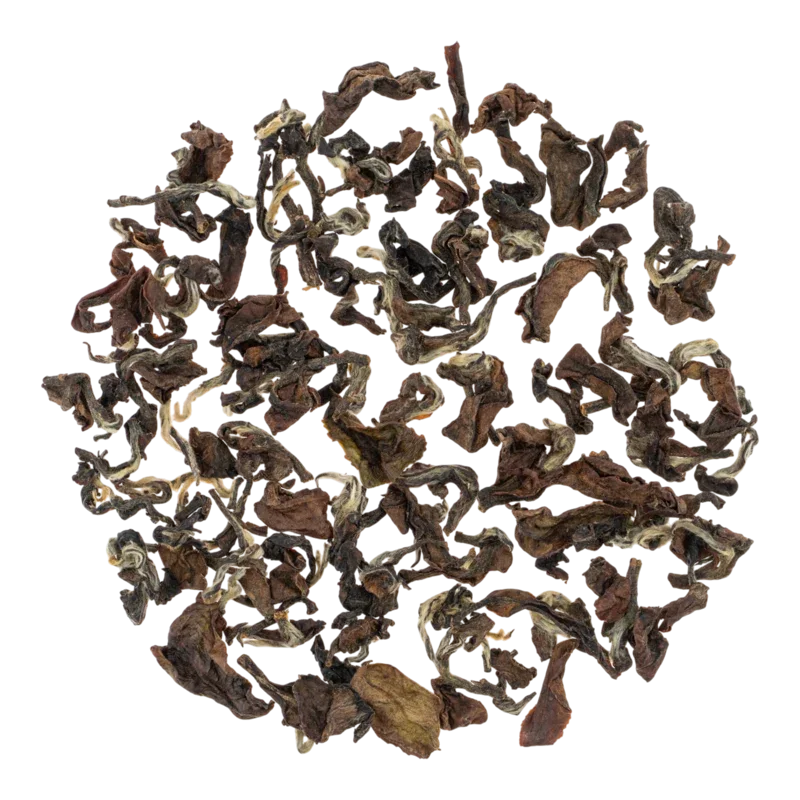
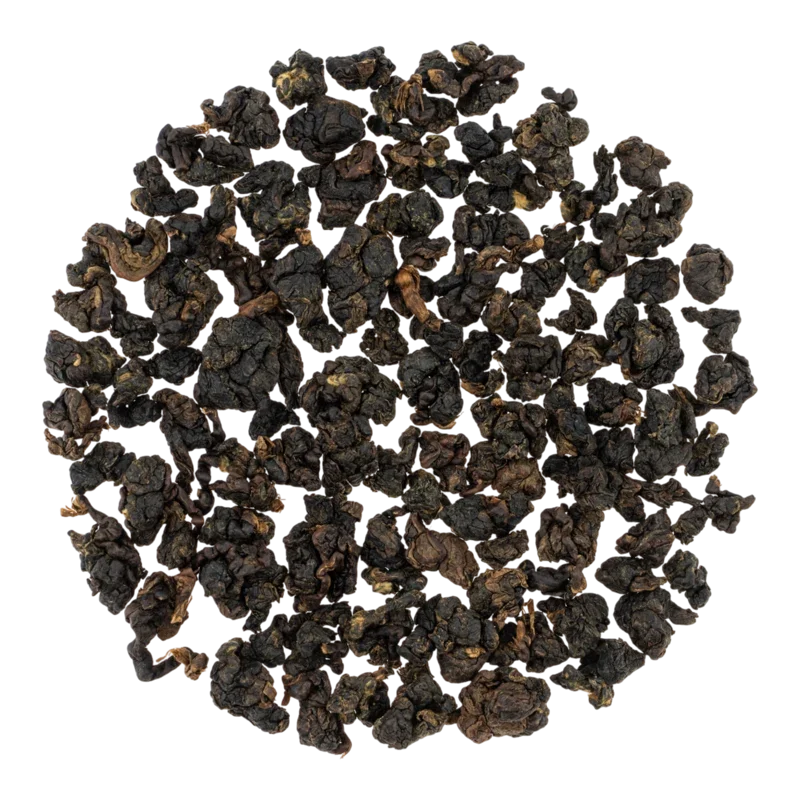
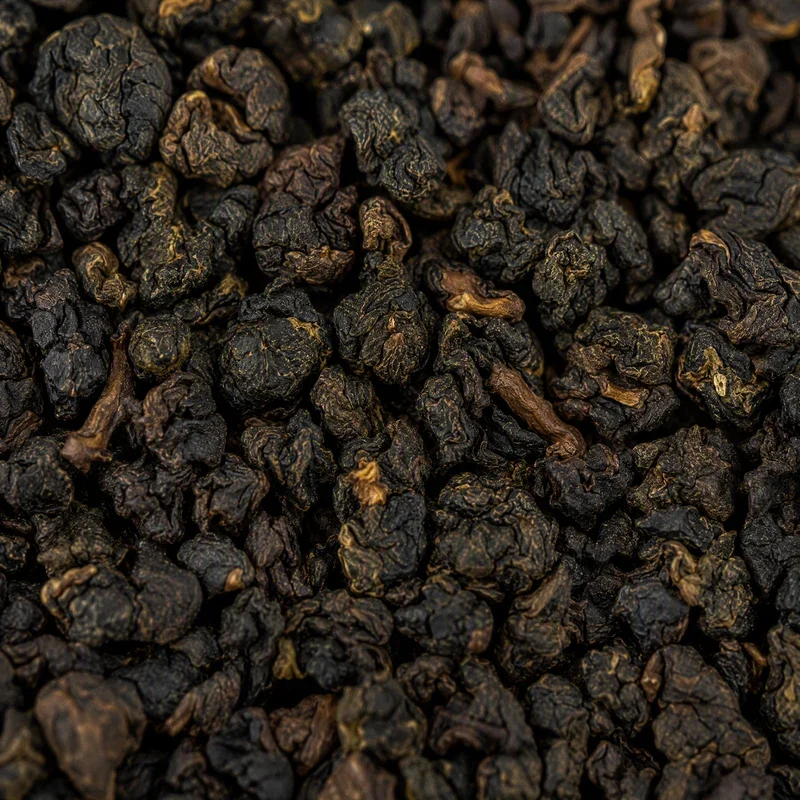
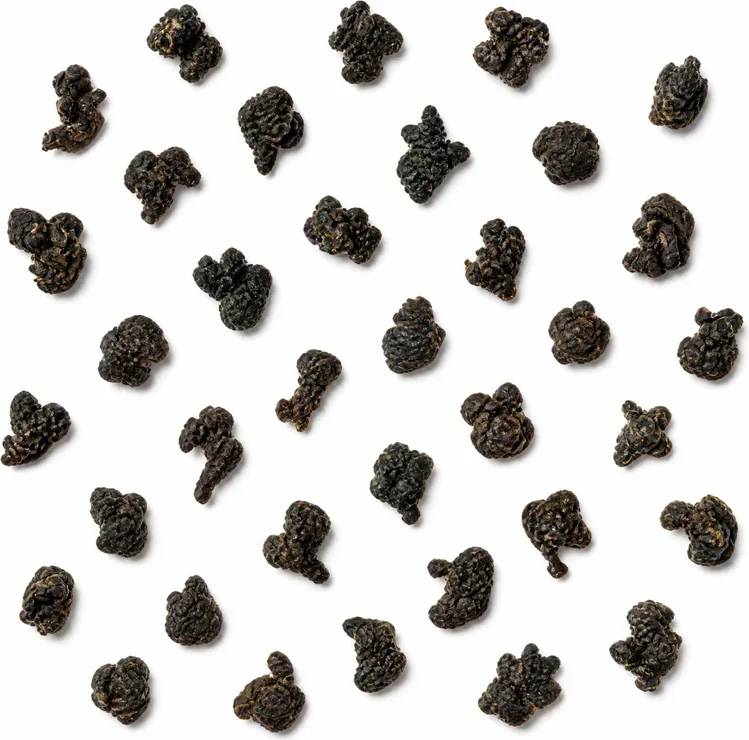
Dry Leaf Appearance: Tightly rolled semi-spherical granules, identical in shape to standard gaoshan oolong. Color — dark, from deep olive-brown to almost black with glossy sheen; significantly darker than classic green-olive gaoshan oolong.
Dry Leaf Aroma: Fresh and sweet — notes of green apple, ripe apricot and honey. In «mixiang» versions — distinct honey-floral component. Coniferous-woody undertone characteristic of Shanlinxi terroir is traceable even in dry leaf.
Liquor Aroma: Multi-layered and developing from infusion to infusion. First steeps — bright fruity tops (apricot, peach, green apple) with honey base and spicy-berry nuances (cherry, plum). In middle steeps, the characteristic Shanlinxi coniferous note comes to the forefront — that very «杉木香» (shānmùxiāng — cryptomeria aroma) that became the calling card of the region. In roasted versions — additional tones of malt, barley sugar and dried fruits.
Liquor Color: From golden-orange to rich amber-red or cognac color, clear and transparent, with pronounced brilliance. Color intensity approaches red tea, but transparency and oiliness reveal oolong nature.
Spent Leaves: Evenly oxidized leaves, whole, elastic. Characteristically oolong pattern: central part of leaf blade — greenish-brown, and edges — reddish-brown, which testifies to deep but uneven oxidation initiated by shaking. In quality samples, leaf opens completely, demonstrating uniformity of processing.
Taste: Smooth, enveloping, with absence of bitterness and astringency — one of the main virtues of high-mountain red oolong. Body — dense, almost syrup-like, with noticeable oiliness of texture. Dominants: honey, ripe stone fruits (peach, plum), light acidity in the finish reminiscent of aged plum jam. Aftertaste (回甘, huígān) — prolonged, sweet, with mineral shade. Unlike low-mountain red oolongs from Taitung, the Shanlinxi version possesses noticeable «high-mountain freshness» (高山氣, gāoshān qì), which gives the tea airiness and lightness even with deep oxidation.
Alkaloids: Caffeine — moderate level (typical for Taiwanese oolongs), theobromine, theophylline.
Amino Acids: L-theanine is preserved in higher concentration than in red teas (fixation effect), providing softness and sweetness. High-mountain origin additionally increases amino acid content: slowed growth in conditions of diffused light and low temperatures stimulates their accumulation.
High content of pectic substances (characteristic feature of high-mountain raw material) provides oily, enveloping texture of the liquor.
Essential Oils: Qingxin Oolong cultivar is characterized by high content of alcoholic aromatic compounds (50–70% of volatile profile). With heavy oxidation, they transform into ester and terpene compounds forming the honey-fruity spectrum.
Minerals: Potassium, magnesium, manganese, zinc, fluorine — profile enriched due to multi-component mountain soils of Shanlinxi.
Polyphenols: With 70–90% oxidation, a significant portion of catechins transforms into theaflavins and thearubigins — pigments responsible for the red-orange color of the liquor and velvety taste. Total polyphenol content is lower than in light oolongs but higher than in fully oxidized red tea, thanks to fixation (殺青).
Vitamins: Vitamin C (in non-roasted versions), B-group vitamins, vitamin A.
Synergy of caffeine and L-theanine provides calm, prolonged vigor without sharp rises and falls.
Theaflavins and thearubigins — products of partial catechin oxidation — possess pronounced antioxidant properties, while fixation preserves part of original catechins.
Deeply oxidized oolongs are traditionally considered most comfortable for the stomach. Heavy fermentation reduces content of irritating tannins.
Thanks to high-mountain origin and deep oxidation, the tea contains virtually no bitter components, making it suitable for people with sensitive stomachs.
Red oolong is ān excellent base for cold brewing (冷泡, lěng pào), recommended by Taiwan's Tea Research Station as one of the best formats for this type of tea.
Polyphenols and caffeine contribute to metabolism activation.
Multi-infusion tea drinking in gongfu format — mindfulness practice helping to reduce stress load.
Moderate caffeine content may cause insomnia or rapid heartbeat in sensitive people, especially when consumed in evening hours.
Use with caution during gastritis or ulcer exacerbation — despite the mildness of deeply oxidized oolong, polyphenols may stimulate gastric juice secretion.
Moderate consumption recommended; when in doubt — consult physician.
5 g per 500 ml cold water, in refrigerator 6–8 hours. Red oolong from Shanlinxi is one of the best candidates for cold method: tea reveals pure fruity sweetness without the slightest bitterness.
Tea Amount: 5–6 g per 100–120 ml (gongfu method); 2.5–3 g per 200–250 ml (European method, 2–3 minute steeping).
Teaware: Porcelain gàiwǎn (蓋碗, gàiwǎn) — best choice for first acquaintance and aroma evaluation. Clay teapot (Yixing or Taiwanese clay) suits roasted versions, emphasizing depth and velvetiness.
Water Temperature: 90–95°C. Slightly below boiling — optimal for revealing the fruity-honey spectrum without risk of «burning» delicate top notes. For roasted versions, full boiling water (100°C) is acceptable.
Enemies: Moisture, heat, foreign odors, direct sunlight.
Airtight packaging (vacuum foil bag), refrigerator storage at 0–5°C. Shelf life — up to 12 months.
Airtight tin or ceramic container, dry cool place protected from light. Roasted red oolong has exceptional stability and is suitable for long-term storage — 2–5 years and more. Over time, tea acquires additional depth and softness; many connoisseurs intentionally age it as «陳年茶» (chénnián chá — aged tea).
Classic «light» oolong from the same region — oxidation degree 15–25%, liquor color — light golden. Orchid, floral notes dominate with coniferous undertone. Compared to it, red oolong is significantly darker, denser, fruity-honey; but both share characteristic Shanlinxi «杉木香» (coniferous note).
Original red oolong from Taitung — «cradle» of the style. Produced at low altitudes (200–400 m) predominantly from Daye Oolong cultivar or TTES #8. Compared to Shanlinxi version: denser and «heavier» in taste, less elegant, without high-mountain freshness; but distinguished by powerful fruity body and affordable price.
«Oriental Beauty» from Hsinchu — another heavily oxidized Taiwanese oolong (60–80%), also often with cicada participation. However, Dongfang Meiren has strip (not semi-spherical) rolling, more floral-muscatel profile and is never roasted. Red oolong from Shanlinxi is more «rounded» and honey-like, with mineral depth.
Red oolong from even higher-mountain Lishan region (1,800–2,600 m). Even more refined, transparent and «airy», with even more pronounced acidity and floral character. Found extremely rarely and costs significantly more.
Highest-mountain Taiwanese oolong (~2,600–2,800 m), but produced exclusively in classic light style (oxidation 15–20%). Comparison is appropriate by prestige and terroir complexity, however by processing type these are complete opposites: Dayuling — ultimate freshness and florality, Shanlinxi hong oolong — ultimate fruity depth.
Fully oxidized red tea (100%) from Sǔn Moon Lake area (日月潭). Produced from unique cultivar — hybrid of Taiwanese wild tea and Burmese Assam. Unlike Shanlinxi Hong Oolong, this is precisely red tea, not oolong: no fixation (殺青), no semi-spherical rolling, no «回甘». Profile — minty-cinnamon, with notes of cinnamon and menthol, completely unlike the honey-fruity character of red oolong.
Price Category: Shanlinxi Hong Oolong is a niche tea: production volume is small, the main mass of Shanlinxi raw material goes to classic qingxiang oolong. Price is generally lower than spring or winter gaoshan oolong from the same region, since red oolong is more often made from summer harvest. Nevertheless, growing altitude, hand picking and limited batches place it significantly above mass red oolongs from Taitung. Cost depends on subregion (Longfengxia — most expensive), altitude, season, presence of «mixiang» character and degree of roasting.
No reviews yet. Tell us what you think of this tea.
Rate this tea and share your impressions. We review each submission before publishing it.