Brewing
Gongfu brewing
- Water temperature
- 75 °C
- Tea amount
- 5 g
- Water volume
- 100 ml
- First steep
- 10 s
- Time added per infusion
- 5 s
- Infusions
- 3

Shàngguǎn xiān hú chá
Choose a brewing method. Start with the recommended quantities and time, then adjust to taste.
Brewing
Brewing
Taste
Tea encyclopedia
Category: Regional teas of Guangdong Province. National geographical indication product (国家地理标志产品). Awarded the status of «Guangdong Regional Public Brand» (广东省区域公用品牌, 2017) and included in the registry of «National Famous Special Quality New Agricultural Products» (国家名特优新农产品, 2020).
Category: Regional teas of Guangdong Province. National geographical indication product (国家地理标志产品). Awarded the status of «Guangdong Regional Public Brand» (广东省区域公用品牌, 2017) and included in the registry of «National Famous Special Quality New Agricultural Products» (国家名特优新农产品, 2020).
Coordinates: Approximately 24°00′ N, 115°10′ E.
Origin: China, Guǎngdōng Province (广东, Guǎngdōng), Héyuán City (河源市, Héyuán shì), Dōngyuán County (东源县, Dōngyuán xiàn), Shàngguǎn Township (上莞镇, Shàngguǎn zhèn). Tea gardens are located in the Xianhu mountain range (仙湖山脉, Xiān Hú shānmài).
Type: Green tea (unoxidized). Belongs to the category of hong qing lü cha (烘青绿茶, hōng qīng lǜchá) — green teas with final drying by heating (hongbei), although the primary fixation is conducted by pan-firing (chao qing), and the final stage is two-step heating (maohuo + zuohuo). Thus, technologically the tea combines elements of both chao qing and hong qing.
Cultural Significance: Shangguan Xian Hu Cha is not only an agricultural product but also a symbol of Hakka culture in eastern Guangdong. The township's tea gardens are inextricably linked with revolutionary history: during the War of Resistance against Japan and the Civil War, detachments of the Dongjiang Column (东江纵队) — the East River guerrilla army — were based in the Xianhu mountains. Remains of stone observation posts of the guerrillas have been discovered directly on tea plantation territory. Today the township develops a model of «red-green» tourism, combining visits to revolutionary monuments with tea tasting and walks through tea gardens. Tea is the foundation of Shangguan's economy — it accounts for about 70% of the township's agricultural production.
History: Shangguan Township is located in a mountainous area at the junction of Dongyuan, Longchuan, and Heping counties, in the zone of historical Hakka (客家, Kèjiā) settlement. Tea cultivation has been practiced here for centuries — residents of mountain villages at altitudes around 1000 m have grown tea as their main agricultural product from generation to generation. In the Ming and Qing eras, local teas were already known: in «Chuting Baizhu Lu» (《楚庭稗珠录》) by Qīng jǐnshí Tān Cuì (檀萃), it was noted that residents of the Guishan area «grow excellent tea, especially famous is [tea from] Shangguan, whose taste is very good». The tea was sold to merchants who flocked to the area each spring.
Cultivar: Main variety — Hakka xiǎo yè qúntǐ zhǒng (客家小叶群体种, Kèjiā xiǎo yè qúntǐ zhǒng) — Hakka small-leaf population variety, of seed (not clonal) origin, bush type. Camellia sinensis var. sinensis. Bushes are low (1–2 m), with small oval leaves with shallow serration and abundant pubescence (茸毛发达). High content of chlorophyll and nitrogen-containing aromatic substances. The root system of old bushes (over 100 years old) reaches a depth of 6 m, allowing extraction of microelements from deep horizons.
Picking: Spring picking by seasonal categories:
Pluck Standard: Supreme grade (AAA) — single buds or bud with one leaf ≤2.5 cm long. First grade — bud with one leaf. Second grade — bud with two leaves.
Raw Material: Hand picking. Buds and shoots must be uniform, fresh, without traces of pests. All raw material undergoes 100% control for pesticide residues.
Altitude: 850–1,080 m a.s.l. The core of plantations — the Wǔzhǐ Mountain (五指山) area and Xianhu Village (仙湖村), at altitudes above 1,000 m a.s.l. The core accounts for up to 80% of the township's production.
Climate: Average annual temperature about 18.9°C. Annual precipitation 1,570–1,839 mm. Clouds and fog year-round — the number of foggy days exceeds 180 per year. Daily temperature difference >10°C. Proportion of diffused light — about 70%, which significantly extends the period of amino acid accumulation in shoots. Climate is mild, without sharp extremes, ensuring a stable growing season.
Soil: Predominantly acidic yellow and red soils (酸性黄壤、红壤, suānxìng huáng rǎng, hóng rǎng) with deep soil horizon (>1 m), high organic matter content and acidic reaction (pH 4.5–6.0). Soils provide good drainage and are rich in microelements.
The Xianhu mountain range is located in the northeastern mountainous part of Dōngyuán County (东源县), between 24° and 25° N. Shangguan Township is situated at the junction of three counties — Dongyuan, Longchuan, and Heping — in the zone of traditional Hakka settlement. The region is classified as an «old revolutionary base area» (革命老区).
Forest coverage of the territory is 78.48%. Industrial facilities are absent — the area is ecologically clean. A unique feature of local plantations is the joint planting of tea bushes and cherry trees (樱花与茶树套种): cherry trees create natural shade, reducing pest damage by 60%. Traditional «ancient method» (百年古法) of physical pest protection is used — without any chemical agents. Production is certified as organic (有机食品) and «green» (绿色食品).
Hand picking of buds and young shoots according to grade standard.
Freshly picked raw material is spread under diffused sunlight for 4–6 hours. Surface moisture is removed, formation of aromatic precursors begins.
Pan-firing at high temperature (~260°C) in a traditional cast iron wok. Rapid enzyme inactivation, preservation of green color and formation of characteristic roasted rice aroma (炒米香, chǎo mǐ xiāng). This stage — hand firing in a heated wok — is considered key for forming the signature aroma.
Gentle pressing and twisting of leaves (轻压成条, qīng yā chéng tiáo) to break cell walls and form the characteristic twisted shape.
Separation of rolled leaves for uniform subsequent drying.
Heating at ~110°C to remove the main mass of moisture.
Low-temperature (~90°C) slow heating until moisture content ≤6.5% is achieved. It is at this stage that the roasted rice aroma is intensified and stabilized.
Completely manual production without use of mechanisms — the Hakka «ancient method». Leaf integrity is maintained at >95%. Each batch undergoes complete control for pesticide residues (result — 100% compliance).
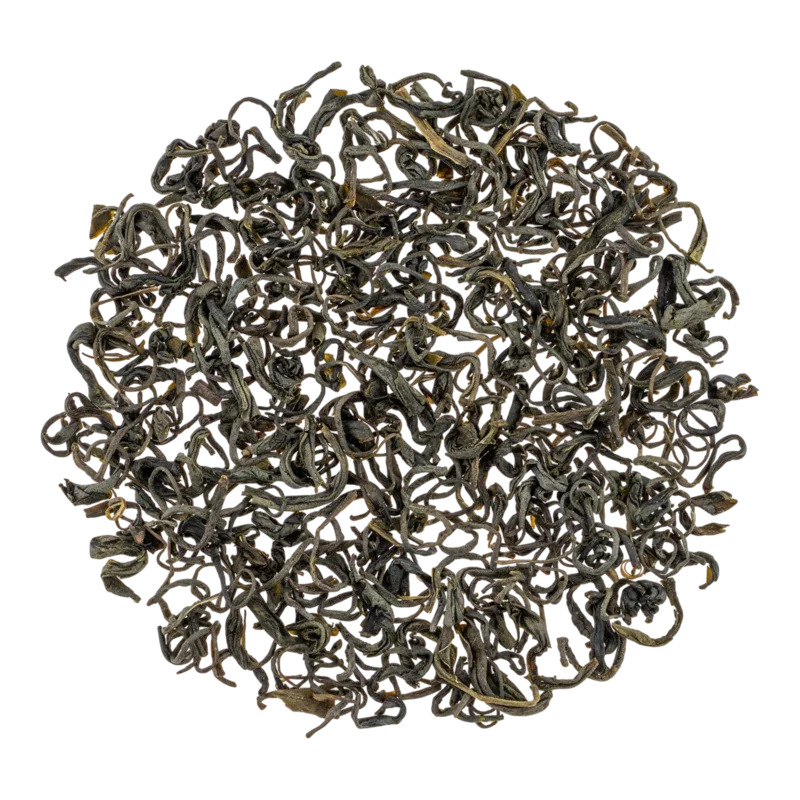
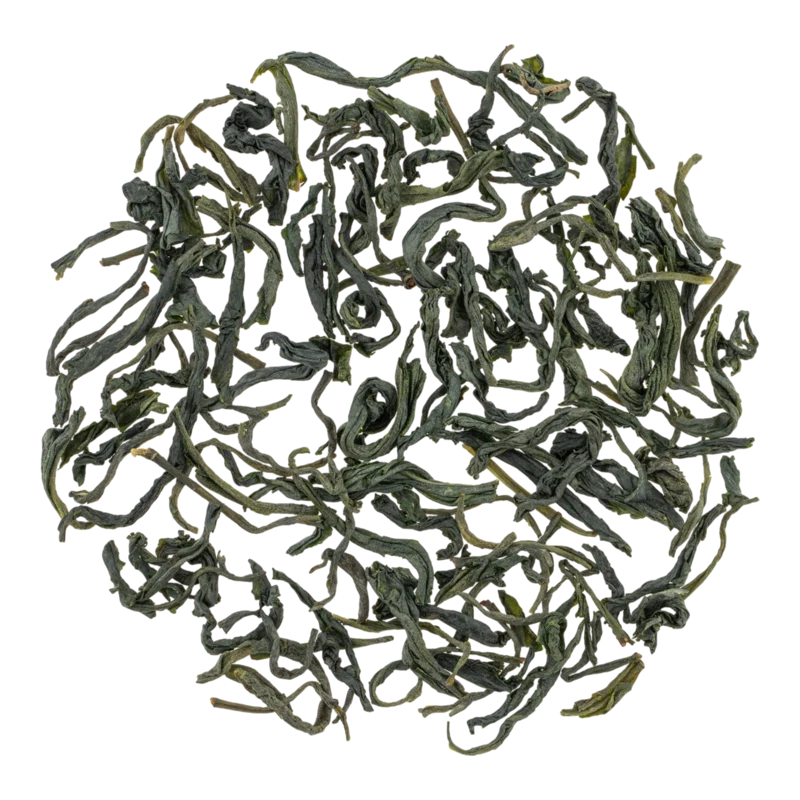
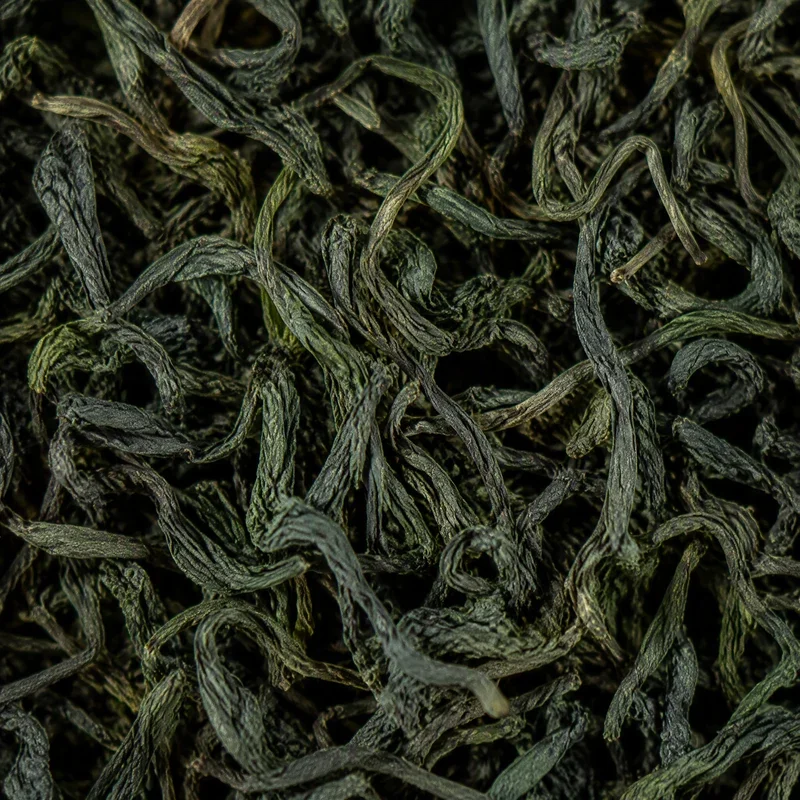
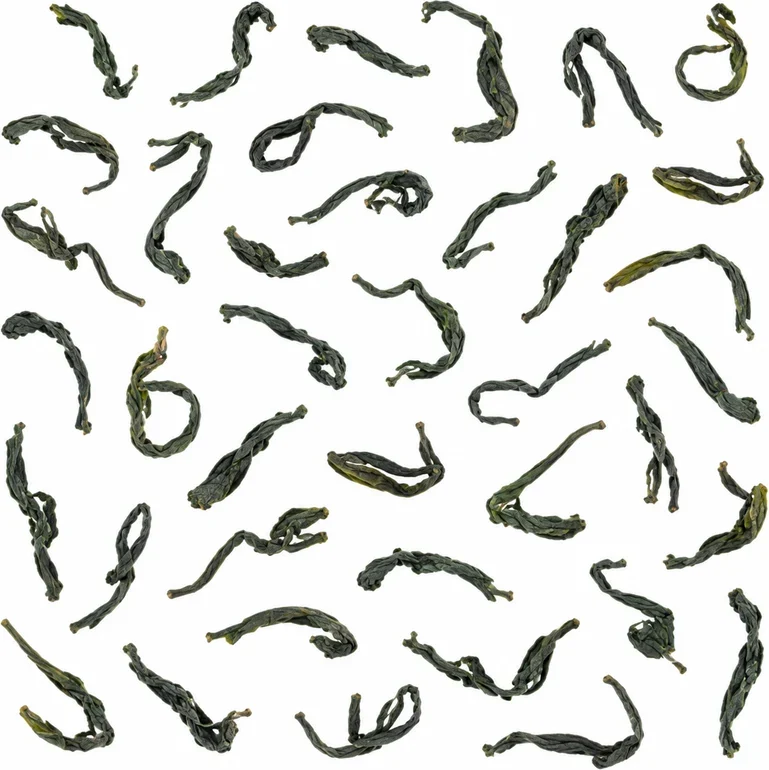
Dry Leaf Appearance: Two main shape types — traditional twisted (卷曲紧结, juǎnqǔ jǐn jié) and innovative flat (扁平挺直, biǎnpíng tǐng zhí). Twisted form is classic for the «ancient firing method»: tightly curled thin «cords» of emerald-green color. Flat form is created using new cultivars (Fuyun No. 6). Color varies from bright green (mingqian cha) to greenish-yellow (autumn picking).
Dry Leaf Aroma: Dominant — «roasted rice aroma» (炒米香, chǎo mǐ xiāng): warm, nutty, slightly toasty, formed during hand firing in the wok. In the background — clean green freshness with notes of grass and wood (清香, qīng xiāng). Aged tea may show honey notes (蜜香, mì xiāng).
Liquor Aroma: Persistent chestnut-rice, with clean green note. Aroma persists through many infusions.
Liquor Color: Jade-green, transparent and bright (碧绿清澈, bìlǜ qīng chè) for mingqian cha. Yellow-green, light (黄绿明亮) for autumn picking.
Spent Leaves: Tender-green, uniform, bright (嫩绿匀亮, nèn lǜ jūn liàng). Buds and leaves are fresh and lively, with characteristic reddish dots along leaf edges (叶缘红点显) — trace of gentle processing.
Taste: Sweetness (甘, gān) — clean returning sweetness reminiscent of fresh olives (鲜橄榄回甘, xiān gǎnlǎn huígān), persistent and long-lasting. Mellowness (醇, chún) — harmonious combination of polyphenols and amino acids, without sharp bitterness or astringency. Smoothness (滑, huá) — silky texture due to high amino acid content. The throat feels coolness (喉韵清凉, hóuyùn qīngliáng).
Alkaloids: Caffeine — moderate content. Theobromine and theophylline are present.
Amino Acids: High content, typical for high-mountain teas with prolonged cloudy exposure. Main component — L-theanine. High level of amino acids combined with moderate polyphenols determines mildness and sweetness of taste.
Elevated content — result of 70% diffused light proportion and extended accumulation period.
Essential Oils: Responsible for signature roasted rice aroma; formed during hand firing in wok and two-stage drying.
Minerals: Fluorine (forms protective fluorapatite layer on tooth enamel), potassium, magnesium, zinc, manganese, selenium. Deep root system of old bushes provides rich microelement profile.
Polyphenols: Tea polyphenol content ≥18.3% in spring flush. Main components — EGCG, EC, ECG. High content provides pronounced antioxidant action.
Vitamins: Vitamin C (high content due to gentle final drying temperature), B vitamins, vitamin A (β-carotene).
Polyphenols effectively neutralize free radicals. According to some data, tea polyphenols can bind radioactive isotopes (strontium-90, cobalt-60).
Catechins suppress activity of fat synthesis enzymes, promoting normalization of blood lipid levels. EGCG slows glucose level rise after meals.
Fluorine contained in tea forms a protective fluorapatite layer on tooth enamel, increasing resistance to acid exposure and caries. Catechins have antibacterial action.
Gentle, steady alertness without sharp peaks — result of caffeine and L-theanine synergy.
Gently stimulates digestive enzymes. Well suited after meals (recommended interval — 1 hour after eating).
Complex of vitamins C, A and E, microelements and polyphenols.
L-theanine promotes relaxed concentration and improved attention.
this information is for reference only and is not medical advice. For caffeine sensitivity, it is recommended to drink tea in the first half of the day. Daily consumption — no more than 500 ml.
Soft water with low mineralization is recommended — it emphasizes sweetness and purity of taste. Not recommended to drink on empty stomach.
Tea Amount: 3 g per 150 ml (1:50 ratio).
Teaware: Glass tumbler — for observing the «green tea dance» (绿茶舞, lǜchá wǔ) and evaluating liquor color. White porcelain gàiwǎn (盖碗) — for fuller aroma development.
Water Temperature: 80–85°C. For supreme grades (Special AAA) — 75°C. Boiling water (>90°C) is unacceptable — liquor yellows, bitterness appears.
Container: Airtight, opaque — foil packages, tin or ceramic jars with tight lid.
Enemies: Light, moisture, high temperature, foreign odors.
Shelf Life: Most expressive in first 6–12 months after production. Opened packaging should be used within 3 months to preserve roasted rice aroma.
Temperature: Optimally — refrigerator, 0–5°C (airtight packaging mandatory to prevent odor absorption).
Although Yinghong No. 9 is a red tea (black tea) (from Yingde, Guangdong), comparison is appropriate as a contrast of two main tea traditions of Guangdong: Shangguan Xian Hu Cha represents the mountain-Hakka green line, while Yinghong represents the oxidized tea line. Flavor profiles are radically different: freshness and «rice» aroma versus maltose sweetness and «honey» notes.
Another green tea from Heyuan (Yuancheng district), but with different aromatics — signature «cinnamon tree note» (桂花香), due to tea bush cultivation in proximity to cinnamon trees. Shangguan Xian Hu Cha is more «rice-like» and «nutty», Guishan is more «floral-cinnamon».
Green tea from neighboring Kanghe Township (same Dongyuan County). Produced from similar Hakka cultivars but at lower altitudes. Profile is milder and simpler; Shangguan Xian Hu Cha is more intense and aromatically complex due to higher altitude and «ancient firing» method.
Famous oolong from Chaozhou, Guangdong. Despite fundamentally different processing type (semi-oxidized), comparison illustrates the breadth of Guangdong tea palette: where Dancong is bright, floral, polymodal, Shangguan Xian Hu Cha is clean, even, with emphasis on freshness and returning sweetness.
Price Category: Grades by T/CSTEA standard:
No reviews yet. Tell us what you think of this tea.
Rate this tea and share your impressions. We review each submission before publishing it.