Brewing
Gongfu brewing
- Water temperature
- 75 °C
- Tea amount
- 5 g
- Water volume
- 100 ml
- First steep
- 10 s
- Time added per infusion
- 5 s
- Infusions
- 3

Qiāndǎo yù yè
Choose a brewing method. Start with the recommended quantities and time, then adjust to taste.
Brewing
Brewing
Taste
Tea encyclopedia
Category: Modern famous teas of China (新创名茶, xīnchuàng míngchá); regional green teas of Zhejiang Province.
Category: Modern famous teas of China (新创名茶, xīnchuàng míngchá); regional green teas of Zhejiang Province.
Coordinates: Approximately 29°36′ North latitude, 118°54′ East longitude.
Origin: China, Zhèjiāng Province (浙江, Zhèjiāng), Chun'an County (淳安县, Chún'ān Xiàn), Qiandaohu Lake area (千岛湖, Qiāndǎo Hú). Production core — Qīngxī district (青溪, Qīngxī) and adjacent mountain ranges with island microclimate.
Type: Green tea (unfermented), chaoqing (炒青, chǎoqīng) — dried by pan-firing in a wok. Subtype — bianxing (扁形, biǎnxíng) — flat form.
Cultural Significance: Qiandao Yu Ye became the calling card of Chun'an County and Qiandaohu Lake — one of the largest tourist centers in Eastern China. The tea is inseparably linked with the ecological reputation of the lake: Qiandaohu is a national first-class water body with transparency up to 7 meters, one of the cleanest freshwater lakes in the country. The region has long been known as "Muzhou" (睦州, Mùzhōu) — a historical name that appears in poems dedicated to local teas: "Born on the shores of the Thousand Islands — quality surpasses all. Yu Ye and Yu Ya — sister teas from Muzhou." The lake territory is among the first 44 national scenic zones of China and in the top ten national forest parks. For modern Chun'an, Qiandao Yu Ye is not only the economic foundation of the tea industry, but also a cultural brand uniting tea and tourism.
History: Qiandao Yu Ye is one of the most successful "new famous teas" of China from the second half of the 20th century. Its history begins in 1982, when the tea-forestry enterprise at Qiandaohu Lake (千岛湖林场, Qiāndǎo Hú Línchǎng) developed a new tea using the local Jiūkēng variety (鸠坑, Jiūkēng) and adapted Xi Hu Longjing technology. Initially the tea was called "Longjing from Thousand Island Lake" (千岛湖龙井, Qiāndǎo Hú Lóngjǐng). In July 1983, the famous tea scientist, Professor Zhuāng Wǎnfāng (庄晚芳, Zhuāng Wǎnfāng) of Zhejiang Agricultural University, visited Chun'an to inspect tea production. Evaluating the robust, downy buds and unique landscapes of the Thousand Islands, he personally inscribed the new name — "Qiandao Yu Ye" (千岛玉叶, "Jade Leaf of the Thousand Islands"), thereby establishing the tea's individual identity, distinct from West Lake Longjing.
Name Breakdown: "Qiandao" (千岛) — "thousand islands," a direct reference to Qiandaohu Lake, an artificial reservoir formed after construction of the Xin'anjiang Hydroelectric Station. On its waters are scattered more than a thousand islands, creating an incomparable landscape. "Yu" (玉, yù) — "jade, nephrite," symbolizes the tea's value, purity and nobility. "Ye" (叶, yè) — "leaf." Thus, the full name poetically conveys the image of precious tea leaves born among a thousand islands. The name was given by Professor Zhuang Wanfang, who emphasized that the white down on the robust buds makes the tea unlike classic Longjing and deserves its own identity.
Cultivar: Main cultivar — Jiūkēng quntichong (鸠坑群体种, Jiūkēng qúntǐ zhǒng), a provincial-level seed variety. This is a historically formed population of Camellia sinensis var. sinensis, characterized by large, fleshy leaves with abundant down. Tea polyphenol content — more than 30%, ensuring pronounced flavor depth. The cultivar possesses high adaptability and universal suitability for various processing types. Additionally used is cultivar Longjing 43 (龙井43, Lóngjǐng 43) — to improve quality of early spring harvest due to earlier vegetation periods.
Picking: Main picking — early spring. Timing varies: Longjing 43 gives first harvest approximately from March 20, Jiukeng — from late March. Quality peak — period from Qīngmíng (清明) to Gǔyǔ (谷雨). After Gǔyǔ the leaf is used for everyday tea (炒青, chaoqing).
Pluck Standard: For special grade (teji) — bud with one unopened leaf (一芽一叶初展, yī yá yī yè chū zhǎn), with the bud being longer than the leaf. 500 g of fresh leaf contains 4100–4300 buds. For first grade — bud with one leaf, slight non-uniformity permitted. For second grade — small proportion of "bud + two leaves" material allowed. General requirements: damaged, purple, excessively thin or overripe shoots not permitted; material must be uniform, clean, with pronounced down.
Raw Material: Fresh leaf after picking undergoes mandatory spreading (摊放, tānfàng) for 6–12 hours, until moisture drops to 70–72%. This stage is critically important for aroma formation and leaf preparation for pan-firing.
Altitude: Tea gardens located on hilly slopes around the lake at 200–600 m elevation. Quality production core — Qingxi district, where primeval forests create natural shading.
Soil: Acidic red soils (红壤, hóng rǎng) and sandy soils (砂质土), rich in minerals. Reaction — weakly acidic, optimal for Camellia sinensis.
The Qiandaohu area belongs to the subtropical monsoon climate zone. Average annual temperature — 15–17 °C, frost-free period — 230–270 days, annual precipitation — 1319.7 mm. Main rainy periods — spring rains and "plum rain" season (meiyu). July-August — dry period (伏旱, fúhàn). Chun'an County topography — predominantly hilly, with elevation differences: periphery elevated, central part — lowland, occupied by the lake. Key terroir feature — "lake-land microclimate" (湖陆小气候, hú lù xiǎo qìhòu): the huge mass of fresh water moderates temperature fluctuations, forms abundant morning mists and stable humidity, optimal for tea bushes.
Forest cover of Qiandaohu territory — from 81% to 93%. The lake has national first-class water body status (国家一级水体) with transparency up to 7 meters. Such ecological purity of the surrounding environment directly influences tea raw material quality.
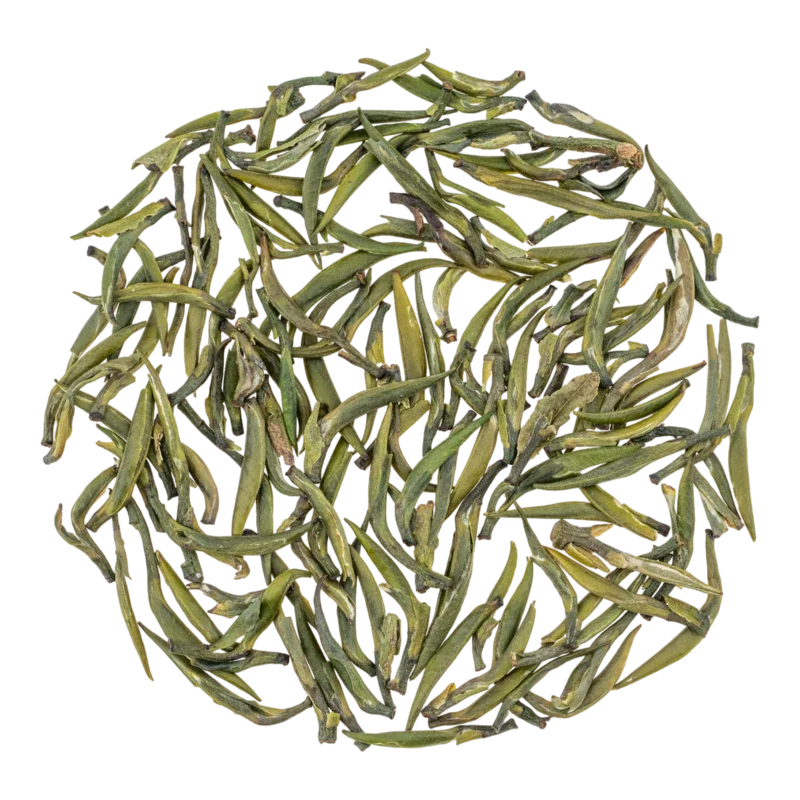
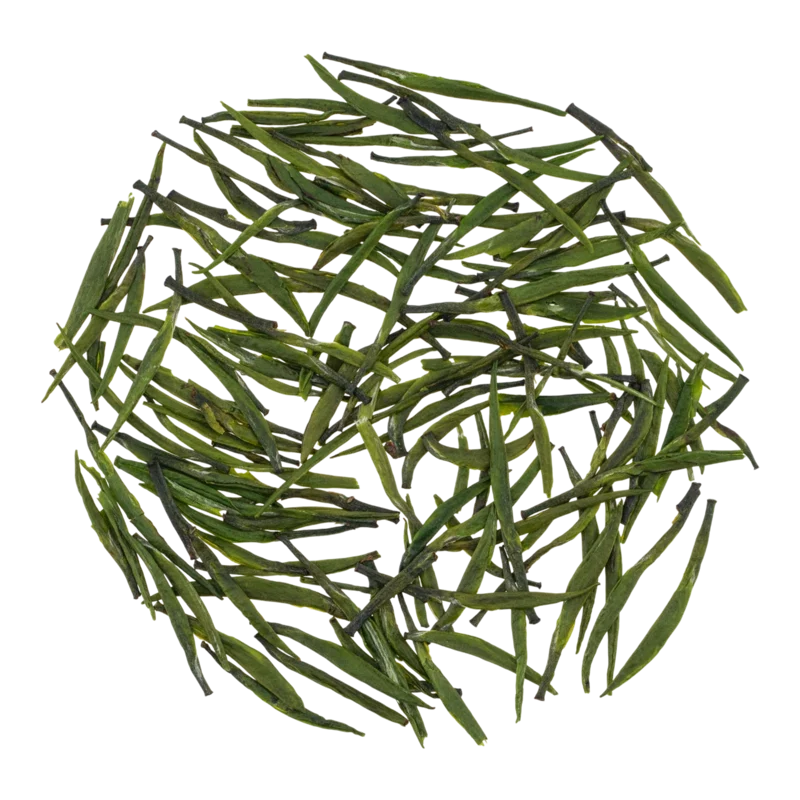
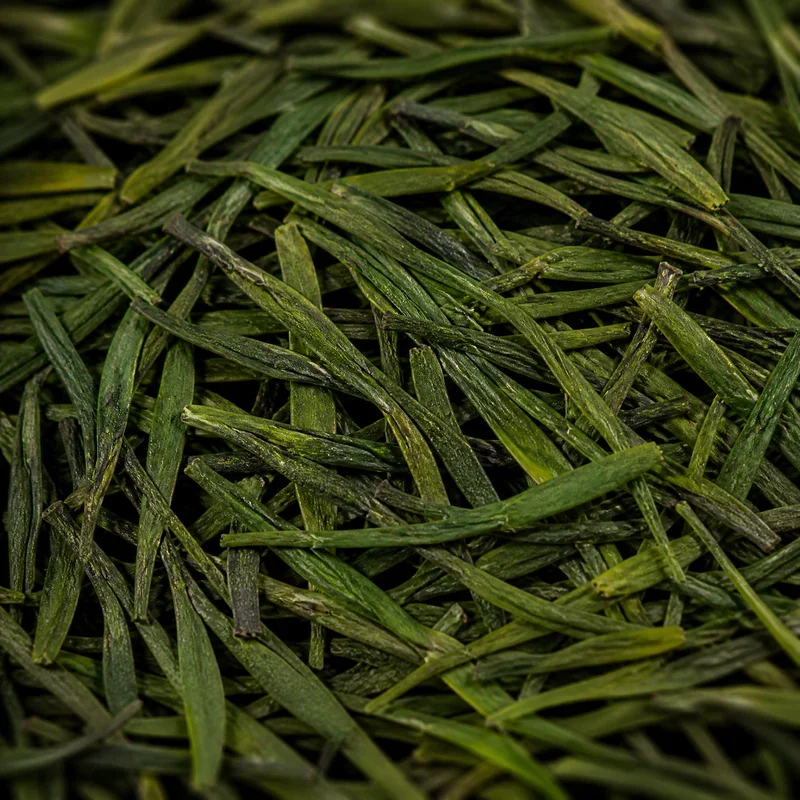
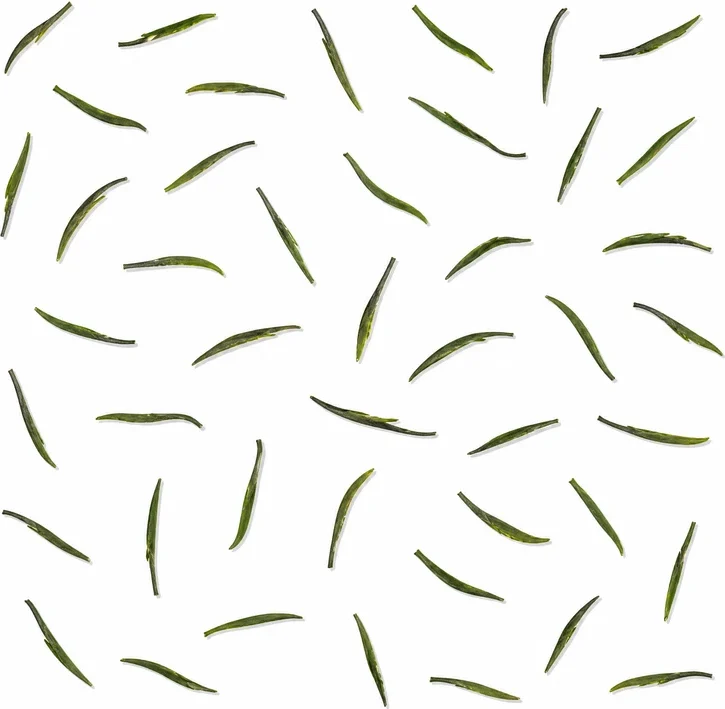
Dry Leaf Appearance: Flat, straight, slightly flattened form (扁平挺直). Color — green with tender yellow tint (翠绿嫩黄), with visible white down on the surface. Buds large, dense. Tea leaves smooth, uniform, without fragments. Externally resembles Xi Hu Longjing, but differs in more pronounced down and slightly greater leaf mass.
Dry Leaf Aroma: Clean, high, with pronounced bean note (豆香, dòu xiāng) — main tone — and soft undertone of fresh greenery (清香, qīng xiāng). Light "milky" tenderness (嫩香, nèn xiāng) present, characteristic of young raw material.
Liquor Aroma: Fresh, persistent, with dominating bean-nutty profile. As the cup cools, floral and herbal undertones emerge. Aroma clean, without foreign admixtures.
Liquor Color: Yellow-green, bright, clear (黄绿明亮). Fresh tea — with tender greenish glow; with storage the liquor darkens.
Spent Leaves: Tender green, fleshy, uniform leaflets, gathered in neat "bouquets" (嫩绿成朵, nèn lǜ chéng duǒ). Leaves elastic, dense. Even coloring without spots and darkening — sign of quality processing.
Taste: Rich and full-bodied (醇厚, chúnhòu) — noticeably denser than classic Xi Hu Longjing. Freshness (鲜爽, xiānshuǎng) clearly expressed, due to high amino acid content in Jiukeng cultivar. Distinct returning sweet aftertaste (回甘明显, huígān míngxiǎn). Without bitterness and sharp astringency when properly brewed. With prolonged steeping moderate astringency may appear.
Alkaloids: Caffeine — moderate content, providing mild tonic effect in synergy with L-theanine. Also present are theobromine and theophylline.
Amino Acids: High content (exact figures for Qiandao Yu Ye not standardized, but source material Jiukeng is characterized by good amino acid accumulation). L-theanine — main component, forming sweetness and umami-like "body."
Additional antioxidant compounds, including vitexin, morin and catechins. Pronounced antibacterial activity noted.
Minerals: Fluorine — 200–300 ppm (tooth enamel strengthening). Potassium, manganese, zinc. Acidic red soils with rich mineral composition provide saturated elemental profile.
Polyphenols: More than 30% of dry mass — above average for green teas. Main components — EGCG, ECG, EGC. Provide antioxidant activity, structural taste density and astringent component, balanced by amino acids.
Vitamins: Vitamin C — relatively high content in fresh raw material. B-group vitamins. Vitamin K.
Tea polyphenols possess pronounced bactericidal activity — suppression of dysentery bacillus growth, by estimates, exceeds 90%.
High catechin content (>30% polyphenols) neutralizes free radicals, supporting cellular health.
Fluorine content 200–300 ppm promotes formation of protective layer on enamel, and antibacterial action of polyphenols suppresses cariogenic microorganisms.
Caffeine together with polyphenols stimulates fat breakdown and thermogenesis.
L-theanine and caffeine create state of calm alertness, improving cognitive functions without anxiety.
Catechins promote reduction of LDL cholesterol levels, maintenance of vascular elasticity.
Polyphenols and tannins stimulate digestive enzyme secretion, ease digestion of fatty and heavy food.
Tea Amount: 3 g per 150 ml (1:50 ratio). For more concentrated taste — 5 g per 150 ml.
Teaware: Glass tumbler (recommended — allows observing leaf opening and liquor clarity); white porcelain gaiwan (盖碗); porcelain cup with lid.
Water Temperature: 80–85 °C. Absolutely not recommended to pour boiling water — this destroys chlorophyll (liquor yellows) and increases bitterness.
Main "relative" and source of inspiration for Qiandao Yu Ye technology. Differences are substantial: Longjing uses Longjing 43 cultivar or Qun Tizhong Longjing (without abundant down), its aroma — higher, "chestnut-bean," form — perfectly flat, smooth, practically without down. Qiandao Yu Ye, thanks to Jiukeng cultivar, is more downy, more massive in bud structure, with denser and fuller taste.
Green tea from northern Zhejiang (Anji County). Produced from albino cultivar Bai Ye Yihao with record amino acid content (~6–7%). Externally — thin, elongated, light green with yellow. Taste — exceptionally fresh, with pronounced umami and minimal astringency. Qiandao Yu Ye, in contrast, possesses greater body fullness and bean-nutty profile.
Historical green tea from Jinhua city, dating to Tang era. Form — slightly twisted, aroma — floral-fruity. Unlike flat Qiandao Yu Ye, Juyan is more voluminous in form and tenderer in taste.
Produced in Kaihua County in western Zhejiang. Form — straight, thin, resembling needle. Aroma — clean floral-chestnut, taste — light, fresh. Qiandao Yu Ye differs in flat form and more saturated, dense taste.
Authentic Qiandao Yu Ye — flat, straight, with pronounced white down and tender yellow-green color. Counterfeits (often from lower quality raw material from other regions) look duller, with non-uniform color and broken fragments.
Clean bean/nutty aroma without mustiness and raw grassiness. Absence of characteristic bean note — sign of substitution.
Should be bright yellow-green, clear. Cloudy or dark liquor indicates poor quality raw material or technology violation.
Full-bodied, fresh, with pronounced returning sweetness (huigan). Flat, watery taste without aftertaste — sign of counterfeit.
Purchase tea with geographical indication marking "千岛玉叶" from certified Chun'an producers. Pay attention to harvest date and transparency of origin information.
No reviews yet. Tell us what you think of this tea.
Rate this tea and share your impressions. We review each submission before publishing it.