Brewing
Gongfu brewing
- Water temperature
- 75 °C
- Tea amount
- 5 g
- Water volume
- 100 ml
- First steep
- 10 s
- Time added per infusion
- 5 s
- Infusions
- 3

Pǔtuó fúchá
Choose a brewing method. Start with the recommended quantities and time, then adjust to taste.
Brewing
Brewing
Taste
Tea encyclopedia
Category: National geographical indication product (国家地理标志产品, 2025). "Chinese Cultural Famous Tea" (中华文化名茶, 1998). Famous Tea of Zhèjiāng (浙江省名茶, 1984). Silver medal at the Panama-Pacific Exhibition of 1915. In 2020 — inclusion in the list of China-Europe mutually recognized geographical indications (中欧地理标志保护名录).
Category: National geographical indication product (国家地理标志产品, 2025). "Chinese Cultural Famous Tea" (中华文化名茶, 1998). Famous Tea of Zhèjiāng (浙江省名茶, 1984). Silver medal at the Panama-Pacific Exhibition of 1915. In 2020 — inclusion in the list of China-Europe mutually recognized geographical indications (中欧地理标志保护名录).
Coordinates: Approximately 30°00′ North latitude, 122°23′ East longitude.
Origin: China, Zhèjiāng Province (浙江, Zhèjiāng), Zhōushān City (舟山市, Zhōushān Shì), Zhōushān Archipelago (舟山群岛). The geographical indication zone covers 28 townships and streets in Dinghai District (定海区), Pǔtuó District (普陀区) and Daishan County (岱山县). The terroir core — Mount Fodingshan (佛顶山, Fódǐng Shān — "Buddha's Peak") on Putuoshan Island, elevation 286.3 m — the highest point of the sacred island.
Type: Green tea (non-oxidized). By technology — half pan-fired, half baked (半炒半烘, bàn chǎo bàn hōng). Produced in several forms: spiral (螺形), "eyebrow-shaped" (眉形) and "tadpole-shaped" (蝌蚪状, kēdǒu zhuàng).
Cultural Significance: Putuo Fu Cha — tea inseparably connected with one of the four great Buddhist mountains of China and the bodhisattva of compassion Guanyin. Putuoshan — the largest pilgrimage center in East Asia, and tea from this island possesses the aura of a "sacred beverage" offered to pilgrims in monasteries. The status "中华文化名茶" (1998) emphasizes that the value of this tea lies not only in organoleptics but also in its spiritual heritage.
History: Putuo Fu Cha traces its history to the Tang dynasty (618–907), when Buddhist monks of Putuoshan first planted tea bushes for offerings to Buddha and treating pilgrims. Putuoshan — "Southern Sea Guanyin" (南海观音) — is visited annually by millions of believers, and tea from this mountain possesses special spiritual status. Monks grew tea on the peak of Fodingshan, in cloud and mist, and called it "观音灵芽" (Guānyīn Língyá — "Miraculous Shoots of Guanyin").
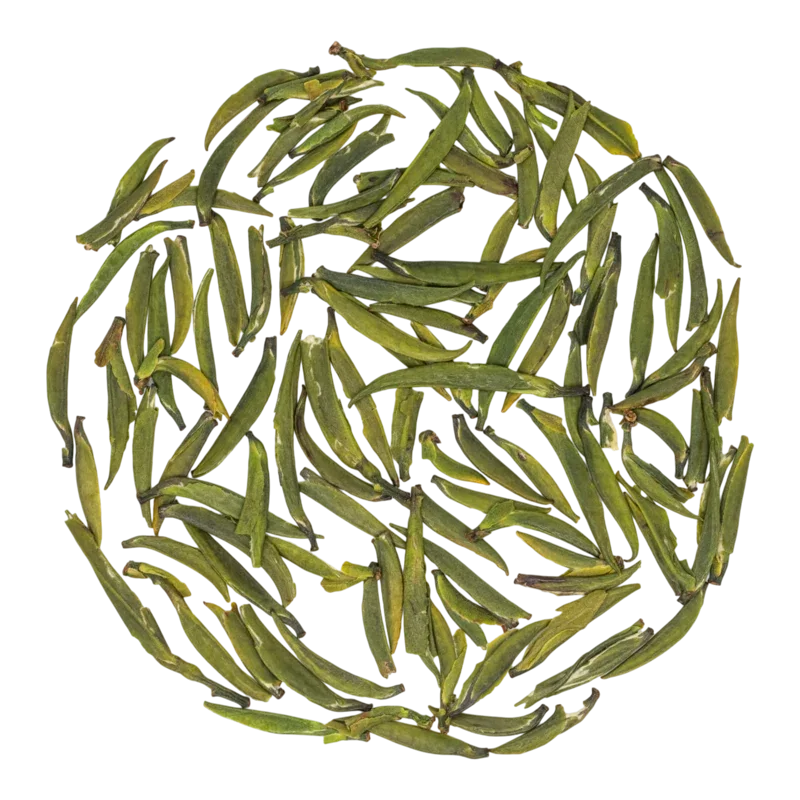
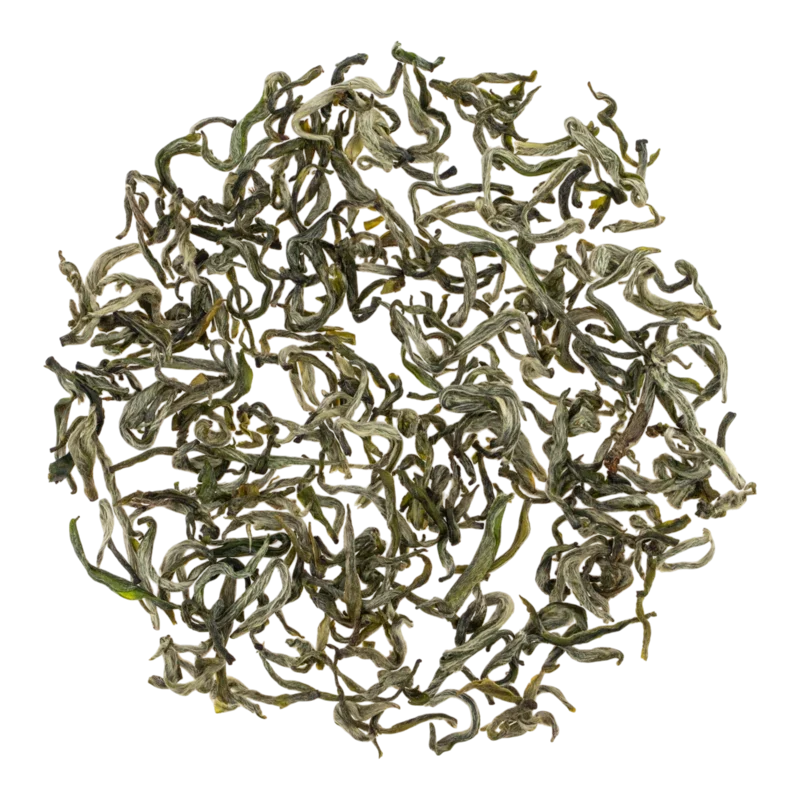
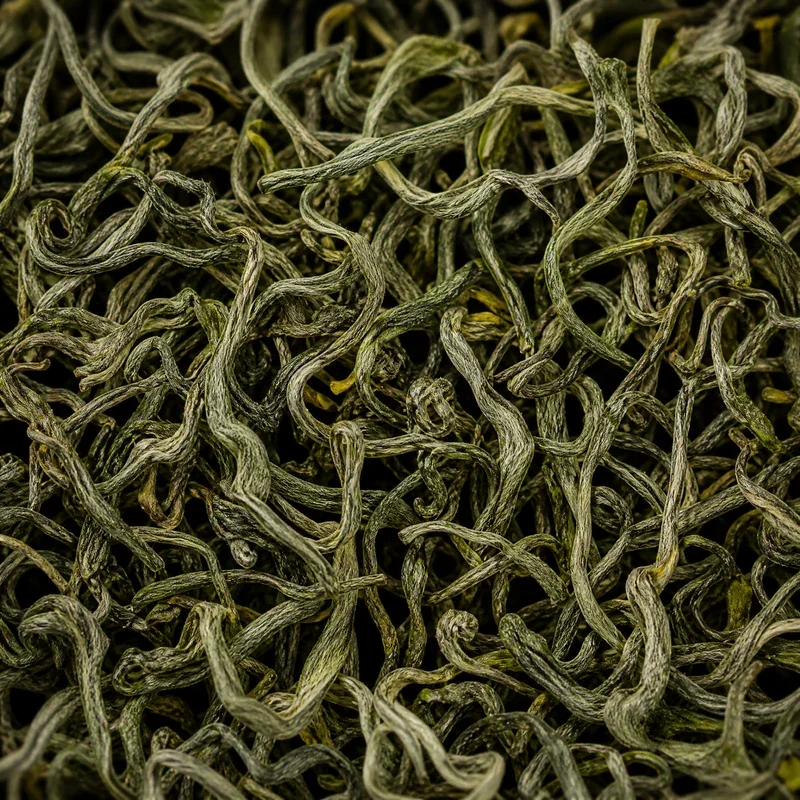
"Resembles spiral, resembles eyebrow" (似螺似眉). Abundant down, uniformly green. Aroma — pure, persistent. Taste — fresh, tender.
Tight rolling with down. Pure high aroma. Fresh taste.
Rolled form with down. High persistent aroma. Moderately fresh.
Rolled form, light down. High aroma. Mild taste.
Cultivar: Pǔtuóshān Dàyèzhǒng (普陀山大叶种, Pǔtuóshān Dàyè Zhǒng) — local indigenous large-leaf variety of Camellia sinensis, adapted to the island maritime climate. Bushes grow slowly (slowed growth in oceanic climate), leaves are large, buds are strong, nutrient content — elevated. Unique feature: tea bushes are not fertilized — the only fertilizer is natural grass mulch (仅以杂草为天然肥料). Many bushes are centennial (树龄多超百年), with deep roots penetrating rocky substrate and absorbing island minerals.
Picking: Strictly defined: picking begins 3–5 days after the Qīngmíng festival (清明后3-5天). Standard — one bud with one leaf or one bud with two leaflets in initial opening stage. Requirements: uniformity, integrity, cleanliness, tenderness (匀、整、净、嫩).
Climate: Northern subtropical oceanic (北亚热带海洋性气候). Winters — warm, summers — cool, humidity — year-round. Average annual temperature — 16°C. Annual precipitation — over 1200 mm. The peak of Fodingshan (286.3 m) — constantly shrouded in clouds and mist, abundant dew (露珠丰沛).
Soil: Weakly acidic red soils (微酸性红壤), rich in minerals. Tea bushes are located on sunny slopes and in wind-protected hollows.
Putuoshan — island in the Zhoushan Archipelago, located in the East China Sea. This is the only island terroir among famous green teas of China. Maritime mists, salty air, mild winters and cool summers create a microclimate without analogues on the mainland.
Maritime mists (海雾, hǎiwù) — key factor. Unlike mountain mists, maritime mist carries salt microparticles and sea minerals, which forms the unique "rock rhyme with orchid aroma" (岩韵兰香, yányùn lánxiāng) — a taste characteristic not found in mainland green teas.
Manual, 3–5 days after Qingming.
Brief spreading for withering.
Pan-firing in wok. Between batches the master washes the wok (每锅需洗刷一次) — unique technique ensuring absolute cleanliness and preventing contamination of aromas between batches.
Formation of initial structure.
Key stage forming the characteristic "spiral-eyebrow" shape — "似螺非螺,似眉非眉". The master rolls shoots into tight spirals while simultaneously giving them a curved "eyebrow-like" form.
Special technique for "drawing out" silvery down to the surface.
Final drying at moderate temperature.
Dry Leaf Appearance: "Resembles spiral, but not spiral; resembles eyebrow, but not eyebrow" (似螺非螺,似眉非眉) — unique formula. Shoots with abundant down (茸毫披露), uniform, tender green (匀净嫩绿). Three forms: spiral (螺形), eyebrow-shaped (眉形), "tadpole-shaped" (蝌蚪状).
Dry Leaf Aroma: Pure, high (清香). Orchid note (兰花香). Chestnut overtone (栗香).
Liquor Aroma: Persistent, elegant, with orchid-chestnut profile. "岩韵兰香" — "rock rhyme with orchid aroma" — unique characteristic of island terroir.
Liquor Color: Tender green, bright and clear (嫩绿明亮).
Spent Leaves: Tender, uniform shoots, gathered in "buds" (幼嫩成朵).
Taste: Fresh and brisk (鲜爽, xiānshuǎng), mellow-sweet (甘醇, gānchún), with returning sweetness — long and "velvety" (回甘绵长, huígān miáncháng). Tasting formula: "First cup — freshness; second — aromatic roundness; third — long sweetness" (初品感受鲜爽,再品体会香韵圆融,三品回味甘长).
Alkaloids: Caffeine — moderate content.
Amino Acids: Elevated content — result of slow growth in oceanic climate and abundance of maritime mist.
Minerals: Unique "maritime" mineral profile — enrichment with potassium, magnesium and trace elements from rocky substrate and marine aerosol.
Polyphenols: Significant content — provides antioxidant potential.
Vitamins: Vitamin C, carotenoids.
Thirst quenching.
Carotenoids and vitamin C.
Catechins.
Caffeine and L-theanine.
Polyphenols.
the listed properties are based on publicly available data and are not medical recommendations.
First brewing is recommended as rinse (头遍茶作洗茶弃用). Freshly purchased tea — age for 2 weeks before consumption. Three stages of tasting: freshness (鲜爽) → aromatic roundness (香韵圆融) → long sweetness (回味甘长).
Tea Amount: 5 g per 250 ml water (1:50 ratio).
Teaware: Transparent glass cup — for observing the opening of "spiral-eyebrows" and evaluating the pure green liquor.
Water Temperature: 80–85°C.
From Mount Jiuhuashan, abode of bodhisattva Dizang. Both — "Buddhist", both — from great mountains. Jiuhua — mainland, mountain, with orchid-chestnut profile; Putuo — island, maritime, with "岩韵兰香" (rock rhyme with orchid).
From Mount Jingshan, "birthplace of Japanese tea ceremony". Jingshan — Chan; Putuo — Guanyin. By style: Jingshan — twisted "mao feng"; Putuo — "spiral-eyebrow".
From Mount Emei, abode of bodhisattva Puxian. Zhuyeqing — flat, "bamboo"; Putuo — twisted, "spiral". Three great Buddhist mountains — three completely different teas.
From Qingdao, also "coastal". Laoshan — on Yellow Sea coast, bean-mineral; Putuo — on East China Sea island, orchid-"rock".
"似螺非螺,似眉非眉" — unique "spiral-eyebrow" shape. Regular spirals or straight shoots — different tea.
"岩韵兰香" — "rock rhyme with orchid" — marker of island terroir. Absence of "maritime" minerality — suspicion.
authentic Putuo Fu Cha — only from Zhoushan Archipelago.
suspiciously low — sign of counterfeit.
No reviews yet. Tell us what you think of this tea.
Rate this tea and share your impressions. We review each submission before publishing it.